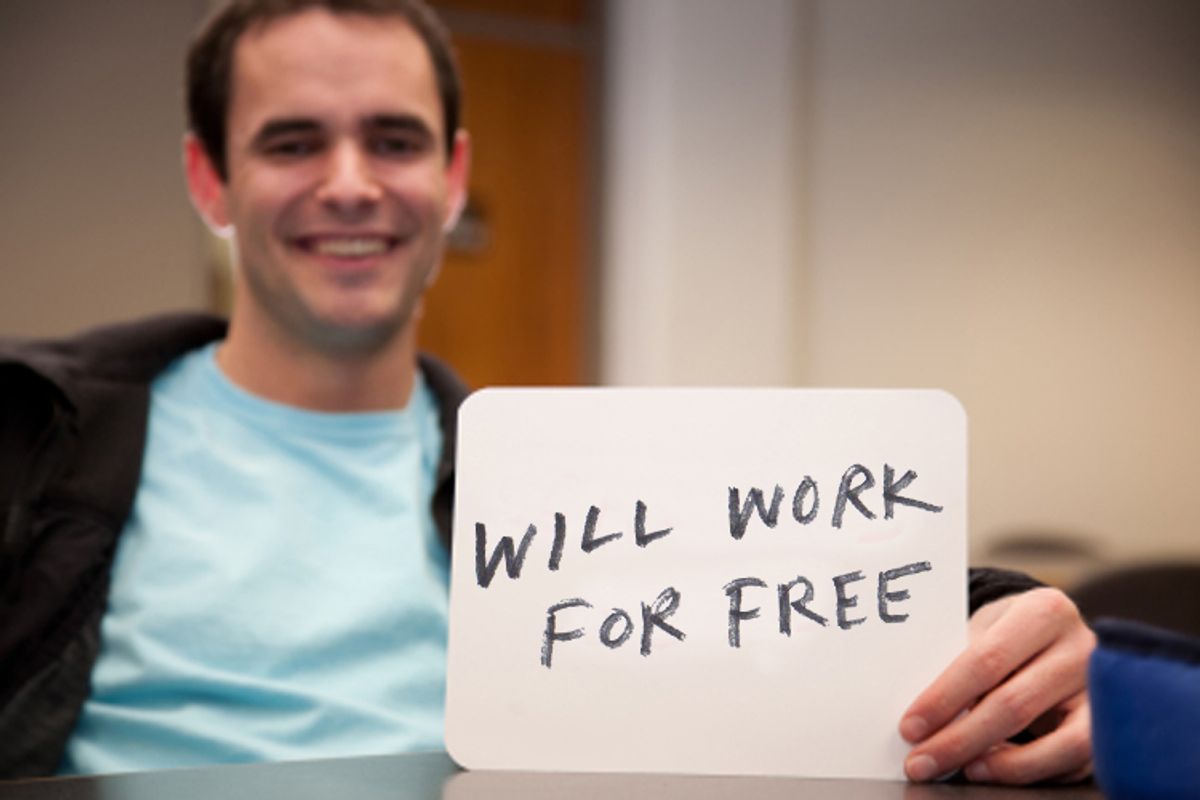
If you scroll down to the bottom of this Q&A, you'll notice this article was written by an "editorial fellow," which is publishing speak for "office intern." What you may or may not know is that our contributions to Salon go unpaid. While some of us take masochistic pleasure in being torn apart by the website's (mostly) savvy commentariat, the majority of us are here to earn some kind of graduate school credit or to bolster our writing portfolios as we learn the ins and outs of a fast-moving online magazine. As far as internships go, it seems more than reasonable: We sort through a bit of mail, transcribe interviews and read submissions, and as a reward, Salon publishes our best work and provides us with an endless supply of peanut M&Ms and Swedish fish.
In his new book "Intern Nation," an exhaustive examination of the intern's insidious new role in the working world, author Ross Perlin questions whether this kind of bartering should be a professional rite of passage. By his estimation, nearly half of this country's internships are illegal under the Fair Labor Standards Act, and still the cubicles of corporate America remain packed with trainees champing at their wireless headsets for a chance to have their labor exploited in the name of networking and résumé-boosting. [Ed. note: Salon considers its limited use of unpaid interns to be legal.] Are interns simply paying their dues, or have they been hoodwinked by a culture that seems to trade in low self-esteem? Is there any hope for reform? To answer these questions, Salon sat down with the "Intern Nation" author at the Flying Saucer Cafe in Brooklyn. Perlin, a graduate of Stanford, SOAS and Cambridge, has written for such publications as Time, Lapham's Quarterly and Open Democracy. Over coffee, we discussed the tragicomedy of the modern internship.
When did internships begin and how have they evolved?
The concept of the "intern" dates back to the Civil War. Through World War II and into the 1950s, the title was associated almost exclusively with medical students and aspiring doctors. I talk about that history a little in my book, but I'm really more interested in the internship boom of the last 30-40 years, when the term spread into just about every white-collar profession -- for-profit and nonprofit, public and private sector. By now, it's become standard operating procedure that every company has an internship program. The reasons are complicated, but they have to do with businesses trying to save money on labor cost, young people feeling pressured to "credential" themselves, and colleges and universities radically changing their academic policies.
Was there a tipping point when the internship became the new apprenticeship?
I'm reluctant to point to any individual moment in history because there's no single person or organization pushing internships. As far as our cultural awareness of them is concerned, you could make a compelling argument that the Monica Lewinsky scandal was a kind of tipping point. In many ways, she was a typical intern. She wasn't protected in the workplace from sexual harassment, and she was on her second internship in the White House -- one she'd secured through personal connections. In fact, the circumstances under which she and the president came into such close contact were due in large part to the government shutdown of 1995, when full-time workers were sent home. Interns were being used as a kind of flexible, sub-labor force. The same holds true today.
Given how nebulous the intern title has become, why does it still hold so much cachet with both employers and aspiring professionals?
What's curious about interns is that they're simultaneously privileged and exploited. They're privileged because internships, coupled with a four-year degree, have become the principal way into the white-collar workforce. Those who can't access these opportunities, people who need to work full-time paid jobs to support themselves, have a lot of trouble breaking into industries like politics, entertainment and the arts, where internships are a barrier to entry. They're exploited, of course, because they often have to offer their labor for free. I think the title's cachet stems in large part from the perception that interns come from privileged backgrounds. There's also this notion that while they're at the bottom of the totem pole now, interns are on a trajectory to one day become employers themselves.
We'll come back to this notion of privilege, but why do you think the internship model is broken? Is this a byproduct of the recession?
Internships used to be paid gigs at blue-chip companies that focused on training and recruitment. It was considered a marker of a good internship program that it hired between 50 and 70 percent of its workers to full-time jobs. Today, people sometimes have to do five or six internships in order to land the work they're ultimately looking for. You also have a number of companies that are freezing future hires or simply replacing their paid employees with interns. The recession has definitely exacerbated the problem. According to one study, there was a 21 percent drop in paid internships after the economic crisis began in 2008. We're at a turning point where the traditional use of these jobs as humane, white-collar apprenticeships and recruiting tools is being phased out. As a result, the violations of labor law are becoming more and more egregious.
What makes an internship illegal?
The law's not that well-known. I certainly didn't know it when I did my unpaid internship six years ago. Part of the problem is that there are almost no new employment laws being made, so we often have to refer back to the Fair Labor Standards Act of 1938 -- a crucial piece of legislation that effectively ended child labor, helped set up the minimum wage in the U.S., and required employers to pay their workers overtime. Twelve years after it was passed, the Supreme Court made a ruling that modified the act to allow for unpaid training situations if a job met a certain set of criteria. Because they're viewed as a kind of trainee, interns today are held to the same standards by the Department of Labor. Unfortunately, few of these internships actually pass the test. One of the most frequently violated conditions states that the trainee should provide no immediate advantage to his or her employer. Whether it means making Xeroxes or writing speeches for senators, interns are always expected to contribute to the bottom line.
If that's the case, why do you think so many companies leave themselves so vulnerable to possible lawsuits?
Either they themselves don't know the law, or they assume these contracts have loopholes that are big enough to wiggle through. In many cases, internships get started informally without the approval of a company's H.R. department (assuming, of course, the company is big enough to have one). Many people feel, "Well, this is what everyone's doing." As awareness of the law spreads, companies will need to start thinking about things like back pay and bad publicity.
Given how many illegal interns there are out there, how come so few seem willing to take their grievances to court?
I think a lot of people are afraid to go after an employer they're hoping might write them a letter of recommendation or offer them a job. Many of my research subjects felt that all they got out of their internship was the goodwill they managed to accrue. Throwing this away on a lawsuit that might not even net them all that much money hardly seems worth it. Mostly, though, I think young people today have very little awareness of labor issues. They simply accept that this is the way the world works.
Do you think this is a distinctly American phenomenon?
The internship craze certainly began here. I also think the intern's mindset is a reflection of how we as a society think about our work and our careers -- this idea that we have to pay our dues and make sacrifices to get ahead. The reception of internships by young people in Western Europe has been a lot chillier, but these jobs have become quite pervasive there in the last 10 to 20 years.
How are academic institutions complicit in all of this?
This is another big difference between the U.S. and the rest of the developed world. The internship boom in other countries has largely been a matter of companies interacting with young people. Internships are a way for them to attract future employees. In the U.S., schools have been a lot more involved in the process. Since the early 20th century, our educators have been smitten with the idea that they need to go beyond the classroom to connect their students to the workplace. In my book, I talk about something called cooperative education, which was kind of a proto-internship model that made professional work part of a student's learning experience. Of late, however, schools have started using internships as a means of outsourcing their education altogether. By offering course credit, colleges and universities are effectively charging their students to work off campus for free.
So the promise of academic credit doesn't guarantee an internship's legality?
A spokesman for the Department of Labor has explicitly said that it does not. Academic credit might be viewed as a mitigating factor if the school has made a good-faith effort to monitor these internships, but my research shows that most colleges and universities are pretty lax in their supervision.
Reading your book, I was shocked to learn that more than 75 percent of unpaid interns are women. What do you make of that?
The benign explanation is that the fields of study to which women are drawn -- humanities and social sciences -- don't typically offer paid internships. With that said, I do think this statistic lends itself to a more sinister interpretation. Employers may see that the majority of incoming interns are women and feel that they'll be more accepting of whatever economic conditions they put forth. Maybe they think an intern's parents are more willing to support a daughter than they are a son.
"Intern Nation" consistently champions the cause of all unpaid interns, but are they really deserving of our sympathy? The majority of them understand what they're signing up for, and you yourself admit that only the most privileged can afford to take these jobs in the first place.
First off, I believe it's something of a myth that all interns are rich kids. Outside of the glamour fields of arts and entertainment, the vast majority of them actually come from middle-class and lower-income backgrounds. Ultimately, however, it's more than just the unpaid interns who are being cheated by this system. I'd like to think that I'm also championing the cause of the non-interns, whether they're community college kids who can't afford to work for free, high school graduates who've been told that an internship is only open to college students, or even people in their 30s who can't break in to certain industries because they don't come from the right background. As a society, we need to start asking ourselves: How do you become a politician, or a film producer, or an Op-Ed writer at a major newspaper? Increasingly, we're seeing that former interns are dominating these positions because at a crucial stage in their careers, they had the resources to endure a period of unpaid work. The bottom of the social ladder shouldn't have to make such a tremendous sacrifice.
Later in the book, you talk about the similarity between intern and Internet cultures. I was wondering if you could expand on that a little.
From music to news to online search engines, people expect everything on the Internet to be free. In a curious way, I think these expectations have eroded our understanding of what we pay for and what we earn money for. It also bears mentioning that interns are particularly widespread in Silicon Valley start-ups, where their responsibilities are often related to social media -- maintaining Twitter feeds, updating Facebook pages, etc. None of these sites cost money to access, and many organizations feel they shouldn't have to spend money on a labor force to maintain them.
So where do we go from here? Is it even possible to reverse this trend?
We've shifted away from this for an assortment of reasons, but I think we need to re-embrace the mentality that work brings reward. Young people have to examine what they're doing and ask: "Is this something I should be paid for?" I also think parents need to take a long, hard look at themselves in the mirror. In many cases, they're the ones who are directly or indirectly subsidizing these Fortune 500 companies by lending money to their children. Ultimately, though, I think we ought to start thinking about this more systemically as a matter of public policy. Until legislators begin enforcing the law, this cycle is doomed to repeat itself.
Jacob Sugarman is a Salon editorial fellow.
Shares