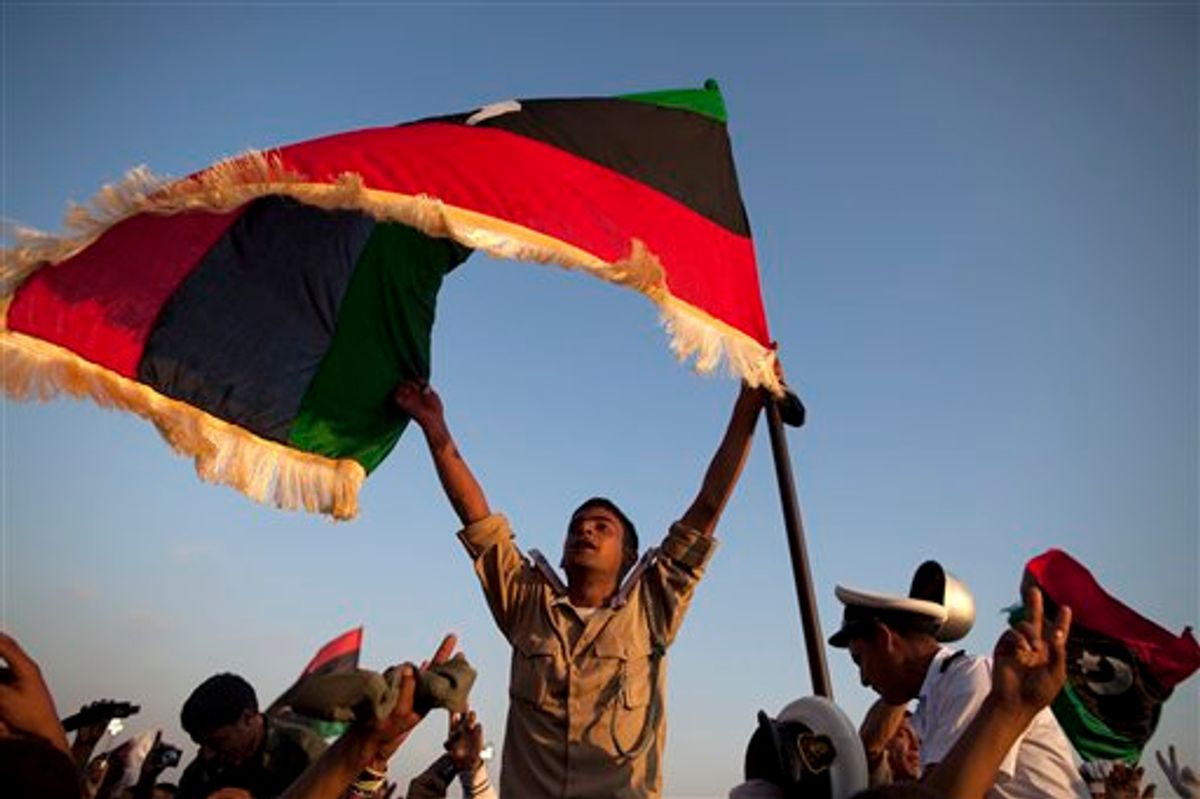
A new cadet for the Libyan rebel army holds a pre Moammar Gadhafi flag after a graduation ceremony for new cadets in Benghazi, Libya, Sunday, May 29, 2011. (AP Photo/Rodrigo Abd) (Credit: AP)
To the extent that the War Powers Resolution (WPR) authorized President Obama to fight a war in Libya for 60 days without Congressional approval — and, for reasons I described here, it did not — that 60-day period expired 12 days ago. Since that date, the war has been unquestionably illegal even under the original justifications of Obama defenders, though I realize that objecting to “illegal wars” — or wars generally — is so very 2005. After making clear that they intended to contrive “some plausible theory” to justify this illegal war, the White House finally settled on the claim that the war in Libya — despite featuring substantial U.S. military action with the goal of destroying a foreign army and removing that nation’s leader — is too small and limited to be a real ”war” under the Constitution and the WPR.
On Wednesday, 74 days after U.S. forces joined the military operation in Libya, President Obama seemed to run out of goodwill on Capitol Hill.
A group of both liberals and conservatives — defying the leaders of both parties — threw their support behind a bill to pull the U.S. military out of the Libya operation. That prospect led GOP leaders to shelve the bill before it came to a vote. . . .
On Wednesday, the bill at issue was far more drastic. Introduced by Rep. Dennis J. Kucinich (D-Ohio), it would demand that Obama withdraw forces from the Libyan operation within 15 days. That would be a crippling loss for the NATO-led campaign, which relies heavily on U.S. air power.
The resolution looked, a week before, like a legislative long shot.
Then, on Wednesday, it wasn’t.
“There’s been disquiet for a long time,” said Rep. Jeff Flake (R-Ariz.), one of those who supported it. “Republicans have been too eager to support some military ventures abroad. And this, I think, is perhaps a little more consistent with traditional conservatism.”
Conservatives expressed support for the bill in a closed meeting, but GOP leaders put off the vote.
Waging a war for 74 days without Congressional approval is illegal enough. Doing so when there is a growing bipartisan movement in Congress to compel an end to the war — rather than approve it — is even worse. And note the individuals on whom Obama is now relying to protect him from this bipartisan effort to put an end to his illegal war: ”GOP House leaders” — John Boehner and Eric Cantor, who refused to allow the bill to come up for a vote despite ample support among conservative members of their caucus as well as numerous liberal House members. Can we hear more now about how the two parties are so radically different that bipartisan cooperation is impossible? The Emperor has decreed that we will fight this war, and thus we will — that seems to be the prevailing mindset.
* * * * *
Last week, I delivered the keynote address to the ACLU in Massachusetts for their annual Bill of Rights dinner. The topic was the Bipartisan National Security State and President Obama’s continuation of it, and it obviously relates to the Libya issue. Those interested in listening to the 25-minute speech can do so here.
GlobalPost correspondent James Foley spent 44 days in captivity inside Moammar Gadhafi's Libya. This first chapter of his story originally appeared on GlobalPost. For the full series, click here.
There is a single main highway along which lies every major city between the rebel stronghold of Benghazi in the east and the capital Tripoli in the west. It snakes along the coast and passes through Ajdabiya, Brega, Sirte and Misrata, cities made world famous by months of back and forth, and deadly, conflict.
The four of us were riding in the back of a blazing red minibus at the beginning of April, approaching the strategic oil town of Brega, where the worst fighting of the conflict had been taking place. Our driver was a teenage boy, like his friend in the passenger’s seat. The so-called front in this war was always changing. But we had already passed the last rebel checkpoint and we knew whatever front existed was beginning to reveal itself.
Our goal was to learn, and then report, who was in control of Brega.
We were getting nervous. We knew the boys driving were scouting the road ahead, and maybe on their own initiative. Anton, the most experienced journalist in the group, mumbled something about it being risky. We could feel our guts begin to tighten. Manu and I looked at each other. But said nothing.
Two armed trucks raced toward us from behind, filling up our back window before soaring past. This was how the rebel convoys seemed to form, like schools of fish that hunted together, but have no clear leader or command structure.
Over a small hill we saw some men, boys really, standing around a sedan. We leaped out to do some interviews. Clare asked how far away Gadhafi’s forces were. The boy said 300 meters. 300 meters? I looked at Clare. It seemed impossible. But as a precaution, we hustled off to the side of the road. A static mortar or a rocket position could have easily dialed in on us from that distance. The small convoy rolled ahead, leaving us behind in what we thought was relative safety.
We watched the rebels push forward. They weren’t 200 meters away, at the rise of the next hill, when they sped back around. We watched for a second as they beared back down on us, followed by a barrage of machine gun fire. The loudest I had ever heard. Our small group of journalists — Anton, Clare, my fellow American, and Manu, a Spanish photographer — took off running.
“We need to get to the vehicles,” Anton shouted. But the rebel trucks were retreating too fast and the ones in pursuit were firing wildly. There were two Gadhafi military pickups — tan with large machine guns mounted on the back. The trucks were overflowing with armed men.
With all the bullets flying, we pressed ourselves as close to the ground as possible. The rebels faded into the distance and the Gadhafi trucks slowed to a stop. The shooting continued. The roar of bullets overhead sounded like machines eating up metal. AK-47 rounds ripped past us from less than 50 meters.
Libya: Tripoli scenes from the uprising:
I crawled back toward Clare and Manu, who were under several small trees. The shooting intensified. We tried to speak, to yell for each other. But the bullets tearing overhead deafened everything. In a corner of my mind I hoped that we were in a cross fire, that behind us the rebels were shooting back. I crawled forward toward a larger sand dune with my camera rolling. Anton crouched in front of me. The bullets streamed directly over my helmet and shoulders. This was no crossfire. They were shooting at us, and they were shooting to kill.
“Help, help,” I heard Anton cry. His voice was weak. My mind tried to convince me of something I knew was not true. Maybe he had just fallen and twisted something. Another barrage of bullets passed over me. “Anton, are you OK?” I shouted between bursts of fire.
“No,” he said, in a much weaker voice.
****
I’ve heard journalists say that Libya was the perfect war. A reporter could get to the front line, close enough to hear the shells coming in, and back to a comfortable hotel in Benghazi, with a solid Internet connection, by evening.
But in reality, this war was anything but perfect — something I’d soon come to learn. It was a war led by confusion, abductions and an oppressive sense of the unknown. This latest spasm of the Arab Spring had none of the idealism of Tunis or Cairo. For me, it began with a rifle butt to he head, which bled into weeks of uncertainty, crushing captivity and ended, however improbably, in a four-star hotel in the besieged Libyan capital.
Along the way, between blindfolds and quiet conversations with fellow captives deep inside the country’s brutal prison system, I witnessed the last gasps of the Gadhafi regime — a corrupt and corrupted system that for more than 40 years ruled this tribal, oil-rich land.
I had done several tours as an embedded reporter with U.S. troops in Iraq and Afghanistan. So, for me, the frontlines felt natural. And I believed it was my job. But the freedom with which you could maneuver was deceptive. There was no highly-trained U.S. platoon to escort you. And the rebels were said to be some of the worst trained soldiers in the world. Most had never held a gun before the end of February, when they stormed Benghazi’s “katiba” and took them by force.
I tried to hold farther back after a few close calls — a near miss by a Girad rocket, for instance, or a tank shell ripping over the heads of Manu and I outside Ajadibya. Our ears popped. But the front kept calling.
As is common among freelancers, Clare Gillis, a 34-year-old from Connecticut, Manu Brabo, a 29-year-old from Gijon, Spain, and myself had been sharing rides and interviews together for several weeks. Anton Hammerl, a South African photographer who covered much of Africa — from the townships during Apartheid to child soldiers in the Congo — came late to our little group.
With all the rebel offensives and retreats along the coastal highway, we felt we had to get to the front every few days or risk completely losing track of the story. So on April 5, we headed out.
Our plan was to try to get a sense of who was really controlling Brega, a strategic oil town that had been the scene of some of the most deadly fighting since the uprising began several months earlier. A rebel general told us that if the rebels took Brega, they would hold it without advancing right away, thus learning from earlier mistakes where they stretched themselves too thin and were forced into whole scale retreats.
But Brega was dangerous. Manu and I had been caught in heavy shelling outside the town days before. I had seen two shells bounce off the ground a hundred meters away. A rebel was killed by shrapnel to the head in the truck Manu and I had leaped into for escape. We went with them to the hospital, hugged the bawling comrades afterwards and shot some eerie photos of them washing blood off their grenades.
Still, Brega was where the front was, so we woke up early to beat the crush of reporters. The four of us went in a Mercedes van piloted by a teen. We stopped at the only manned checkpoint some 20 kilometers outside town, where a crowd of the usual disheveled men, many of them teens, milled about waiting for the real fighters to assemble. We got out into the early sunshine and told our driver he could leave us there. It was just after 10 a.m.
We waited. Usually, with shouts of “Allah Akbar,” a convoy would push ahead, and we’d jump into one of the rebel vehicles heading to the front.
The red minibus started moving and we hustled on. It drove ahead with us as its only passengers, the young driver and his friend in front looked nervously from side to side. We stopped after a kilometer to inspect two smoldering pickup trucks, blackened crisps in the road. It appeared to have been a rebel ambush.
“Hit by a Sam 7,” Anton said pointing out the expended launcher and wire guidance system leading to the cindered vehicles. I took note of his wealth of knowledge. He’d been forced to join the South African infantry as a young man and hadn’t relished it.
****
The firing continued all around us. The men had gotten out of their vehicles and were now approaching. “Anton!” I shouted again. He was silent. The terrifying reality grabbed hold of me. The soldiers firing probably didn’t know that we were reporters. Rebels didn’t dress in regular uniforms and many were often not even armed. I had to surrender or we’d all be gunned down.
I leaped up from where my head had been buried in the sand to face the group of wild men shooting uncontrollably — it seemed our only hope. I held up my hands and yelled, “Sahafa! Sahafa!” It was one of the few Arabic words I knew. It means “journalist.” I walked slowly toward them.
There were three or four skinny, Arab-looking soldiers carrying AK-47s and a larger, darker one to the right. My eyes drifted toward Anton as I stumbled past the dune ahead of me. He was lying face down in the sand, his body askew, cameras still strapped around his shoulders, his legs splayed out.
As soon as I reached the soldiers, the dark one slammed me across the chin with the butt end of his AK-47. I dropped my camera. He smashed his rifle down on my head. My helmet and Oakley sunglasses were thrown off and he punched me in the eye. Another one crushed my head several more times with an AK-47. All my instincts for self-preservation gathered within me. I went completely limp and complacent. The adrenaline was coursing so heavily through my body. I felt no pain.
I was thrown into the back of one of the pickup trucks. An Army boot pushed my face onto the floor. I glanced back and saw Manu and Clare being pulled off the ground.
A crazed looking soldier looked down and jeered at me in English, “You go on patrol! You go on patrol!” as if he knew exactly what we’d been trying to do. A cell phone was pushed close to my face. A picture was snapped. “Gadhafi Meia Meia,” a younger one said, thumping his chest, “Gadhafi 100 percent.” These words terrified me. After weeks of being with rebels who said things like, “Fuck Gadhafi,” with regular consistency, we had now found ourselves with the other side, the ones who had pledged their dying allegiance to the country’s dictatorial leader of more than four decades.
Clare and Manu were also forced down into the bed of the truck. Manu was face down and Clare, pushed against his side, was facing me. I looked at her for the first time. She had a purpled eye. She saw blood running from my scalp.
“Jim, are you OK?” she said, pleadingly. I nodded, and took stock of the blood pooling in the back of the truck. With a boot again on my face, my hands were bound behind me with a plastic cord. We sped away from the scene.
The New York Times has a must-read story today about a motley group of American political operatives who tried to get a $10 million consulting contract with Moammar Gadhafi earlier this year. Depending on who you ask, the plan was to either help Gadhafi cling to power, or to find him refuge in a friendly Arab country.
It turns out one of the operatives reportedly involved in the failed scheme has a history of getting caught up in scandals, and his hiring by the Republican National Committee last year helped discredit then-chairman Michael Steele.
From the Times:
To a colorful group of Americans — the Washington terrorism expert, the veteran C.I.A. officer, the Republican operative, the Kansas City lawyer — the Libyan gambit last March looked like a rare business opportunity.
Even as NATO bombed Libya, the Americans offered to make Col. Muammar el-Qaddafi their client — and charge him a hefty consulting fee. Their price: a $10 million retainer before beginning negotiations with Colonel Qaddafi’s representatives.
…
The other American partners wereNeil S. Alpert, who had worked for the Republican National Committee and the pro-Israel lobbying group the American Israel Public Affairs Committee, and Randell K. Wood, a Kansas City, Mo., lawyer who has represented Libyan officials and organizations since the 1980s.
If the name Neil Alpert sounds vaguely familiar, it’s because he played a role in the string of RNC scandals and embarrassments that led to the downfall of (now MSNBC analyst) Michael Steele last year.
With the RNC already facing allegations of gross mismanagement, Steele hired Alpert as a “special assistant for finance,” Politics Daily reported in April 2010.
This was problematic because just a few years before, Alpert had been ousted as the chair of the D.C. Baseball PAC after he was caught using the group’s bank accounts as his “personal piggy bank.” The political action committee’s mission was to bring Major League baseball back to Washington.
As I reported at the time, Alpert used the PAC’s debit card at gas stations, a cheesecake restaurant, Chick-Fil-A, and a Washington nightclub called LOVE. Alpert denied wrongdoing in the case, but Washington’s Office of Campaign Finance slapped him with a fine. Read the details of that saga here.
A collective face-palm could be heard throughout the Western world when Libya’s interim leader Mustafa Abdul-Jalil announced that he was overturning Gadhafi-era restrictions on polygamy. However, from a certain liberal American perspective, the idea of plural marriage doesn’t seem so outrageous.
As Jonathan Turley, a law professor at George Washington University, argued in a New York Times Op-Ed this summer, “Regardless of whether it is a gay or plural relationship, the struggle and the issue remains the same: the right to live your life according to your own values and faith.” Indeed, the ongoing U.S. battle over marriage equality has highlighted the injustice that can arise when the state sanctifies certain unions and forbids others – all on religious and moral grounds. And while the Warren Jeffs trial brought attention to the dangers of cloistered polygamist societies in a major way, there are also normalizing examples at hand, albeit on TV via “Big Love.” In such a context, it can seem a basic issue of the freedom to define our families for ourselves.
But it’s also true that polygamy doesn’t happen in a cultural vacuum — it’s different in reality than it is in theory.
It’s critical to understand the specific context in this case. Contrary to many reports, it isn’t that polygamy was previously illegal in Libya – it’s just that it came with serious restrictions. As Joanna Grossman, a law professor at Hofstra University who has written about legal issues surrounding plural marriage, tells me, “The fact that the [former] polygamy rules in Libya, which require consent of the first wife given in front of a judge and the showing by the man of an affirmative need for an additional wife, has resulted in relatively low rates of polygamy is telling,” she says. “Wives clearly do not support polygamy in large numbers and must have some power to refuse consent.” Returning to unrestricted polygamy “would deprive women of any control over their husbands’ acquisition of multiple wives and reduce their intra-family power, as well their power in society,” Grossman says.
Moving from the specific to the general, it’s true that copious research has demonstrated the negative social impacts associated with polygamy (which almost always manifests as polygyny, a man taking multiple wives, and not the other way around). Many of these findings were summarized in a report that anthropologist Joseph Henrich presented in testimony during a Supreme Court case challenging Canada’s ban on polygamy. The chief problem introduced by the practice, at least when it is widely adopted, is that it creates “a pool of low-status men” whose potential wives go to “high status, wealthy men,” he argues. An unmarried male underclass is associated with greater crime – including rape and kidnapping of women — and generally leads men “to seek to exercise more control over the choices of women,” from what they wear to whom they date.
Polygyny also tends to lead to women — nay, girls — marrying younger and younger; at the same time, the age gap between husbands and wives expands dramatically. It’s also associated with lesser paternal investment in children, as the father’s resources are spread thin. An additional upshot of that is that it “may reduce national wealth (GDP) per capita both because of the manner in which male efforts are shifted to obtaining more wives and because of the increase in female fertility,” Henrich writes. He says that “monogamy seems to redirect male motivations in ways that generate lower crime rates, greater GDP per capita, and better outcomes for children” and goes so far as to argue that monogamous marriage “may have created the conditions for the emergence of democracy and political equality.” (I spoke with Henrich at length about this for my series on monogamy.)
As a philosophical thought exercise, there is a totally reasonable debate to be had over whether these many issues can be addressed independently, instead of by criminalizing the practice of polygamy. The question of how to strike a balance between preventing harm and defending personal freedom is a tricky one. In this case, though, it’s neither tricky nor an issue of balance: Abdul-Jalil has moved to overturn a law that guarded against harm while also defending freedom of choice.
Moammar Gadhafi’s killer will face prosecution, declared the National Transitional council, Libya’s interim government, on Thursday.
Though earlier the NTC had maintained that the former dictator had been killed during crossfire when rebels liberated Sirte, NTC officials have said that they will prosecute the person found responsible for Gadhafi’s death, reports the Guardian.
“With regards to Gadhafi, we do not wait for anybody to tell us,” said Abdel Hafiz Ghoga, the deputy chief of the National Transitional Council, to the al-Arabiya satellite channel, according to the Guardian.
“We had already launched an investigation. we have issued a code of ethics in handling of prisoners of war. I am sure that was an individual act and not an act of revolutionaries or the national army. Whoever is responsible for that [Gaddafi's killing] will be judged and given a fair trial.”
The Guardian reports that the investigation may prove to be unwelcome in Misrata, which is where the rebels who captured Gadhafi in Sirte are based.
“Why are they even asking this question?” said Ibrahim Beit al-Mal, Misrata’s military chief. “He was caught and he was killed. would he have given us the same? Of course.”
In a leaked video days after Gadhafi’s capture, a rebel fighter who identified himself as Senad el-Sadik el-Ureybi, said that he had shot and killed Gadhafi.
“We grabbed him. I hit him in the face,” the fighter said in Arabic in the video, reports UPI. “Some fighters wanted to take him away and that’s when I shot him twice, in the head and in the chest.”
The National Transitional Council’s statement comes after cell phone video, obtained by GlobalPost, showed the wounded former leader being sodomized with a stick or knife.
MISRATA, Libya — If anyone is surprised by the apparent killing of Moammar Gadhafi while in the custody of militia members from the town of Misrata, they shouldn’t be.
More than 100 militia brigades from Misrata have been operating outside of any official military and civilian command since Tripoli fell in August. Members of these militias have engaged in torture, pursued suspected enemies far and wide, detained them and shot them in detention, Human Rights Watch has found. Members of these brigades have stated that the entire displaced population of one town, Tawergha, which they believe largely supported Gadhafi avidly, cannot return home.
As the war in Libya comes to an end, the pressing need for accountability and reconciliation is clear. The actions of the Misrata brigades are a gauge of how difficult that will be, and Misrata is not alone in its call for vengeance. In the far west, anti-Gadhafi militias from the Nafusa Mountains have looted and burned homes and schools of tribes that supported the deposed dictator. Anti-Gadhafi militias from Zuwara have looted property as they demanded compensation for damage they suffered during the war.
The apparent execution of 53 pro-Gadhafi supporters in a hotel in Sirte apparently under control of Misrata fighters is a bad omen. It is up to the National Transitional Council to rein in all the militias and quickly establish a functioning justice system. The NTC should take control of the many makeshift detention facilities, expedite the return of displaced Libyans, and ensure the investigation, trial and punishment of wrongdoers acting in the name of vengeance. That includes Gadhafi’s killers if the evidence showed crimes were committed. The NTC, and its foreign backers, have comprehensively failed to start setting up a justice system — even in Benghazi, where they have been in charge since the spring.
Clearly the NTC is up against the passions of a nasty war. Misrata withstood a two-month siege at the hands of Gadhafi’s forces with near-daily indiscriminate attacks that killed about 1,000 of its citizens. The town’s main boulevard, Tripoli Street, is in ruins. Facades of public buildings and private homes collapsed from tank fire and are charred inside and out. The pockmarks of bullet holes disfigure construction everywhere.
The fierce fight for Misrata has left a penetrating bitter aftertaste. Misratans say they detest anyone who backed Gadhafi. They are not welcome in Misrata, even if the city and its environs was their home for generations.
The Misrata militia is focusing its greatest wrath on Tawergha, a town of about 30,000 people just south of the city. Both Misratans and Tawerghas say residents there were enthusiastic Gadhafi supporters. Hundreds of erstwhile civilians in that town took up arms to fight for him. Misratans say Tawergha volunteers committed rapes and pillaged with gusto, though Misrata officials decline to produce evidence of the alleged rapes, saying family shame inhibits witnesses and victims from coming forward.
In any event, Misratan militia members are venting their anger on all Tawerghas, who are largely descendants of African slaves. Most fled their town as Misratan fighters advanced there between Aug. 10 and Aug. 12.
Witnesses and victims we interviewed provided credible accounts of Misratan militias shooting and wounding unarmed Tawerghas and torturing detainees, in a few cases to death. In Hun, about 250 miles south of Misrata, militias from Benghazi have taken it upon themselves to protect about 4,000 refugees. They say Misratans are hunting down Tawerghas.
One hospitalized Tawergha told Human Rights Watch how he was shot in the side and leg and abandoned to die near Hun: “They left us at the edge of the road, put a blanket over us and then started swearing, ‘You are dogs, hope you die.’”
Misrata militias, with the momentary compliance of local officials, insist that no Tawerghas should return to the area. Ibrahim Yusuf bin Ghashir, a representative of the NTC, said: “We think it would be better to relocate them somewhere else.” The allegations of rape, he added, “cannot be forgiven and it would be better to resettle them far away.”
This unforgiving campaign is not limited to Tawerghas. Many Misratans say that any tribe or group that supported Gadhafi — thousands of people — should not return to the city. The graffiti on tumble-down town walls express Misratans’ view: “(Expletive) No returnees.”
Human Rights Watch has interviewed refugees from Misrata who tried to return and were forbidden to enter the city without a permit from the local council. A Misrata militia member told the media that all pro-Gadhafi travelers are barred from the city.
As painful as the losses have been for Misrata and the rest of Libya, everyone who fought Gadhafi should remember what they were fighting for: an end to torture, to arbitrary detention, to pitting one tribe against another; for respect and equality among neighbors. Otherwise, the agony that preceded victory will breed vengeance, rancor and a divided new Libya — one that in disturbing ways may resemble the old.