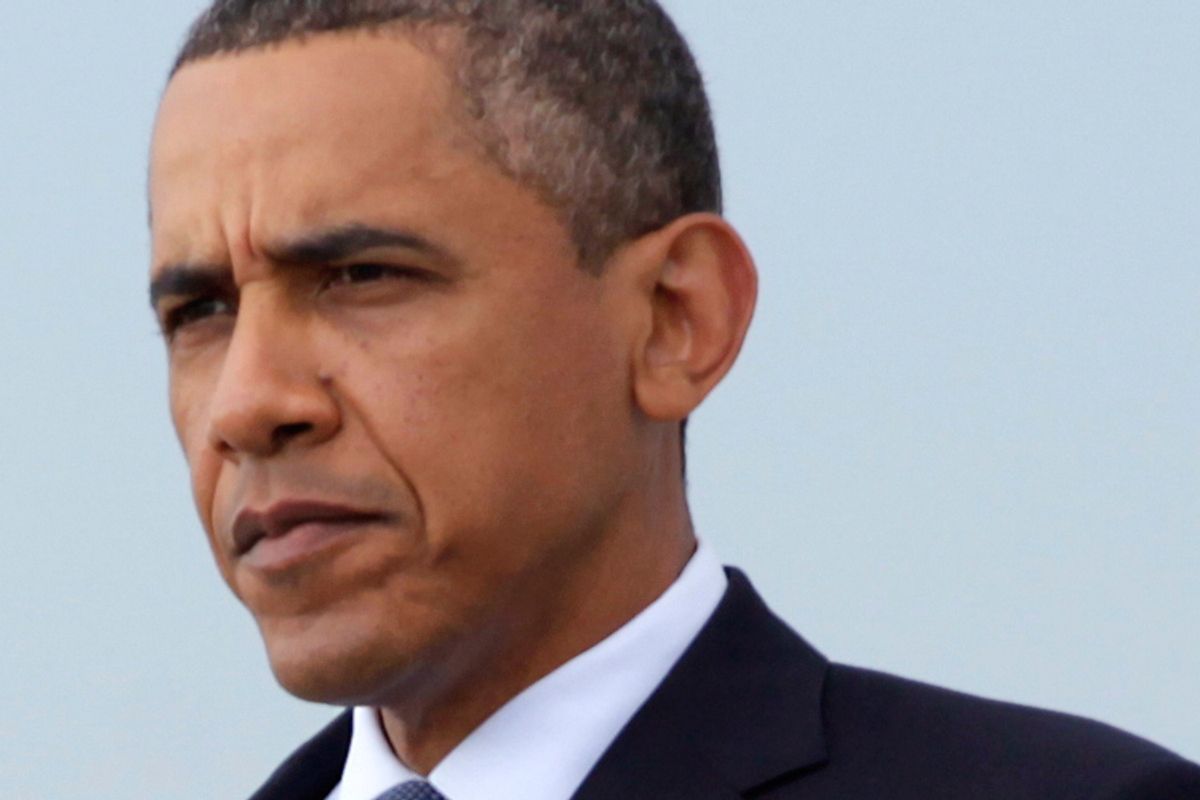
President Obama's post-Bin Laden poll bounce has predictably disappeared. Gallup's weekly tracking poll shows his approval rating down to 46 percent, with 44 percent disapproving, from a recent high of 50. Wednesday's NBC/Wall St. Journal poll found a similar drop. That poll also looked at voters' opinions about the economy, and found overall, voters' disapproval of Obama's handling of the economy rose to 54 percent. The number of people who think the economy will get worse or stay the same over the next year climbed, and the number who think things will get better dropped. May's unemployment jump, combined with the inability to push another stimulus bill at a time when the focus is on cutting the deficit, gives Democrats reason to worry things won't get appreciably better any time soon.
It's against this backdrop that AP yesterday zeroed in on a so-called "intensity gap" between Democrats and Republicans heading into 2012. It quoted a recent Pew Research Center survey that found 84 percent of staunch conservatives strongly disapprove of the president, but only 64 percent of solid liberals strongly approve of him. But those numbers are different from what Gallup finds in its weekly polls, where Obama's approval rating with liberal Democrats is pretty stable, at a respectable 87 percent. Lately, though, he's suffered several dips with black and Latino voters: African Americans have mostly given Obama approval ratings in the 90s; they've been down in the low 80s several times in the last few months, including this week. Latino support also dropped from highs in the mid-60s to 54 percent this week.
But the AP story featured Obama himself anticipating an intensity gap. "It's not as cool to be an Obama supporter as it was in 2008, with the posters and all of that stuff," he told a gathering of donors in Miami this week, admitting some of the magic was gone. "The posters and all of that stuff" let supporters project their own version of the president in 2008. Right after he clinched the Democratic nomination, Obama told the New York Times, "I am like a Rorschach test. Even if people find me disappointing ultimately, they might gain something." But the Rorschach test became president, and he's given his supporters and opponents plenty of information about his governing style.
One big problem for Obama is that he assembled an unprecedented electoral coalition in 2008, but it wasn't a governing coalition. Progressives like to think of the themselves as the president's base, and it's partly true: Obama won thanks to an unrivaled turnout of young voters, first time voters, African Americans and Latinos; and an energetic labor effort. But they – we – weren't enough by ourselves. He also did well with independents and even some Republicans who were ashamed of what the Bush Cheney years did to their party. Predictably, lot of those voters are going home now. I'm not sure they'll be entirely happy with what they'll find when they get there, or whether they'll discover the Tea Party ransacked the place. But they're uncomfortable with the way Obama used government to solve the banking crisis, stimulate the ailing economy and extend health insurance to more people. Of course, on the left he hasn't done enough on those fronts. When both sides are carping, the common wisdom goes, that means you must be doing something right. I'm not sure that's true when you're facing re-election.
Plenty of Democrats think Obama has nothing to worry about, given the seven dwarves currently committed to seeking the GOP presidential nomination. Some say he should be alarmed by former Utah Gov. Jon Huntsman's plan to jump into the race. But the traits that should make Huntsman formidable – he's a strong conservative with a history of bipartisan cooperation, the latest proof being his stint as Obama's ambassador to China – probably mean he can't be nominated. The fact that McCain campaign manager John Weaver is running Huntsman's bid will make it entertaining – Weaver amused political writers today with sharp remarks about the GOP field in Esquire. It could also make Huntsman look like the McCain 2012: A grownup whose bipartisan track record ought to be a political advantage, but it won't be in a party dominated by the Tea Party. I don't see Huntsman getting through a primary.
But I still see reason for Democrats to worry. Re-energizing the party's progressive base is key to the president's 2012 strategy, and some parts of the base are dissatisfied. AFL-CIO president Richard Trumka outlined his plan to pay more attention to his union's own political structure and spend less on the Democratic Party and specific candidates, and other unions are saying the same thing. Particularly on the issue of the economy, there's a risk of core constituencies being demoralized, and demobilized. Since I've been critical of the president before, let me say here that I don't believe there were many concrete measures he could have taken to accelerate the recovery and reduce unemployment, because Republicans in Congress dug their heels in to fight on day one, and conservative Democrats wouldn't go along, either. My main concern has been Obama's failure to use his presidency to tell voters a story about our changing economy, and even when he didn't have the votes in Congress, to lay out what he thought was the right course.
That story has to do with the dangerous and unprecedented amount of income and wealth clustered at the very top of American society. The concentration of wealth and the rise in economic inequality isn't just a matter of fairness or morality, it's a matter of economic stability. The economy is stuck in the dumps of a demand crisis, where people are too broke or too financially insecure to help purchase their way out of the problem. Few people seem to understand that we deliberately used government to build a middle class in the years after the war – building public schools and universities, subsidizing college and homeownership for veterans, building highways and roads -- and we began to tear it down in the late 1970s. Wages stagnated; jobs moved abroad; taxes on the rich were slashed. Productivity kept rising, but unlike the previous 40 years, wages didn't rise along with it. Without rising salaries, people began to borrow.
Too many Obama economic advisors misdiagnosed the problem as the borrowing itself, insisting that Americans were irresponsibly living beyond their means, going into debt for homes, cars and college educations they really couldn't afford. In his great book "Aftershock" Robert Reich relates a disagreement between Paul Volcker, who made that "living beyond their means" case about the recession to the president, and Laura Tyson, chair of Clinton's Council of Economic Advisors, who retorted, "The real problem is their means haven't been growing." Obama seems to have listened to Volcker (who is now best remembered for stepping into the financial regulatory reform debate and strengthening the hand of those who wanted it stricter.) Now Geithner is pushing the deficit as the administration's top economic priority, when it clearly ought to be jobs. (Larry Summers has seen the light, though – he wants more stimulus, but only after he left the administration, where he kept the focus on the deficit, too.) In an economy that could be headed for another dip, the only option on the table seems to be more spending cuts. And Obama himself shares blame for that stalemate; he bought into the Republican notion that the deficit was an immediate and urgent problem; he tied his own hands. Not that Democrats alone could pass a stimulus with the far-right GOP House, but Obama would be able to explain the stalemate and point to the Democrats' "story," their analysis of our current economic woes and their agenda to move the country past them.
Facing 2012, the president also has to correct the impression that he's the candidate of Wall Street, and that the TARP program that saved the banking system did so by coddling and bailing out bankers who took reckless risks with other people's money. A couple of data points from CNN's 2010 congressional exit polls stay with me, because they were shocking. Among the third of voters who blamed Wall Street for the nation's economic woes -- which should have been good news for Democrats -- 57 percent voted Republican. Among those who were "very worried" about economic conditions, 68 percent voted Republican. While TARP was a bipartisan program, it's widely associated with Obama and the Democrats. The fact that so many current and former Goldman Sachs bankers helped craft it made people distrust it. With reason: When bailing out AIG and taking on banks' risky mortgages, Geithner gave them full-dollar value on their "losses," while homeowners continued to lose their homes. The administration opposed efforts to permit bankruptcy judges to modify the terms of mortgages, or to impose a moratorium on foreclosures. Too many people on the left and right believe, not without reason, that the White House let the bankers rig the rules of the game to ensure they remained winners, and others lost. We know that Republicans tagged Democrats, unfairly, as the party of the undeserving poor in the 1960s and 70s; now we risk seeming like the party of the undeserving rich, too.
Finally, it doesn't help that the president raised more money from Wall Street in 2008 than John McCain did, or that overall, Democrats got far more contributions from Wall Street than Republicans did that year ($88 million to $67 million). Of course, Wall Street tycoons are furious with Obama for even moderate attempts at financial regulatory reform: The New York Times revealed energetic efforts by the president and his campaign team to woo back petulant Wall Street donors with lavish dinners and special meetings. In a case of bad timing, the next day the campaign sent emails to its small-donor list coming "from" Barack Obama himself, with the subject "Dinner?" The president announced a lottery for donors who give as little as $5 to win a small dinner with him. It was a nice populist touch, but it contrasted sharply with his outreach to the wealthy, and by comparison, it might have sounded stingy. (Also, the line "I want to spend time with a few of you," given coverage of the Wall Street campaign, might not get people fired up. "A few" isn't inspiring. Dreaming of meeting "as many of you as possible during this campaign" would sound more like the old Obama.)
But he's never going to be the old Obama, whom dreamy young progressives could believe would be a left-wing hero, while Susan Eisenhower could expect to join a growing cadre of "Obamacans" behind him. And the left can't remain unrealistic, either. Too many progressives sold Obama as a soulmate, when it was always clear he was a centrist who'd placed a high value on conciliation, and who believed he was good at it: He'd done it all his life, how could it not work in Washington? It's unfair to blame him for being the president he said he'd be. So far, conciliation has not worked, and the president will face tough choices between the two divergent sides of his 2008 coalition. The nation needs a leader who explains just how bad things are, but reassures people we're up to the challenge.
Obama's great speech shredding the Ryan plan laid out part of the "story" he needs to tell – Republicans seem to have given up on the American dream; Democrats still believe it – but he's got to keep hammering those themes. And it would be nice to see him match words with deeds soon – not caving to GOP blackmail on the debt ceiling might be a place to start. But Republicans are acting like terrorists, threatening to take down the economy in the absence of big cuts. It's scary out there right now, and we need a leader who'll fight for what he believes in.
Shares