Body Wars
Yoplait’s dangerous eating disorder ad
A commercial with a perverse message about women and food gets pulled after advocates speak out
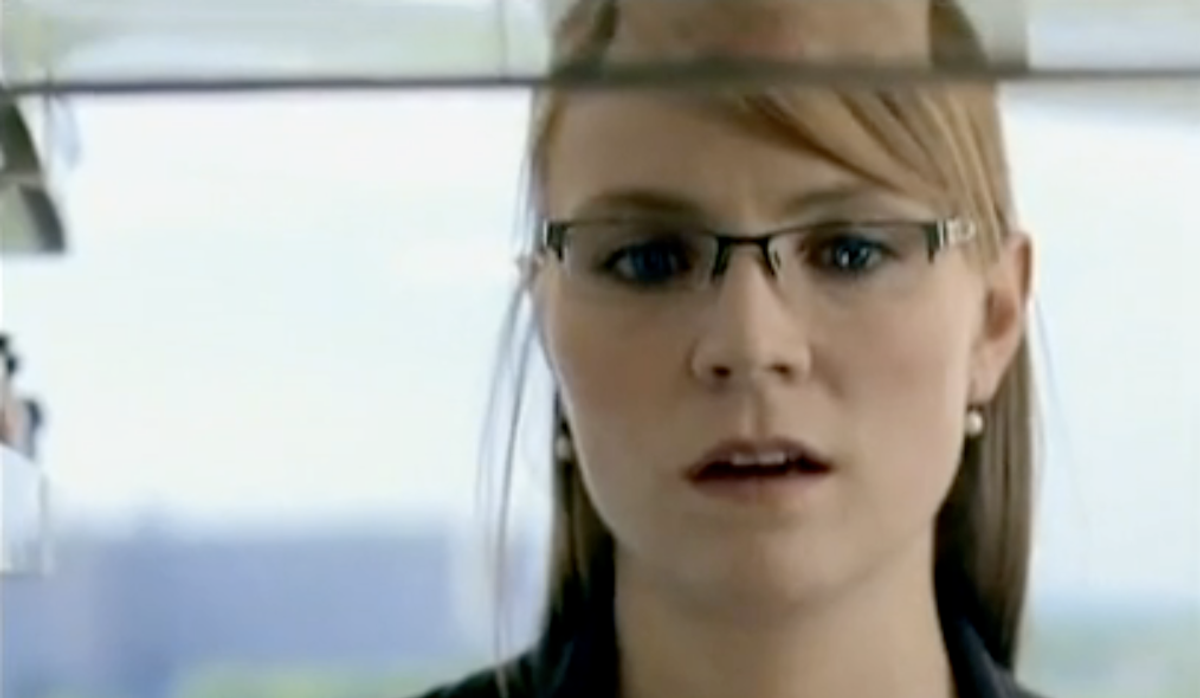
The slender woman looks with concern into the office refrigerator, staring down the enemy. “Oh, cheesecake,” she sighs to herself. And then the recrimination and self-doubt kick in. “OK. What if I had just a small slice? I was good today, I deserve it! Or, I could have a medium slice and some celery sticks and they would cancel each other out, right? Or, OK, I could have one large slice and jog in place as I eat it. Or, OK, how about one large slice while jogging in place followed by eight celery…” Fortunately, it’s at this point that her obsessive internal math is interrupted by an equally svelte colleague who coos, “Mmmm, raspberry cheesecake. I’ve been thinking about this all day.” Does she then pull out the cake and enjoy a slice? Don’t be silly – these are women we’re talking about here. No, she reaches for a cheesecake flavored Yoplait, prompting her colleague to admiringly note, “Wow, you’ve lost weight,” and grab her own carton of artificially sweetened yogurt. Whew. Crisis averted. Guess the men and fat chicks in the office can have that cheesecake now.
The first time I saw that ad, I thought immediately how much it reminded me of a mom I used to know, who I long suspected had an eating disorder. She’d talk constantly of how the kids never “let” her get a moment to eat, and when we went out together, she’d all but beg me to be “bad” and order dessert, which she would longingly watch me consume. Apparently, that Yoplait ad reminded a lot of other people of someone they knew or were – and now the National Eating Disorders Association has convinced General Mills to pull the campaign.
The company’s v.p. of corporate communications told Huffington Post Wednesday that the idea that ad was promoting eating disorders “had never occurred to anyone, and no one raised the point. We aren’t sure that everyone saw the ad that way, but if anyone did, that was not our intent and is cause for concern. We thought it best to take it down.”
So what’s more stunning: that an ad in which two slim women work out their food issues with cartons of artificially flavored treats made it to the air, or the news that nobody, at any point in the creative process, said, “Hey, doesn’t this sound messed up?” That says a lot about how deeply ingrained that kind of dysfunctional thinking is; it’s assumed that women, even women who clearly don’t have a weight problem, would anguish over a slice of cheesecake, would careen from Restriction Village to what’s looking like Binge Town, without pausing to ask themselves something really crazy like, “Am I hungry?”
That’s why the ad isn’t just offensive to anyone who has had an eating disorder or cared about someone who has. It imposes the notion of sin on one’s eating habits, with the implication that depriving oneself of cheesecake is “good.” Lynn Grefe, president and CEO of NEDA, told the Huffington Post that “To see this behavior in a commercial tells people with eating disorders, see, it’s even on TV. It’s OK and normal for my head to go through all these mental exercises.”
It’s a sign of progress that General Mills has pulled the Yoplait spots. It does, however, still offer a “2 week tune-up” diet on its website, one that promises “it’s easy” to “replace breakfast and lunch with a Yoplait Light, a grain and a fruit.” Suggested grains, by the way, include General Mills’ own sugary, salty Cheerios and Nature Valley Granola Bars.
I’m not endorsing a steady diet of dessert. Rising rates of obesity have plunged us into the throes of a serious public health crisis, one that is targeting women with rising rates of stroke and heart disease, and contributing to our now shortened life expectancies. But here’s a thought: Maybe both obesity and eating disorders wouldn’t be quite so big a problem if we weren’t constantly being peddled these maddening notions of virtue and reward. Maybe when we embrace regular physical activity and learn to trust our own hunger cues, we don’t need to portion out cups of Cheerios or 100 calorie ersatz treats dolled up in the guise of something super good for you. Maybe we don’t need General Mills to make unhealthy thoughts seem like desirable behavior. And a raspberry cheesecake is a terrible thing to waste.
Mary Elizabeth Williams is a staff writer for Salon and the author of "Gimme Shelter: My Three Years Searching for the American Dream." Follow her on Twitter: @embeedub. More Mary Elizabeth Williams.
Old ladies who didn’t love me
I thought a gym class with elderly women would ease my aging anxiety, but it made me miserable in new ways
“Isn’t it soon for me to be getting arthritis?” I asked my orthopedist. I assumed I had a young person’s pain: an injury, or maybe a cyst.
“No,” he said, then checked my chart again for my age. “No, not at all.”
At 36, I had been preoccupied by my age, and this didn’t help. I’d been looking at every woman’s neck to see when the accordion stretch of the chin would kick in. Could I stave it off a few more years? Had I blown it by not being skinny, so that I couldn’t later gain five pounds to smooth out my wrinkles?
Continue Reading CloseTaffy Brodesser-Akner has written for the New York Times, Los Angeles Times, Self, Redbook, and other publications. More Taffy Brodesser-Akner.
Ashley Judd’s facial war
In a bold new essay, the actress confronts the critics of her body head-on -- and makes some incisive points
Ashley Judd (Credit: Reuters/Jean Amet) Ashley Judd would like you to get out of her face. The 43-year-old actress, activist and sometime controversial memoirist has had a high-profile return to the public eye, with the debut of her new drama “Missing.” And it’s a profile that has been the subject of much snark and WTFing.
In the past few weeks, Radar has lamented that she’s gone from “pretty to puffy” and “fattened her face with fillers” while Us declared her “nearly unrecognizable.” SheKnows hit her even harder, complaining that “the pretty face we’re used to [has been] replaced by a puffy disaster.” And when her reps declared that her swollen look was the result of steroids for a sinus infection, they only fanned the flames, leading The Stir to snap of her “way chubbier than usual” look, “Come on, Ashley, we may be dumb, but we’re not stupid.”
Continue Reading Close
Mary Elizabeth Williams is a staff writer for Salon and the author of "Gimme Shelter: My Three Years Searching for the American Dream." Follow her on Twitter: @embeedub. More Mary Elizabeth Williams.
Fat-shaming a child into a book deal
A mom's horrible dieting strategy for her 7-year-old pays off
Dara-Lynn Weiss with her daughter, Bea.
How could a story that Jezebel last week declared “The Worst Vogue Article Ever” get even more terrible? By becoming a book.
It began with a feature called “Weight Watchers” in the April Vogue, written by Dara-Lynn Weiss. In it, Weiss chronicles her then 7-year-old daughter Bea’s dieting odyssey after the child had “grown fat.” It was a tale that involved putting Bea — who at 4-foot-4 and 93 pounds was veering toward childhood obesity — on an intense regimen of calorie restriction and public shaming. “I once reproachfully deprived Bea of her dinner after learning that her observation of French Heritage Day at school involved nearly 800 calories of Brie, filet mignon, baguette and chocolate,” she writes. “And there have been many awkward moments at parties, when Bea has wanted to eat, say, both cookies and cake, and I’ve engaged in a heated public discussion about why she can’t.”
Continue Reading Close
Mary Elizabeth Williams is a staff writer for Salon and the author of "Gimme Shelter: My Three Years Searching for the American Dream." Follow her on Twitter: @embeedub. More Mary Elizabeth Williams.
Surprised to see me
The biggest shock of losing weight is the (sometimes weird) reaction by my old friends
It’s funny what you notice when you lose 40 pounds. I have noticed, for instance, that it is much easier to get dressed when your clothes actually fit. I have noticed the way certain bones feel underneath my hands (my rib cage, my pelvis) or how I look in the mirrored glass of a store I am passing. I have also noticed how people react to me. Mostly, I have noticed what they say.
“You look healthy!” they exclaim, giving me a hug, or grabbing my shoulders like an aunt at a family reunion. They say it so often and with such enthusiasm that it can have the inverse effect of upsetting me. I can’t help wondering how unhealthy I used to look.
Continue Reading CloseSarah Hepola is an editor at Salon. More Sarah Hepola.
Can a viral video save an obese man?
A 700-pound man begs for his life -- and becomes an online sensation VIDEO
Robert Gibbs (Credit: YouTube screen shot) It’s difficult to watch Robert Gibbs. But it has nothing to do with the fact that he weighs nearly 700 pounds.
In a candid and wrenching plea on the eve of his 23rdbirthday last week, the Livermore, Calif., man did something extraordinary. He braved the mockery and opprobrium of the entire Internet in the calculated hope of “trying to go viral” and turn his life around. In a clip self-explanatorily called “Overweight guy asks for help,” Gibbs explains, “I’m making this video because I don’t know what else to do. I’ve tried losing weight on my own. Tried doing everything possible. Been on diets, been hospitalized. Always done what needed to be done at the time and then I’d just gain the weight back.”
Continue Reading Close
Mary Elizabeth Williams is a staff writer for Salon and the author of "Gimme Shelter: My Three Years Searching for the American Dream." Follow her on Twitter: @embeedub. More Mary Elizabeth Williams.
Page 1 of 21 in Body Wars