Syria

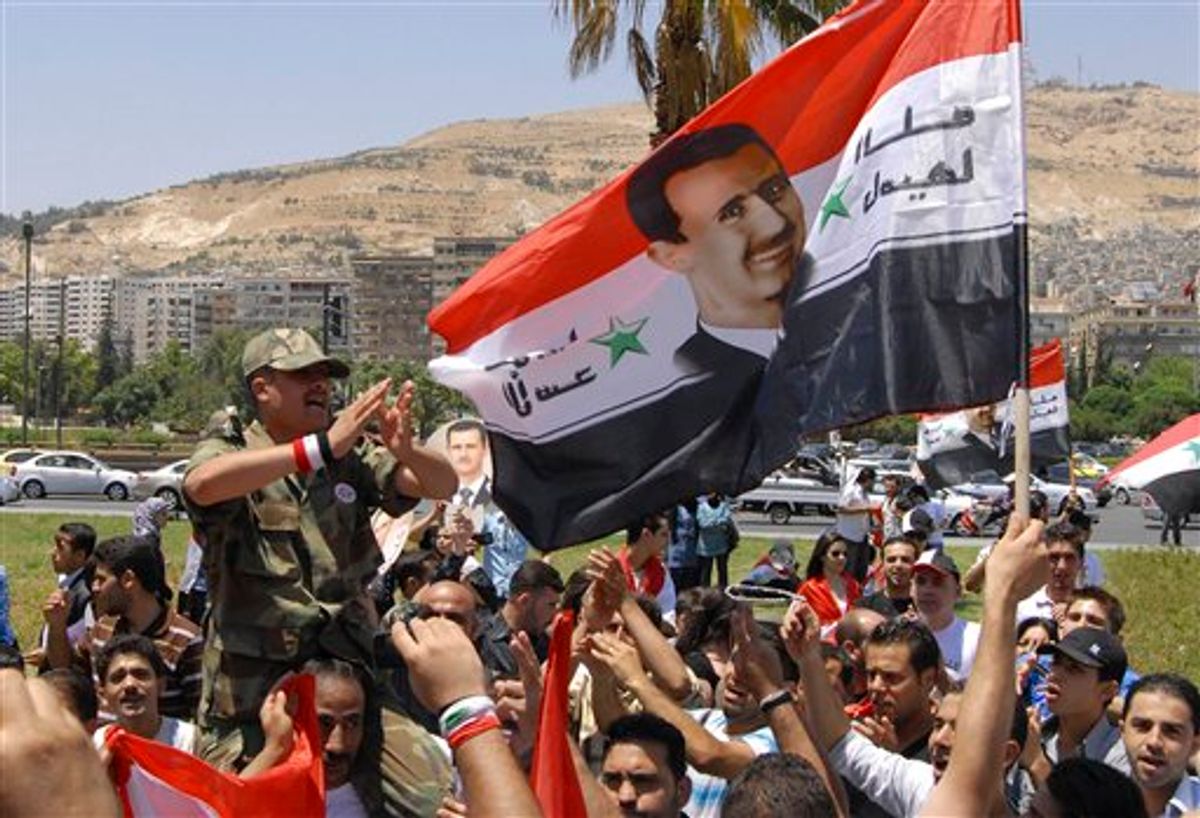
Tens of thousands of Syrians in pro-Assad rallies

Mobilized opposition appears to be digging in as supporters of the president converge on major cities

  • more
    • All Share Services

Tens of thousands of Syrians in pro-Assad ralliesPro-Syrian regime protesters, shout pro-Syria's President Bashar Assad slogans after he delivered a speech, in Damascus, Syria, Monday, June 20, 2011. Syria's embattled president says "saboteurs" are trying to exploit legitimate demands for reform in the country. President Bashar Assad's speech Monday was only his third public address since the country's uprising began in March. What is happening today has nothing to do with reform, it has to do with vandalism," Assad told a crowd of supporters at Damascus University. "There can be no development without stability, and no reform through vandalism. ... We have to isolate the saboteurs." (AP Photo/Muzaffar Salman)(Credit: AP)

Tens of thousands of people waving flags and pictures of Bashar Assad converged on Syria’s main squares Tuesday, pledging allegiance to their president in the latest show of government support to counter a three-month uprising against his authoritarian rule.

The rallies came a day after a speech by President Assad offered a vague plan for reform but was rejected by the opposition, whose supporters took to the streets immediately afterward, shouting “Liar!” Assad had shown no sign of readiness to end his family’s long political domination of Syria, a key opposition demand.

On Tuesday, tens of thousands of Syrians took part in boisterous pro-regime demonstrations, shouting, “The people want Bashar Assad!” and releasing black, white and red balloons — colors of the Syrian flag.

The largest gathering appeared to be in Damascus, but Syrian state TV showed similar demonstrations in the northern cities of Aleppo and Latakia, Hasaka in the northeast, and the southern city of Daraa.

Assad’s speech — and Tuesday’s demonstrations — showed the president clearly intends to try to ride out the wave of pro-democracy protests, showing the steely determination that has kept the Assad family in power for 40 years.

But the mobilized opposition appeared to be digging in as well, bracing for a showdown in one of the deadliest uprisings of the Arab Spring.

The opposition estimates more than 1,400 Syrians have been killed and 10,000 detained as Assad unleashed his military and security forces to crush the protest movement that erupted in March, inspired by the revolutions in Tunisia and Egypt.

Assad’s speech at Damascus University on Monday was only his third public appearance since the uprising began in March. He said a national dialogue would start soon and he was forming a committee to study constitutional amendments, including one that would open the way to forming political parties other than the ruling Baath Party. He acknowledged demands for reform were legitimate, but he rehashed allegations that “saboteurs” were exploiting the movement.

The U.N. refugee agency’s spokesman, Adrian Edwards, said Tuesday that 500 to 1,000 people a day have been crossing from northern Syria into Turkey since June 7 and more than 10,000 Syrian refugees are being sheltered by Turkish authorities in four border camps.

Turkish President Abdullah Gul said late Monday that Assad’s speech was welcome but “not enough.”

“He wants to (carry out reforms), but he has to say clearly and with determination: ‘Things have changed, we are moving to a multiparty system. Whatever the people’s will is, it will happen and I will bring about this transition,’” Gul said.

“As soon as he says this, I believe, he will be able to get ahead of the situation and take things under control. Maybe he is saying these things in between the lines, but he has to say them clearly,” the Turkish president said.

——

Zeina Karam can be reached on http://twitter.com/zkaram

World powers worry Syria sliding to civil war

With a stalemate over proposed sanctions, the situation in Syria could easily become a civil war

  • more
    • All Share Services

World powers worry Syria sliding to civil warA Syrian man Nidal Kodssi, 27, who was wounded in his legs after the Syrian forces shelled his house and killed his wife and his eight month son at Baba Amr in Homs Province in February, is being treated by a Lebanese nurse at a hospital, in the northern port city of Tripoli, Lebanon, Wednesday May 30, 2012. Since the uprising against President Bashar Assad's regime began in March 2011, thousands of Syrian refugees who fled the violence in their country now live in Lebanon, and many wounded Syrians are smuggled across the border for treatment in Lebanese hospitals, mostly in the northern city of Tripoli which is largely sympathetic to the Syrian uprising. But Lebanon is sharply divided by the Syrian conflict, and even in hospitals, Syrian opposition activists are fearful of retaliation. (AP Photo/Hussein Malla)(Credit: AP)

GENEVA (AP) — World powers share a belief that Syria could descend into civil war and plan to map out possible ways to avoid such a disaster for the region, a deputy to international envoy Kofi Annan said Wednesday.

Jean-Marie Guehenno told reporters after privately briefing the U.N. Security Council, the world body’s most powerful unit, that diplomats are deeply troubled by Syria<s cycle of violence.

“I believe that in the council there’s an understanding that any sliding toward full-scale civil war in Syria would be catastrophic, and the Security Council now needs to have that kind of strategic discussion on how that needs to be avoided,” Guehenno said in Geneva after speaking to the New York-based Security Council by videoconference.

However, there was no indication that Russia, one of the veto-wielding permanent members of the Security Council, was changing its position on Syria.

Dmitry Peskov, President Vladimir Putin’s spokesman, was quoted as saying by the ITAR-Tass news agency Wednesday that “there can be no talk” about a shift in Russia’s stance on Syria under foreign pressure.

Russia, along with China, has twice shielded Syrian President Bashar Assad’s regime from the U.N. sanctions over his crackdown on protests. Syria is Russia’s last ally in the region, providing Moscow with its only naval base outside the former Soviet Union and a top customer for Russian weapons industries.

Guehenno, the Annan deputy and a former U.N. peacekeeping chief, also warned of the possibility of outside groups and terrorists taking advantage of the violence. “In any situation where there is a risk of civil war you have opportunistic actors, if one can say that, that can try to exploit that,” he said.

Guehenno said he told the closed session of the 15-nation council that Annan’s six-point peace plan to end the 15-month conflict must be fully implemented and that political process must include talks between the Syrian government and the opposition.

“It<s very important that the Security Council be united in pushing for a political process,” Guehenno said.

Annan held talks with Assad in Damascus on Tuesday following the weekend massacre in Houla of more than 100 people, many of them women and children.

At the U.N. headquarters in New York, Germany’s U.N. Ambassador Peter Wittig said Guehenno told the council that while Annan was in Damascus he appealed to the Assad<s government “to take bold steps forward” to end the violence immediately and implement the peace plan.

U.S. Ambassador Susan Rice said the worst but most probable scenario in Syria is a failure of Annan’s peace plan and a spreading conflict that creates “a major crisis” not only in Syria but also region-wide.

“And members of this council and members of the international community are left with the option only of considering whether they are prepared to take actions outside of the Annan plan and the authority of this council,” she told reporters.

The best scenario would be for the Syrian government to immediately start complying with the plan, she said, but that doesn’t seem to be “a high probability.”

And if Assad refuses to implement it, Rice added, then the Security Council should set aside its differences and up the pressure on Syria with added sanctions.

Minutes after she spoke, Russia<s U.N. Ambassador Vitaly Churkin told reporters that “our attitude to sanctions frankly continues to be negative.”

But Rice, Churkin and other council members agree the best scenario is full implementation of the Annan plan, with talks between opposing sides, despite the increasing worry that will never happen.

They also agree on the need for all sides to immediately halt the violence and for Syrian troops and heavy weapons to be withdrawn from towns and cities, with the government also providing access to detainees, journalists and humanitarian workers.

Annan said in Damascus that the situation has reached “a tipping point” and many council ambassadors agreed, including Rice.

“I think we may be beginning to see the wheels coming off this bus,” she said.

Britain’s U.N. Ambassador Mark Lyall Grant said Guehenno and one of his French successors, the current U.N. peacekeeping chief Herve Ladsous, provided a grim briefing.

Lyall Grant said there was a sense of “revulsion” at the weekend massacre and the increase in extremist attacks with a new sectarian element, all of which are throwing up roadblocks to Annan<s peace plan.

“The key thing is unity of the council,” he said, calling for discussion at the U.N. and in world capitals on how to avoid a civil war in Syria.

___

Lederer reported from the United Nations. Eileen Powell contributed from New York.

(This version CORRECTS Corrects British ambassador’s surname on second reference to Lyall Grant.)

Continue Reading Close

Western nations expel Syrian envoys over massacre

With the peace plan failing, Assad isolates himself further and embarrasses his allies

  • more
    • All Share Services

Western nations expel Syrian envoys over massacreThis photo dated Tuesday, May 29, 2012 released by the Syrian official news agency SANA shows UN-Arab League Joint Special Envoy for Syria (JSE) Kofi Annan, fourth left, Norwegian Maj. Gen. Robert Mood, head of the U.N. observer team in Syria, third left, Syrian President Bashar Assad, third right, and Syrian Foreign Minister Walid Moallem, second right, attend a meeting in Damascus, Syria. International envoy Kofi Annan met Syrian President Bashar Assad on Tuesday following a massacre last week that killed more than 100 people and sparked widespread international condemnation against Damascus. (AP Photo/SANA)(Credit: AP)

BEIRUT (AP) — Eyewitness accounts from the Syrian massacre are emerging, describing shadowy gunmen slaughtering whole families in their homes and targeting the most vulnerable in poor farming villages. Western nations have expelled Syrian diplomats in a coordinated move against President Bashar Assad’s regime over the killing of more than 100 people.

U.N. special envoy Kofi Annan met with Assad in Damascus on Tuesday to try to salvage what was left of a peace plan, which since being brokered six weeks ago has failed to stop any of the violence on the ground.

Survivors of the Houla massacre blamed pro-regime gunmen for at least some of the carnage as the killings reverberated inside Syria and beyond, further isolating Assad and embarrassing his few remaining allies.

“It’s very hard for me to describe what I saw, the images were incredibly disturbing,” a Houla resident who hid in his home during the massacre told The Associated Press on Tuesday. “Women, children without heads, their brains or stomachs spilling out.”

He said the pro-regime gunmen, known as shabiha, targeted the most vulnerable in the farming villages that make up Houla, a poor area in Homs province. “They went after the women, children and elderly,” he said, asking that his name not be used out of fear of reprisals.

Assad’s government often deploys fearsome militias that provide muscle for the regime and carry out military-style attacks. They frequently work closely with soldiers and security forces, but the regime never acknowledges their existence, allowing it to deny responsibility for their actions.

U.N. peacekeeping chief Herve Ladsous said there are strong suspicions that pro-Assad fighters were responsible for some of the killings, adding that he has seen no reason to believe that “third elements” — or outside forces — were involved, although he did not rule it out.

The Syrian regime has denied any role in the massacre, blaming the killings on “armed terrorists” who attacked army positions in the area and slaughtered innocent civilians. It has provided no evidence to support its narrative, nor has it given a death toll.

Following his meeting with Assad, Annan called on the government and “all government-backed militias” to stop military operations and show maximum restraint. He also called on the armed opposition to stop all violence.

“We are at a tipping point,” Annan told reporters in Damascus. “The Syrian people do not want the future to be one of bloodshed and division.”

Cranking up the pressure on Assad, the Obama administration gave Syria’s most senior envoy in Washington, the charge d’affaires at the Syrian Embassy, 72 hours to leave the United States. Britain, Canada, Australia, France, Germany, Italy, Spain and Bulgaria also expelled Syrian diplomats.

“We hold the Syrian government responsible for this slaughter of innocent lives,” State Department spokeswoman Victoria Nuland said in Washington. “This massacre is the most unambiguous indictment to date of the Syrian government’s flagrant violations of its U.N. Security Council obligations.”

The massacre in Houla could prove to be a watershed moment in the Syrian crisis, which began in March 2011 with peaceful protests inspired by the wave of uprisings sweeping the Arab world.

Nearly 15 months later, the country is in many ways unrecognizable from the days before the revolt. Assad, once considered a potential reformer in a region filled with aging dictators, is a global pariah. A country that once boasted it was the safest in the Middle East is riven with violence, some of it reminiscent of the worst days of the Iraq war. The economy is in tatters. Syrians are facing price increases for basic goods and endure regular power cuts.

And in some haunting cases, neighbors who have lived side by side for years are turning on each other, driven by sectarian hatred that so many months of violence is laying bare.

According to witnesses, the massacre, which began late Friday in an area about 40 kilometers (25 miles) northwest of the city of Homs, had dangerous sectarian overtones.

The victims lived in the Houla area’s Sunni Muslim villages. But the shabiha forces allegedly behind many of the killings came from an arc of nearby villages populated by Alawites, an offshoot of Shiite Islam.

Most shabiha fighters belong to the Alawite sect, to which the Assad family and the ruling elite also belong. This ensures the gunmen’s loyalty to the regime, built on fears they will be persecuted if the Sunni majority gains the upper hand.

Sunnis make up most of Syria’s 22 million people, as well as the backbone of the opposition. Even as much of the opposition insists the movement is entirely secular, disturbing reports from the ground suggest religious tensions are boiling over.

The volatile sectarian divide makes civil war one of the most dire scenarios.

Activists say as many as 13,000 people have been killed in the uprising. The U.N. put the toll at 9,000 as of March — one year into the revolt — but many hundreds more have died since.

On Tuesday, the U.N.’s human rights office said most of the 108 victims of the Houla massacre were shot at close range. The U.N. report indicated that most of the dead were killed execution-style, with fewer than 20 people cut down by regime shelling.

Deaths from heavy artillery can be blamed on regime forces with relative confidence because rebel fighters do not have such weapons. But it is more difficult to determine who is behind the close-range killings — particularly as Syria sharply restricts media access.

Still, the U.N. cited survivors and witnesses blaming the house-to-house killings on shabiha. Witnesses also told the AP that shabiha were behind the attacks.

“What is very clear is this was an absolutely abominable event that took place in Houla, and at least a substantial part of it was summary executions of civilians, women and children,” said Rupert Colville, spokesman for the U.N. High commissioner for Human Rights.

“At this point, it looks like entire families were shot in their houses,” he said.

It is not clear what touched off the convulsion of violence. Houla activists reached by Skype said government troops shelled the area after anti-government protests on Friday and clashed with local rebels. Later, shabiha from nearby villages swept through the area, stabbing residents and shooting them at close range.

Videos posted online by anti-regime activists show explosions in Houla and dismembered bodies in the streets, then row upon row of the dead laid out before being buried in a mass grave. Some videos showed dozens of dead children, some with gaping wounds.

According to the state-run news agency, SANA, Assad on Tuesday blamed terrorists and weapons smugglers for scuttling the peace plan, which called for a cease-fire and dialogue with the opposition. The regime denies there is any popular will behind the country’s uprising, saying foreign extremists and terrorists are driving the unrest.

Although Damascus has remained largely impervious to international condemnation over the course of the uprising, Tuesday’s diplomatic squeeze will increase pressure on Syria’s remaining allies, including Russia.

Russia has provided a key layer of protection for the Syrian government in the uprising. Russia and China have used their veto power to block U.N. resolutions against Assad. But Russia has grown increasingly critical of Damascus in recent months, and the Houla massacre has prompted some of the strongest condemnations yet from Moscow.

Russian President Vladimir Putin is traveling to Germany and France this week and is likely to come under even greater criticism for his support of the regime.

“We have to continue our work with the Russians,” British Foreign Secretary William Hague said. “We will continue to discuss this with Russia. Russia has particular leverage on the regime and therefore has a particular role in this crisis.”

Despite some shift in Russia’s stance recently, Russian Foreign Minister Sergey Lavrov said Tuesday the Houla massacre must not be a pretext to push for military intervention from outside. Instead, he urged all sides to focus on the Annan plan.

Hague said that the situation in Syria is more complicated than what international powers faced in Libya last year, when a U.N. resolution ushered in NATO military intervention against dictator Moammar Gadhafi’s regime.

White House spokesman Jay Carney said the Obama administration remains opposed to military action, reasoning that it would lead only to more carnage. He said the U.S. will continue offering non-lethal assistance to the Syrian people and said Tuesday’s coordinated move to expel Syrian diplomats was a signal of the international community’s “absolute disgust” with Assad’s rule.

Assad still commands a strong army that has proven largely unwilling to turn on him. The entire structure of the state has been built to preserve Assad’s power, with the military, the police and security services — even the economy — tied up with the survival of his presidency.

But as the violence engulfs the country, many see Assad’s departure as the only way out.

Fawaz Zakri, a member of the opposition Syrian National Council, urged action by the U.N. Security Council, saying the world body “must do something to save the Syrian people’s souls.”

___

Associated Press writers Zeina Karam and Ben Hubbard in Beirut, Angela Charlton in Paris, Frank Jordans in Geneva, Edith M. Lederer at the United Nations, Albert Aji in Damascus, Syria, and Selcan Hacaoglu in Ankara, Turkey, contributed reporting.

Continue Reading Close

Syria’s walking wounded

Syrian forces target medical workers and hospitals, leaving the country's injured with no place to go

  • more
    • All Share Services

Syria's walking woundedThis image, made from amateur video released by the Shaam News Network and accessed Monday, May 14, 2012, purports to show a Syrian rebel helping an injured man in Rastan, Homs, Syria. (Credit: AP Photo/Shaam News Network via AP video)
This article originally appeared on GlobalPost.

JABAL AL ZAWIYA, Syria — The pickup truck swerved around the corner as three frantic men stood on the back screaming,“Go! Go!” Bouncing painfully between their legs was a man drenched in blood.

Global PostHe was one of seven injured in a series of tank blasts last week in the village of Deersonpol, in Syria’s northern Idlib province. Four others were killed instantly in the attack by government security forces. Of the seven to undergo the harrowing route to the nearest “safe” hospital in Deir Alsharky, 12 miles of bad road away, three survived, three died and the whereabouts of the fourth remains unknown.

There were many hospitals much closer to the scene, but these are government run, and the risk of execution or arrest, particularly for those arriving with battle wounds, is so high that citizens throughout the area endure these dangerous journeys every day.

“Most of the death cases we see are because of the distance,” said Dr. Mohammed, a neurosurgeon who treated the Deersonpol cases at his clinic in Deir Alsharky. “Most bleed to death along the way. Today we lost three from injuries that could be treated if we’d got to them in time.”

Many doctors and patients asked to be referred to only by their first names for fear of authorities. Dr. Mohammed was no exception. After his home and his practice in Damascus were raided by authorities, he became wanted on the charge of treating injured demonstrators and members of the Free Syrian Army. He was forced to flee the city with nothing.

“The soldiers would come into the hospitals and kill and arrest patients, especially after the Friday demonstrations,” he said of his work in Damascus before he fled the city in January. “Even in the intensive care units, the soldiers would come in and kill the patients in their beds or drag them into the streets. I have seen this many times.”

Due to the risks, secret hospitals have sprung up across the country. Some are manned only by untrained nurses. Volunteer doctors and surgeons working in primitive conditions run others, like Dr. Mohammed’s clinic. Immediately after surgery, the patients are sent to safe houses protected by the Free Syrian Army, where their condition is monitored.

Doctors Without Borders, an international nongovernmental organization, confirmed the government practice of targeting medical workers and patients in a report released earlier this month.

“We saw militarized health care facilities, meaning that access to medical care depends on which side you belong,” said Brice de le Vingne, the organization’s director of operations in Brussels. “Health facilities are being targeted, thus endangering patients and preventing health care workers from doing their jobs. Health facilities and pharmacies are looted and destroyed.”

Dr. Mohammed said most of his equipment is donated and smuggled in from Turkey. He shows a respirator, two new surgical sets and a radio that just arrived. Medical supplies and medications are always in short supply.

For some patients, the treatment they need is simply not available in these makeshift secret clinics.

In Maarat Al-Numaan, a government checkpoint stands by the city hospital. A few blocks away in a narrow alley is the door to the secret clinic. The doctor here, Ahmed Rawin, said they are afraid to keep patient records in case of a raid. They list only those who need follow-up treatment in the safe houses in a small notebook. Dr. Ahmed told the story of one recent patient in desperate need of life support.

“We moved him to the international hospital under a fake name,” he said. “Within days the soldiers came and killed him. They threw his body into the street.”

Many seek treatment in Turkey, but the journey is difficult. Rowad, 22, said he just returned from surgery across the border. As a member of the Free Syrian Army, he was injured by shrapnel during a clash with government forces. Nerve damage caused him to lose feeling in his right leg. After surgery performed by Dr. Mohammed, members of the Free Syrian Army snuck him across the Turkish border for follow-up surgery.

“Most of the way we managed to go by car, but they had to carry me for about three kilometers,” said Rowad, who still has no feeling in his leg, but can now walk with the help of crutches.

Dr. Mohammed said in the past week he has sent three urgent cases across to Turkey. Two died en route.

Activist Abdul Aziz Agini, who works with the Free Syrian Army near the Turkish border, said he receives requests to arrange transport for patients almost daily.

“We suffer a lot to get them there. We must carry them on our backs,” he said.

There isn’t enough manpower for everyone, however, and many in desperate need of medical treatment must wait to find a safe passage.

In Ariha, another town in Idlib province, the smell was nauseating as a 60-year-old man removed a bandage from his infected feet — most of the skin and flesh was gone. The man, who works as a butcher, was arrested at a checkpoint. His court papers say he is accused of “participating in demonstrations.” He was held and tortured for 45 days.

“They hit my foot with a wire cable telling me to confess,” he said, adding that he was released 10 days earlier. “When they took me to court, they had to carry me. When the judge saw me, he didn’t even question me. He ordered my release.”

So far, the route through Turkey has been too dangerous for someone in his condition. Until now he has been unable to get any treatment.

“We are in a large concentration camp called Syria,” he said. “My fate is in God’s hands.”

Volunteer doctors say they receive many cases of torture by authorities. Treating these patients often leads to their own arrest. Dr. Najib Aledel has been imprisoned twice for his work in a secret hospital in Ariha. Ten days after his last release, Dr. Aledel said he was back on the wanted list.

“There was no injury for me,” he said in reference to his two months of total prison time. “But I saw very bad deeds happen to others, and there is no [medical] treatment inside the prisons.”

Dr. Aledel said the cease-fire agreement between the government of Bashar al-Assad and the Free Syrian Army is in name only. The patient number has dropped, but not significantly, he said. And medical supplies, he said, are so low he and his staff often give their own blood to patients in need of transfusions. He said there are no humanitarian groups or overseas aid, and the only supplies come through private donations, both local and international. In all clinics, doctors said they desperately need more support from abroad.

Mohammed, an activist and pharmacist that secretly supplies these underground clinics in Ariha, believes these attacks on the medical system are yet another way to instill fear into the people.

“The government is aiming for social chaos so people will get desperate and ask for the government to come back,” he said. “But now we have started. There is no going back.”

Continue Reading Close

Syria defiantly denies killings, UN council meets

Following the massacre of over 100 civilians, The UN reconsiders sanctions

  • more
    • All Share Services

Syria defiantly denies killings, UN council meetsThis citizen journalism image provided by Shaam News Network taken Saturday, May 26, 2012, purports to show shrouded dead bodies following a Syrian government assault on Houla, Syria. The Syrian government denied Sunday its troops were behind an attack on a string of villages that left more than 90 people dead, blaming the killings on "hundreds of heavily-armed gunmen" who also attacked soldiers in the area. Friday's assault on Houla, an area northwest of the central city of Homs, was one of the bloodiest single events in Syria's 15-month-old uprising. The U.N. says 32 children under 10 were among the dead. (AP Photo) THE ASSOCIATED PRESS IS UNABLE TO INDEPENDENTLY VERIFY THE AUTHENTICITY, CONTENT, LOCATION OR DATE OF THIS CITIZEN JOURNALISM IMAGE(Credit: AP)

BEIRUT (AP) — Syria on Sunday strongly denied U.N. allegations that its forces killed more than 90 people in one of the deadliest events of the country’s uprising, and diplomats said the Security Council met in an emergency session to discuss the massacre.

The killings in the west-central area of Houla on Friday brought widespread international criticism of the regime of President Bashar Assad, although differences emerged from world powers over whether his forces were exclusively to blame.

Britain and France had proposed issuing a press statement condemning the massacre, but Russia told Security Council members it could not agree and wanted a briefing first by Norwegian Maj. Gen. Robert Mood, the head of the U.N. observer team inside the country. Russia has been Syria’s most powerful ally during the uprising, and along with China has used its veto power to shield Damascus from U.N. sanctions.

The massacre in Houla on Friday cast fresh doubts on the ability of an international peace plan put forward by envoy Kofi Annan to end Syria’s 14-month-old crisis.

The brutality of the killings became clear in amateur videos posted online that showed scores of bodies, many of them young children, in neat rows and covered with blood and deep wounds. A later video showed the bodies, wrapped in white sheets, being placed in a sprawling mass grave.

The U.N. counted at least 32 children under the age of 10 among more than 90 dead and said its observers found tank and artillery shells at the site, suggesting the regime’s well-equipped forces were to blame.

Activists from the area said the army pounded the villages with artillery and clashed with local rebels after protests Friday. Some activists said pro-regime thugs later stormed the area, doing the bulk of the killing.

The Syrian government rejected that narrative Sunday, painting a vastly different picture.

Speaking to reporters in Damascus, Foreign Ministry spokesman Jihad Makdissi said Syrian security forces were in their local bases Friday when they were attacked by “hundreds of heavily armed gunmen” firing mortars, heavy machine guns and anti-tank missiles, staring a nine-hour battle that killed three soldiers and wounded 16.

The soldiers fought back, but didn’t leave their bases, he said.

“No Syrian tank or artillery entered this place where the massacres were committed,” he said. “The security forces did not leave their places because they were in a state of self-defense.”

He blamed the gunmen for what he called a “terrorist massacre” in Houla and accused the media, Western officials and others of spinning a “tsunami of lies” to justify foreign intervention in Syria.

Makdissi did not provide videos or other evidence to support his version of events, nor did he give a death toll. He said the government had formed a committee to investigate and share its findings with Annan, who is due to visit Damascus in the coming days.

Throughout the uprising, the government has deployed snipers, troops and thugs to quash protests and shelled opposition areas.

A video released by the U.N. team in Syria on Sunday showed observers in Houla the day after the attack, meeting with local rebels and watching residents collect more bodies for burial. It also showed two destroyed armored personnel carriers — suggesting that local rebels put up more of a fight than the activists acknowledged.

At U.N. headquarters, Russia’s deputy U.N. ambassador Alexander Pankin told reporters as he headed into the closed-door Security Council meeting that “there is substantial ground to believe that the majority of those who were killed were either slashed, cut by knives, or executed at point-blank distance.”

“We have to establish whether it was Syrian authorities … before we agree on something,” he said.

Annan’s peace plan for Syria, sponsored by the U.N. and the Arab League, is one of the few points of agreement among world powers about Syria’s crisis, which began in March 2011 with protests calling for political change. As the government violently cracked down on the uprising, many in the opposition took up arms to defend themselves and attack government troops.

The U.N. put the death toll weeks ago at more than 9,000. Hundreds more have been killed since then.

Daily violence has marred the plan since a cease-fire was supposed to begin April 12. The Houla attack made Friday the deadliest day since the truce was announced, and has cast a shadow over Annan’s visit.

In another defiant move, Syria on Sunday denied permission for Annan’s deputy to travel to Damascus with his boss, a senior Arab League official said. The rejection of former Palestinian Foreign Minister Nasser al-Kidwa was intended as a slap to the Arab League, which suspended Syria’s membership and approved sanctions against it last year.

The official spoke on condition of anonymity because of the sensitivity of the issue. Annan’s spokesman declined to comment.

The Houla attacks caused outrage among American and international officials that Makdissi’s comments Sunday failed to assuage.

British Foreign Secretary William Hague said he would summon Syria’s most senior diplomat in the U.K. on Monday so the Foreign Office could “make clear our condemnation of the Syrian regime’s actions.”

Kuwait, which currently heads the 22-member Arab League, called for an Arab ministerial meeting to “take steps to put an end to the oppressive practices against the Syrian people.”

Switzerland’s Foreign Ministry urged that an international inquiry be convened, saying the killings “could constitute a war crime.”

In Paris, the head of the exile Syrian National Council also condemned the killings.

“The kids of Houla are the kids of all of Syria,” Burhan Ghalioun told reporters. “Killing the kids of Houla is like killing the kids of all of Syria.”

Anti-regime activists scoffed at the government’s version of events. One Houla activist said via Skype that the area had at most 300 fighters, but that none had more than rifles and that they often lacked ammunition.

“If we had anti-tank missiles, there would be no tanks left in the area,” said Mohammed, declining to give his full name for fear of retribution.

Activists reported shelling, gunfire and arrest raids in opposition areas throughout the country Sunday as well as clashes between regime forces and rebels in a number of areas. The Britain-based Syrian Observatory for Human Rights said security forces killed at least 14 civilians, while rebels killed nine soldiers.

Activist claims could not be independently verified. The Syrian government bars most media from operating in the country.

Annan’s plan calls for eventual talks between all sides on a political solution to the crisis.

The U.S. hopes Russia can use its influence with Damascus to press for a political transition similar to that seen in Yemen. In February, longtime Yemeni President Ali Abdullah Saleh passed power to his deputy in exchange for immunity from prosecution.

U.S. officials say Russia does not oppose a political transition in Syria in theory, but has not agreed to specific terms.

___

Associated Press writers Edith M. Lederer at the United Nations, Adam Schreck in Dubai and Hamza Hendawi in Cairo contributed to this report.

Continue Reading Close

Syria’s sealed-off rebels

Baba Amr in Homs, once an opposition stronghold, is now isolated by a 10-foot high concrete wall

  • more
    • All Share Services

Syria's sealed-off rebelsIn this Saturday April 21, 2012 photo, a Syrian man leaves his home carriying a suitcase as he walks in a destroyed alley damaged from Syrian army forces shelling, at Bab Sbaa neighborhood in Homs province, central Syria.(Credit: AP)
A GlobalPost journalist whose name has been withheld for security reasons, reported this story from Baba Amr, Syria. Hugh Macleod and Annasofie Flamand contributed reporting and wrote the story from Beirut, Lebanon. This article originally appeared on GlobalPost.

BABA AMR, Syria — For Syrians on both sides of the concrete wall that now surrounds this neighborhood, the comparisons to the region’s longest running conflict are unavoidable.

Global Post

“When my wife described the wall to me I immediately thought of the wall built by the Israelis to isolate Palestinian villages and towns in the West Bank,” said Abu Annas, formerly a resident of Homs’ devastated Baba Amr district.

“I can understand that Israel built a wall to protect Israeli settlers from Palestinians. But I cannot understand how a national government builds a wall to separate its citizens from each other.”

Since forcing the retreat of rebel fighters from Baba Amr after a brutal month-long bombardment in February, government forces have constructed a massive concrete wall to seal off the former opposition stronghold.

A reporter for GlobalPost recently visited Baba Amr and the wall, describing it as up to 10-feet high and made of cement. It’s still so new there is no graffiti. Since most residents have long fled, the neighborhood behind the wall has become “a dead land for cats and dogs,” as one former resident described it.

Soldiers and secret police guard the few narrow passages through the wall, arresting any male aged between 13 and 60, said Annas, whose wife and young daughter recently went to check on what remained of their home inside Baba Amr.

“They spent half an hour arguing with the security officer who said his men would have to check them before they passed through,” he said. “She came back crying, saying, ‘There is no Baba Amr.’”

Those houses not destroyed in February’s siege have been taken over by soldiers, Annas said. Electricity and phone lines have been cut for months and now cars cannot enter, nor delivery trucks, meaning shops are almost all closed.

Activists in the area said the neighborhood — once home to some 28,000 people — has now been all but abandoned, with only about 1,000 still living inside the wall.

In other Sunni-majority opposition neighborhoods throughout Homs, such as Karm al-Zeitoune, where whole families were killed in recent sectarian massacres, and Deir Balbah and Qarabes, the majority of residents have also fled.

With the UN-Arab League ceasefire plan in tatters — at least 462 people have been killed since April 16 when the UN resolved to send ceasefire monitors, according to the opposition Local Coordination Committees — and veto-wielding Russia blaming the armed opposition for the majority of attacks, the Assad regime appears to be taking steps to re-exert long-term security control and collectively punish rebellious communities.

On Saturday, Abu Bakr Saleh, a spokesman for the Baba Amr media center who lived through the bombardment, said other security measures were preventing residents from traveling between Baba Amr and neighboring Joubar neighborhood, to the far southwest of the city.

Last week, GlobalPost witnessed continued shelling in Khaldiyeh and Bayada, Sunni-majority neighborhoods in north Homs that support the opposition and lie adjacent to Zahara, a neighborhood of mainly Allawites, an offshoot of Shiite Islam, to which the ruling Assad family and a majority of government elites belong.

Cairo Street, which leads from north Homs into Zahara in the east of the city, has been renamed “Death Street” by locals after the deadly snipers deployed to rooftops, presumably to protect the pro-regime neighborhood.

On their first visit to Homs on April 21, members of the advance team of UN observers, the first of 300 due to be deployed to monitor violations of the ceasefire agreement, were forced to take cover after shots rang out as they walked down Cairo Street from Bayada.

“The regime will not adhere to the Annan plan and the near future will prove that,” said Omar, a 24-year-old member of the rebel Free Syrian Army, told GlobalPost in an interview at his home in Homs’ Deir Balba.

“The regime is preparing for the post-Annan cease-fire by building walls around Sunni districts to block our movement and is digging a long trench around Homs two meters wide.”

Reports of Assad’s forces digging trenches around the south and west of Homs, where Baba Amr is located, first emerged last November. A video journalist working with GlobalPost witnessed the trench during a visit to Homs this February. The purpose of the trench remains unclear, but it appears to be a another military tactic to hinder access to rebellious neighborhoods.

In Daraa, the first city to rise up against the regime and suffer a sustained military assault, GlobalPost recently witnessed a labyrinth of checkpoints and deployment of tanks, troops and snipers, effectively sealing off the population from surrounding areas and the capital.

The regime blames “armed terrorist groups” for the breakdown in the ceasefire agreement. Information Minister Adnan Mahmoud told state-run Syrian Arab News Agency last week that the “terrorists” had committed more than 1,300 violations.

Russia last week echoed a similar line. Foreign Ministry spokesman Alexander Lukashevich accused the opposition of shifting “to tactics of terror on a regional scale,” claiming Western governments were arming the rebel fighters.

Rather, it appears post-revolutionary Libya, which strongly supports Syria’s opposition, has made the first serious effort to arm the rebels. On Saturday Lebanese authorities announced they had discovered guns and rocket propelled grenades aboard a ship attempting to dock in north Lebanon’s Tripoli, a Sunni-majority city also widely supportive of Syria’s opposition.

Omar, the young rebel fighter from Homs, said the FSA was now restructuring after suffering a strategic defeat in Baba Amr.

“We will adopt guerilla tactics,” he said. “We are fighting in small groups and moving from one district to another so we don’t let the regime block this district and kill us. The FSA leaders made a big mistake when they tried to hold Baba Amr.”

As the rebels seek new strategies for their armed struggle, the Assad regime has made its contempt of the international diplomatic effort clear. Assad himself revealed his scorn for last December’s Arab League monitoring mission in an email, first obtained and verified by the Guardian.

Writing to Hadeel Ali, his young media consultant, the president forwarded a YouTube video ridiculing the mission’s inability to spot hidden Syrian tanks, to which she responded, “Hahahahahahaha, OMG!!!”

That same contempt appeared to be on display more recently as Kofi Annan, the Arab League envoy, briefed the Security Council on a letter received from Syrian Foreign Minister Waleed Mualem on April 21. The letter stated that the government had now withdrawn all heavy armor and troops from population centers, the first step in Annan’s cease-fire plan.

But daily videos of smoke billowing above Homs and troops opening fire in urban protest centers have told a very different story.

Syrian officials see Annan’s plan as “a license for the regime to do more of the same,” the respected International Crisis Group, one of the only international think tanks able to still interview Syrian officials, wrote in its April 10 report.

“As the regime sees it, Annan’s mission, far from presenting a threat, can be a way to drag the process on and shift the focus from regime change to regime concessions,” ICG reported, “granting humanitarian access, agreeing to a ceasefire and beginning a vaguely defined political dialogue, all of which can be endlessly negotiated and renegotiated.”

As that process unfolds, the wall in Baba Amr stands as a physical symbol of the deep-seeded sectarian hatred that a year of relentless violence in Syria has engendered in former neighbors.

“The Sunni districts are hosting terrorists and armed gangs so the government should close them off by all means. If this needs a high wall, why not?” Haidar, a 35-year-old Allawite from Homs’ Zahara neighborhood, told GlobalPost.

A member of the Popular Committees, the official name for armed civilian militias fighting for the regime, Haidar said the possible collapse of the regime would mean no future for three million Allawites in Syria’s big cities. “We would return to our villages in the mountains,” he said.

“We have been occupying senior positions in the army, security agencies and government in Syria for four decades and we will keep the power in our hands, whatever this costs us.”

Continue Reading Close

Page 1 of 29 in Syria