Mortgage Crisis
Why did Bank of America escape prosecution?
An $8.5 billion settlement suggests they did something wrong, but the feds never went after them
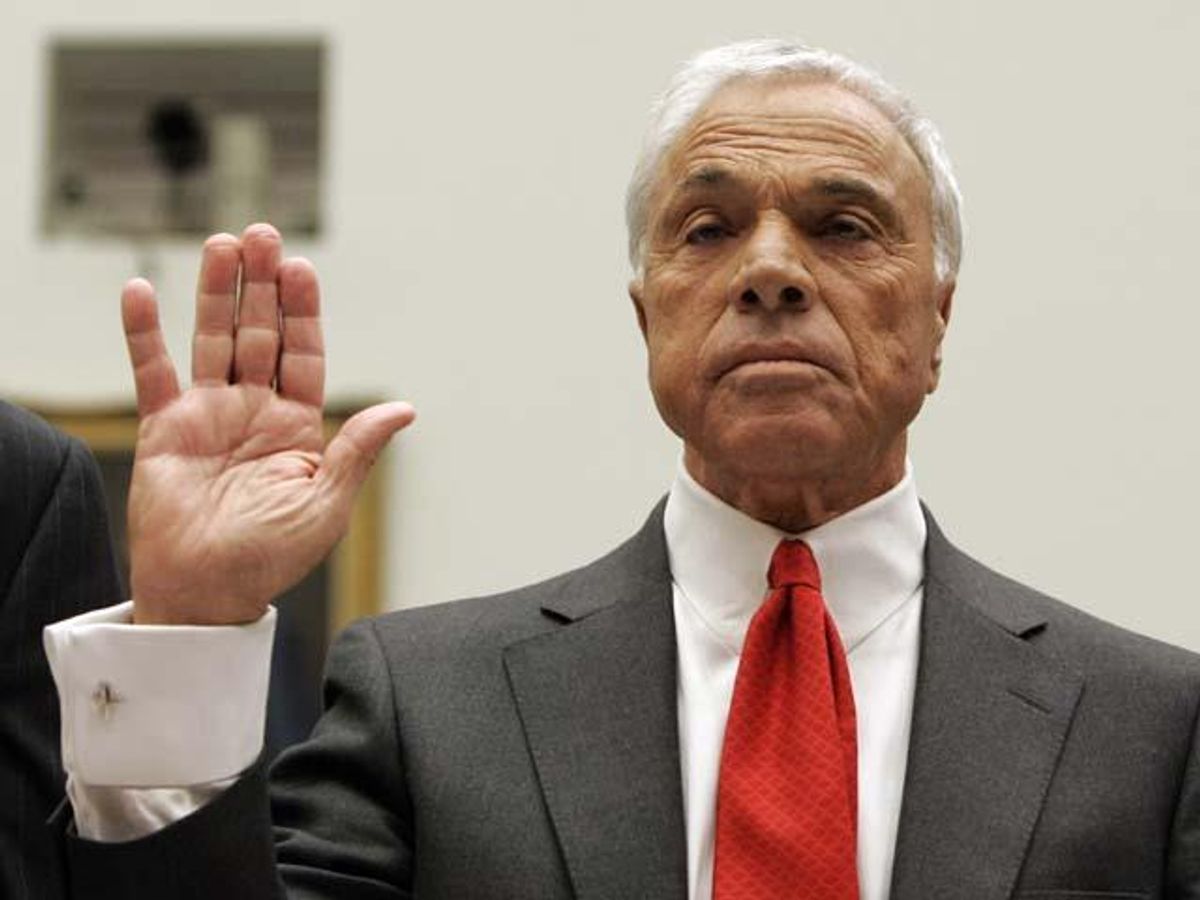
Former Countrywide CEO, Angelo Mozilo Bank of America has agreed to settle with a group of high-profile investors for $8.5 billion for losses on mortgage-backed securities. A settlement of this size would seem to point to considerable wrongdoing by the bank. And yet, no criminal charges have been brought against Bank of America.
How could this be?
Charles R. Morris, a former banker and the author of “The Trillion Dollar Meltdown,” told Salon on Wednesday that while it is clear that BofA behaved with “no shame,” there are numerous reasons why the feds left the bank alone.
For instance, unlike in a case of insider trading, when the guilty party is caught red-handed on the phone, “it’s really hard to make these criminal cases stick and if you really want to get the top guy, it will take forever,” Morris said.
“You don’t have a clean smoking gun,” he explained. “It seems to me that Goldman Sachs was pretty much the only competent bank, in that when they took a view, they really took it and managed it up and down the institution.” But proving “intent” at the top can be problematic.
Even with a case like Bear Stearns — where there seems to be ample grounds for a criminal case (email trails that have come up in lawsuits that have reached discovery and Senate investigations show clear instances of fraud) — criminal charges might not stick, Morris noted.
The desire of the federal government to follow up with criminal charges is relevant, too. When it came to bringing charges against Enron’s Jeff Skilling and Ken Lay, the FBI worked very hard indeed, but “they haven’t done that here,” Morris said. “The federal government was confused over whether they wanted to save or punish the banks. They’ve decided to save them.”
“The settlement is actually pretty modest considering the losses involved,” he said. “The Wall Street Journal said the investors held securities originally valued over $100 billion, which I think is a bit steep. But on the Wall Street Journal figures, if they’re settling for 8.5 percent of what the investment was originally worth, it’s pretty modest.”
Morris explained that the settlement was won by 22 investors — including the giant money manager BlackRock Inc. and the insurer MetLife Inc. — who jointly share 25 percent of a securities trust. This was a group, therefore, with considerable power. And there is ample evidence that Countrywide broke all kinds of contractual obligations.
“I believe this will become a template for settlements,” said Morris, noting that attorney Talcott Franklin is already bringing together a second settlement group of smaller investors — around 500 of them — with another joint 25 percent stake in the BofA trust.
Natasha Lennard covers the Occupy movement for Salon. A British-born, Brooklyn-based journalist, she has been covering Occupy Wall Street since before the first sleeping bag was unrolled in Zuccotti Park. One of the first journalists arrested at an Occupy action, she has managed to enrage Andrew Breitbart, Rush Limbaugh and Glenn Beck. You can follow her on Twitter (@natashalennard), and email her any Occupy updates/videos/ideas to natasha.lennard@gmail.com More Natasha Lennard.
National Journal reports: Things are bad out in Real America
The crumbling of once-great institutions isn't to blame for middle-class decline and anger. Politicians are
(Credit: Andy Dean Photography via Shutterstock) Ron Fournier, the editor in chief of the National Journal, and reporter Sophie Quinton have a story on hard times in Muncie, Ind., as a microcosm of the failure of American institutions as a whole.
It’s a good piece. It’s even an “important” piece, in the sense that the cloistered elites who run the country could learn something of the reality of life out in the country at large if this piece makes it to their desks. D.C.-based news organizations should report from “the rest of America” more often, because in Washington mass foreclosures and double-digit unemployment are usually seen as abstract problems slightly less pressing than the fact that Social Security will, decades from now, pay out slightly more than it takes in. (Joe Klein, who is basically a buffoon, returned from his stunt “2010 road trip” sounding suddenly much less buffoonish. Getting outside the bubble is often instructive.)
Continue Reading Close
Alex Pareene writes about politics for Salon and is the author of "The Rude Guide to Mitt." Email him at apareene@salon.com and follow him on Twitter @pareene More Alex Pareene.
The big banks win again
Foreclosure victims get little help in a mortgage-settlement plan that only benefits the banks' bottom line
This Oct. 12, 2011 file photo shows the J.P. Morgan Chase logo at the base of one of the bank's larger Lower Manhattan buildings in New York (Credit: AP Photo/Kathy Willens) On Thursday, a group of well-connected and powerful men announced that the federal government and state attorneys general had agreed to a multibillion-dollar settlement of claims relating to falsified foreclosure documents. The image of former corporate lawyer-turned-Attorney General Eric Holder and Iowa official Tom Miller complimenting each other on their courage and bravery was a stark reminder of how little power foreclosure victims have in Washington. The terms of the settlement were still secret, but we saw hints of what is to come: The website set up to inform the public noted that homeowners may not know for up to three years whether they are eligible for help.
Continue Reading CloseThe foreclosure deal: Every little bit counts
The banks don't get the punishment they deserve, but the White House finally gets some traction on housing woes
(Credit: whitehouse.gov) The first thing to understand about Thursday’s much ballyhooed $26 billion foreclosure fraud settlement between five big banks, the federal government and 49 states is that it is nowhere near as big of a deal as it is being made out to be. You can safely ignore the claim that the torturously negotiated settlement is the heftiest financial punishment of industry by government since the landmark multistate tobacco deal in 1998 or President Obama’s declaration Thursday morning that it is the “largest joint federal-state settlement in our nation’s history.”
Continue Reading Close
Andrew Leonard is a staff writer at Salon. On Twitter, @koxinga21. More Andrew Leonard.
Newt Gingrich can’t talk his way out of Freddie Mac tie
His former firm invents excuses not to release the former speaker's "consulting" contract
(Credit: AP) I bet, when he launched his presidential campaign in what I still assume was primarily an attempt to embarrass those who said he’d never actually do it, that Newt Gingrich did not think his greatest liability would be consulting for the Federal Home Loan Mortgage Corp. No, he surely assumed it’d be the marriages, adulteries and divorces. Or even the climate change ad with Nancy Pelosi. But the one attack he has not been able to talk his way out of has turned out to be that he took a great deal of money from Freddie Mac, which, according to Republican lore, caused the financial crisis.
Continue Reading Close
Alex Pareene writes about politics for Salon and is the author of "The Rude Guide to Mitt." Email him at apareene@salon.com and follow him on Twitter @pareene More Alex Pareene.
Old people getting richer, young people getting poorer
The age-based wealth gap is big and growing, thanks to younger Americans' debts
(Credit: MitarArt via Shutterstock) Have you noticed how most of the Tea Party people were sort of old, while most of the Occupy Wall Street people are fairly young? Here’s an interesting factoid, from the USA Today: Old people are much, much richer than young people. According to the Pew Research Center, Americans 65 and older are 47 times richer than those 35 and younger.
It makes sense that old people would have more money than young people, because they have been working and saving longer. But this wealth gap is massive by historical standards. In 1984, old people were a mere 10 times richer than young people. Not only have old people gotten richer since then, but the median net worth of households headed by young people has declined considerably.
Continue Reading Close
Alex Pareene writes about politics for Salon and is the author of "The Rude Guide to Mitt." Email him at apareene@salon.com and follow him on Twitter @pareene More Alex Pareene.
Page 1 of 21 in Mortgage Crisis