
The year's most puzzling film has viewers scratching their heads. Here's a primer that should help
How does one watch Terrence Malick’s “The Tree of Life”?
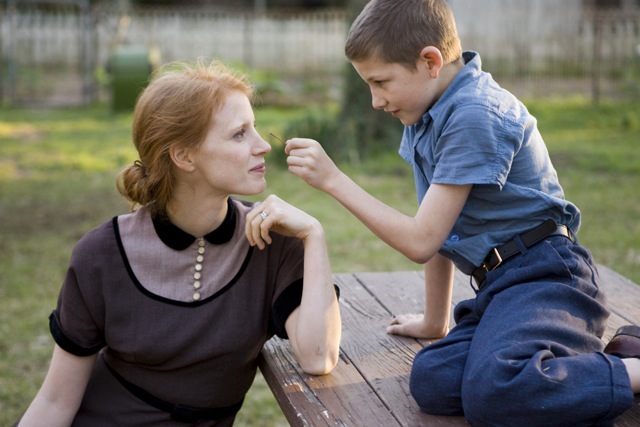
That is the question. Malick’s domestic epic is the most talked-about movie of the summer, and surely the most divisive — a two-hour-and-18-minute sound-and-light show that doubles as a nostalgia piece. Avoiding a strict linear plot, it instead offers a rush of images, sounds and sensations. It consists of fragments of a life remembered (and in a few cases, imagined) by its hero, an architect named Jack (Sean Penn), with special attention paid to Jack’s boyhood in 1950s Waco, Texas, where he was torn between the old-line machismo of his father (Brad Pitt) and the angelic, almost childlike openness of his mother (Jessica Chastain).
With this piece, I was aiming to write an “explainer” similar to this checklist of Spielbergian elements in J.J. Abrams’ early-Spielberg-eseque sci-fi adventure “Super 8,” but Malick is working in a different mode, or on a different intellectual plane, and is after different things. And he has over the years become a director that one cannot “explain” or otherwise pin down. Although Malick’s filmography has recurring themes and images and situations just like any other director’s, those aspects are not self-contained enough to be excavated like artifacts, labeled and put on display. One element tends to bleed into, or overlap with, others, in a way that makes the individual parts inseparable from the whole. More so than most directors’ movies, Malick’s films are all of a piece.
Although the film is released by Fox Searchlight, a boutique subdivision of 20th Century Fox, it has less in common with the typical studio film than with the tradition of European art cinema. It has a spectacular 20-minute sequence that re-imagines the creation of the universe, the forging of the planet and the gradual evolution of humankind, from multicelled organisms on up. There are a couple of scenes involving dinosaurs, with special effects by Douglas Trumbull (“2001: A Space Odyssey”), and lots and lots of searching voice-over that sounds like the hushed, poetic version of direct address in a stage play (“Father…mother…always you wrestle inside me”). It even has what a friend of mine calls “a 1970s head-scratcher ending” whose exact meaning no one can seem to agree on. No wonder that there have been walkouts — a lot of them, apparently — along with hosannahs from critics and quite a few civilian moviegoers.
The movie’s premiere at this year’s Cannes Film Festival drew a few boos, countered by enthusiastic applause. “The Tree of Life” is, in other words, the sort of film that either seizes your imagination or leaves you cold. It’s not the sort of movie you leave thinking, “Well, that was okay, I guess.” And it’s not typical of any filmmaking tradition except the uniquely personal one created by Malick, a mysterious figure who has made just five films since 1973, and hasn’t given an interview explaining himself in almost 25 years.
As regular Salon readers know, I’m a huge fan of Malick — I even did a five-part series of video essays on the director for the Museum of the Moving Image, which you can see by clicking here. So it’s no huge shock that I responded very positively to “The Tree of Life,” even more positively than my colleague Andrew O’Hehir, who had some misgivings about the film but praised it for being impressively different from most American studio pictures. But I also understand that your mileage may vary. And I believe there is no “wrong” or “right” way to watch a movie like this except to keep a completely open mind at all times, and that “The Tree of Life” is, by virtue of all the factors mentioned above, a different kind of picture than we’re used to seeing in U.S. multiplexes — a work more in the spirit of “2001: A Space Odyssey” (a film whose galactic panoramas Malick invokes in the film’s creation sequence) than 99 percent of the star-driven films being made today.
So what is Malick trying to do with “The Tree of Life”?
It’s impossible to say for sure, and the film is constructed in such as way as to deflect and even undermine one-size-fits-all explanations. But I’ve come up with a series of questions and answers anyway, culled from conversations I’ve had with friends and colleagues over the past few weeks.
Bear in mind that none of the “answers” are meant to be definitive. They’re just my take. Yours will be different because “The Tree of Life” is designed to elicit unique, personal responses in viewers, as unique and personal as what Malick is putting onscreen. Nobody gets points for liking or not liking the film. It’s not a litmus test. And I doubt Malick intended it as such, because all his movies radiate a benevolent acceptance of difference, and show different people, groups, institutions, even nations and religions coexisting and clashing on the same planet without ever coming out and saying, “X is clearly superior to Y, therefore you should root for X,” or “This means exactly what it seems to mean and nothing more.”
With those caveats in mind, here we go.
[Caution: Spoilers from here on out.]
What are we looking at here, exactly? What is “Tree of Life”?
I think this is a 20th and 21st century cinematic memory piece in the tradition of such literary works as Marcel Proust’s “Remembrance of Things Past” and James Joyce’s “Portrait of the Artist as a Young Man,” but constructed in a much more fragmented way. I’ve had a number of arguments with fellow viewers about whose memories, exactly, we are seeing. Are they Jack’s? If so, how do we account for the parts of the film that seem to delve into the consciousness of his father and mother, and the images of the Big Bang and the creation of the earth, which obviously he could not have personally witnessed?
The obvious answer is that everything is happening inside the mind of Jack, and the images he could not have personally witnessed are his imagining of things that happened when he wasn’t there.
Honestly, though, I suspect that a lot of the reviews of this movie are mistaking it for a puzzle that one can eventually solve, and that’s a mistake because it’s really not that kind of movie. If there’s a puzzle aspect at all, you probably have to think of it as a puzzle that you discover in the back of a closet, a big bag of several hundred loose pieces in a bag, minus the box with the picture on it that tells you what the finished image is supposed to look like. Each shot or scene is a piece of the puzzle, and the pieces sometimes cohere into distinct patterns or panoramas that you can look and say, “Oh, of course, this is the creation of the universe, which ties into the creation of Jack’s own personality” or “this part is about the love-hate relationship between Jack’s mother and father and the traumatic effect that their conflicts had on the children,” or “this part is a freestanding sketch of the dad’s personality that gives us insight into who he is.”
I think what we’re seeing is the contents of Jack’s head during a particular day. He’s at an undefined crisis point, maybe just a typical midlife crisis, or maybe something more specific — he’s a architect in his late 40s or early 50s (Penn’s age doesn’t jibe with the chronology of the flashbacks, but that wasn’t a dealbreaker for me). This crisis might be due to divorce, or because the anniversary of his brother’s death just happened (the film starts with a flashback to a childhood scene that occurs many years after most of the stuff depicting in the childhood portion). But Malick leaves the exact fulcrum for all this reminiscing unclear. I like how this strategy runs counter to the mainstream Hollywood tendency to tie flashbacks to distinct events. My dad just had a heart attack, therefore I flash back to memories of my father.
I don’t need an anniversary or a traumatic event to trigger thoughts about my past. My own imagination is constantly racing through the past and the present and projecting into the future, with side trips into fantasy. I’ve even thought about the creation of the universe and dinosaurs a lot during adulthood, and not just because of this film. How about you?
What does Jack want?
I don’t think Jack “wants” anything, in the traditional, goal-directed Hollywood movie sense. The only thing he wants, I think, is to understand himself and his past a bit better, and impose some order on the chaos of his imagination without oversimplifying or falsifying any part of it. A big part of his journey — and I mean “journey” in the sense of a trip from cradle to grave and beyond, not “journey” in the Screenwriting 101 sense of “What does the hero want and how does he eventually attain it?” – consists of grappling with the fact that he doesn’t really understand all the forces that shaped him and probably never will, and that when he looks back on his life, he doesn’t really see a clear pattern there, a clear pathway guiding him from childhood through adulthood and into old age. Nor can he separate out the influences (nature vs. grace, mom vs. dad, the religious/cosmic vs. the mundane). It’s an ongoing process that stays unresolved, unfinished.
This is the first Terrence Malick film I’ve ever seen. Are they all like this?
Yes and no.
Over time, Malick’s films have become increasingly dense, lyrical and abstract. His 1973 debut “Badlands,” about a couple of young, dumb killers wandering through middle America, had a strict linear narrative, two main characters and one, somewhat unreliable voice-over narration. His second film, “Days of Heaven,” was much more elusive and allegorical, with a young narrator who was disconnected from the main action, and a story that invoked the Bible as well as the creation myths of other cultures. His 1998 film “The Thin Red Line,” based on James Jones’ novel, was less a traditional war picture than an inquiry into being, nothingness, mortality and love, one that just happened to be set in the World War II Pacific theater; it had multiple voice-over narrators and dipped into and out of them like the angels eavesdropping on mortals’ thoughts in Wim Wenders’ “Wings of Desire.” And his fourth movie, “The New World,” was in some ways a continuation of “Days of Heaven,” with three narrators, a sprawling story, and a searching, reflective style that linked the birth, adolescence, marriage and eventual death of its heroine to the cycles of life that affect civilizations as well as individuals.
With each new feature, Malick moves a bit further away from what we’re used to seeing at this budget level of filmmaking, edging closer to experimental cinema and the exceedingly private, delicate, figurine-like memory pieces of the English filmmaker Terence Davies (“The Long Day Closes,” “Distant Voices, Still Lives”).
But they always maintain a sense of what you could call “intimate immensity,” and are constantly connecting the evolution of individual lives such as Jack’s and his parents’ to the evolution of a community, a country, a world, and the universe itself.
You could say that Malick is thumbing his nose at the American studio film’s commercial imperative to be understood and liked, if indeed there were any evidence that Malick cared about such things — which he probably doesn’t, otherwise why would he make these kinds of movies? I think he’s got more in common with the American Transcendentalists, and in fact there’s a particular passage from Ralph Waldo Emerson’s “History” that for me sums up Malick’s philosophy of life as expressed in his movies pretty well.
“If the whole of history is in one man, it is all to be explained from individual experience. There is a relation between the hours of our life and the centuries of time. As the air I breathe is drawn from the great repositories of nature, as the light on my book is yielded by a star a hundred million of miles distant, as the poise of my body depends on the equilibrium of centrifugal and centripetal forces, so the hours should be instructed by the ages and the ages explained by the hours. Of the universal mind each individual man is one more incarnation. All its properties consist in him. Every step in his private experience flashes a light on what great bodies of men have done, and the crises of his life refer to national crises. Every revolution was first a thought in one man’s mind, and when the same thought occurs to another man, it is the key to that era.”
Are the voice-overs meant to represent actual thoughts that people are having in real time? Because they sound very affected, like the business about “the way of nature vs. the way of grace” or the line about how someday we will “understand it all” and fall to our knees and weep.
This is a sticking point for a lot of viewers, even some fans of Malick. His first couple of movies had what I call “contrapuntal narration,” meaning narration that works in opposition to, or that runs parallel to, the images, rather than verbally restating information we can already see or perhaps undermining or contradicting it. But that narration still bore some resemblance to real speech. It sounded like what you’d hear if you could put a microphone in front of those characters or read their journals or letters.
But the narration from “The Thin Red Line” onward is more along the lines of theatrical soliloquy or poetry. It’s like when a couple of characters in a play are speaking to each other in the context of a scene, then one of them turns to the audience and confides private thoughts. It also reminds me of song lyrics sung by a first-person narrator who’s summing up something that happened to him in language that’s meant to be stripped down, metaphor-laden and provocative, maybe a bit obscure or oblique.
In any event, I don’t think it’s supposed to be taken as real speech, or as “natural” in the sense that word is typically used. My pet theory about this sort of narration is that over time, as Malick’s sense of camerawork and editing has grown increasingly adventurous, he’s started to distrust the ability of speech to convey anything except a sense of what people are feeling at any given moment. The more formal and lofty the speech becomes, the more likely that the characters are trying and failing to use language to express something that cannot be boiled down into a few words.
In the Moving Image Source article “English Speakers,” about the dialogue and voice-over in “The New World,” Bilge Ebiri writes, “In Malick’s world, language often becomes a kind of prison, driving us further away from the transcendental truths the director’s films have increasingly endeavored to convey.” He continues:
“The classic voiceover — as heard in films like ‘Goodfellas,’ ‘A Clockwork Orange,’ ‘Hannah and Her Sisters,’ ‘Brief Encounter,’ even ‘Badlands’ — usually represents actual thoughts of which the characters are presumably aware. (‘As far back as I can remember, I always wanted to be a gangster,’ ‘I was cured, all right,’ etc.) But in Malick’s later films, these thoughts are often half formed. One might even wonder if the characters are aware of them; they certainly don’t quite know or understand what they’re trying to express. Consider how much of the narration in both ‘The Thin Red Line’ and ‘The New World’ consists of questions without answers: ‘What’s this war in the heart of nature? Why does nature vie with itself?’ ‘We were a family. How’d it break up and come apart, so that now we’re turned against each other?’ ‘Who are you whom I so faintly hear? Who urged me ever on? What voice is this that speaks within me… guides me towards the best?’ It appears that the words are still dancing around something inexpressible, trying to approximate it with the limited power of human language.”
Why is there a creation sequence? What does it mean?
It’s probably in there because Malick has been imagining the creation of the universe since he was a boy, and always wanted to see it depicted on a big screen.
But it also ties into that searching sensibility that’s at the core of the entire movie, that impulse to ask, “Where did I come from? What created me? How do I fit in with the universe?” As Roger Ebert wrote in an essay titled “A Prayer Beneath ‘The Tree of Life’”:
“In Texas we meet the O’Brien family. Bad news comes in the form of a telegram, as it always did in those days. Mrs. O’Brien (Jessica Chastain) reads it in her home, and gives vent to grief. Mr. O’Brien (Brad Pitt) gets the news at work. We gather a child has died. It is after that when we see the universe coming into being, and Hubble photographs of the far reaches. This had an uncanny effect on me, because Malick sees the time spans of the universe and a human life a lot like I always have. As a child I lay awake obsessed with the idea of infinity and the idea of God, who we were told had no beginning and no end. How could that be? And if you traveled and traveled and traveled through the stars, would you ever get to the last one? Wouldn’t there always be one more? In my mind there has always been this conceptual time travel, in which the universe has been in existence for untold aeons, and then a speck appeared that was Earth, and on that speck evolved life, and among those specks of life were you and me. In the span of the universe, we inhabit an unimaginably small space and time, and yet we think we are so important. It is restful sometimes to pull back and change the scale, to be grateful that we have minds that can begin to understand who we are, and where are in the vastness.”
What is the significance of the Book of Job in “Tree of Life”?
Among other things, “The Tree of Life” s about suffering and transcendence — and about carrying on with the often tedious business of life being fully aware that one is fated to die, yet still being able to take pleasure in small moments and find wonder in outwardly “ordinary” things. The film opens with a quote from the Book of Job before delving into what you might call a “late flashback” – the moment when the family is sent reeling by the death of one of Jack’s brothers. The rest of the film keeps returning to this death (there’s even a figurative shot of the boy still alive, buried in a cross-section of earth) while also bringing in contemplation of the suffering of people beyond the family, suffering that strikes Jack and other family members as unfair (such as the palsied child they see in town).
As Craig Detweiler writes in his article” “‘Tree of Life’: From Genesis to Job”:
“Countless stories have started with the problem of pain. We wonder why the innocent suffer. Why do bad things happen to good people? Tree of Life opens with quotations from the book of Job. In the biblical narrative, Job loses his wife, his children, his health and his home. Friends offer bad advice, blaming him for his ordeal, suggesting he repent from whatever sins caused God to send so much suffering. Job is understandably tempted to curse God.
Malick has chosen source material ripe for drama. In 1959, Archibald MacLeish turned the trials of Job into the Pulitzer Prize-winning play ‘J.B’. Yet, ‘Tree of Life’ focuses not upon the losses of Job but upon the overwhelming answer from God. Ultimately, Job is humbled by a God’s barrage of questions rooted in creation. ‘Where you there, Job?’ ‘Did you set this all in motion?’ ‘Tree of Life’ dares to offer a divine perspective on tragedy.
Without that framework, ‘Tree of Life’ may seem random and intractable. It is a poetic meditation on loss. It unfolds as a visual symphony with five or six movements centered around a core aspect of life: death, birth, the age of awareness. The sections are separated by musical cues rather than plot twists. The soundtrack includes classical compositions by Bach, Brahms, and Holst and contemporary requiems by Henryk Goreki, John Tavener and Mother Thekla. The threadbare plot flows from tragedy to creation, and from innocence to experience. A family is invited to move from grief to surrender. And viewers are taken from Genesis to Revelation.”
How come that one predatory dinosaur looks like it’s about to kill the wounded dinosaur at the river, then walks away instead?
I hate to cop out here, but like so much in “Tree of Life,” I don’t know exactly what this is supposed to mean. I think it ties in with the nature vs. grace dichotomy that’s teased out in the voice over and in the images of the warring influences of Jack’s closed-off, hot-tempered, disciplinarian dad and his proto-flower-child mom, who’s so warm and giving and kind. But we don’t know why the dinosaur walked away. We might be witnessing the very first stirrings of a moral consciousness in nature, or it might just be that the predator decided it wasn’t hungry or would rather go do something else at that moment.
Malick is big on “What did that mean?” moments. In his gentle way, he likes to baffle and provoke. Such moments are of a piece — there’s that phrase again! — with the juxtaposition of nature and spirituality/religion that runs throughout all of his films. As I asked in my video essay about “Days of Heaven,” is there a God in Terrence Malick’s universe? He never answers that question, ever. It certainly seems as though larger forces are at work, forces beyond individual human will, but neither his characters nor we will ever know that for sure. Maybe God is punishing the schemers in “Days of Heaven” by sending a plague of locusts and burning the wheat fields and contriving horribly violent deaths for two major characters. Or it might just be a bunch of stuff that happens, and that nobody can control.
Is the scene on the beach supposed to mean that Jack is dead and this is the afterlife?
Many critics have interpreted it that way, and some have complained that for Malick, the scene is uncharacteristically trite. Maybe so, if that’s what he meant by it.
But I drew a different conclusion. I saw the presence of all those people from Jack’s past — in some cases multiple incarnations of the same characters, and a number of people we never met or did not spend much screen time with — as a metaphorical representation of the jumble of memories and experiences inside Jack’s mind, which he’s trying to reconcile or sort out during the preceding two-and-a-half hours. (As he heads into that scene, he is pursuing his younger self.)
I also was reminded of the psychoanalytic notion that we are not — contrary to the “nature vs. grace” motif — an either/or type of creature, we humans. We are cruel and kind, practical and impractical, mature and childish, honest and dishonest, all at the same time. There are multiple selves within each of us, a multitude of incarnations coexisting at the same instant, and depending on circumstance, one self might momentarily step forward and eclipse the others, only to recede when circumstances change. I think that scene on the beach is Jack’s way of saying: All these experiences, all these people who meant so much to me, all these incarnations of me, are all ME. [Update 7-2-2011 111:30 PM:] My friend Dean Treadway just emailed me with a slightly different spin on the scene: ”I think the beachside ending is Jack’s imagining of the afterlife, where all life’s characters meet, all questions are answered, and all things are forgiven.”] In any event, I don’t think we’re just supposed to think we’re in Heaven now, and that Jack is dead and that the whole film was an “Occurence at Owl Creek Bridge” sort of scenario. But I could be wrong about that.
Is this a religious film? If so, is the film’s religious vision a Christian one?
Yes, in a sense. And no, it’s not strictly Christian.
Malick was raised in Texas in the 1940s and ’50s, and as anyone who ever spent time there will tell you, Texas is very much a Southern Baptist-dominated part of the United States. (There’s even a closeup of an illustration of an enormous serpent in a book that evokes the serpent in the Garden of Eden — and it’s the exact same illustration that Malick used in a scene in “Days of Heaven”!) And the film has a very strong Catholic strain. As Jay Michaelson writes in the Religion Dispatches article “‘Tree of Life,’ Book of Job”:
“‘The Tree of Life’ is a very Christian, indeed very Catholic, film. Pitt is the Father God, the cliché of the Old Testament judge. He is religious, and more complex than I am suggesting here. But ultimately it is Chastain’s character who is redemptive, and who in the film’s final sequence surrenders one of her three sons in an act of unspeakable grace. She, not the macho sky-god of the oxymoronic ‘Religious Right,’ represents religion as Ought; as the impulse toward poetry rather than the prosaic. Of course, in the chauvinism of traditional religion, it is the feminine that is denigrated as too earthly, too fleshly. Yet here the feminine, precisely by refusing to denigrate the earth, also embodies its transcendence. As the film makes clear, both responses, and all shades of gray between them, are suitable to the sweep of cosmic time. We may emphasize the poetry of creation and destruction, or the cold mechanism of it. We may soften or toughen. But the very existence of the former tendency gives birth, we might say, to religion.”
But Malick’s father was an Assyrian Christian, with family roots in the mideast, which surely created a lot of cognitive dissonance growing up, and might partly account for the pantheistic vision that his films depict. Malick goes looking for God, or forces beyond the immediate, everyday world, in every frame of every movie. I get the sense that he doesn’t have much use for organized religion but sees all of it as a form of spiritual searching, however imprecise or flawed.
Richard Brody, The New Yorker’s film blogger, noticed something that would appear to validate this notion. In a post titled “Roots and Shoots,” he writes:
“I laughed out loud at the moment when, along with a shot of the sky, one character (the mother, I think) says, ‘That’s where God lives,’ and the soundtrack then blares a clip from Smetana’s ‘Ma Vlast,’ namely, ‘The Moldau’—the piece of music from which Israel derived its national anthem, ‘Hatikvah.’ Though it’s really funny, it’s also a nod to the ‘Judeo-’ part of the Judeo-Christian tradition in which the protagonist was raised.”
What does that shot of the sunflowers mean?
It might be Malick’s way of saying that we are all the same, yet different, and that the intent of this movie was to show you pieces of his own life and parts of his own imagination in order to spark similar reflections in the viewer. But it might just be a lovely shot of sunflowers.
What is Malick trying to tell me about life, the universe, God or anything else?
Nothing specifically. I just think he’s opening up the top of his head and letting the memories and fantasies and personal anecdotes pour out, and arranging the pieces in such a way as to prompt you to remember your own life and reflect on it, and think about your own place in the cosmos, however small or large you may imagine it to be.
Nostalgic for everything
From "Midnight in Paris" to "The Artist" to "Mildred Pierce," in 2011 we wanted to be anywhere but 2011
VIDEO
Stills from "Midnight in Paris," "Super 8" and "The Tree of Life"
“Nostalgia is denial — denial of the painful present,” says a philosopher (Michael Sheen) in Woody Allen’s surprise hit “Midnight in Paris.” “The name for this denial is Golden Age thinking: the erroneous notion that a different time period is better than the one [that] one’s living in. It’s a flaw in the romantic imagination of those people who find it difficult to cope with the present.”
If nostalgia is indeed a flaw, it’s one that many 2011 films and TV programs shared. Some of the year’s most talked-about movies and shows gave themselves over to some form of nostalgia — unabashedly reveling in, and idealizing, not just an earlier time, but the artists and artistic styles that we associate with that time, and the rush of emotion that accompanies our fantasies of same. Allen’s “Midnight in Paris” — his top grossing movie ever — is Exhibit A. It’s an immensely likable reworking of his short story “A Twenties Memory” in which an Allen stand-in, screenwriter Gil (Owen Wilson), magically gets to travel back to the time of Ernest Hemingway and Gertrude Stein. But it’s merely the keynote address in a year of budget-busting, production-design-showcasing, time-tripping cinema and television, a year that invited viewers not merely to experience stories from another time but to slip into them with deep pleasure and savor their restorative power.
“Midnight in Paris,” “The Tree of Life,” “Super 8,” “The Artist,” “Tinker Tailor Soldier Spy,” “Hugo” and “The War Horse” were all, to some extent, about nostalgia — about wrapping oneself in the texture of some glorious past, be it an earlier period in a character’s own life or an earlier era in filmmaking. Some of the highest-profile TV — successful and unsuccessful — had nostalgia on the brain, wallowing in luxurious sets, costumes, hairstyles, music and slang from the early- and mid-20th century — even as they repeatedly told and showed us that things weren’t so great Back Then, whenever Back Then was. The short list includes the glossy but unsuccessful network series “The Playboy Club” and “Pan Am,” HBO’s “Mildred Pierce” and “Boardwalk Empire,” ReelzChannel’s “The Kennedys,” PBS’ “Downton Abbey” and “Brideshead Revisited” and “The Hours.” That “Midnight in Paris” quote sums then all up rather nicely. Superficially they’re all so different that it seems crazy to group them together — they vary in setting from the very early 20th century to the early ’60s, and their tones are all over the map: dramatic, melodramatic, droll, shticky, tragic, horrific, you name it.
But there’s something basic and significant connecting all of them, and I think the connection is more aesthetic than historical. It is, as Paul said, about the need to escape the present, and not so much about the particular of the past that’s being escaped into. It’s about tactility — a fear that the virtual world is displacing the real one, and a corresponding conviction that a cinematic or televised re-creation of the past — however stylized or “unreal” — can feel somehow more real than whatever we’re living through now.
To borrow a literary analogy, the texts of these productions were often overwhelmed by the illustrations; even as the plotlines showed us how cruel life could be, and how ignorant and venal the characters were, the viewer’s eye still feasted on those dresses! Those hats! Those cars! Those hissing vinyl records spinning on those elegant Victrolas! And of course the white beams of light slicing through cigarette-befogged darkness in movie theaters and casting black-and-white images up on big screens, images shots on honest-to-God film.
Martin Scorsese’s “Hugo” and Michel Hazanavicius’s “The Artist” both worshiped, even fetishized silent cinema, or more accurately, the idea of silent cinema, and the era that spawned it: a time of steam engines and big black automobiles and stony-faced men in hats and long coats. Like the boozy, smoky, wood-and-wool-and-brass tableaux of “Mildred Pierce” and “Boardwalk Empire” and ABC’s intriguing if ultimately unsuccessful “Pan Am,” these films were not so much about the historical particulars of a time or place as the re-created, fantasized texture of it. Anything prior to the 1990s could still be considered a remnant of the Industrial or Machine Age, an epoch in which things were physical and present — when they were indisputably and obviously there, and not some incredible digital simulation; when some person, or some machine run by people, made things, and when even popular culture was something you could touch, or that you at least knew you could touch: a book, a film, a record. Until as recently as 10 years ago, even television was shot on tape, and could (in a pinch) be cut on tape, with a razor blade and tape — just like film, or a construction paper collage.
That’s all gone now, or going away soon: This was the year that major camera manufacturers announced that they would no longer make new motion picture film cameras. This same year we learned that the days of film itself were numbered. Some sources claim it will be extinct by 2015. Major distributors just don’t see the point of producing it any longer, now that everything is being shot, edited and shown digitally. Major studios announced that they would begin phasing out rentals of actual film prints, because it was too expensive and bothersome to store, maintain and ship them — and besides, now that everything has been converted to ones and zeroes, what’s the point?
This was also the year that we started to hear very serious rumblings about the end of media as a physical object that one could hold in one’s hand: not just the vinyl records and 35mm film prints that old timers like yours truly love to blather on about, but the supposedly more cold and forbidding late 20th century versions, such as videotapes and CDs and DVDs. Those are on their way out, too, if reports — and the maneuverings of industry giants such as Netflix — are to be believed. It’ll all be virtual soon, an endless stream of data held on gigantic servers in undisclosed locations and “licensed” to us for private use on our computers and mobile devices and perhaps soon in the chips that will be installed on the brain stem of every American newborn, along with the port that allows them to jack into the Matrix.
“All men fear death,” says Ernest Hemingway in “Midnight in Paris.” “It’s a natural fear that consumes us all. We fear death because we feel that we haven’t loved well enough or loved at all, which ultimately are one and the same.” The film’s tone is rather jokey as he says this, but from the intensity in his eyes you can tell he’s not kidding — and if you read the words in plain black-and-white, divested of lush celluloid images and piquant music, it sure does feel like a line from a manifesto, or a lament.
Allen ultimately deflates the very nostalgia that his movie indulges; the film’s comic climax takes Gil and his girlfriend Adriana, a ’20s Frenchwoman, back to Paris during the Belle Epoque era, the period that she worships as brazenly as Gil worships the Paris of her own time. “I’m from the ’20s, and I’m telling you the golden age is la Belle Epoque,” she insists. But really: “Midnight in Paris” is not a hit because of the director’s clear-headed attitude about the blind worship of earlier, supposedly more interesting times. It’s a hit because of the clothes, the music, the cultural references and the comic star power of the Paris writers and artists we’ve read about in school. It’s a hit because it’s a warm bath in another era, and a blessed escape from this one.
J.J. Abrams’ Steven Spielberg pastiche “Super 8″ was not merely a paean to the filmmaker’s adolescence in the late ’70s and early ’80s — an era that spawned such early Spielberg classics as “Jaws” and “Close Encounters” and “Raiders of the Lost Ark” and “E.T.” — but a valentine to the last great age of analog media, the Carter-Reagan-Bush I era, when records were on vinyl and films were shot on film, and both could be looked at, lifted, touched. Abrams went so crazy re-creating Spielbergian, late’70s lens flares that there were times when the actors’ faces were partly obscured by horizontal bands of blue light. A telling moment at a drugstore showed the teenage hero waiting to get his Super 8mm film back; in the days — days!! — leading up to that glorious moment, he looked as anxious as a young father in some mid-20th century sitcom, pacing around in a hospital waiting room and smoking cigarette after cigarette until the doctor arrived with the good news. And while Abrams’ “Super 8″ was playing in multiplexes this past summer, Spielberg himself was finishing his epic “War Horse,” which is set during World War I but strains to evoke the shots, camera moves, music, pacing and tone of a 1940s Hollywood prestige picture. (During a recent New York preview screening, Spielberg said he was hugely influenced by 1940s John Ford films, particularly “She Wore a Yellow Ribbon” and “How Green Was My Valley.”)
“You’ll never be a great writer if you fear dying,” Hemingway tells Gil in “Midnight in Paris.” “Do you?”
“Yeah, I do,” Gil replies. “I would say it’s my greatest fear.”
A more ruminative, searching, open-ended take could be found in Terrence Malick’s “The Tree of Life,” a Proustian reverie by way of suburban Texas in the 1950s and ’60s. To watch this movie is to be completely immersed in the mind of another person: ostensibly the narrator, Jack (Sean Penn), but really Malick himself, a generous filmmaker who seems to be remembering his own past because he can’t remember anyone else’s. It’s a tough movie in some ways, filled with confusion, pain, regret and messy Oedipal resentments and desires. But ultimately the look and sound of the film eclipses all of that. What predominates is an overwhelming, at times helpless-seeming urge to escape this horrible, sterile modern prison of virtual being-and-nothingness, and go back to a more casually physical time, a time when you could stay outside all day and all night without your parents worrying about your being raped or doped up or kidnapped by sex slavers or organ thieves or converted to Shariah Law or whatever bugaboo is obsessing modern parents at this very moment; a time when you could fall down and scab your knees, tear-ass through woods and vacant lots, roll around in grass, even strap a poor frog to a rocket and then feel horrible about it later, then come home and clean the dirt out from under your fingernails and sit down to supper with Mom and Dad, who maybe didn’t know quite what to do with you, and perhaps even resented you at times, but loved you unconditionally.
Well, maybe not your parents, but somebody’s.
“The Tree of Life” ends on a beach that might represent the afterlife or that might simply be a metaphorical or figurative space — a place where all Jack’s most beloved fellow beings can gather in one place and just be loved, admired, embraced. It’s a place where the virtual becomes real and the dead return to us, if only for a moment. A place where everything is beautiful and nothing hurts.
“That’s what the present is,” Gil says in “Paris,” responding to the quote that opens this article. “It’s a little unsatisfying because life is unsatisfying.”
Jessica Chastain: The dazzling redhead who's suddenly everywhere
After "Tree of Life" and "The Help" -- and with six more movies on the way -- Jessica Chastain's moment has arrived
Actress Jessica Chastain of the U.S. poses for photographers as she arrives on the "Wilde Salome" red carpet at the 68th Venice Film Festival September 4, 2011. REUTERS/Alessandro Bianchi (ITALY - Tags: ENTERTAINMENT PROFILE TPX IMAGES OF THE DAY) (Credit: Reuters)
Jessica Chastain may not yet qualify as a movie star, but within seconds of meeting her you completely understand why every casting agent in Hollywood is convinced she will become one. To put it bluntly, she is dazzling — and I’m talking more about her manner and presence than her beauty, although she’s exceptionally pretty, with flaming red hair and pale, translucent skin. She’s vivacious and charming, seemingly without effort, and has the kind of spectacular smile that uplifts everyone’s spirits within a 50-foot radius.
It makes you wonder where all those casting directors and filmmakers who so desperately want Chastain in their movies now were a few years ago, when she was a little-known television actress whose biggest part had been a four-episode role on “Law & Order: Trial by Jury.” There are no answers beyond the usual clichés: Showbiz is full of pretty faces, and sometimes all it takes is one little break. Chastain’s break was pretty big, and came when Terrence Malick cast her opposite Brad Pitt in “The Tree of Life,” where her shimmering, ethereal presence created a thematic and visual balance to Pitt’s intense, compulsive, authoritarian father-figure.
But “Tree of Life” was only the tip of the iceberg, and the 30-year-old Chastain has most definitely been making up for lost time. In terms of audience appeal, her biggest role has been as Celia Foote in “The Help,” the hapless, white-trash-made-good housewife who was both that film’s comic relief and, in an odd way, its most honest and unaffected white heroine. The scene when Celia insists on eating lunch in the kitchen with her African-American maid (Octavia Spencer) — who is none too sure she wants to be friends with this high-maintenance, neurotic white lady — was arguably more moving than “The Help’s” more histrionic race-relations drama.
It’s not much of an exaggeration to say that Chastain seems to suddenly be in every upcoming film. Within the last year or two, she has played a Mossad agent (the younger version of Helen Mirren) in “The Debt,” a detective in the serial-killer drama “Texas Killing Fields” (out next month), Virgilia in Ralph Fiennes’ version of Shakespeare’s “Coriolanus” (to be released this winter) and Salome in Al Pacino’s meta-theatrical “Wilde Salome,” which premiered in Venice a few days before I met her at the Toronto International Film Festival. Her big-budget Hollywood breakthrough may lie just ahead, since she will reportedly star opposite Tom Cruise and Olivia Wilde in “Horizons,” an interplanetary science-fiction thriller from “TRON: Legacy” director Joseph Kosinski.
Then there’s “Take Shelter,” an intense psychological horror drama from indie director Jeff Nichols — looking for his own breakthrough after the 2008 underground sensation “Shotgun Stories” — which Chastain was promoting in Toronto. I’ll have more to say on this film very soon, but it’s an absolute knockout, one of the best American films of the year. Chastain and the remarkable Michael Shannon play Samantha and Curtis, a married couple in small-town Ohio clinging to the lower edges of the working class. It’s very much a film about this moment in America, a film about economic recession and madness and faith and family, even climate change and disastrous weather. Samantha must decide whether to cling to Curtis or flee from him as he goes through a breakdown and suffers from disturbing, apocalyptic visions — which may just have some basis in reality.
So, Jessica, you’ve had this amazing run of movies. I understand you can pull up the list in your mind pretty easily.
Yes! Let’s see, there’s “Tree of Life,” “The Help,” “The Debt,” “Take Shelter,” “Texas Killing Fields,” “Coriolanus” and then “Wilde Salome,” which just played in Venice. So six films that have already come out or are coming out, and seven if you include that one.
And you just finished shooting at least one other movie. Or two, if we count Terry Malick’s next film as well.
Yes, I just finished working on “The Wettest County in the World.” I’d be surprised if that came out this year.
That’s John Hillcoat’s film, right? Another collaboration with Nick Cave. (They made the 2006 Aussie western “The Proposition.”)
Yes! And I’m so excited about this film. I keep telling everyone that the acting, across the board is — oh, my gosh — every performance was mind-blowing. It’s got Guy Pearce, Tom Hardy, Shia LaBeouf, Gary Oldman, Mia Wasikowska. The ensemble is sick.
Can you actually keep all these movies clear in your head? I mean you come to a festival to help out some movie you shot a long time ago, and people like me ask you to remember specific episodes or specific scenes.
I mean, sometimes it’s hard. I don’t have a problem remembering the films, because they’re all like children at a certain point. But when people say, “Can you tell me a funny story, something that happened on set?” And you’re like, oh God, from “Tree of Life”? That was three years ago. So trying to think of a funny thing that happened, that’s a bit tough. Other than that, I remember them all like my beloved children.
Right. What about if I’m, like, “What was going through your mind in this scene? Why does your character do that?”
Oh, I’ll remember that forever, yeah. With the characters that I play, I absolutely know them and the psychology of where they come from. What they deal with every day, what their fears are. I don’t think I’ll ever lose that.
Well, you’ve been picking winners. It’s such a terrific list. In “Take Shelter” and “Tree of Life” and “The Help,” you play these really different women who are touchingly, doggedly loyal to very difficult husbands. That’s not much of a connection, maybe, but I do feel a kinship between Mrs. O’Brien in “Tree of Life” and Samantha in “Take Shelter.” Do you see it that way?
You know, I see more difference between these characters, because Mrs. O’Brien in “Tree of Life” is the representation of grace, whereas I feel like Samantha in “Take Shelter” is closer to nature. She has a lot of nature in her. The most dangerous animal in the wild kingdom is the mother grizzly, or, like, the female tiger. They’re the ones who do all the killing. I think Samantha is more like that. Nobody messes with her family, nobody hurts her child. In fact, she reacts with violence, she hits her husband in the face. She’s very, very strong. She’s the head of the household, really. He makes the money, but she makes the rules. For me, they are completely different women, but I can understand what people see there: They’re both women who stick with their husbands, they’re both powerful and committed mothers.
A lot of people talk about Terry Malick’s methods, and about his unwillingness to discuss the film too much. I wonder if that was a big difference between these roles, working with him versus working with Jeff Nichols. Because these are two powerful and disturbing films that have an allegorical quality.
Actually, when we did “Tree of Life” we talked about it a lot. I had the script and I knew exactly what the film was when we were making it. I was very much a part of that conversation. I think people who say they’re not sure are usually people who come in for a couple of days. I just had that experience recently on Terry’s new film. I don’t know what the film’s about, I never read a script, and I came in for less than a week! It was strange going from “Tree of Life” to this thing where I had to say, “I have no idea what I’m doing, but fine!”
“Take Shelter” was really different. We had no time to shoot this film! So we couldn’t have a lot of discussion. We really had to be quick. I met Mike [Shannon] on Saturday night, I think it was. On Sunday, we hung out with Tova Stewart, who plays our daughter, for a little bit, and then on Monday we were filming the doctor scene that comes at the end of the film. We had never met before, and for a movie that Jeff says is about marriage and faith, that’s a scary thing. You go in there and you think, OK, I have to make this relationship as real as possible. We don’t have time to be polite, we just have to be honest.
Did you have to do that classic actor thing, where you identify ways the character is like you, and work from that?
Not really. I kind of felt Sam before, I understood her journey. I’d had the script for a while, but I was mostly concerned with the relationship between Mike and me, between Curtis and Samantha. I mean, the whole film hinges on this relationship. What does this man have at stake, what does he stand to lose? If that’s not there or that’s not strong, then the film doesn’t work. Jeff even told us that there’s a look between Samantha and Curtis at the end of the film, at the very end. And if that look doesn’t work, the whole film falls apart.
I agree with that, and that’s really a devastating moment between them. Talk about the way Samantha changes, and this relationship changes. Because I think this is one of the most interesting screen depictions of marriage I’ve seen in a long time.
What I really like about the dynamics of what we play is that in the very first scene, we don’t even look at each other. It doesn’t mean we’re not in love, but I find that really honest. These are people who’ve been together a long time, they’re going about their day and saying, “Oh, don’t forget to pick up this thing. We’ve got to be here at this time.” There’s no time for, like, “Hello, darling.” Which sometimes you see in films, let’s show that they love each other: “Hello, my love.”
We’re being as realistic as we can, and then at some point there’s this change where she starts to look at him, and realizes something’s wrong. It’s like, how long have I not seen this? How long has this been going on? She’s wondering, have I been taking this relationship for granted? All of a sudden he’s somewhere else, and I don’t know how he got there.
To me, the most important shift in Samantha’s character is after the ambulance comes to the house [after Curtis suffers an apparent seizure in the middle of the night]. Then there’s a scene where Curtis lays everything out on the table. Before that, I think Samantha was heartbroken and thought their relationship was over. There was no communication left, and the closeness they had was gone. After that scene, when he shows such great faith in her, in telling her this and trusting her to be there, she in turn shows great faith in him. Even when something happens later and she feels like he hurts her daughter and she hits him, she still shows faith in this man, like she knows he’s beyond his own actions and behavior.
Often marriage is portrayed in the movies with these very even, steady arcs. Either the people are pulling apart, pulling apart, until it’s over or they have one big crisis and then get back together. This marriage has a lot of wobble, a lot of give and take. It shifts back and forth.
Yeah, absolutely. After that moment where I hit him — and I hated doing that scene, because I hate violence and I love Mike! I don’t want to hit him in the face! — after that scene, when she decides to come back, she lays everything out on the table. It’s not like [overdramatic voice], “I love you, my darling!” I loved that, and it’s not the expected idea of, you know, we just had a fight and let’s make up, in Hollywood. It’s not until the fish-fry scene, when they’re in public and she has demanded that he be there, that she truly understands the place where he has gone. [Curtis suffers a major public breakdown in that scene.] And from then on, she needs to act with the utmost compassion that she can muster.
That scene is something, as people will soon discover. Michael Shannon is a very powerful actor all the time, but that’s like watching a volcano erupt. We’ve been waiting for it and waiting for it, we know it’s going to happen, and then — oh, man.
It was amazing. He’s such a brilliant actor. After the very first take of that scene, all the people applauded. All the extras, and I was like, “No, you’re supposed to be scared of him! Don’t clap!” He’s one of those actors — it’s undeniable, his talent. He has so much intensity and power physically, because he’s a big guy, but also he’s got this great face and these amazing eyes. There’s such strength in him, and that masks this really intense vulnerability, this epic vulnerability. He’s got both, and that’s really exciting — to be in a scene with somebody who can muster such great strength and such vulnerability.
Let me ask this the right way: The end of “Take Shelter” is very ambiguous, and I’d like to hear your opinion. Without giving too much away, is Samantha entering his reality, maybe his madness? Or is what we see happening at the end of the movie really happening in the outside world?
I don’t want to answer that question.
I didn’t really think you would.
No! [Laughter.] I guess it’s because — and I found this out with “Tree of Life” — when I answer questions, it’s not as interesting as an audience member solving it for themselves. I made a mistake at Cannes, after someone saw “Tree of Life” and totally loved it, and then they asked me something. I answered the question and, like, you could see them going, “What?” They were so disappointed with my answer! I was like, whoops, I learned my lesson right now.
Well, if they were asking you the question, it probably means they already thought they knew the answer.
Exactly! They have an opinion about what it is, and they want me to validate their opinion. They want me to agree with them so they can say, “Oh! I was right!” But if you say something else, they’re wondering, maybe I didn’t get the movie, maybe I didn’t understand it. It’s more interesting when we see ourselves in films, when they move us on a personal level. For me to impose what I think it is robs the viewer of that experience.
“Take Shelter” opens Sept. 30 in New York and Los Angeles, with wider national release to follow.
All things shining: The films of Terrence Malick
A video essay series examines the "Tree of Life" director's career, from "Badlands" through "The New World"
Paradise lost: Richard Gere and Brooke Adams in Terrence Malick's second feature "Days of Heaven" (1978).
Filmmaker Terrence Malick’s Palme d’Or-winning, critically divisive epic “The Tree of Life“ opened in limited release last Friday and will gradually expand to other cities throughout the summer. Over the years I’ve written quite a few pieces about his work, including a series of articles for the House Next Door and a recent slide show for Salon. Over the past couple of weeks I’ve also written, narrated and edited a series of video essays about Malick’s first four movies: ”Badlands,” ”Days of Heaven,” ”The Thin Red Line” and “The New World.”
The five-part series “All Things Shining: The Films of Terrence Malick” is compiled below. I’ve also included links to accompanying articles at Moving Image Source, the online magazine of the Museum of the Moving Image, where these pieces originally appeared.
Chapter 1: ”Badlands” (1973). To read the accompanying article, click here.
Chapter 2: ”Days of Heaven” (1978). To read the accompanying article, click here.
Chapter 3: ”The Thin Red Line” (1998). To read the accompanying article, click here.
Chapter 4: ”The New World” (2005). To read the accompanying article, click here.
Pick of the week: Malick’s gorgeous, crazy “Tree of Life”
Pick of the week: Fresh off its Palme d'Or win, can the gorgeous, goofy "Tree of Life" find an audience?
At least until Lars von Trier stole the spotlight by proclaiming his addled sympathy for Adolf Hitler — and although we should’ve heard the last about that, we probably haven’t — Terrence Malick’s long-awaited and long-delayed new film “The Tree of Life” was Topic A at Cannes this year. Frequently beautiful and even more frequently baffling, Malick’s would-be masterpiece premiered to a confused chorus of boos and cheers and ended up by winning the Palme d’Or, Cannes’ trademark prize. As jury president Robert De Niro put it, it was a movie with “the size, the importance, the intention — whatever you want to call it.”
Whatever you want to call it, indeed. “The Tree of Life” is finally reaching the general public, and what I want to call it is a terrible mess, the result of such a long and painful and personal process of gestation that neither its cast nor its director nor anybody else can really say what it’s about. On one hand, it’s about a transcendental observation so simple as to be banal: The vanished life of an almost-forgotten family, half a century ago in a small town in Texas, is connected to the larger life story of the universe, which we hardly think about but is around us and within us all the time. On the other hand, as a former doctoral candidate in philosophy like Terrence Malick could tell you, the simplest observations are often the most profound moments of insight.
And on the other, other hand, no movie is as much about its supposed subject matter as it’s about its delivery of pictures and sound, and Malick is nothing if not a believer in the mysterious unity of form and substance. To my taste the visual and auditory experience of “The Tree of Life” is frequently spectacular, but also nearly drowns the film’s Texas family story in a rising tide of mystical mumbo-jumbo, culminating in a vision of the afterlife that seems sentimental and alarmingly literal-minded.
You can tell me all you like that the religious visions and addresses to the deity in “The Tree of Life” are metaphorical and nonsectarian, and my response is: Kind of, maybe, but not that much. I speak as someone who does not quite qualify as an atheist, someone with a pretty high tolerance for nonspecific spirituality and a near-worshipful relationship with the great Russian director Andrei Tarkovsky (a probable influence on “Tree of Life,” although as I mention below Malick doesn’t wear those on his sleeve as other filmmakers do). It was undeniably brave of Malick to go this deep into karmic-cosmic-evolutionary-Christian woo-woo, but I honestly wonder who’s going to swallow it. “Tree of Life” feels too credulous for bicoastal secular-humanist art-house audiences, but way too tripped-out and non-narrative for the stereotypical “Christian” viewer. It’s a big, expensive folly of a movie, overstuffed with remarkable perception and irredeemable glop, and even with the most accomplished performance of Brad Pitt’s career it may not find much of an audience. But Malick’s failures — if that’s even the right word — are superior to many directors’ successes, and of course you should see it and talk about it and love it or hate it.
Even by the standards of this idiosyncratic and reclusive filmmaker — Malick has completed only five feature films in his 38-year career, and remains best known for “Badlands” and “Days of Heaven,” both made in the ’70s — “The Tree of Life” tells nothing close to a conventional story. (From this point onward much of this review repurposes material from my original Cannes post, although I have made additions and editing changes throughout.) During the dense barrage of images and sounds that fill the first half-hour or so you may wonder whether it has a story at all. Malick, at one time a Ph.D. candidate at Oxford, might respond to that question with questions of his own: Does the Bible tell a story? Do the Upanishads? Does the 13 billion-plus-year history of creation — large or small C, as you prefer — tell a story? Those are relevant touchstones or reference points for this massively ambitious work of allegorical and almost experimental cinema that seeks to recapture the lived experience of a 1950s family, after the fashion of a Texas Proust, and connect it to the life of the universe, the nature and/or existence of God, the evolution of life on earth and even the microscopic chemistry and biology of life.
Yes, there are dinosaurs, as you know if you’ve seen the movie’s already-famous trailer. (They look borrowed from the “Prehistoric Planet” series my kids watch, and unfortunately have even more of that weightless CGI feeling.) They show each other kindness, and while that’s a nice thought I ain’t buying it. There are Hubble Space Telescope images of distant galaxy clusters, animated sequences of asteroids crashing into the infant Earth and chromosomes wiggling themselves into the double helix, undersea photography of marine life, images of human childbirth. There are discussions about Satan and evil, a sermon on the injustice and ubiquity of suffering taken from the Book of Job — a key text for this film and indeed for the entire Western religious-philosophical tradition — and portentous voice-over narration, apparently directed at the Abrahamic God or the universe or an absent loved one. (“In what shape did you come to us? What disguise? What are we to you?”)
One of the many reasons to admire Malick is that he is far less reliant than other major directors on other people’s movies. I mean, I’m sure he’s seen plenty of them, but he never seems obsessed with quoting obscure genre films or sequences out of Eisenstein or Michael Powell, or making work aimed at fellow directors and their legions of fans and followers. So the fact that “The Tree of Life” clearly has a relationship to Stanley Kubrick’s “2001: A Space Odyssey” feels both deliberate and carefully considered. You could almost call it a remake or a reverse-engineered version of Kubrick’s massive head-trip, one in which humanity begins in space and then returns to Earth. I’d put it this way: If the cosmic astronaut God-baby from the end of “2001″ came back to earth and made a movie, this would be it. (And we wouldn’t understand what it was trying to tell us, either.)
Yes, amid all the murky, pretentious, religious cum scientific chaos, there’s a movie star. Brad Pitt plays Mr. O’Brien, the hardass father of the mid-century family (no first name is indicated, and you call him “Dad” at your peril), which gives him a chance to sport a neat barbershop haircut and a tightly tailored period wardrobe. Sean Penn plays his adult son, Jack, many years later, when he’s an architect or a real estate guy or something in Houston, but it’s more like the idea of Sean Penn than the real thing. He appears in only a few brief scenes and mostly wanders around as if unaware that the camera is turned on. Indeed, there’s not much dialogue in “The Tree of Life,” hardly any conversations that last more than a few seconds and absolutely none of the extended dramatic scenes associated with the psychological-realist tradition.
That said, Malick’s fragmentary approach to reconstructing the life of the O’Brien family, mostly as perceived by 10- or 11-year-old Jack (jug-eared Hunter McCracken, who really does look like Sean Penn), has a remarkable resonance, at least for viewers patient enough to allow the movie to work its spell. Emmanuel Lubezki’s camera races alongside Jack and his younger brother at eye level through the flat, tree-shaded landscape of their middle-class Waco neighborhood, where they play Kick the Can and Three Flies Up; dance behind a DDT truck as it spreads great, opaque clouds of poison; join and then reject the casual, anarchic violence that comes with a mob of preteen boys. (I get the feeling Malick is really, really sorry about that frog he sent into orbit way back when.) They witness a boy drowning in a local swimming pool, which echoes something that’s already been revealed: One member of this family will die young, although not yet, and that the echoes of that trauma are calling forth these memories from Jack.
Malick belongs to that select group of filmmakers who often seem more interested in contemplating nature and the landscape than in human characters — I’d also suggest the French director Bruno Dumont and the Japanese director Naomi Kawase — but, that said, the people in this movie are vivid and compelling. Jack’s father is a loved and feared figure in the classic 20th-century mode, demanding, abrasive, violent and affectionate, a serious devotee of classical music and the Roman Catholic Church (unusual attachments in ’50s Waco, I would think). It’s a powerful, physical performance and one of Pitt’s best, even though this really isn’t his movie. As played by the gorgeous, delicate redhead Jessica Chastain, the boys’ mother is also an archetypal figure, perceived by them almost as an angel or a martyred saint — we once see her, mysteriously, floating in the air for a few seconds — but also a real woman, playful and nurturing, not just teaching her boys to love the natural world around them but personally embodying it. In the now-famous dichotomy between “the way of nature” and “the way of grace” presented in the film’s trailer, my reading is that Mrs. O’Brien says she espouses the latter but really represents the former, or perhaps a harmonious fusion of the two.
As compelling as Malick’s portrait of the sometimes idyllic, sometimes feral boyhood of the O’Brien brothers is, it’s bracketed by much more mysterious material. It’s desperately difficult to pull off the mystical-contemplative mode and the realistic mode in the same movie, at least if you’re not named Bergman or Tarkovsky. On the other hand, Terrence Malick doesn’t punch much below that weight, and although I can’t say that I personally buy “Tree of Life” all that much, it’s a dense and complicated work, imbued with cinematic craft and visual poetry and religious philosophy, and I also won’t pretend that I got all of it or completely know what I think.
Actually, the questions Malick is pursuing in “The Tree of Life” are simple ones, even purposefully naive ones, which have plagued human beings since the beginning of time. Why are we here? Why is there something instead of nothing, and how do we perceive the order in that something? What is the past, and time, and memory? Where are the dead, who seem ineradicably gone yet still somehow with us? It’s Malick’s highly personal, highly aestheticized methods of addressing these questions — of connecting “the microscopic story of a family in a small town in Texas” to “the macroscopic story of the birth of the cosmos,” as Brad Pitt put it at the Cannes press conference — that is the film’s real substance.
We are here, living and dying on this little blue rock in the middle of space, mesmerized by the mysterious relationships between parents and children that define our lives, connected at every point — a tree we climb, an animal we feed, the earth we dig in, the thoughts we think — to something much larger we can’t really understand. Trying to get at some of that in a 2011 movie-star vehicle that cost many millions of dollars to make, and is partly an autobiographical family story and partly an indecipherable spiritual allegory — well, that’s nuts. But even though I suspect that “The Tree of Life” is pretty much nuts overall, it’s mostly a good kind of nuts, a possible or probable classic of contemplative cinema to rank alongside “2001″ and Tarkovsky’s “Solaris,” alive with passion for nature and God and art and the world, for all that is lost and not lost and still to come, everything we try to seize at and cannot grasp.
“The Tree of Life” is now playing in New York and Los Angeles, with national release to follow.
Cannes: Malick’s “Tree of Life” wins Palme d’Or
Brad Pitt's small-town epic claims Cannes' big prize; Kirsten Dunst named best actress for von Trier movie
Kirsten Dunst, winner of the best actress award at the Cannes Film Festival for her performance in "Melancholia."
CANNES, France — In a strong and wide-ranging year for world cinema at its biggest annual trade show, the Cannes Film Festival concluded with a major American triumph. Terrence Malick’s “The Tree of Life,” a long-gestating epic starring Brad Pitt as a 1950s Texas dad, which sought to summarize its auteur’s view of not just movies but human life and the universe, won the Palme d’Or. It’s the first American movie to capture the film world’s biggest non-Oscar prize since Michael Moore’s “Fahrenheit 9/11″ in 2004.
At least Moore’s film was a hit; the last American narrative feature to win the Palme was Gus Van Sant’s “Elephant” a year earlier, a minimal and dark Columbine-inspired drama that found very little audience in the United States. Fox Searchlight will release Malick’s film in American theaters this week, and couldn’t have asked for a bigger or better publicity push. “Tree of Life” will presumably now be discussed as a factor in the Academy Awards race, but no film has won both the Palme d’Or and the best-picture Oscar since Delbert Mann’s “Marty” in 1955.
Malick has apparently left Cannes, but even when he was in town he declined to address the press or appear on the red carpet. Journalists here have grumbled all week about the precedent this sets, since filmmakers attending the festival are customarily expected to put in a certain amount of face time with both the press and the public. There’s a sense in which this long, long awaited project — originally scheduled to premiere here last year — is a special case on many levels. At any rate, I don’t think Malick or his production partners are terribly concerned about that tonight.
“Tree of Life” producers Bill Pohlad and Dede Gardner accepted the Palme d’Or in Malick’s stead, and Pohlad addressed the subject of the director’s absence at the ensuing press conference. “I’m not saying it’s an easy question to answer,” he said. “But Terry personally is a very humble guy and a very sincere guy. He wants the work to speak for himself and stay in his private life, and not have it be about the ego of it or the celebrity of it.” Gardner added that Malick’s only words to the press were to express his gratitude to his wife and his parents.
It was left to the Palme d’Or jury’s normally taciturn president, Robert De Niro, to expand a bit on the group decision. He did so ambiguously, not even trying to pretend that the final verdict was unanimous. Clearly there was some backstage disagreement, but exactly what its substance was we can only speculate. “Most of us felt very clearly that it was the movie,” De Niro said. “It had the size, the importance, the intention — whatever you want to call it. It seemed to fit the prize. Of course there are other movies that are very good, and it was a very difficult decision. At the end of the day you need to make certain compromises. Most of us thought it was a terrific film.”
Speaking broadly, critics’ opinions here seemed divided between “The Tree of Life,” Lars von Trier’s “Melancholia,” Nicolas Winding Refn’s “Drive” and Michel Hazanavicius’ “The Artist” — and none of those films went home empty-handed. Kirsten Dunst won the jury’s best-actress award for her role in the apocalyptic family drama “Melancholia,” and on stage she made an indirect reference to the trouble her director got in for his bizarre comments about Hitler and the Nazis.
“What a week it’s been!” Dunst exclaimed, before thanking von Trier “for giving me an opportunity to be so brave in this film.” Mention of the exiled director’s name brought brief applause, perhaps a sign that his festival ban has already provoked the European instinct to root for the underdog. Dunst, however, declined to appear at the post-awards press conference, no doubt eager to put the whole thing behind her.
One reporter at the press conference asked French filmmaker Olivier Assayas, a jury member known to admire von Trier’s work, how much the group had discussed “Melancholia” and the worldwide media furor surrounding the Danish director. “As far as I’m concerned, it’s one of his best films,” Assayas responded. “I think it’s a great film. I think we all join in condemning the press conference of Lars von Trier, but if you ask me about the film I think it’s beautifully acted and it’s a great work of art.”
Refn, who at first seemed to be the other Danish director at this festival, took home the best-director prize for his exciting heist film with Ryan Gosling, “Drive” — and richly deserved it. Big international box office is expected for this Euro-American art-action hybrid, and Refn and Gosling told the press conference that they’ve already begun kicking around possibilities for a sequel. Arguably the young Dane was a little too impeccably cool on stage in the Lumière, pretending to tweet on his iPhone — or really doing it — and thanking the jury for its “good taste.”
Jean Dujardin, the bluff and handsome French comedian who anchors Hazanavicius’ joyous neo-silent “The Artist,” playing a 1920s Hollywood star in the Douglas Fairbanks mode, captured the best-actor award. He’s a hilarious charmer who has called himself “the poor man’s Sean Connery,” and at this point only his limited English is holding him back from massive international stardom.
The festival’s second-place award, the Grand Prix, was split between two highly deserving films with limited commercial prospects, Jean-Pierre and Luc Dardenne’s “The Kid With a Bike” and Turkish director Nuri Bilge Ceylan’s “Once Upon a Time in Anatolia.” The Dardenne brothers have never brought a film to Cannes without winning an award, and have captured the Palme d’Or twice (for “Rosetta” and “The Child”). So this isn’t a huge surprise, but “The Kid With a Bike” is a terrific, intimate film about a ferocious, fatherless teenage boy and his accidental relationship with the stranger who takes him in.
As for “Once Upon a Time in Anatolia,” it’s a slow and demanding film that was poorly served by being screened at the tail end of the Cannes competition, and was judged unfairly by many in the press. It might almost be described as an episode of “CSI” written by Chekhov and filmed on the desolate steppes of rural central Turkey, which takes two and a half hours to reach its ambiguous destination. It’s just as good, and just as challenging, as that sounds, and it’s gratifying to see that the jury had the patience for it. I can only hope some American distributor with modest means and modest aims will follow suit.
The third-place Prix du Jury went to “Polisse,” a Parisian ensemble cop drama by one-named French actress and director Maïwenn, which I did not see (but should eventually get niche-market American release). Best screenplay was awarded to Israeli director Joseph Cedar’s ingenious academic-world tragicomedy “Footnote,” which feels more and more like a sneaky international hit waiting to happen.
Two longtime Cannes bridesmaids and European art-house favorites, Pedro Almodóvar and Aki Kaurismäki, were spurned once again. In the case of Kaurismäki’s winsome and delightful French immigration fable, “Le Havre,” that’s something of a surprise. Almodóvar tried to blend elements of science fiction and thriller with the gender-studies melodrama in his dark Frankenstein parable, “The Skin I Live In,” and I guess the jury shared the view that the results are mixed. Lynne Ramsay’s explosive “We Need to Talk About Kevin,” also shut out, will be a much-debated film later this year, and Tilda Swinton’s amazing performance certainly could have won an acting award. But Kirsten Dunst may have benefited from the jury’s apparent desire to reward “Melancholia” without directly mentioning Lars von Trier.
With that, another year closes at Cannes — but this was no ordinary year, and no ordinary Cannes. It says something about the breadth and quality of the 2011 lineup that those three films, each a rich, strange and distinctive viewing experience, had almost become afterthoughts by festival’s end. Cannes becomes exhausting long before it’s over, and I’m grateful to be going home, along with all the other journalists, executives, publicity flacks, filmmakers and dealmakers, so this overgrown beach village can settle into its summer stupor. But amid all the customary dumb hype and decadent glamour — not to mention the Cirque von Trier — the film industry threw itself an extraordinary 10-day party to celebrate a remarkable artistic resurgence.
Page 1 of 2 in The Tree of Life
Our nation of moaners
A very pornographic Rick Santorum
The death of chick lit
The futile search for meaning in “Linsanity”
Gidra takes on the American war machine
What can primates feel?
Did crafty Dems make contraception a campaign issue?
The man behind Romney’s “self-deportation” plan
Don’t ignore Facebook’s silly-sounding policies
A pro-choice win in Virginia, assisted by “Saturday Night Live” 

