
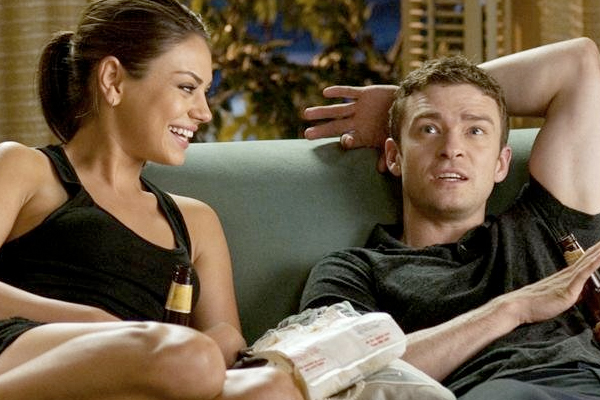

I’m calling lazybones on all the critics who are saying that “Friends With Benefits,” starring Mila Kunis and Justin Timberlake as a couple who seek to get physical without emotional consequences, is almost exactly the same movie as “No Strings Attached,” which came out six months ago and featured Natalie Portman and Ashton Kutcher as blah blah blah. It’s actually almost exactly the same as several other movies too, notably “Going the Distance” with Drew Barrymore and Justin Long, and “Love and Other Drugs” with Anne Hathaway and Jake Gyllenhaal, which in terms of degree of difficulty and actual sex appeal remains the champion of this ill-starred mini-genre (although nobody cared about it then and fewer do now). In fact, “we’re just two adults doin’ it like donkeys” has replaced Mr. Darcy-style misunderstandings as the central rom-com device. Bag the pride and the prejudice; whip out the ribbed condoms.
I’m not sure this great leap forward into sexual postmodernism is enough to save the romantic comedy, at least as long as it remains tied to an inflexible three-act formula with a nebulous happy-ever-after ending, all of it inherited from the 19th-century novel. “Friends With Benefits” is often uproariously and profanely funny, and anchored in high-spirited performances from its central duo, who are well matched as comic foils if oddly lacking in erotic electricity. Fresh off his underappreciated “Easy A,” director and co-writer Will Gluck proves again that he has a terrific sense of comic pacing and manages zinger-laden contemporary dialogue well. Arguably Gluck’s in-jokey sense of his own auteurishness is a little inflated after just two movies (I’m overlooking the execrable guy comedy “Fired Up!”); you might think you’re bad by having Kunis grab an airport-greeting sign marked “O. Penderghast” — a reference to Emma Stone’s “Easy A” character — but I’m on to you, dude.
This is precisely the kind of movie where nobody remembers the characters’ names: Kunis and Timberlake are basically playing themselves, or, more accurately, playing our idea of what they might be like if they were just as hot as they actually are but had real jobs. In fact, Timberlake plays an L.A. Web designer called Dylan and Kunis plays a New York corporate headhunter named Jamie, but it could just as easily be the other way around. (Maybe those names were useful because if the producers wanted to recast the movie as a gay and/or lesbian marriage comedy at the last minute, they didn’t have to change anything.) Both have just gotten dumped in their respective cities and have made separate vows to approach sexual liaisons ruthlessly, “just like George Clooney.” As for relationships, as Dylan observes, they start out “so fun” and then turn into “suck a bag of dicks.” Oscar freakin’ Wilde, I tell ya.
No, seriously, the writing (credited are Keith Merryman and David A. Newman, along with Gluck) is pretty funny, combining just such blunt aphorisms with a convincing degree of pop-culture awareness. Jamie rages against Katherine Heigl for the lies she tells about love (in her movies, that is), and Jamie’s unreliable hippie mom (the always delicious Patricia Clarkson) promises that their upcoming weekend getaway, which never actually happens, will be “just like a Nora Ephron movie.” Timberlake and Kunis do a funny getting-to-know-you scene, early on, where they sit on the couch watching a cheesy romance movie and mocking all the musical cues designed to make you know how to feel at every moment. They’re basically behaving like married people before they’ve even kissed, and they’re also forestalling the inevitable, as is Gluck: Before long “Friends With Benefits” will become exactly the same kind of movie they’re making fun of, relying on whimpery indie folk-rock and shots of people pensively looking out windows to herd you into its emotional corral.
So Jamie and Dylan meet when she recruits him from his groovy online job in L.A. to become the new art director at GQ magazine. (That’s not especially plausible, but I’d describe the depiction of journalism overall in “Friends With Benefits” as funny, superficial and better than average in Hollywood terms.) As we’ve seen, they’re supposedly both open to a little Clooney-style, no-strings FWB recreation, but like almost all movies of this sort — again, I’ll declare a loophole for “Love and Other Drugs” — this movie utterly fails to make the relationship seem convincing. Now, the dance that people have to perform in the corporate world when they’re both professionally enmeshed and profoundly attracted is fertile ground for comedy and drama, at least potentially. It never works all that well here; there’s the stilted and awkward part of the movie where they’re supposed to be chaste, businessy pals, and the slightly less stilted part where they’re having sex but haven’t faced the inevitable denouement.
Timberlake and Kunis have a nice energy when they’re bouncing off each other verbally, Tracy and Hepburn style, but the bouncing off each other physically doesn’t amount to much. I can only imagine that being proclaimed two of the hottest people in show business is a lot to live up to, but for whatever reason this movie that’s so frank and funny so much of the time is both dull and reticent when it comes to the bedroom. Are the nerdy but muscular pop star and the Mediterranean wild child, considered in the abstract, mightily attractive people? Of course, but they’re not quite good enough actors to fake a chemistry that clearly isn’t there, and the movie’s actually sexier in fully clothed rom-com mode. (Many of the sex scenes employ a body double for Kunis or Timberlake or both, and while that’s not what I’m complaining about it definitely doesn’t help.)
Gluck and his collaborators very nearly save the ship from sinking with a crackling script and a cast of completely irrelevant but delightful supporting characters, especially Clarkson (“So, my daughter is just your slam-piece,” she tells Dylan, approvingly) and Woody Harrelson as a macho yet flamboyantly gay editor at GQ. Women are superior to men in every way, he tells Dylan, “yet melikes cock. So I’m strictly dick-ly.” Timberlake’s best acting in the film comes not with Kunis but opposite the great Richard Jenkins, who plays his beloved father sinking into an Alzheimer-type dementia. On the whole, “Friends With Benefits” is a rewarding summer diversion, albeit one that’s fatally torn between what it wants to be — riotous, anarchic and anti-moralistic — and the disappointing wet-blanket formula it reverts to in the end.
