Attack the Block

“Attack the Block”: Aliens in the hood, London-style

In the painfully hip sci-fi comedy "Attack the Block," only a teen gang stands between England and apocalypse

  • more
    • All Share Services

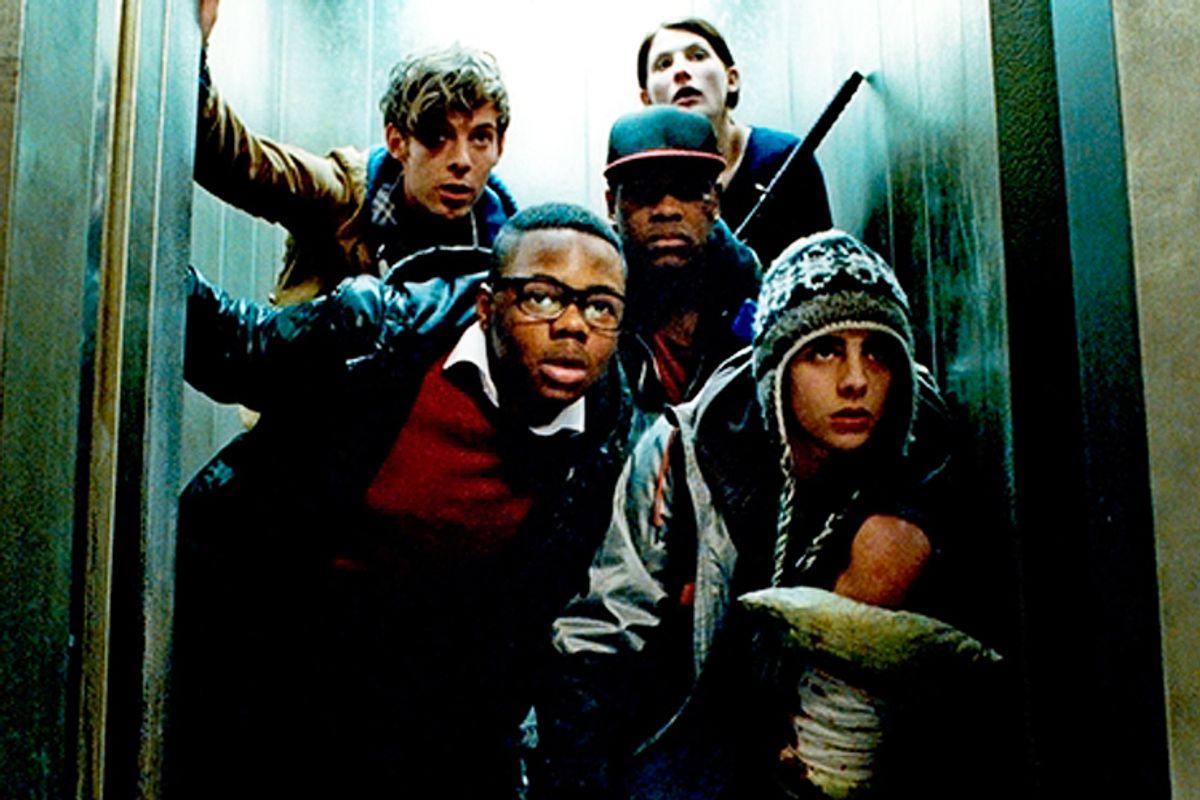
A still from "Attack the Block"

First of all, let’s ack-cent-choo-ate the positive. “Attack the Block” is a British alien-invasion thriller that ingeniously blends two disparate strains of Anglo cinema, or maybe three: working-class realism, social comedy and science fiction. (Calling all geeks: The main location of this film is called Wyndham Tower, and nearby streets are named Huxley and Moore. Discuss.) Ink-black, gorilla-like creatures from outer space descend on a South London “council estate” (aka housing project), which must be defended by a plucky, multi-ethnic crew of its youthful residents, who might hitherto be described as muggers, drug dealers and hoodlums. In fact, I would argue that the snarling alien monsters are a ginormous MacGuffin for first-time writer-director Joe Cornish, whose real agenda is forcing us to shift perspective on the teen gang members, who at first appear threatening and then band together with a woman they robbed a few hours earlier. They are meant, as the movie’s denouement makes rather too clear, to represent a new multicultural, globalized version of Britishness.

At the risk of sounding stodgy and moralistic, I felt ideologically bullied by this aspect of “Attack the Block,” and spent much of the movie actively hoping that Moses (impressive teen actor John Boyega), the gang’s stone-faced leader, would get munched by the furry invaders. Moses and his mates mug and terrorize Sam (Jodie Whittaker), a young nurse who’s coming home late from work, and then deliver a fatal beatdown to the first invader who plummets from the sky, possibly a female or a juvenile. They’ve behaved like sadistic creeps not once but twice, and now we’re supposed to root for them when the aliens bring it for real? Sorry, guys. You could argue that this is taking a bit of low-budget, John Carpenter-style fun too seriously if the blame-society liberal guilt weren’t item No. 1 on Cornish’s agenda (as it sometimes is with Carpenter).

I’ll stop ranting, especially since other people clearly don’t have this reaction to “Attack the Block.” Or rather, I’ll stop ranting after I say that my problem isn’t Cornish’s overt political intentions — I never object to that — but the fact that he fails to sell them convincingly or package them with enough sweetener. If the movie has been massively overhyped in hipsterish movie-insider circles since playing Sundance and SXSW, that really isn’t his fault. And if you’re OK with Moses and his junior posse there’s a lot of cheerful, anarchic humor to be found here.

Much of the enjoyment in Cornish’s script comes from the almost impenetrable Cockney-West Indian-hip-hop lingo spoken by his young characters, which he and the cast apparently worked out together: “I’m shittin’ meself, innit, bruv? ‘Nat same time — dis is sick!” The police are the “five-oh” or the “po-po” or, even less appropriately, “the feds.” Moses is a fount of stern catchphrases, especially his growled “Allow it,” which pretty much means “yes” or “OK” or “word.” When someone suggests hiding in “Ron’s weed room,” Sam the nurse wonders what that is. “It’s a big room full of weed,” explains Brewis (Luke Treadaway), a middle-class student who hangs out in the block in order to acquire the aforementioned herb. “And it’s Ron’s.”

Ron of the weed room is in fact played by Brit-comedy veteran Nick Frost, which is as close as “Attack the Block” gets to a movie star. Boyega stands out in the crowded cast of teenage newcomers — many of them recruited from the neighborhood seen in the film — along with Alex Esmail as a motormouth known as Pest, Leeon Jones as the bespectacled good kid Jerome, and Jumayn Hunter as a genuinely terrifying drug lord named Hi-Hatz. These guys take on the aliens with a mix of improvised weapons, BMX bikes, mopeds and parkour moves, and it’s reasonably good fun even if Cornish’s action scenes are just above mediocre. As I’ve made clear, “Attack the Block” hovers in that uneasy zone between eager-beaver likability and trying way too hard to be cool, but it captures its gritty setting with unusual affection. Science-fiction buffs seeking a change of pace and fans of British pop culture shouldn’t miss it.

“Attack the Block” is now playing in Chicago, Los Angeles, New York, San Francisco, Seattle, Toronto and Austin, Texas, with wider release to follow.

Hollywood’s summer of revolution

"Rise of the Planet of the Apes" and other hits build upon the rage of the oppressed underclass

  • more
    • All Share Services

Hollywood's summer of revolutionA still from "Rise of the Planet of the Apes"

Our oppressed underclass rises up and rebels against inhuman treatment — well, at least in some of Hollywood’s biggest current blockbusters.

While Tim Burton’s 2001 “Planet of the Apes” remake didn’t seem to have much on its mind, “Rise of the Planet of the Apes” is far more engaged with the culture of the moment — as was the original, widely seen as a response to the civil rights movement. It’s the only recent American film with even metaphorical relevance to the Arab Spring movement. And it shares some interesting resonance with Tate Taylor’s “The Help” and British director Joe Cornish’s “Attack the Block.”

“The Help” falls into a long line of “problem pictures” running from Elia Kazan’s “Gentleman’s Agreement” and “Pinky” to Paul Haggis’ “Crash.” They’ve proven popular with Oscar voters, but while they purport to expose racism and other prejudices, they often subtly reinforce stereotypes in the guise of dismantling them. Whatever their virtues (usually as showcases for actors), such films tend to suffocate on their own earnestness. That can’t be said for “Rise of the Planet of the Apes,” which falls into another tradition. It’s no B-movie, but it moves along like one. Its depiction of the fine line between humanity and the animal kingdom owes a lot to George Romero’s “Living Dead” trilogy and David Cronenberg’s films. Genre films benefit from being irresponsible, which I mean in the most positive sense. By talking about animals and monsters rather than speaking more directly about race and class, they have the freedom to escape from received wisdom about the latter subjects.

Scientist Will Rodman (James Franco) injects several chimps with a wonder drug he believes has the potential to cure Alzheimer’s, a disease his father, Charles (John Lithgow), suffers from. He adopts the baby of a chimp named Bright Eyes, who was killed in a rampage through his bosses’ offices. Charles names the chimp Caesar. Caesar proves to be quite smart, and Charles, after receiving injections of his son’s drug, recovers from Alzheimer’s. However, this happy state of affairs doesn’t last.

Last month also brought the release of a film dealing directly with the civil rights struggle: “The Help.” If “Rise” can be seen as an allegory of the struggles of people of color. “The Help” offers up saintly heroes and easily identifiable villains. No human with any power in “Rise of the Planet of the Apes” is as benign as “The Help’s” white heroine, writer Skeeter (Emma Stone). The African-Americans in “The Help” need her to teach them how to express their anger, with the exception of one maid who serves her former boss a pie made of shit. (The film refers back to this scatological moment obsessively.) It concludes with a fired maid (Viola Davis) deciding to follow in the footsteps of Skeeter, whose book is appropriated from her experience, and become a professional writer, a far cry from the insurrection and mad rush to freedom that close “Rise of the Planet of the Apes.” The kindest interpretation one could place on “The Help” is that it depicts the very early beginnings of a revolt.

“Attack the Block” hit American screens a few short weeks ahead of the riots that tore up England. It’s full of the rage underpinning them, sharing a populist skepticism of authority with “Rise of the Planet of the Apes.” It shows an alien invasion landing in a housing project laden with drugs and guns, and its main narrative arc shows how its gangsta protagonists, who mug a woman in its opening scenes, swerve from being antiheroes to heroes. To them, aliens may be just one of the Man’s tools against poor people, like crack and the widespread availability of weapons, and the police are more of a threat than protection. The alien invasion brings its characters together across gender and racial barriers as they have to protect themselves. It showcases the vibrant, multiracial but violent British urban culture reflected in grime and dubstep music that is missing from most of the British films Americans get to see. While it deals more bluntly with race and class than “Rise,” it uses the metaphor of an alien invasion to address these subjects in fresh ways.

The environmentalism of “Rise of the Planet of the Apes” isn’t particularly new; as critic Manohla Dargis has pointed out, the ’70s brought us disaster films about all kinds of mutant animals. What’s different this time around is the frank misanthropy with which Wyatt indulges it. Caesar’s time in a primate center doesn’t seem much different from a particularly run-down jail. Through bars, he’s fed slop that looks like vomit. He gets to see the worst of the human race, and only the most cold-hearted people would side with us. These scenes don’t go as far as the images of real-life experimental chimp Nim Chimpsky in a hepatitis vaccine lab in James Marsh’s documentary “Project Nim” (released earlier this year), but they justify Caesar’s anger. In a key moment, an orangutan tells Caesar (via sign language) “human no like smart ape.” The film’s action bears this out.

The original “Planet of the Apes” series cast actors in makeup and costumes. “Rise of the Planet of the Apes” uses elaborate CGI instead. Wyatt seamlessly integrates computer-generated apes into real locations. The film wouldn’t have such pull if there wasn’t an element of recognizable reality behind it. It seems to be taking place in our world, not a distant futuristic construct.

“Rise” never idealizes Will, a nice guy whose actions show the limits of liberal good intentions. Initially, he refuses to take care of Caesar and only does so when told that the chimp will be killed otherwise. The two develop a real bond, and the first third of the film is genuinely sweet. However, after Caesar attacks a neighbor arguing with Charles, Will is forced to send Caesar to a primate center. He makes empty promises to free him. By the time he’s finally in a position to do so, Caesar prefers the company of ape society. Worst of all, Will’s “wonder drug” turns out to be deadly to people.

As of the time of this writing, “Rise of the Planet of the Apes” has grossed $160 million in the U.S. It’s gotten mainstream audiences to embrace a startling degree of schadenfreude, cheering on the demise of their on-screen counterparts. It encourages the spectator to recognize that if another intelligent species were to emerge, they would be horrified by our treatment of animals. No doubt some of the film’s audience would reject such an argument if it were stated directly by an animal rights activist or environmentalist, but the filter of metaphor makes it far more palatable. “Rise of the Planet of the Apes” ends with a successful rebellion of the apes, hinting at a full-fledged revolution to come in the sequel. Could Hollywood — or even Indiewood — imagine such an uprising with people in place of apes? You might have to turn to the Egyptian documentary “Tahrir,” about to play the fall film festivals, for its real-life equivalent.

Continue Reading Close

Steve Erickson's new novel, "The Sea Came in at Midnight," will be published next spring by Bard/Avon.