Democratic Party
Democratic politics in a nutshell
Report: Dems don't worry about angry liberals -- they'll just scare them into submission with pictures of Bachmann
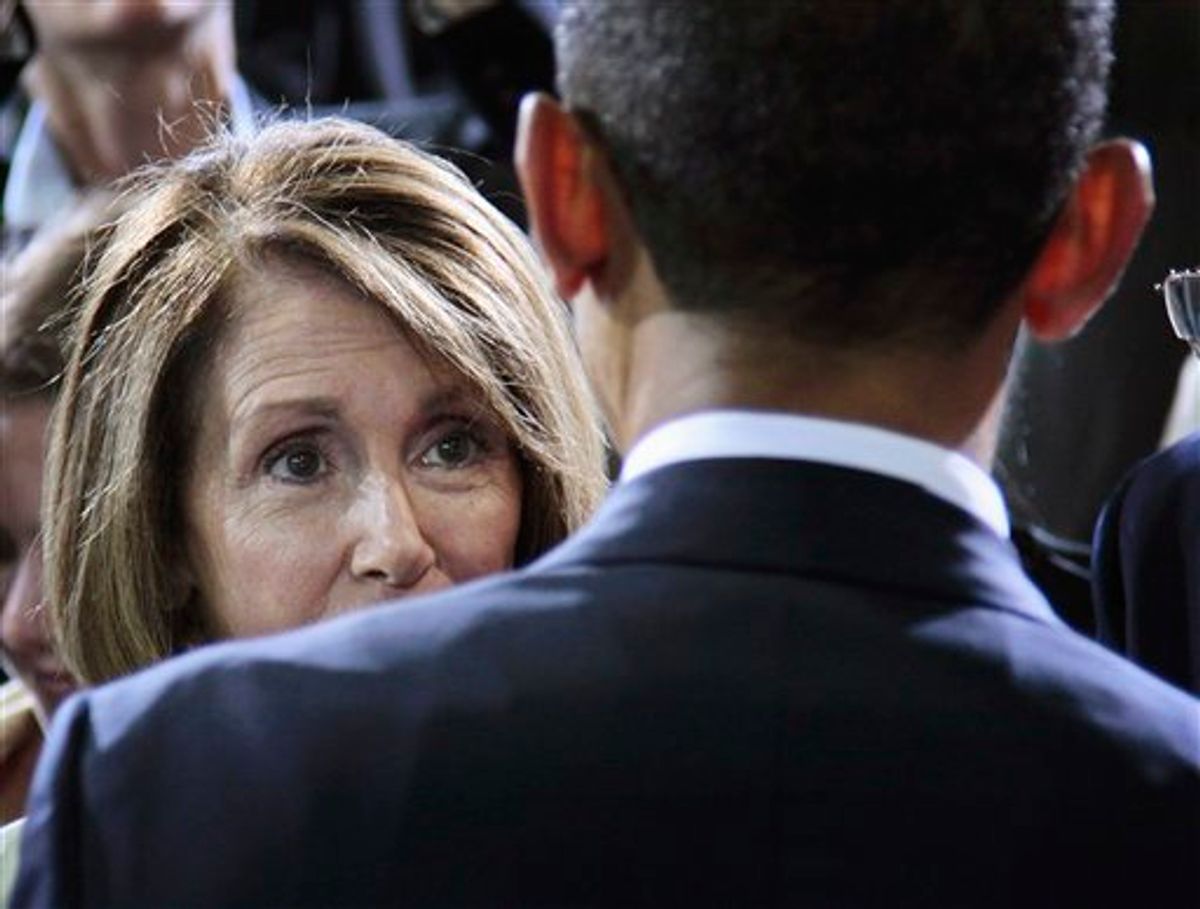
President Barack Obama speaks with House Minority Leader Nancy Pelosi of Calif., at the Washington Convention Center in Washington, Friday, July 29, 2011, after delivering remarks on improved Fuel Efficiency Standards for cars and light trucks. (AP Photo/Pablo Martinez Monsivais)(Credit: AP) Let’s begin by taking note of three facts:
(1) Three days ago, Democratic Rep. John Conyers, appearing at a meeting of the Out of Poverty caucus, said: “The Republicans — Speaker Boehner or Majority Leader Cantor — did not call for Social Security cuts in the budget deal. The President of the United States called for that” (video here, at 1:30);
(2) The reported deal on the debt ceiling is so completely one-sided — brutal domestic cuts with no tax increases on the rich and the likelihood of serious entitlement cuts in six months with a “Super Congressional” deficit commission — that even Howard Kurtz was able to observe: “If there are $3 trillion in cuts and no tax hikes, Obama will have to explain how it is that the Republicans got 98 pct. of what they wanted,” while Grover Norquist, the Right of the Right on such matters, happily proclaimed: “Sounds like a budget deal with real savings and no tax hikes is a go.”
(3) The same White House behavior shaping the debt deal — full embrace of GOP policies and (in the case of Social Security cuts) going beyond that — has been evident in most policy realms from the start. It first manifested in the context of Obama’s adoption of the Bush/Cheney approach to the war on civil liberties and Terrorism, which is why civil libertarians were the first to object so vocally and continuously to the Obama presidency, culminating in this amazing event from mid-2010: “Speaking at a conference of liberal activists Wednesday morning, ACLU Executive Director Anthony Romero didn’t mince his words about the administration’s handling of civil liberties issues. ‘I’m going to start provocatively . . . I’m disgusted with this president,’ Romero told the America’s Future Now breakout session.”
In other words, a slew of millionaire politicians who spent the last decade exploding the national debt with Endless War, a sprawling Surveillance State, and tax cuts for the rich are now imposing extreme suffering on the already-suffering ordinary citizenry, all at the direction of their plutocratic overlords, who are prospering more than ever and will sacrifice virtually nothing under this deal (despite their responsibility for the 2008 financial collapse that continues to spawn economic misery). And all of this will be justified by these politicians and their millionaire media mouthpieces with the obscenely deceitful slogans of “shared sacrifice” and ”balanced debt reduction” – two of the most odiously Orwellian phrases since ”Look Forward, not Backward” and ”2009 Nobel Peace Prize laureate” (and anyone claiming that Obama was involuntarily forced by the “crazy” Tea Party into massive budget cuts at a time of almost 10% unemployment: see the actual facts here).
With those fact assembled, this morning’s New York Times article — headlined: “Rightward Tilt Leaves Obama With Party Rift” — supplies the perfect primer for understanding Democratic Party politics. The article explains that “Mr. Obama, seeking to appeal to the broad swath of independent voters, has adopted the Republicans’ language and in some cases their policies,” and then lists numerous examples just from the debt debate alone (never mind all the other areas where he’s done the same):
No matter how the immediate issue is resolved, Mr. Obama, in his failed effort for greater deficit reduction, has put on the table far more in reductions for future years’ spending, including Medicare, Medicaid and Social Security, than he did in new revenue from the wealthy and corporations. He proposed fewer cuts in military spending and more in health care than a bipartisan Senate group that includes one of the chamber’s most conservative Republicans. . . .
But by this month, in ultimately unsuccessful talks with Speaker John A. Boehner, Mr. Obama tentatively agreed to a plan that was farther to the right than that of the majority of the fiscal commission and a bipartisan group of senators, the so-called Gang of Six. It also included a slow rise in the Medicare eligibility age to 67 from 65, and, after 2015, a change in the formula for Social Security cost-of-living adjustments long sought by economists.
How can the leader of the Democratic Party wage an all-out war on the ostensible core beliefs of the Party’s voters in this manner and expect not just to survive, but thrive politically? Democratic Party functionaries are not shy about saying exactly what they’re thinking in this regard:
Mark Mellman, a Democratic pollster, said polling data showed that at this point in his term, Mr. Obama, compared with past Democratic presidents, was doing as well or better with Democratic voters. “Whatever qualms or questions they may have about this policy or that policy, at the end of the day the one thing they’re absolutely certain of – they’re going to hate these Republican candidates,” Mr. Mellman said. “So I’m not honestly all that worried about a solid or enthusiastic base.”
In other words: it makes no difference to us how much we stomp on liberals’ beliefs or how much they squawk, because we’ll just wave around enough pictures of Michele Bachmann and scare them into unconditional submission. That’s the Democratic Party’s core calculation: from “hope” in 2008 to a rank fear-mongering campaign in 2012. Will it work? The ones who will determine if it will are the intended victims of that tactic: angry, impotent liberals whom the White House expects will snap dutifully into line no matter what else happens (even, as seems likely, massive Social Security and Medicare cuts) between now and next November.
Follow Glenn Greenwald on Twitter: @ggreenwald. More Glenn Greenwald.
Senate Democrats heroically fund TSA
Democrats score the dumbest political victory of 2012
(Credit: Reuters/Frank Polich) On Tuesday, a Senate Appropriations Committee vote effectively highlighted everything that is stupid about politics.
The Transportation Security Administration, a universally loathed government agency, is facing a shortfall, despite its more than $8 billion budget. Instead of having a debate over what effective airport security might actually look like and how much should reasonably be spent on the honestly rare threat of commercial-air-travel-based terrorism, there was a debate over how best to come up with the money needed for all the radioactive naked picture machines and bomb-sniffing dogs. The Democrats suggested passing on the cost of ineffective, cumbersome and intrusive security theater to citizens, via higher fees on airfares. The Republicans, even more predictably, suggested cutting spending that directly helps poor people to ensure there is enough to spend on stopping imaginary future 9/11s.
Continue Reading Close
Alex Pareene writes about politics for Salon and is the author of "The Rude Guide to Mitt." Email him at apareene@salon.com and follow him on Twitter @pareene More Alex Pareene.
The Democratic Senate might just survive
A Senate map that looked bleak a year ago is now littered with surprise pick-up opportunities
Charles Schumer and Harry Reid (Credit: Reuters/Jonathan Ernst) The growing likelihood that Richard Lugar will lose next Tuesday’s Indiana Republican Senate primary is the latest in a string of unexpected developments that have bolstered Democrats chances of hanging on to the Senate.
As I wrote yesterday, Lugar’s conservative primary challenger, state Treasurer Richard Mourdock, lacks the incumbent’s broad cross-partisan appeal and is closely identified with Tea Party-flavored Republicanism. Democrats, meanwhile, are poised to nominate Joe Donnelly, a moderate third-term congressman who defied the odds to hold onto his seat in the GOP tide of 2010. Mourdock would still probably be the favorite over Donnelly in the fall, just because of Indiana’s red tint, but the seat would be in play – something that would never be the case with Lugar as the GOP nominee.
Continue Reading Close
Steve Kornacki writes about politics for Salon. Reach him by email at SKornacki@salon.com and follow him on Twitter @SteveKornacki More Steve Kornacki.
Dems desert the left
Why aren't Democratic candidates for Senate promoting liberal causes on their websites?
Victories in two Pennsylvania House districts over two conservative Democrats who voted against healthcare reform gave liberals something to cheer about this week. And they’re quite right to focus on primary elections: Nomination contests are really fights over who will control the political parties. And yet liberals appear to be missing some major opportunities to influence the next round of Democratic senators, just when they have the chance to do so. A look at the websites of the 10 Democratic candidates most likely to become U.S. senators reveals that few of them are interested in several of the issues that have been the hallmark of liberal activism and often frustration during the Obama years: marriage equality, a public option on healthcare, filibuster reform and civil liberties.
Continue Reading CloseJonathan Bernstein writes at a Plain Blog About Politics. Follow him at @jbplainblog More Jonathan Bernstein.
All for none and none for all
Forty years of culture wars and racial battles wrecked the country and the GOP – but it's not too late to change
(Credit: AP Photo/Gregory Bull) My March 4 post “What’s the matter with white people?” was Salon’s top story that week, and it got a lot of comments and online attention. I went on vacation a few days later, but I’ve wanted to address a few arguments, if belatedly.
I asked “What’s the matter with white people?” because my people are increasingly coming under fire from the right and the left. Republicans have begun to blame not the economy but “dependency” on government and rising rates of single parenthood for the economic troubles of the white working class. On the left, meanwhile, whites are dismissed as the backward base of the increasingly radical GOP, and working class whites, in particular, are derided as racists who won’t vote for Democrats because the party is now led by a black man (ignoring the fact that a larger share of working class whites voted for Barack Obama than for Caucasians John Kerry, Al Gore or Bill Clinton.)
Continue Reading CloseJoan Walsh is Salon's editor at large. More Joan Walsh.
The economic story Obama must tell
We need government investment to restore prosperity. The president needs to explain that in a way that makes sense
(Credit: AP Photo/Susan Walsh) Look at it this way: If the Wall Street banking crisis had taken place in 2007 instead of 2008, George W. Bush wouldn’t be able to leave home without being jeered. (As it is, he rarely leaves Texas.) Hardly anybody would buy the brand of tycoonomics GOP presidential candidates are selling. People would understand that save-the-millionaires tax cuts and deregulation had dramatically failed. President Obama would get more credit for pulling the economy out of a nose dive.
Alas, people have short attention spans and a weak understanding of abstract economic issues. You have to tell them a story. The failure of policymakers to do that has been driving progressive MVP Paul Krugman crazy. How can it be, he asks, that governments foreign and domestic are repeating the mistakes of the early 1930s — slashing government spending to reduce budget deficits, putting more people out of work, reducing demand, and inadvertently increasing deficits? Rinse and repeat.
Continue Reading CloseArkansas Times columnist Gene Lyons is a National Magazine Award winner and co-author of "The Hunting of the President" (St. Martin's Press, 2000). You can e-mail Lyons at eugenelyons2@yahoo.com. More Gene Lyons.
Page 1 of 165 in Democratic Party