Norway

Norway’s right-wing on defensive after attacks

Country's Progress Party tries to distance itself from former member Anders Behring Breivik

  • more
    • All Share Services

Topics:

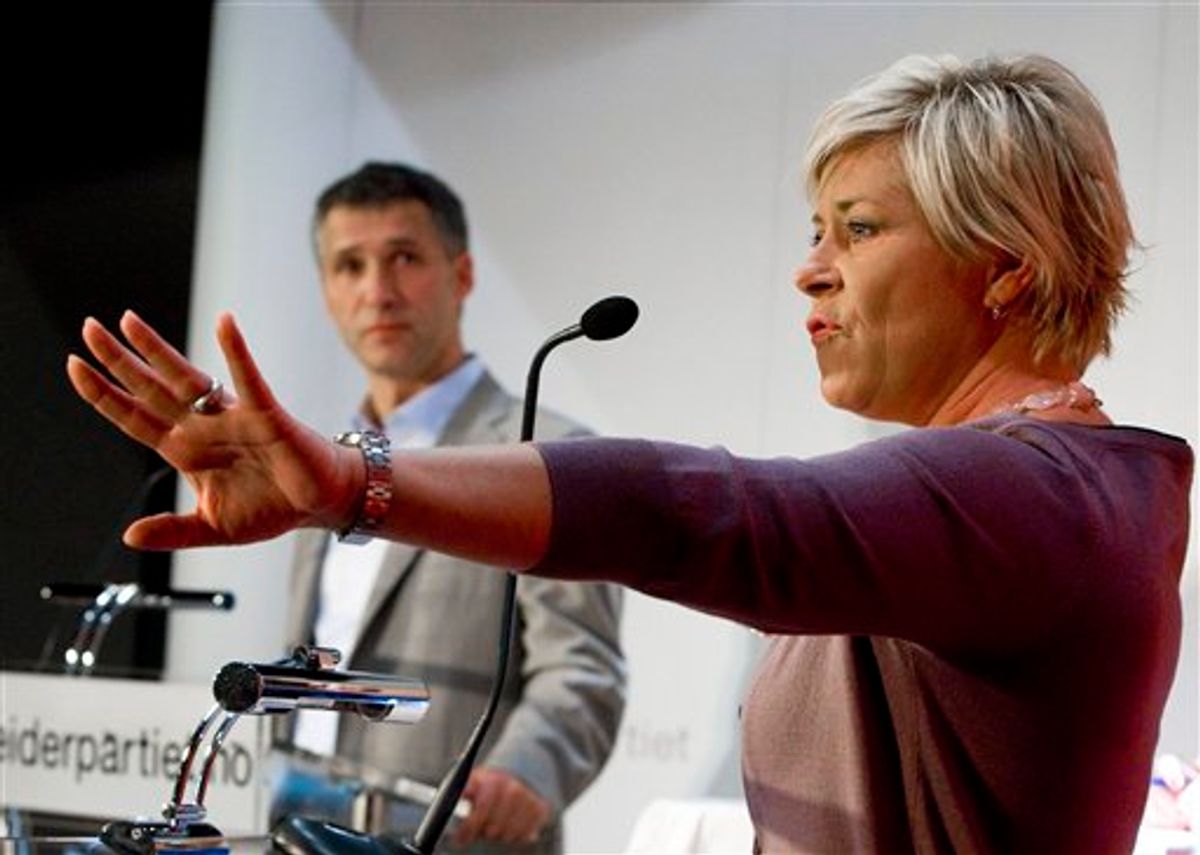
Norway's right-wing on defensive after attacksFILE - In this Sunday Sept. 14, 2009 file photo Siv Jensen, leader of Norwegian Progress Party, right, speaks during a last pre-election debate watched by Norway's Prime Minister and leader of the Norwegian Labour Party, Jens Stoltenberg in Oslo, Norway. The leader of Norway's right-wing Progress Party calls former member Anders Behring Breivik's anti-Muslim views "perversely unique" and not in any way linked to her party. Jensen told AP on Tuesday Aug. 2, 2011 he kept a low profile and never revealed his murderous plans: "It was impossible for us to forsee at the time. He obviously changed in recent years without anyone knowing." She resents being linked to Breivik's views, noting he condems "all political parties in Norway, mine included, because he feels that we are all responsible for what he feels is the wrong development of Norway and Europe." (AP Photo Heiko Junge / Scanpix Norway) ** NORWAY OUT **(Credit: Associated Press)

Warning voters about the danger of increasing Muslim influence in Norway, the Progress Party rode a wave of anti-immigrant feeling and took nearly a quarter of the seats in parliament in the country’s last election.

Now one of Europe’s most successful right-wing parties is on the defensive after one of its former members massacred 77 people in the name of fighting immigration.

The Progress Party has confirmed that Anders Behring Breivik, the confessed perpetrator of last month’s massacre, was a member between 1999 and 2006. That has focused intense criticism on its platform of sharply cutting the immigration that is changing Norway’s once virtually homogenous population of white Christians.

“They have to change their tone,” said Magnus Takvam, a political commentator for Norwegian public broadcaster NRK. “They have to reconsider their vocabulary.”

Progress Party leader Siv Jensen has been criticized for warning of a stealth Islamization of Norway. And in May, the party’s leader in Oslo called the governing Labor Party’s immigration policy a “demographic experiment” and said a left-wing political elite was allowing Western civilization to be eroded by Muslim immigrants with opposing values.

Breivik also condemned leftists for their tolerant attitude towards immigrants from the Muslim world, but Jensen, 42, noted that he condemned all of Norway’s political parties, “mine included,” in the rambling 1,500-word manifesto he released before the massacre.

Breivik, 32, says he grew disillusioned with the party and concluded that the only way to stop what he called the “Islamization” of Norway and Europe was through armed struggle. Breivik has confessed to the twin terror attacks — a bombing of Oslo’s government quarter and a shooting rampage at a Labor Party youth camp — that killed 77 people.

“He has obviously developed some very, very strange, sick ideas over the years,” Jensen told The Associated Press. “His manifesto is perversely unique and cannot be linked to any organization or legal political party of Norway.”

First elected into Parliament in 1973, the Progress Party has steadily gained support for its calls to sharply cut immigration and lower taxes, primarily by spending more of Norway’s oil revenue now, instead of saving it for future generations.

No longer a maverick opposition group, the Progress Party now boasts support that few of its counterparts in Europe can match. It won 41 of the 169 seats in Parliament in the 2009 election, its best result ever. Only the Labor Party is bigger, with 64 seats.

But the July 22 terror attacks, which shook Norway to the core, have generated a wave of sympathy for Prime Minister Jens Stoltenberg’s Labor Party, the apparent target of the attacks. Polls show its support surging, ahead of local elections in September.

Jensen said Breivik kept a low profile in the party and never revealed his murderous plans.

“He didn’t say much, he didn’t do much, he didn’t take part in our activities at all,” Jensen told AP in her wood-paneled office decorated with an American flag — a gift from Republicans Abroad — and a tiny bust of President Ronald Reagan. “So we could not foresee any of this.”

In his manifesto, Breivik says he left the Progress Party after concluding “that it would be impossible to change the system democratically.” Describing himself as a defender of Europe’s Christian heritage, he couldn’t accept that once homogenous Norway is now an increasingly diverse nation, where more than 12 percent of the 5 million residents are immigrants or children of immigrants — about half of them from Asia, Africa or Latin America.

The number of Muslims is unclear because people aren’t registered by religious affiliation, but estimates range between 2 percent and 4 percent of the population.

Stoltenberg’s Labor Party embraces the idea of Norway as a multicultural nation, though it doesn’t advocate unfettered immigration.

Stoltenberg has won praise for his statesmanlike demeanor following the attacks, calling for the nation to unite behind its ideals of peace, democracy and tolerance. His expressions of grief for the victims — some of whom he knew — have come across as genuine and heartfelt, and he has personally attended several funerals.

In a speech to Parliament on Monday, Stoltenberg urged all political parties to “choose our words more carefully in the future” in what was seen as subtle criticism of the Progress Party’s rhetoric on immigration.

Jensen didn’t see it that way, saying political leaders of all stripes have at times said something they regret. She suggested that campaigning for the local elections, postponed until mid-August because of the attacks, will be carried out in a less divisive manner than usual.

“I think she should not escape so easily,” said Mehtab Afsar, secretary general of the Islamic Council of Norway, an umbrella group with some 70,000 members. “I think they have to think about what is so attractive in their program that people like Breivik come joining the party.”

Continue Reading Close

Pick of the week: Haunting, gorgeous “Oslo, August 31st”

Pick of the week: "Oslo, August 31st" is a wrenching voyage of discovery in Norway's suddenly trendy capital

  • more
    • All Share Services

Topics: , , , , ,

Pick of the week: Haunting, gorgeous

“Oslo, August 31st” is, as the title suggests, an evocation of one day in the Norwegian capital, as experienced by a troubled young man who’s facing the end of summer and the end of his youth. It’s a marvelously constructed personal journey, both wrenching and bittersweet, whose emotional ripple effects stay with you for days and weeks afterward. While much of international art cinema can seem overly talky or conceptually alien to American viewers, this second feature film from Norwegian director Joachim Trier is a dynamic, even breathtaking visual experience without much dialogue or any philosophical heavy lifting, following the bony, handsome, exceedingly vulnerable Anders (Anders Danielsen Lie) through coffee shops, nightclubs and bodies of water, en route to an ambiguous final destination.

I saw “Oslo, August 31st” last year at Cannes and found it powerfully affecting, but I never would have guessed that this small movie from a small country would have touched an international nerve the way it apparently has. In the wake of a breathless profile of doctor-turned-actor Lie and his supermodel wife, Iselin Steiro, in the New York Times’ style magazine — which made the film sound rather like a fashion accessory, or a handbook to Oslo architecture — I almost feel the need to dial back expectations a little. Yes, there are drugs and dance clubs and traveling shots but, honest to Pete, we’re not talking stylish, scenic, lovable hipster romp here, people. While “Oslo, August 31st” definitely has the dynamism and street-level energy of, say, an early Godard picture, and may indeed leave you eager to visit Norway, it’s first and foremost an intimate tragedy about a likable young man who has wandered off the path of life into some very dark woods, and isn’t necessarily finding his way back.

As in Trier’s equally wonderful first film, the 2006 “Reprise” — I’m pretty much the president of the cult on that one — the director is interested in exploring the existential dark side of Scandinavian social democracy, with its largely homogeneous character and devotion to equal opportunity. When I talked to Trier about that film, which featured Lie and Espen Klouman-Hoiner as a pair of arrogant, doomed aspiring novelists, he observed that in Norway “there are a lot of people with a lot of choices. It sounds wonderful but there’s a darker side to that. Lots of people are not dealing with those choices very well.” Anders in “Oslo, August 31st” is something like the worst-case outcome for Lie’s character in “Reprise”; he’s a guy from a loving, middle-class family who’s got looks, health, intelligence and education, but for unknowable reasons finds himself on the edge of middle age as a penniless, unemployable, supposedly recovering junkie.

Trier and co-writer Eskil Vogt adapted their central premise from “Le Feu Follet,” a 1930s novella about alcoholism by Pierre Drieu La Rochelle, but “Oslo, August 31st” could really be set anywhere at any time. It’s about the painful necessity of adapting to change, every single day that we’re alive, and if we identify with Anders even as we rage against his despair, it’s because every living human has at some point considered the possibility that it’s just too much and the struggle isn’t worth it. Anders is doing well in drug rehab, and has cautiously been granted a one-day leave to visit Oslo friends and apply for a job. But we can tell from the first moments of the film that his agenda is more complicated than that; Anders is in the position of a certain Danish prince, evaluating the reasons for being against the reasons for ceasing to be. (Trier, by the way, is cousin to another famous Dane, “Melancholia” director Lars von Trier, and one could argue their visions of the world are related as well.)

“Oslo, August 31st” runs a lean, mean 95 minutes, and not one second seems unimportant. Anders moves through the streets of Oslo looking for reasons to live and reasons to die, and even though we don’t know those streets as he does, we can tell that they’re haunted with memories and private agonies. The city is dotted with construction cranes and demolition sites, remorselessly regenerating itself while he appears to stand still. Indeed, Anders’ family home will soon be sold, and one of his personal missions is to pay a final visit. (The fluid, poetic cinematography is by Jakob Ihre.) He insults a prospective employer, refuses to make peace with his alienated sister, falls off the wagon — at first tentatively, and then enthusiastically — and leaves increasingly pathetic messages for his lost love, a woman who’s now in New York. (It’s the voice of Steiro, Lie’s real-life spouse.) On the other hand, he flirts with a younger girl who seems affectionate and charming, and who seems to open for him the promise of a new beginning. Their scene together at an Oslo swimming pool that has just closed for the season, so suggestive of both death and rebirth (and, literally, of baptism) is so gorgeous I wanted to cry. OK, I did cry, and that wasn’t the only time.

But none of that, not even the scenes where we feel that Anders is in imminent danger of taking his own life, are quite as painful as his visit with Thomas (Hans Olav Brenner), an old friend and veteran of long literary discussions and booze-and-drug sessions. Thomas has a wife and a kid now, and his vices involve an occasional bottle of beer. In the manner of one-time bohemians who’ve more or less grown up, he’s kind of an ostentatious jerk about it — but then admits to Anders, when they’re alone, that he’s desperately unhappy. Perhaps that’s the “ordinary unhappiness” Freud wrote about, the unhappiness we all have to accept to get from the last day of August into the first day of September, in Oslo or anywhere else. But is that enough? Is that ever enough, for anybody? And can we forgive those who decide that it isn’t?

“Oslo, August 31st” opens this week at the IFC Center in New York, and June 1 at Laemmle’s Playhouse 7 and Laemmle’s NoHo 7 in Los Angeles, with more cities and DVD release to follow.

Continue Reading Close

Breivik: Product of the Internet?

Educated by Wikipedia and World of Warcraft, the Norway mass murderer developed his dangerous philosophy online

  • more
    • All Share Services

Topics: , ,

Breivik: Product of the Internet?Norwegian Anders Behring Breivik appears in court to face terrorism and premeditated murder charges, Oslo, Norway, Monday, April 16, 2012. Breivik, who confessed to killing 77 people in a bomb-and-shooting massacre went on trial in Norway's capital Monday, defiantly rejecting the authority of the court. (AP Photo/Frank Augstein) (Credit: AP)
This article originally appeared on GlobalPost.

OSLO, Norway — Anders Breivik, the Norwegian extremist behind the country’s worst-ever peacetime massacre, spent an entire year immersed in “World of Warcraft,” an online multiplayer fantasy game.

Global Post

He claims to have used the Internet for 70 percent of what he said was 15,000 hours of self-study. And, on the second day of his trial, he admitted that the Knights Templar National and pan-European Patriotic Resistance Movement he claims to represent was “merely a few individuals,” a likely reference to like-minded people he met on Internet forums.

The deaths of the 77 people Breivik massacred in Norway are sadly all too real. But the killer himself looks more and more like a product of the Internet. As prosecutors skillfully drew out details of Breivik’s failed life in the run-up to the attacks, it seemed that from 2006 — when he wound up his business selling fake diplomas and moved in with his mother — Breivik had retreated into an online world.

In the Internet network of anti-Islamic “ultra-nationalists,” he became the vanguard of the resistance, a martyr and patriotic hero. In “World of Warcraft,” meanwhile, he was a Justicar Knight, one of the highest levels a Web warrior can attain.

“I think this case is resting on unexplored areas,” Randi Rosenqvist, a prominent Norwegian psychiatrist, argued before the trial, suggesting Breivik had succumbed to an Internet version of the group thinking, which had, for example, convinced members of post-World War II Germany’s Baader Meinhof gang that it was right to murder political opponents.

“We know about different religious sects, and we know about different political associations, but what about a single man thinking the same things as an organization thinks?” Rosenqvist asked.

“These Internet groups, they are groups in the same way, but previously you had to be in the same place. There is very little academic psychiatry on these types of questions.”

When Breivik engaged in off-line politics, the court heard, he quickly found others recoiling at his extreme views.

“My proposals were slaughtered, so to speak,” he said, of his unsuccessful involvement in Norway’s anti-immigration Progress Party, for which he came a lowly 37th in the list of nominees for a seat on Oslo City Council.

“They sold out on so many principles in order to get into power, that I thought they had thrown out the baby with the bathwater.”

But online, he could follow the writings of anti-Islamic extremists with the exact same ideas, developing an extreme doctrine, which perhaps more face-to-face meetings would have moderated.

Breivik’s strange view of European history since World War II, which sees a liberal, Marxist elite taking control and secretly allowing a Muslim incursion, similarly bears the hallmarks of an Internet autodidact.

Asked by the judge what the main source was for his worldview? His answer was simple: “Wikipedia.”

“I have used Wikipedia the most. The English articles are incredibly rich in information,” he said.

Breivik, a high-school dropout, said the Internet had allowed him to make up for his lack of formal higher education. The Internet, he argued, had opened access to knowledge, so people no longer needed libraries or universities. He added, with unintentionally comic earnestness, that this had yet to be properly “recognized,” forcing him to cite the 15,000 hours of self-study to underline his credentials.

Breivik had admitted to playing “World of Warcraft” “fulltime” for a year between 2006 and 2007, living off his savings from his diploma business.

The killer broke into a broad smile when the prosecutors projected an image of Justicar Andersnordic, his avatar from “World of Warcraft,” on the screen.

Prosecutors barely needed to point out the parallels to “Knight Justicar,” the title Breivik claimed to hold in a real-life Knights Templar National and pan-European Patriotic Resistance Movement.

“World of Warcraft,” a massive multiplayer online fantasy game, has more than 10 million users, giving its fantasy universe a population more than twice that of Norway’s.

In its universe of wizards, monsters, knights and heroes, players collaborate to complete violent missions, and are rewarded by reaching higher levels in the hierarchy.

It was in the game, said Sean O’Callaghan, an academic at Britain’s University of Lancaster, that Breivik sourced key elements of his bizarre belief system.

O’Callaghan, who has studied other groups projecting themselves as new incarnations of the Knights Templar, said it was an example of an increasingly common “hyper-real” fusion of fantasy and religion.

“Breivik, far from retreating into fantasy, was actually, in my opinion, utilizing fantasy to construct his own fantastical Templar-based politico-religious worldview,” O’Callaghan said. “The fact that he homed in on one particular character in ‘World of Warcraft,’ Justicar Andersnordic, and seems to have constructed a persona based on this character, is an example of a fundamental trend within hyper-real spiritual movements.”

On Wednesday, Thomas Hylland Eriksen, a sociology professor at Oslo University who Breivik’s lawyers have called as a witness, said Breivik had lost the ability to distinguish between the game and reality.

“I think one factor which hasn’t been taken sufficiently into account is his obsession with a certain kind of computer game and his way of using the Internet in order to create for himself a kind of alternative reality. … He does not seem to be very successful in distinguishing between the virtual reality of ‘World of Warcraft’ and other computer games, and reality,” said Eriksen.

In the court, Breivik has referred to the Knights Templar as a “glossy,” “grandiose” or “pompous” version of a group with a real existence.

The manifesto Breivik released on the day of his attacks already presents the group as only half-real, describing how “a fictional resistance group is emerging … to prevent an alleged future Muslim takeover.”

The Knights Templar, he goes on, is this “hypothetical fictional group,” which would wreak its vengeance on the ”enablers” or the so-called “cultural Marxist/multiculturalist” elites.

As the third day of a masterful cross-examination by prosecutor Inga Engh came to an end, Breivik was visibly uncomfortable as he tried to explain the exact status of the group.

“Your intention is to try to sow doubt about whether this network exists,” he protested, sweating. “That is your motive, that is your purpose.”

“That is clear, and we said that from the outset,” Engh responded.

If the Knights Templar network is indeed a fantasy Breivik concocted from Wikipedia, “World of Warcraft” and his own imagination, he’ll be lucky to get through the end of the week’s cross examination without his make-believe world crumbling.

Continue Reading Close

The trippiest martial arts movie ever?

"Norwegian Ninja" is a hallucinogenic reinterpretation of Scandinavian history -- and it is utterly awesome

  • more
    • All Share Services

Topics: , , ,

The trippiest martial arts movie ever?A still from "Norwegian Ninja"

When you review straight-to-DVD movies, you see a lot trailers built around Kimbo Slice fighting Rampage Jackson in a cage intercut with shaky cam footage of strippers working the pole. But every so often I run across one full of nothing but sheer, unadulterated WTF. If trailers like these are the precious metals of the video world, then the one for “Norwegian Ninja” is pure gold valued at nearly $1,900 an ounce.

In a little under two minutes, the “Norwegian Ninja” trailer combines the Scandinavian martial arts madness that the title suggests and footage of miniatures set ablaze with flames that look like they’re coming out of a Zippo lighter. And there are crazy-looking amphibious assault vehicles and sheep — lots and lots of sheep — and a synth score that resembles the repetitive triumphalist theme to the Chuck Norris epic “Delta Force,” only more somber and European. “Be one of us,” a stern blond man wearing glasses and a black karate uniform urges, “Be a Ninja.” I am so there.

With “Norwegian Ninja,” first-time writer-director Thomas Cappelen Malling somehow, against all odds, delivers a film that’s even stranger than its boffo trailer suggests. Malling bases his hallucinatory mishmash on the biggest case of espionage and treason in his country’s history. Arne Treholt was a Norwegian diplomat who was busted for passing secrets to the Soviets in 1984, but here he is reimagined as the patriotic commander of a crack team of ninjas dedicated to guarding “the Norwegian way of life.”

“No one will occupy us,” the heroic Treholt vows through subtitles, “neither Russians nor Americans.”

As it turns out, protecting Norway’s “sovereignty and self-sufficiency” seems to involve lots of philosophical discussions held around campfire barbecues, all in an island compound that looks like a petting zoo and is protected by Feng Shui. “System disharmony halts the flow of energy, slowing down intruders with illness and bad luck,” Treholt explains. When the ninjas do go out on missions to find marauding Russian subs or stop oil derricks from blowing up, they always seem to come up short. Mads Ousdal of Norway’s National Theater holds the lunacy together by playing Treholt with utter seriousness — even when he’s appearing and disappearing in puffs of smoke like a low-rent magician or flicking cigarettes into his mouth with action hero aplomb.

Squaring off against Treholt is Hans Otto Meyer (Jon Øigarden), another shadowy figure lifted from the annals of Norwegian conspiracy theories. Here, as well as certain corners of Wikipedia, Meyer works for Stay Behind, a CIA-backed covert op that stages train station bombings in Italy and other acts of terror all around Europe, and then blames it all on Soviet partisans to get these countries to allow U.S. bases on their soil. “Would you kill one person to save a thousand?” the Stay Behind field manual reads during a sequence of visual exposition. “Then you’d kill 4,500 to save all of Norway,” is the grim answer. Meyer even resembles G. Gordon Liddy and has a framed 8×10 of Ronald Reagan on his desk as he plots plane crashes and sabotage to “scare voters into the lap of the powers that be” and demands “war against an innocent scapegoat.”

The influence of Wes Anderson’s kooky visual and storytelling style is undeniable here (especially “The Life Aquatic with Steve Zissou”), but the seriousness of “Norwegian Ninja’s” source material has it sharing common, albeit less bloodstained, ground with Tarantino’s “Inglorious Basterds” (2009). While Tarantino clings to the “Dirty Dozen” paradigm of a band of gun-toting sociopaths shooting their way to freedom, Malling shows its absurdity by infusing the mundane and somber world of espionage with ridiculous amounts of hyper-macho super spy mythos. The real Treholt was just a bureaucrat attempting to pass some folders pulled from a ubiquitous gray file cabinet to other bureaucrats over a brunch of sausages. In the end, he was apprehended by airport police.

To illustrate his point, Malling intersperses scenes of ninja ass-kicking with old television news reports on the real Treholt and Meyer. And while this may be a silly movie, this disregard for nationalistic masculine fantasy goes at least a short way towards explaining Norway’s sober response to the recent massacre. After the attacks, Norwegian Prime Minister Jens Stoltenberg called for “more democracy, more openness and greater political participation” — a stark contrast to American politicians’ response to 9/11.

“A real ninja wins without fighting,” the fictional Treholt tells us in between explosions that look like sparklers. Now there’s a piece of chop-socky zen to think about.

Continue Reading Close

Bob Calhoun is a California freelance writer who specializes in rock 'n' roll, martial arts and Hollywood stuntmen.

Pamela Geller and Robert Spencer fundraise on Norway attack

America's most virulent anti-Islam bloggers continue attacking all Muslims, accuse terror victims of anti-Semitism

  • more
    • All Share Services

Topics: , , ,

Pamela Geller and Robert Spencer fundraise on Norway attackRobert Spencer and Pamela Geller

As a writer, it sure sucks when someone murders a bunch of people based on your ideas. (I mean, I assume that sucks. Weirdly, it’s never happened to me.) So you can understand why right-wing anti-Islam bloggers are all being kind of defensive, these days.

Anders Breivik, the anti-Islam terrorist who killed 77 people in Norway on July 22, read a lot of American anti-Islam bloggers, many of whom he cited in his lengthy manifesto. Breivik’s favorites included Robert Spencer, a self-proclaimed expert on Islam whose “Jihad Watch” blog was quoted and cited in Breivik’s manifesto, and Spencer’s ally and collaborator Pam Geller, whose “Atlas Shrugs” was similarly recommended by the killer.

So some people have been like, “hey, wow guys, a crazy person took everything you write so seriously that he murdered a bunch of people, in the name of protecting his nation from the creeping ‘Islamization’ of Europe that you guys constantly crow about, maybe you guys should stop and think for a minute about the horrible, hateful things you all write, all the time.” And Spencer and Geller have basically screeched back, “CENSORSHIP!!!!!”

They are now actually fundraising on the fact that they helped inspire a massacre. Or more accurately, they’re begging for money to protect them from the imaginary witch hunt that they claim the liberals will mount. (Is this part of the witch hunt? I am always confused about whether I’m witch-hunting or not, when I call people horrid hateful bigots.) Spencer also signed Geller’s fundraising blog, and if you donate more than $500 to Atlas Shrugs, ThinkProgress reports, they will send you a signed copy of Geller’s book, “Stop the Islamization of America: A Practical Guide to the Resistance.” (I assume a coordinated terror attack against radical Islam’s liberal enablers is written off in the pamphlet as impractical.)

People are not responsible for what crazy people do after reading their blog posts for years, obviously (though inciting fear of and hatred for ethnic and religious minority groups tends to be the sort of speech with the bloodiest track record), and Pamela Geller never called on anyone to go out and murder some liberals, to save us from the Islamists. But she has now stopped just short of justifying the attacks, after the fact!

Adam Serwer notes the strong ‘they had it coming’ vibe in Geller’s latest on Norway. From Geller’s post:

But the more that is revealed about that youth indoctrination center, the more grotesque the whole story becomes. Of course, the genocidal leftists will twist what I write here; I am not condoning the slaughter in Norway or anywhere. I abhor violence (except in regard to self defense). But the jihad-loving media never told us what antisemitic war games they were playing on that island. Utoya Island is a Communist/Socialist campground, and they clearly had a pro-Islamic agenda.

Only the malevolent media could use the euphemism summer camp and get away with it.

The slaughter was horrific. What these kids were being taught and instructed to do was a different kind of grotesque. There is no justification for Breivik’s actions whatsoever. There is also no justification for Norway’s antisemitism and demonization of Israel.

Those are pretty perfunctory disclaimers against violence. Those dead people clearly had a pro-Islamic agenda! “Antisemitic war games” makes the victims sound like … soldiers preparing to attack Israel, making violence against them conceivably an act of “defense of Israel,” which is, of course, a justification for violence that in Geller’s world is indistinguishable from “self-defense.”

It may surprise you to learn that Geller feels any shame, ever, but she did delete the blatantly racist photo caption that originally accompanied the post. The faces of the camp attendees look, to Geller, “more Middle Eastern or mixed than pure Norwegian.” (!) In other words: I abhor violence, but these pro-Islamofascist soldiers were being trained by the Commie-Nazis to destroy Israel, also they look sorta Arab, right?

So! Please remember how horribly these guys are reacting to what should be a moment of shameful self-reflection for them, the next time you see them cited in some newspaper editorial or interviews on Fox or something.

Continue Reading Close
Alex Pareene

Alex Pareene writes about politics for Salon and is the author of "The Rude Guide to Mitt." Email him at apareene@salon.com and follow him on Twitter @pareene

Where’s the outrage in Norway?

We look at why Norwegians aren't searching for a scapegoat after Breivik's massacre

  • more
    • All Share Services

Topics: , ,

Where's the outrage in Norway?People hold up flowers as they take part in a memorial march for the victims of the killing spree and bomb blast in downtown Oslo

OSLO, Norway — In Anders Behring Breivik’s sickest fantasies, he never dreamed he’d be able to blow up downtown Oslo, sail smoothly in a fake police uniform to Utoya island and have 87 unhindered minutes to slaughter his teenage targets.

Even Breivik, on a drug-fueled mission to destroy everything his country stands for, had faith in Norwegian law enforcement. “He was surprised that he reached the island,” Breivik’s attorney Geir Lippestad told a news conference. “He was expecting to be stopped earlier by the police or someone else during the actual day…. He thought he would be killed after the bombing.”

It’s widely reported that traumatized survivors of the massacre screamed “Why didn’t you come earlier?” when police finally did arrive on Utoya, 58 minutes after they say they received the first notification that an armed madman was on the loose.

But these anguished cries are among very few early outbursts of anger by Norwegians against law enforcement.

Many of us watching the horrific events from afar have been far more incredulous than those closest to it: How could it have taken an hour to stop this sick rampage? Whose fault is that? With such an unfathomable loss of life — more than one-and-a-half times the toll of the 9/11 attacks on America, in proportion to the population — why aren’t the Norwegians more angry? Why has no one resigned over this?

The answer is simple and complex at the same time: Because this is Norway and they are Norwegians.

This is a country blessed with significant natural wealth in the form of oil. It has used that wealth to provide what is by most global indices the highest standard of living in the world. While there has long been increasing anti-immigrant sentiment, and many asylum-seekers and other foreigners say they are not made to feel welcome, the tension has not boiled over into outright social conflict. The country has not previously experienced significant acts of terrorism, nor even of public violence. Norwegians have every indication their public officials are doing a magnificent job protecting citizens.

With a population of about 4.9 million, just as most Norwegians have a connection to a victim, they also have a connection to a member of government or law enforcement. When Norwegian officials swear they did everything they could the best that they could — as Oslo Police Chief of Staff Johan Fredriksen did when he said “You can’t expect a better response” –Norwegians trust that it is true.

That esteem doesn’t appear to be affected by the police’s own recounting of the decisions, such as not to call in the solitary national helicopter (which only seats four anyway) or to try to find another one — Norwegian TV booked one and flew over the island and took video of Breivik’s attack before police arrived. The police also overloaded a boat trying to get to Utoya so it took on too much water and stalled.

Both children under attack and their parents tried to get through to police to tell them what was happening on the island, but say their information was not taken seriously. Some say they were told not to call unless it involved the downtown explosion.

But even as Prime Minister Jens Stoltenberg on Wednesday set up the independent “22 July Commission” to look into the procedures and practices, he made sure to emphasize that this is “not a critical inquiry; we have a lot of respect for the way that our authorities and our different agencies have handled the operations.”

Bente Kalsnes, a communications advisor at Norwegian technology company Origo.no, who is active in the blogosphere, isn’t surprised that no one is searching for a scapegoat. “I don’t get the sense that people are getting mad,” she said. “Rather even more sad as the names and ages of the people killed at Utoya are made public. However, there will eventually be more questions about details of the police and rescue operations, but it still feels a bit early.”

Cristina Gallach, a longtime European Union official from Spain, believes the citizens of most other countries would not be so patient. “If this had happened somewhere else, criticism against the leaders would have skyrocketed,” she said, noting that after Spain’s terrorist attacks in March 2004, the incumbent government lost elections, primarily due to its behavior after the loss of 191 people. Prime Minister Jose Maria Aznar had blamed the violence on the Basque Separatist group ETA even when evidence pointed to Al Qaeda.

Gallach said the degree of solidarity in Norwegian society may be almost unique in Europe, both because the nation has never been attacked except in wartime and because “while people pay a lot of taxes, they feel well-protected and that their institutions are trustworthy.”

Nevertheless, Kalsnes said she believes there will be changes in the way police train — and are funded — to prepare for scenarios like this. “It is of course not okay that the police couldn’t get there before, as they could have saved more lives if they had arrived earlier.”

Norwegian newspaper Verdens Gang released part of a transcript of text messages between 16-year-old Julie Bremnes and her mother, as the teen hid from Breivik among the rocks on the Utoya coast. “Tell the police they must be quick!” she wrote at 5:42 p.m., 42 minutes after Breivik had landed. “People are dying here!”

Any mother would want to sound calm for her daughter under such circumstances, and Marianne Bremnes made an assumption based on what she was seeing on the news. “The police are on their way,” she wrote back. “It is going well, Julie.”

It would be 45 more minutes before police reached Breivik, who dropped his weapons and put his hands up. Julie Bremnes survived. But will Norwegian mothers ever be able to reassure their children quite so confidently again?

Continue Reading Close

Page 1 of 3 in Norway