Food safety

When antibiotics no longer work

Scientists fear the growth of "super-bugs" in livestock, and worry that meat recalls could become much more common

  • more
    • All Share Services

Topics: ,

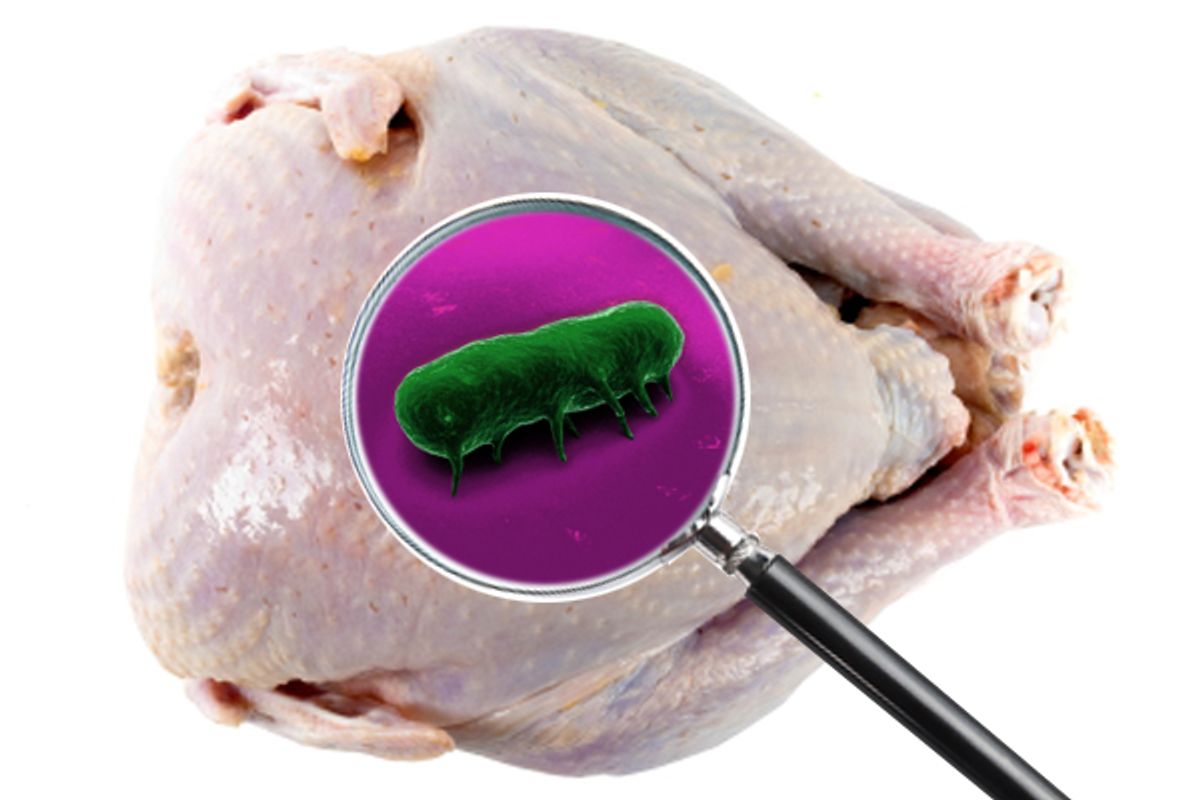
When antibiotics no longer workTurkeys are flying off the shelves as Cargill races to recall 36 million pounds after a salmonella outbreak in California was tied to the company's poultry.

There may be nothing more viscerally unsettling than the idea that our food is tainted and could make us seriously ill. Those anxieties were stoked this morning when Cargill, the third-largest turkey producer in the country, announced the recall of 36 million pounds of poultry for fear of salmonella contamination. The scare was precipitated by an outbreak in California — which left at least one person dead and more than 70 sick — which was traced back to Cargill’s products. The recall is one of the largest recalls of meat in American history. 

What’s particularly alarming is that the salmonella in question is resistant to antibiotics, at a time when drug-resistant bugs, of all stripes, are generating increased public attention. Just as Cargill was pulling its meat off of store shelves, French scientists released a report detailing the emergence of another drug-resistant strain of Salmonella, called “S. Kentucky,” in Europe. (The California strain is “S. Heidelberg.”) S. Kentucky made nearly 500 people sick across the continent between 2000 and 2008, and researchers suspect that it hopped over the pond to the U.S. and Canada. 

The threat isn’t only limited to poultry, either. In May, British researchers detected a new type of drug-resistant staph bacteria — MRSA, a well-known menace in hospitals that has more recently spread into non-clinical settings – lurking within milk products.

Taken together, these cases highlight an area of growing concern among scientists and critics of the agricultural industry. 

The birth of “super-bugs” 

While the source of the current salmonella outbreak remains murky, we can reasonably speculate about the genesis of the bug’s drug-resistance: the reportedly endemic overuse of antibiotics by the agricultural industry. 

Drugs are given to livestock for multiple reasons. An obvious one is for the treatment of diseases. When livestock are sick, veterinarians administer a significant dosage in hopes of  eliminating the animal’s affliction. Another reason is preventative. Animals in close quarters are more susceptible to infection, so farmers will often administer medicine to healthy animals in order to nip anything nasty in the bud. Most controversially, though, members of the agricultural industry use antibiotics for the express purpose of promoting livestock growth.

It’s a well-known, if not entirely intuitive, fact that healthy animals who are fed small, or “sub-therapeutic,” doses of antibiotics will wind up larger than their unmedicated counterparts. In many such cases, these drugs are given to livestock through their feed or water, and without the prescription or oversight of a veterinarian, according to Dr. Gail Hansen, a senior officer at the Pew Campaign on Human Health and Industrial Farming.

An estimated 80 percent of all antibiotics in the U.S. are given to food-producing livestock, according to the FDA. And approximately 83 percent of that medicine is “administered flock- or herd-wide at low levels for non-therapeutic purposes, such as growth promotion and routine disease prevention,” according to a lawsuit filed against the FDA in May. These figures could have very real consequences for public health, because the Catch-22 of this antibiotic abandon is the widespread development of drug-resistant bacteria, colloquially referred to as “super-bugs.”

“Bacteria can learn to become resistant,” Hansen said. “And when we give low levels of antibiotics, it’s a perfect formula for getting resistant bacteria. [The dosage is] not enough to kill them, and it’s a case of ’whatever doesn’t kill you makes you stronger.’” 

The drugs used vary, but they are, in many cases, significant to the treatment of human diseases. As the Independent notes:

[T]hree kinds of drugs described by the World Health Organization as ”critically important in human medicine”, are being used on animals as much as 800 percent more than a decade ago, despite a fall in the number of farm livestock. 

And the result? According to a report published by the FDA in 2009, nearly 80 percent of the salmonella found in ground turkey meat was resistant to at least one type of antibiotic — while 26 percent were immune to more than three. Overall, the bug appeared in more than 10 percent of all the turkeys tested. And the repercussions, should the practice of using sub-therapeutic doses continue, could be disastrous:

“Doctors will have to go to antibiotics that are more expensive, or have more side-effects,”  Hansen said. “And when we keep running into the problem of feeding animals antibiotics that are used to treat human diseases — we’re going to run out of antibiotics.”

In 2006, the European Union banned all use of antibiotics on livestock for growth promotion. And the U.S. Senate will consider similar legislation this year. Sen. Dianne Feinstein, D-Calif., reintroduced the “Preservation of Antibiotics for Medical Treatment Act” last month, which would significantly rein in agricultural drug use, and strictly prohibit the application of sub-therapeutic doses of drugs that have benefits for humans. 

Still, the agricultural industry disputes data about its use of antibiotics and the rise of super-bugs, and it has aggressively fought efforts to legislate the matter. As a result, it’s hard to tell how far the legislation might proceed.

What you can do to protect yourself

Dr. Martin Wiedmann, a professor of food science at Cornell University, points out that the most important way to keep yourself safe from a salmonella infection is proper food preparation:

This outbreak wouldn’t have occurred if people would have appropriately cooked and handled raw food in the kitchen. It’s important to reiterate that you need to cook food to the appropriate temperature — which for turkey is 165 degrees Fahrenheit. Always use an accurate meat thermometer to measure the temperature inside the product. You also have to be careful about cross-contamination. When you use utensils or your hands or plates to touch raw product, don’t use them again before washing. Every surface needs to be clean. We are all responsible for public health.

Consumers are advised to check for Cargill products in their homes. The AP has put together this helpful breakdown:

All of the packages recalled include the code “Est. P-963,” according to Cargill, though packages were labeled under many different brands. Many of the recalled meats are under the label Honeysuckle White. Other brands include Riverside Ground Turkey, Natural Lean Ground Turkey, Fit & Active Lean Ground Turkey, Spartan Ground Turkey and Shady Brook Farms Ground Turkey Burgers. The recall also includes ground turkey products packaged under the HEB, Safeway, Kroger, Randall’s, Tom Thumb and Giant Eagle grocery store brands. 


Continue Reading Close

36M lbs. of turkey recalled in salmonella outbreak

Meat producer Cargill lifts its product from store shelves after drug-resistant bug kills one in California

  • more
    • All Share Services

Topics: ,

36M lbs. of turkey recalled in salmonella outbreakA product subject to meat giant Cargill's recall of 36 million pounds of ground turkey linked to a nationwide salmonella outbreak is shown in Redwood City, Calif., Wednesday, Aug. 3, 2011. Cargill said Wednesday that it is recalling fresh and frozen ground turkey products produced at the company's Springdale, Ark., plant from Feb. 20 through Aug. 2 due to possible contamination from the strain of salmonella linked to the illnesses. The packages were labeled with many different brands, including Honeysuckle White and Kroger. (AP Photo/Paul Sakuma)(Credit: AP)

Meat giant Cargill is recalling 36 million pounds of turkey after a government hunt for the source of a salmonella outbreak that has killed one person in California and sickened dozens more.

The Agriculture Department and the Minnesota-based company announced Wednesday evening that Cargill is recalling fresh and frozen ground turkey products produced at the company’s Springdale, Ark., plant from Feb. 20 through Aug. 2 due to possible contamination from the strain of salmonella linked to 76 illnesses and the one death.

Illnesses in the outbreak date back to March and have been reported in 26 states coast to coast. Both the Agriculture Department and the federal Centers for Disease Control and Prevention are still working to identify the source. Meanwhile, the Agriculture Department has warned consumers to properly cook ground turkey.

Just before the recall announcement Wednesday, CDC epidemiologist Christopher Braden said he thought health authorities were closing in on the suspect. He said some leftover turkey in a package at a victim’s house was confirmed to contain the strain of salmonella linked to the outbreak.

In announcing the recall, Cargill officials said all ground turkey production has been suspended at the Springdale plant until the company is able to determine the source of the contamination.

“Given our concern for what has happened, and our desire to do what is right for our consumers and customers, we are voluntarily removing our ground turkey products from the marketplace,” said Steve Willardsen, president of Cargill’s turkey processing business.

The Minnesota-based company said it was initiating the recall after its own internal investigation, an Agriculture Department investigation and the information about the illnesses released by the CDC this week.

All of the packages recalled include the code “Est. P-963,” according to Cargill. The packages were labeled with many different brands, including Cargill’s Honeysuckle White.

According to food safety attorney Bill Marler, who publishes a database of outbreak statistics, the ground turkey recall is one of the largest meat recalls ever.

A chart on the CDC’s website shows cases have occurred every month since early March, with spikes in May and early June. The latest reported cases were in mid-July, although the CDC said some recent cases may not have been reported yet. The CDC said the strain is resistant to many commonly prescribed antibiotics, which can make treatment more difficult.

The states reporting the highest number sickened are Michigan and Ohio, with 10 each. Texas has reported nine illnesses; Illinois, seven; California, six; and Pennsylvania, five.

Twenty states have one to three reported illnesses linked to the outbreak, according to the CDC. They are Alabama, Arizona, Georgia, Iowa, Indiana, Kentucky, Louisiana, Massachusetts, Minnesota, Missouri, Mississippi, North Carolina, Nebraska, Nevada, New York, Oklahoma, Oregon, South Dakota, Tennessee and Wisconsin.

The CDC estimates that 50 million Americans each year get sick from food poisoning, including about 3,000 who die. Salmonella causes most of these cases, and federal health officials say they’ve made virtually no progress against it.

Government officials say that even contaminated ground turkey is safe to eat if it is cooked to 165 degrees. But it’s also important that raw meat be handled properly before it is cooked and that people wash their hands with soap for at least 20 seconds before and after handling the meat. Turkey and other meats should also be properly refrigerated or frozen and leftovers heated.

The most common symptoms of salmonella are diarrhea, abdominal cramps and fever within eight to 72 hours of eating a contaminated product. It can be life-threatening to some with weakened immune systems.

Cargill executive Willardsen said, “Public health and the safety of consumers cannot be compromised.”

“It is regrettable that people may have become ill from eating one of our ground turkey products,” he said, “and, for anyone who did, we are truly sorry.”

——

Online:

USDA recall announcement: http://www.fsis.usda.gov/News–&–Events/Recall–060–2011–Release/index.asp

CDC info on salmonella in ground turkey: http://www.cdc.gov/salmonella/heidelberg/080111/index.html

Continue Reading Close

911 called over botched Chinese food order

What do you do when your dinner isn't delivered properly? Call the police, of course

  • more
    • All Share Services

Topics: , , , , ,

911 called over botched Chinese food orderThe police are not here to deal with your delivery mix-up.

How many times has this happened to you? You go home and try to enjoy a nice dinner of Chinese food delivery. But when your meal arrives, they’ve got the order completely wrong!

Do you:

A) Call back the restaurant and ask for a refund;

B) Just eat the food and promise to deal with it next time;

C) Call the police

If you answered C, you are not alone. A woman in Savannah, Ga., called 911 to rectify her dinner order yesterday. This was the result:


Sadly, these kinds of calls aren’t as uncommon as you might think. In March 2009 a woman called the police after being given the wrong order of McNuggets at McDonald’s.

That wasn’t even the first time that year an emergency hotline was called because of fast food. In fact, it happened quite a bit in 2009. (Maybe McDonald’s was just particularly sucky that year.)

Regardless, it’s 2011 now and we’re all grown-ups. That doesn’t mean we expand our 911 repertoires to calling in about botched Chinese food orders. It means that we stop tying up the police phone line unless we actually have an emergency that doesn’t involve a delivery service.

Continue Reading Close

Drew Grant is a staff writer for Salon. Follow her on Twitter at @videodrew.

When is radioactive food dangerous?

The crippled Japanese power plant is contaminating food. What are the health risks?

  • more
    • All Share Services

Topics: , , ,

When is radioactive food dangerous?

Even short of a catastrophic meltdown at Japan’s Fukushima Daiichi nuclear reactor, serious questions remain about the ongoing crisis’s effect on health, particularly with food exposed to radioactive material. Officials have warned about contaminated spinach and milk. Now, hauls of fish pulled in by commercial fishermen near the plant are showing amounts of radioactive iodine-131 double current standards — prompting the Japanese government to regulate radiation levels in seafood. How worried should people be?

Salon talked to Stephen Frantz, director of the Reed College Research Reactor, about the threat.

What does radiation in food do to people?

When you ingest radioactive material, as the material decays, some of the radiation will hit the cells in your body and perhaps do damage and increase the chances of cancer — if there’s a sufficient amount of materials. “Radioactive” does not mean it’s deadly or dangerous. We’ve been eating radioactive materials all our throughout human history. It’s the levels you have to worry about.

At what level does radioactive material become dangerous to consume?

Governments set standards such that if you were to eat that food all of your life, there would be no observable health effects. When the food in Japan is exceeding that limit by just a little, or even a factor of two — if you eat it for a month or two, it’s probably not dangerous. If someone eats one fish that was too high, it’s not like it’s a death sentence. Nobody in the U.S. should be concerned at all.

Is radiation in food a bigger threat than radioactive particles in the air or water?

Yes, it’s the long-term accumulation of the materials in the body that’s probably the bigger risk. If you stand in the rain, you were exposed for a couple of minutes. If you eat the food, the material will stay in you — maybe for years.

Are there certain foods that are more likely to pose a health hazard due to radiation?

Milk is probably the highest risk. At Chernobyl, the biggest health effect was from radioactive material deposited on the grass. Cows ate the grass. Outside of the plant, the biggest death toll was children who drank the milk. If they had dumped the milk or put the animals on stored feed or something like that, it would’ve saved hundreds of lives there. I’m glad to see the Japanese are at least forthcoming enough to say don’t drink this milk, don’t eat this food, don’t do the fish.

Is there anything you can do to clean radioactive food or otherwise render it safe?

I don’t think heat, washing or brushing helps. It depends mostly on the half-life. If it’s radioactive iodine, which has a half-life of about eight days, then if you wait enough days there will be almost nothing there. The thumb rule that radiation protection people use is ten half-lives; but ten half-lives on eight days means you’re waiting three months. The trouble with milk is cesium, and the cesium half-life is 30 years. You’re going to have to dump the milk.

Continue Reading Close

Do food dyes cause hyperactivity?

The FDA is questioning its own old claim that food coloring is harmless. But does that mean it's a villain?

  • more
    • All Share Services

Topics: ,

Do food dyes cause hyperactivity?

The Food and Drug Administration will hear a panel today to examine a possible link between artificial food coloring and hyperactivity in children. Though no one actually expects the FDA to ban the dyes, the panel provides a great opportunity for reporters to dig up hand-wringing parents … and strike fear into the hearts of many more.

According to the New York Times, the petitioner, the Center for Science in the Public Interest, is seeking either an outright ban or, at the very least, a prominent warning label. European companies have had to put warning labels on artificially colored products for years, and many have switched to natural dyes, such as from beets. Should the U.S. follow suit?

The dye debate has been raging since the 1970s, with very little conclusive evidence to settle for either side once and for all. The FDA previously stated that there was no reason to fear the dyes, but since the use of artificial coloring has skyrocketed in recent years, scientists have been examining this claim, with little success. The most convincing evidence comes from a 2007 study headed by University of Southampton professor Jim Stevenson. In the study, children were fed a daily fruit juice containing different concentrations of dyes and the preservative sodium benzoate, and noted a small effect on behavior. It isn’t clear whether the dyes, the preservative or the combination caused the effect.

Basically, scientists don’t know what the cause of hyperactivity is, but children are still going cuckoo. FDA scientists released a report speculating that while many children are probably not adversely affected, those already with conditions like attention-deficit hyperactivity disorder (ADHD) may have their behavior problems exacerbated. In all probability, the two-day panel will conclude that it needs more research to reach any conclusions.

It’s tempting, of course, to try to finger a culprit for a disorder that affects a large number of children, even if the science doesn’t support it. Faced with uncomfortable ambiguity, the Times found a concerned mother to weigh in on the debate:

Renee Shutters, a mother of two from Jamestown, N.Y., said in a telephone interview on Tuesday that two years ago, her son Trenton, then 5, was having serious behavioral problems at school until she eliminated artificial food colorings from his diet. “I know for sure I found the root cause of this one because you can turn it on and off like a switch,” Ms. Shutters said.

NPR’s “Morning Edition,” meanwhile, found its own worried mother of a hyperactive child to refute the claim. After her daughter used blankets to slide down the stairs, Christine Woodman adopted a familiar mantra:

“What is natural is good; what isn’t natural was bad,” she remembers.

On the advice of friends, Christine decided to start by cutting out foods with artificial coloring, but Dawnielle didn’t really go for it. She missed her favorite oatmeal with little red-colored dinosaurs in it. Christine tried a substitute. “You know, I made the oatmeal with blueberries and soymilk and thought you would be happy with it,” she says to Dawnielle.

For Dawnielle, however, the problem was only solved once she was diagnosed by a doctor and given Ritalin.

So, despite the media’s best efforts, even the anecdotal evidence is inconclusive.

However, this doesn’t mean that we should ignore the dye debate entirely. As the director of the Center for Science in the Public Interest, Michael Jacobson, pointed out, regardless of the health risks of the dyes themselves, they exist primarily to lure children to junk foods saturated with sugar — a substance known to stimulate hyperactivity in pretty much everyone:

“Dyes are often used to make junk food more attractive to young children, or to simulate the presence of a healthful fruit or other natural ingredient,” Jacobson said. “Dyes would not be missed in the food supply except by the dye manufacturers.”

Even so, the dyes alone are not the main attraction. Sure, kids might enjoy the rainbow hue of Lucky Charms cereal, but we all know they’re really in it for the marshmallows, no matter what color they are. Ultimately, artificial dyes are the media’s hot new distraction from the real target. Eliminate dyes, and you’re still left with highly processed, sugary foods that pretty clearly increase your child’s hyperactive behavior. They’ll just be a little less colorful.


Continue Reading Close

Aviva Shen is an editorial fellow at Salon.

How many bugs are allowed in your pasta? Reading the FDA’s Food Defect Action Levels

After a congressman sues over an olive pit, we find the FDA's limits for junk in our own food. Brace yourself

  • more
    • All Share Services

Topics: , , ,

How many bugs are allowed in your pasta? Reading the FDA's Food Defect Action Levels

The closest I ever got to being a lawyer was flirting with a married one once, so I’m not going to comment on the legal wisdom of Dennis Kucinich’s suit against congressional cafeteria operators for leaving an unpitted olive in his sandwich three years ago. He bit the pit. The pit hurt him. (Bad, too!) But in light of this awful miscarriage of justice, I recall once learning that many foods are allowed to contain a certain amount of “foreign matter” from the processor.

So, curious about what other “filth” and “water insoluble inorganic matter” are legally tolerated, I consulted the Food and Drug Administration’s stunningly poetic-sounding “Food Defect Action Levels” — the level of screwiness you are allowed to have in your food before the FDA will take action. You never actually want to get some FDA action, but you might be surprised at how much gunk can be in your product before they will show up with some bad news.

Say you’re a frozen broccoli processor. Can you guess how many aphids, thrips, and/or mites you can have in 100 grams of your frozen broccoli before FDA agents will get all sad at you? Fifty-nine. You can have 59 aphids, thrips and/or mites in every three-and-a-half ounces of your product and be in the clear. Sixty is a problem, but 59? Play on, player!

Some other lines that the FDA will not allow you to cross:

Ground paprika: Average mold count is more than 20 percent; or average of more than 11 rodent hairs per 25 grams; or average of more than 75 insect fragments per 25 grams. (There is a glossary in the handbook that helpfully details “insect fragments” — to get the equivalent of a “whole insect,” all you have to do is count the body portions that have heads.)

Red fish and ocean perch: Three percent of the filets exampled contain one or more copepods accompanied by pus pockets. (Back to the glossary: “Copepods — Small free-swimming marine crustaceans, many of which are fish parasites. In some species the females enter the tissues of the host fish and may form pus pockets.” Yum-O!)

Hops: Average of more than 2,500 aphids per 10 grams (!!!).

Macaroni and noodle products: Average of 225 insect fragments or more per 225 grams.

Mushrooms, canned and dried: Average of 20 or more maggots of any size or average of five maggots 2 millimeters or longer per 100 grams of drained mushrooms and proportionate liquid or 15 grams of dried mushrooms.

Paging Rep. Kucinich! Pitted olives: Average of 1.3 percent or more by count of olives with whole pits and/or pit fragments 2 millimeters or longer.

Popcorn: 20 or more gnawed grains per pound and rodent hair is found in 50 percent or more of the subsamples.

And on and on. If you really want to geek out/get nauseated, check out the handbook here.

Now, to be fair, you have to realize that this doesn’t mean these foods aren’t generally safe to eat, even if you might be sharing your popcorn with little furry friends. The handbook details the significance of all of the defects it lists and the vast majority of them are aesthetic. In fact, to make this list, these flaws had to first be determined to present no health hazard (except for the very occasional chipped tooth). And, of course, for large and small producer alike, it’s impossible to harvest or make food that’s totally free of naturally occurring defects.

Funny enough, the FDA itself seems to recognize these action levels are on the extreme end of grodiness. The handbook states in the introduction that these limits “do not represent an average of the defects that occur in any of the products — the averages are actually much lower. The levels represent limits at which the FDA will regard the food product ‘adulterated,’ and subject to enforcement action.” So as long as you, Ms. Hops Packer, can come in comfortably under 2,500 aphids per 10 grams of hops, you should feel good about yourself.


Continue Reading Close

Francis Lam is Features Editor at Gilt Taste, provides color commentary for the Cooking Channel show Food(ography), and tweets at @francis_lam.

Page 1 of 3 in Food safety