Pentagon

The administration’s stated budget priorities

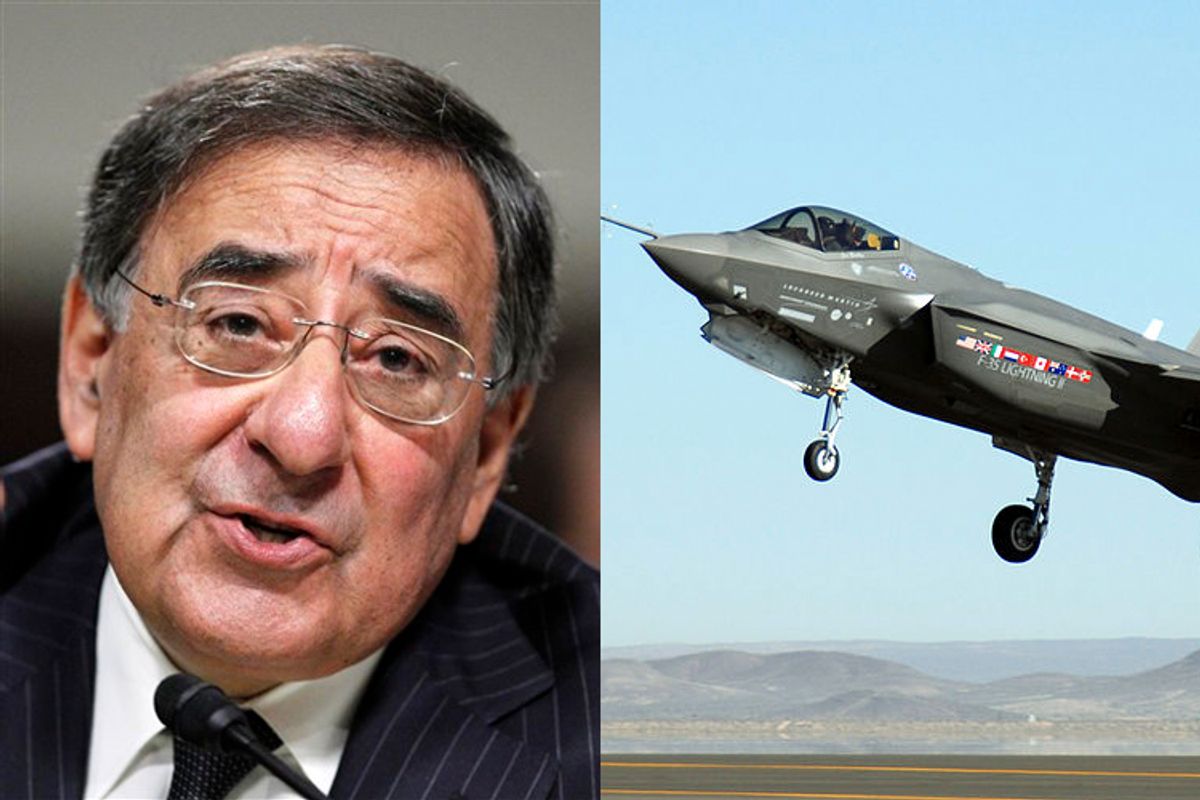
Leon Panetta demands cuts to Social Security and Medicare to avoid cuts in Pentagon spending

  • more
    • All Share Services

The administration's stated budget prioritiesFILE - In this June 9, 2011 file photo, Defense Secretary nominee Leon Panetta testifies on Capitol Hill in Washington. Itís a short hop down the Potomac from CIA headquarters, where Leon Panetta headed the spy agency for 2Ω years, to the Pentagon, where he takes over Friday, July 1, 2011 as secretary of defense. The two jobs, however, are worlds apart.. (AP Photo/Manuel Balce Ceneta, File) (Credit: Manuel Balce Ceneta)

(updated below – Update II)

The theory of Round II of the debt deal is that both parties will be motivated to reach an agreement in the “Super-Committee” on how to reduce the debt by another $1.5 trillion because, if they fail to agree, there will be automatic cuts that are horrendous to each party: draconian domestic cuts will scare Democrats into compromising, while supposedly substantial reductions in military spending will frighten the GOP.  But a serious and quite predictable deviation from that scheme has already emerged: Republicans (at least its Tea Party faction) don’t seem bothered at all by the prospects of military cuts, while Democrats — specifically the Obama administration — are acting as if such cuts, literally, would be nation-threatening.

Yesterday, President Obama’s Defense Secretary, Leon Panetta, donned his Dr. Strangelove hat and decried these prospective cuts as a “doomsday mechanism” — doomsday! – warning that these would be “very dangerous cuts” that “would do real damage to our security, our troops and their families, and our military’s ability to protect the nation.”  Then, this morning, we have this from The Washington Post:

Defense Secretary Leon Panetta warned Thursday of dire consequences if the Pentagon is forced to make cuts to its budget beyond the $400 billion in savings planned for the next decade.

Senior Pentagon officials have launched an offensive over the past two days to convince lawmakers that further reductions in Pentagon spending would imperil the country’s security. Instead of slashing defense, Panetta said, the bipartisan panel should rely on tax increases and cuts to nondiscretionary spending, such as Medicare and Social Security, to provide the necessary savings.

Just think about that for a minute.  We have a Democratic administration installed in power after millions of liberals donated large amounts of their time and money to help elect them.  Yet here we have a top official in the President’s cabinet demanding cuts to Medicare and Social Security in order to protect the military budget from further reductions.  That’s the position of the Democratic administration.  While it’s true that Pentagon officials reflexively protect the Pentagon budget, there is zero question that Panetta — the career-long supremely loyal Democratic Party functionary — is speaking here on behalf of and with the authorization of the White House; indeed, he said exactly that in the written message he sent about these cuts to the Pentagon’s staff (“this outcome would be completely unacceptable to me as Secretary of Defense, the President, and to our nation’s leaders”).

For all the boastful claims from Panetta and others about how much the Pentagon budget was just cut by the first round of the debt deal, the reality, as McClatchy detailed yesterday, is much different: ”The new deficit-cutting law appears to reduce defense spending by $350 billion up front and perhaps by as much as $850 billion over 10 years, but in fact that’s highly unlikely to happen.”  That’s because defense hawks ensured that these initial cuts would be applied not only to “defense” but also “security” spending, which encompasses programs “such as homeland security, border enforcement, foreign aid and even veterans’ benefits as potential targets.”  Moreover, as Foreign Policy‘s Josh Rogin explained on Tuesday night on Rachel Maddow’s program, the magnitude of this first round of cuts as well as the potential series of automatic cuts in the second round is wildly overstated by administration officials given budgetary gimmicks in how these numbers are derived.

President Obama yesterday instructed his supporters on how to advocate for his re-election, and told them that when they go forth to evangelize about his accomplishments — as Steve Benen did yesterday with his celebration of Obama as “the most effective politician since Reagan, and depending on the day, perhaps even the most effective politician since LBJ” — that they should “not to get too bogged down in detail” but instead should emphasize broad themes and values.  As one example of how this avoid-the-details advocacy should work, Obama instructed: ”If somebody asks about the war, whether it’s Iraq or Afghanistan — if it’s Iraq, you have a pretty simple answer, which is all our folks are going to be out of there by the end of the year.”  Except that appears to be completely untrue, as his administration appears on the verge of succeeding in its many months of efforts to pressure the Iraqi Government to allow U.S. troops to remain in that country well past the 2011 withdrawal deadline Obama repeatedly vowed to enforce (and that’s beyond the oversight-free private army which the State Department has long planned to keep in Iraq).

As the U.S. continues to spend almost more than the rest of the world combined on its military while it wages and escalates war in multiple Muslim countries around the world — to say nothing of the dozens of nations in which it continuously engages in lower-level covert military action — the very idea that American security would be gravely jeopardized by these cuts is absurd on its face.  If anything, American security is far more endangered by continuing on this path of unbridled militarism and aggression.  Yet here we have the bizarre spectacle of a Democratic administration demanding cuts to Social Security and Medicare in order to protect the defense industry from cuts that are, in any event, far less meaningful than are being depicted.  Given how public they’re being with these statements, does anyone have any remaining doubt about the constituencies to which they’re actually loyal?

* * * * * 

There are reports this morning that a NATO airstrike killed (another) one of Gadaffi’s sons in Libya, so we’ll be able to have some collective celebration to keep our minds off little things like the collapsing economy.  It is telling indeed how virtually all political good news — all national celebrations — now involve America’s ability to kill the latest Bad Guy.  One benefit of Endless War is that it distracts the citizens’ attention away from what is being done to them at home and makes them cheer for the leaders who are doing it to them.


UPDATE:  Lsat week, Joe Lieberman said we must cut entitlement programs in order to “have the national defense we need to protect us in a dangerous world while we’re at war with Islamist extremists who attacked us on 9/11 and will be for a long time to come.”  About that, Joan McCarter wrote: ”since the Super Congress has been created specifically to pit defense and safety net programs against each other, don’t be surprised if you see this one getting traction” (h/t sysprog)  That is exactly the purpose of the “triggers” and the Super Committee; it is not hard to guess who will prevail in the war between entitlement programs and military spending; and Panetta’s statements are little more than a push to ensure the right outcome.


UPDATE II:  The New York Times reported the same thing as the Post.  From the first sentence of that paper’s article on Panetta’s comments: ”Defense Secretary Leon E. Panetta effectively told Congress on Thursday to raise taxes and cut Social Security and Medicare before taking another swipe at the Pentagon budget beyond defense cuts.”  Even Bill Kristol seems more rhetorically restrained than Panetta about these cuts (h/t HTML Mencken).

Glenn Greenwald

Follow Glenn Greenwald on Twitter: @ggreenwald.

Obama’s secret warriors

Under his watch, the military's least accountable assets have become the pinnacle of military prestige

  • more
    • All Share Services

Obama's secret warriorsU.S. Navy SEALs after a demonstration of combat skills in Fort Pierce, Fla. (Credit: Reuters/Joe Skipper)
This piece originally appeared on TomDispatch.

As he campaigns for reelection, President Obama periodically reminds audiences of his success in terminating the deeply unpopular Iraq War. With fingers crossed for luck, he vows to do the same with the equally unpopular war in Afghanistan. If not exactly a peacemaker, our Nobel Peace Prize-winning president can (with some justification) at least claim credit for being a war-ender.

Yet when it comes to military policy, the Obama administration’s success in shutting down wars conducted in plain sight tells only half the story, and the lesser half at that. More significant has been this president’s enthusiasm for instigating or expanding secret wars, those conducted out of sight and by commandos.

President Franklin Roosevelt may not have invented the airplane, but during World War II he transformed strategic bombing into one of the principal emblems of the reigning American way of war. General Dwight D. Eisenhower had nothing to do with the Manhattan Project that developed the atomic bomb. Yet, as president, Ike’s strategy of Massive Retaliation made nukes the centerpiece of U.S. national security policy.

So, too, with Barack Obama and special operations forces. The U.S. Special Operations Command (USSOCOM) with its constituent operating forces — Green Berets, Army Rangers, Navy SEALs, and the like — predated his presidency by decades. Yet it is only on Obama’s watch that these secret warriors have reached the pinnacle of the U.S. military’s prestige hierarchy.

John F. Kennedy famously gave the Green Berets their distinctive headgear. Obama has endowed the whole special operations “community” with something less decorative but far more important: privileged status that provides special operators with maximum autonomy while insulating them from the vagaries of politics, budgetary or otherwise. Congress may yet require the Pentagon to undertake some (very modest) belt-tightening, but one thing’s for sure: No one is going to tell USSOCOM to go on a diet. What the special ops types want, they will get, with few questions asked — and virtually none of those few posed in public.

Since 9/11, USSOCOM’s budget has quadrupled. The special operations order of battle has expanded accordingly. At present, there are an estimated 66,000 uniformed and civilian personnel on the rolls, a doubling in size since 2001, and with further growth projected. Yet this expansion had already begun under Obama’s predecessor. His essential contribution has been to broaden the special ops mandate. As one observer put it, the Obama White House let Special Operations Command “off the leash.”

As a consequence, USSOCOM assets today go more places and undertake more missions while enjoying greater freedom of action than ever before. After a decade in which Iraq and Afghanistan absorbed the lion’s share of the attention, hitherto neglected swaths of Africa, Asia and Latin America are receiving greater scrutiny. Already operating in dozens of countries around the world – as many as 120 by the end of this year — special operators engage in activities that range from reconnaissance and counterterrorism to humanitarian assistance and “direct action.” The traditional motto of the Army special forces is “De Oppresso Liber” (“To Free the Oppressed”). A more apt slogan for special operations forces as a whole might be “Coming soon to a Third World country near you!”

The displacement of conventional forces by special operations forces as the preferred U.S. military instrument — the “force of choice” according to the head of USSOCOM, Admiral William McRaven — marks the completion of a decades-long cultural repositioning of the American soldier. The G.I., once represented by the likes of cartoonist Bill Mauldin’s iconic Willie and Joe, is no more, his place taken by today’s elite warrior professional. Mauldin’s creations were heroes, but not superheroes. The nameless, lionized SEALs who killed Osama bin Laden are flesh-and-blood Avengers. Willie and Joe were “us.” SEALs are anything but “us.” They occupy a pedestal well above mere mortals. Couch potato America stands in awe of their skill and bravery.

This cultural transformation has important political implications. It represents the ultimate manifestation of the abyss now separating the military and society. Nominally bemoaned by some, including former Secretary of Defense Robert Gates and former Joint Chiefs Chairman Admiral Mike Mullen, this civilian-military gap has only grown over the course of decades and is now widely accepted as the norm. As one consequence, the American people have forfeited owner’s rights over their army, having less control over the employment of U.S. forces than New Yorkers have over the management of the Knicks or Yankees.

As admiring spectators, we may take at face value the testimony of experts (even if such testimony is seldom disinterested) who assure us that the SEALs, Rangers, Green Berets, etc. are the best of the best and that they stand ready to deploy at a moment’s notice so that Americans can sleep soundly in their beds. If the United States is indeed engaged, as Admiral McRaven has said, in “a generational struggle,” we will surely want these guys in our corner.

Even so, allowing war in the shadows to become the new American way of war is not without a downside. Here are three reasons why we should think twice before turning global security over to Admiral McRaven and his associates.

Goodbye accountability. Autonomy and accountability exist in inverse proportion to one another. Indulge the former and kiss the latter goodbye. In practice, the only thing the public knows about special ops activities is what the national security apparatus chooses to reveal. Can you rely on those who speak for that apparatus in Washington to tell the truth? No more than you can rely on JPMorgan Chase to manage your money prudently. Granted, out there in the field, most troops will do the right thing most of the time. On occasion, however, even members of an elite force will stray off the straight-and-narrow. (Until just a few weeks ago, most Americans considered White House Secret Service agents part of an elite force.) Americans have a strong inclination to trust the military. Yet as a famous Republican once said: Trust, but verify. There’s no verifying things that remain secret. Unleashing USSOCOM is a recipe for mischief.

Hello imperial presidency. From a president’s point of view, one of the appealing things about special forces is that he can send them wherever he wants to do whatever he directs. There’s no need to ask permission or to explain. Employing USSOCOM as your own private military means never having to say you’re sorry. When President Clinton intervened in Bosnia or Kosovo, when President Bush invaded Afghanistan and Iraq, they at least went on television to clue the rest of us in. However perfunctory the consultations may have been, the White House at least talked things over with the leaders on Capitol Hill. Once in a while, members of Congress even cast votes to indicate approval or disapproval of some military action. With special ops, no such notification or consultation is necessary. The president and his minions have a free hand. Building on the precedents set by Obama, stupid and reckless presidents will enjoy this prerogative no less than shrewd and well-intentioned ones.

And then what … ?  As U.S. special ops forces roam the world slaying evildoers, the famous question posed by David Petraeus as the invasion of Iraq began — “Tell me how this ends” — rises to the level of Talmudic conundrum. There are certainly plenty of evildoers who wish us ill (primarily but not necessarily in the Greater Middle East). How many will USSOCOM have to liquidate before the job is done? Answering that question becomes all the more difficult given that some of the killing has the effect of adding new recruits to the ranks of the non-well-wishers.

In short, handing war to the special operators severs an already too tenuous link between war and politics; it becomes war for its own sake. Remember George W. Bush’s “Global War on Terror”? Actually, his war was never truly global. War waged in a special-operations-first world just might become truly global — and never-ending. In that case, Admiral McRaven’s “generational struggle” is likely to become a self-fulfilling prophecy.

Continue Reading Close

Has the Pentagon learned nothing?

The Army's response to the attacks in Kabul reflects deadly misunderstandings that date back to the Vietnam War

  • more
    • All Share Services

Has the Pentagon learned nothing?Afghan special forces are seen on top of a building which was occupied by militants in Kabul, Afghanistan, Monday, April 16, 2012.(Credit: AP Photo/Musadeq Sadeq)
This piece originally appeared on TomDispatch.

Recently, after insurgents unleashed sophisticated, synchronized attacks across Afghanistan involving dozens of fighters armed with suicide vests, rocket-propelled grenades and small arms, as well as car bombs, the Pentagon was quick to emphasize what hadn’t happened.  “I’m not minimizing the seriousness of this, but this was in no way akin to the Tet Offensive,” said George Little, the Pentagon’s top spokesman.  “We are looking at suicide bombers, RPG [rocket propelled grenade], mortar fire, etcetera. This was not a large-scale offensive sweeping into Kabul or other parts of the country.”

Defense Secretary Leon Panetta weighed in similarly.  “There were,” he insisted, “no tactical gains here. These are isolated attacks that are done for symbolic purposes, and they have not regained any territory.”  Such sentiments were echoed by many in the media, who emphasized that the attacks “didn’t accomplish much” or were “unsuccessful.”

Even granting the need to spin the assaults as failures, the official American reaction to the coordinated attacks in Kabul, the Afghan capital, as well as at Jalalabad airbase, and in Paktika and Logar Provinces, reveals a fundamental misunderstanding of guerrilla warfare and, in particular, of the type being waged by the Haqqani network, a crime syndicate transformed by the conflict into a leading insurgent group.  Here’s the “lede” that should have run in every newspaper in America: More than 40 years after the Vietnam War’s Tet Offensive, after more than a decade of war in Afghanistan, even after reviving counterinsurgency doctrine (only to see it crash-and-burn in short order), the U.S. military still doesn’t get it.

Think of this as a remarkably unblemished record of “failure to understand” stretching from the 1960s to 2012, and undoubtedly beyond.

The Lessons of Tet

When Vietnamese revolutionary forces launched the 1968 Tet Offensive, attacking Saigon, the South Vietnamese capital, as well as four other major cities, 35 of 44 provincial capitals, 64 district seats and 50 other hamlets nationwide, they were hoping to spark a general uprising.  What they did instead was spotlight the fact that months of optimistic talk by American officials about tremendous strategic gains and a foreseeable victory had been farcical in the extreme.

Tet made the top U.S. commander, General William Westmoreland, infamous for having claimed just months earlier that an end to America’s war was on the horizon.  As he stood before TV cameras on the battle-scarred grounds of the U.S. embassy compound in Saigon — after a small team of Vietcong sappers breached its walls and shot it out with surprised U.S. forces — pronouncing the offensive a failure, he appeared to Americans at home totally out of touch, if not delusional.

Since that moment, it should have been clear that tactical success, even success in any usual sense, is never the be-all or end-all of insurgent warfare.  Guerrillas the world over grasped what had happened in Vietnam.  They took its lessons to heart, and even took them a step further.  They understood, for instance, that you don’t need to lose 58,000 fighters, as the Vietnamese did at Tet, to win important psychological victories.  You need only highlight your enemy’s vulnerabilities, its helplessness to stop you.

The Haqqanis certainly got it, and so just over a week ago sacrificed 57,961 fewer fighters to make a similar point.  Striking a psychological blow while losing only 39 guerrillas, they are distinctly living in the 21st century in global war-making terms.  On the other hand, whether its top civilian and military commanders realize it or not, the Pentagon is still stuck in Saigon, 1968.

Case in point: Secretary of Defense Panetta belittled the Haqqani fighters for not taking “territory.”  It’s a claim that, in its cluelessness, is positively Westmorelandish.

What territory, after all, could a relatively weak and lightly armed force like the Haqqani militants have been out to “regain” by attacking Kabul’s heavily defended diplomatic quarter?  The German Embassy?  And then what would they have done?  À la U.S. counterinsurgency doctrine, launch an oil-spot strategy, spreading out slowly from there to secure the American Embassy, the British Embassy and NATO headquarters?  While Panetta at least granted that the attacks were geared toward symbolic effect, he remained strangely focused on their “tactical” significance.

As was the case in Vietnam, the U.S. military in Afghanistan regularly attempts to prove it’s winning via metrics like the number of enemies captured and body counts from “night raids.”  No less frequently, its spokespeople create rules and measures for its enemies in an effort to prove they’re not succeeding. This Westmoreland-ian mindset was evident last week in those statements that the Haqqanis didn’t accomplish much of anything because they didn’t take territory, sweep into Kabul en masse, or carry out a sufficiently “large-scale offensive” — as if the Pentagon were the war’s ringside judge (as well as one of the fighters) and the conflict could be won on points like a boxing match.

In the Vietnam years, Westmoreland and other top U.S. officials were forever seeking an elusive “crossover point” — the moment when their Vietnamese foes would be losing more fighters than they could replace and so (they were convinced) would have to capitulate.  That crossover point was the Pentagon’s El Dorado and to achieve it, the U.S. military fought a war of attrition, just as in recent years the Pentagon has been trying to capture and kill its way to victory in Afghanistan through night raids and conventional offensives.

More than a decade after its own forces swept into Kabul, however, what began as a rag-tag, remnant insurgency has grown stronger and continues to vex the most heavily armed, most technologically advanced, best-funded military on the planet.  All of America’s “tactical gains” and captured territory, especially in the Taliban heartland of Helmand Province in southern Afghanistan, however, haven’t led to anything close to victory, and one after another its highly publicized light-at-the-end-of-the-tunnel offensives, like the much-hyped 2010 Marjah campaign, have faded away and been forgotten.

Afghan and American “Green Zones”

As the Haqqanis meant to underscore with their coordinated attacks, America’s trillion-dollar military and the hundreds of thousands of allied local security forces are still incapable of fully securing a small “green zone” in the heart of the Afghan capital, no less the rest of the country.

The conflict in Afghanistan began with its American commander declaring, “We don’t do body counts,” but a quick glance at recent U.S. military press releases touting supposed “high-value kills” or large numbers of dead insurgents indicates otherwise.  As in Vietnam, the U.S. is once again waging a war of attrition, even as America’s Afghan enemies employ their own very different attrition strategy.  Instead of slugging it out toe-to-toe in large suicidal offensives, they’ve planned a savvy, conservative campaign meant to save fighters and resources while sending an unmistakable message to the Afghan population, and simultaneously exposing the futility of the conflict to the American public.

The attrition of U.S. support for the war is unmistakable.  As late as 2009, according to a poll by ABC News and the Washington Post, 56 percent of Americans believed the Afghan War was still worth fighting.  Just days before the Haqqanis’ coordinated attacks, that number had sunk to 35 percent.  Over the same span, the number of Americans convinced that the war is not worth fighting jumped from 41 percent to 60 percent.  Whatever the Pentagon’s spin, the latest Haqqani offensive is likely to contribute to these trends, and Pentagon press releases about enemy dead are powerless to reverse them.

In the era of an all-voluntary military, of the “warrior corporation“ and its warzone mercenaries, breaching the “green zone” of American public opinion matters less than in the Vietnam era, but it still makes a difference.  The Haqqanis and their Taliban allies may be taking no territory, but in this guerrilla war it turns out that the territory that really matters, on all sides of the battle lines, is the territory inside people’s heads — and there the Pentagon is losing.

On April 12th, the same day that the ABC News/Washington Post poll was released, U.S. Air Force Lieutenant Colonel James Routt flew his last combat mission in Afghanistan.  It was a noteworthy flight.  After all, Routt began his career flying B-52 bombers at the end of the Vietnam War, and was even involved in support efforts for Operation Linebacker II, President Richard Nixon’s infamous “Christmas bombing” of North Vietnam.

Just a few years after those raids, Nixon was a disgraced ex-president and America’s Vietnamese enemies had won the war.  Decades later, the U.S. stands on the brink of another, more devastating defeat at the hands of far lesser foes, a minority insurgency with weaker allies (and no great power backers).  It’s an enemy that has fought far fewer battles and lost far fewer fighters, despite facing off against a far more sophisticated American war machine.

While Routt is hanging up his bomber jacket and walking away from another American defeat in Asia, the Pentagon continues its efforts to conjure up, if not victory then something other than failure, out of a mélange of money, dead bodies and rosy press releases.  The Haqqanis and their allies, on the other hand, having evidently learned the lessons of the Vietnam War, will undoubtedly continue their carefully controlled war of attrition, while Washington pursues the losing variant it’s been clinging to for years.

The Pentagon might have swapped the Vietnam Syndrome for an Afghan one, but its playbook remains mired in the Vietnam era.  It seems intent on proving that channeling William Westmoreland is the least effective way imaginable to win a war on the Eurasian mainland.

To stay on top of important articles like these, sign up to receive the latest updates from TomDispatch.com here.

Continue Reading Close

Nick Turse is the associate editor of TomDispatch.com and the winner of a 2009 Ridenhour Prize for Reportorial Distinction as well as a James Aronson Award for Social Justice Journalism. His work has appeared in the Los Angeles Times, the Nation, In These Times, and regularly at TomDispatch. This story is a joint investigative project of Salon, AlterNet, and Brave New Foundation.

Conservatives mad at liberal media, Obama over Afghanistan photos

Confused right-wing responses to a grisly scandal

  • more
    • All Share Services

Conservatives mad at liberal media, Obama over Afghanistan photosU.S. Army soldiers from 4-73 Cavalry Regiment, 82nd Airborne Division walk during a mission in Zhary district of Kandahar province, southern Afghanistan April 17, 2012(Credit: REUTERS/Baz Ratner)

The L.A. Times Wednesday published photos of American troops in Afghanistan posing and grinning with the body parts of dead Afghan insurgents. There are 18 photos in all of soldiers posing with human remains, all from 2010, and the Times published two of them. The newspaper received the photos from a soldier in the unit depicted, who, according to Times editors, sought to publicize “dysfunction in discipline and a breakdown in leadership that compromised the safety of the troops.”

The L.A. Times informed the Pentagon of its story and waited 72 hours before publishing. The Army, notably, had not launched a criminal investigation into the troops responsible for the photos until the Times contacted them. The Obama administration and the Pentagon have both condemned the soldiers responsible for the pictures, but also expressed disappointment in the Times for publishing them. Wired’s Spencer Ackerman refers to the photos as “yet another unforced error” for U.S. forces in Afghanistan. It’s a depressing and disturbing story, from a long and miserable war.

It’s also an opportunity, obviously, for various nuts to write asinine and offensive things.

Ralph Peters, a retired Army lieutenant colonel currently employed by the right-wing media as a cartoonish satire of bloodthirsty jingoist militarism, declared on Fox that he was furious not with the soldiers who created the disturbing photos, but with a military leadership that refused to “stand up” for our troops by not investigating them for crimes they commit. He also, naturally, blamed the liberal media:

“The real scandal is that the L.A. Times, desperate to survive, creates a scandal, publishes those pictures over the Pentagon’s objections. The real scandal is that the establishment media leaps on another chance to trash our troops. The worst of the scandal is that our leaders, in and out of uniform, rush to condemn our troops – no explanation, no context.”

“I suggest the White House spokesman Jay Carney join the military and see what it’s like himself before he condemns our troops,” Peters continued. “I’m especially appalled that those in uniform, General [John R.] Allen, our commander in Afghanistan, just jumped to trash our troops.”

(Peters, by the way, never actually saw combat during his years in the Army. That obviously doesn’t disqualify him from commenting on matters of war, but it ought to disqualify him from commenting that only people with armed forces experience can comment on matters of war.)

The “real scandal,” as ever, is not the actual scandalous thing. It’s some other thing, related to Obama’s secret radicalism or fetish for apologizing for America’s greatness, or the liberal media’s apparent hatred of our fighting boys in uniform.

At the National Review’s the Corner today, David French reports that the real scandal is not that these soldiers desecrated bodies, nor even necessarily that the L.A. Times published the photos, but that the L.A. Times didn’t publish some other thing, four years ago, that would’ve proved that Barack Obama is a Muslim, or just a guy who likes Muslims a little too much.

Let’s just reprint the whole thing because it’s a classic of the genre:

If there’s one thing that’s utterly predictable during the course of our war, it’s that major journalistic outlets will publish stories that shame our troops or place them at greater risk — but only after very public (and comically insincere) hand-wringing. I wonder … if any Afghan soldiers turn their weapons on their American allies as a reprisal, will the Times editors at least send flowers to the families of the fallen? Perhaps a card? “We’re sincerely sorry that our journalistic ‘ethics’ led to the death of your husband/wife/son/daughter, but there was a vital need to cast our war effort in a negative light. After all, the New York Times leads us in Pulitzers at the moment, and nothing says ‘Pulitzer’ like exposing two-years-old wrongdoing by privates.”

Did the soldier who sent the photos to the L.A. Times do so in order to help that struggling newspaper win a Pulitzer, do you think? Or did he do so because he is some sort of self-hating troop who wants troops like himself to be killed?

But if you’re one of those courageous and fearless “let’s tell the raw truth, and let the chips fall where they may” types, and you’re tempted to respect the L.A. Times for its journalistic integrity, let me remind you of a time when the newspaper showed restraint: When it decided — in the midst of a hotly contested presidential campaign — not to publish a videotape of Barack Obama praising former PLO spokesman Rashid Khalidi at a 2003 dinner. After all, that’s just a future president discussing one of the world’s most hot-button geopolitical issues (with a bonus appearance by applauding domestic terrorists). Move along. Nothing to see there.

The reason French knows about this shocking tape of Barack Obama praising a well-respected Columbia professor is because the L.A. Times reported on it, in great detail, repeatedly, in 2008. It didn’t release the video because its source gave them the video on the condition that they not release it. I assume the soldier who sent these Afghanistan photos did so on something like the opposite condition.

Finally, the sad lost children of Breitbart belatedly weighed in with this Big Peace post making an argument that I can’t quite follow. It is something like “the media and John McCain were mean to Donald Rumsfeld after Abu Ghraib which totally wasn’t even a big deal and it wasn’t Rumsfeld’s fault so it it will be hypocrisy if they don’t blame Obama for this thing.”

Continue Reading Close
Alex Pareene

Alex Pareene writes about politics for Salon and is the author of "The Rude Guide to Mitt." Email him at apareene@salon.com and follow him on Twitter @pareene

The GOP’s bloated Pentagon dreams

Romney and Santorum would both significantly expand America's unsustainable military budget

  • more
    • All Share Services

The GOP's bloated Pentagon dreams (Credit: AP/Steven Senne/Charlie Riedel)
This originally appeared on TomDispatch.

If you’ve been fretting about faltering math education and falling test scores here in the United States, you should be worried based on this campaign season of Republican math. When it comes to the American military, the leading Republican presidential candidates evidently only learned to add and multiply, never subtract or divide.

Advocates of Pentagon reform have criticized President Obama for his timid approach to reducing military spending. Despite current Pentagon budgets that have hovered at the highest levels since World War II and 13 years of steady growth, the administration’s latest plans would only reduce spending at the Department of Defense by 1.6 percent in inflation-adjusted dollars over the next five years.

Still, compared to his main Republican opponents, Obama is a T. rex of budget slashers. After all, despite their stated commitment to reducing the deficit (while cutting taxes on the rich yet more), the Republican contenders are intent on raising Pentagon spending dramatically. Mitt Romney has staked out the “high ground” in the latest round of Republican math with a proposal to set Pentagon spending at 4 percent of the Gross Domestic Product (GDP).  That would, in fact add up to an astonishing $8.3 trillion dollars over the next decade, one-third more than current, already bloated Pentagon plans.

Nathan Hodge of the Wall Street Journal engaged in polite understatement when he described the Romney plan as “the most optimistic forecast U.S. defense manufacturers have heard in months.”

In fact, Romney’s proposal implies that the Pentagon is essentially an entitlement program that should receive a set share of our total economic resources regardless of what’s happening here at home or elsewhere on the planet. In Romney World, the Pentagon’s only role would be to engorge itself. If the GDP were to drop, it’s unlikely that, as president, he would reduce Pentagon spending accordingly.

Rick Santorum has spent far less time describing his military spending plans, but a remark at a Republican presidential debate in Arizona suggests that he is at least on the same page with Romney. In 1958, the year he was born, Santorum pointed out, Pentagon spending was 60 percent of the federal budget, and now it’s “only” 17 percent. In other words, why cut military spending when it’s so comparatively low?

Of course, this is a classic bait-and-switch case of cherry-picking numbers, since the federal budget of 1958 didn’t include Medicare, Medicaid, the Environmental Protection Agency or the Occupational Safety and Health Administration. The population was 100 million less than it is now, resulting in lower spending across the board, most notably for Social Security. In fact, Americans now pay out nearly twice as much for military purposes as in 1958, a sum well in excess of the combined military budgets of the next 10 largest spending nations.

Of course, in a field of innumerates, Santorum’s claim undoubtedly falls into the category of rhetorical flourish. It’s unlikely that even he was suggesting we more than triple Pentagon spending — the only way to return it to the share of the budget it consumed in the halcyon days of his youth. (Keep in mind that profligate Pentagon spending in that era ultimately prompted President Dwight D. Eisenhower to coin the term “military-industrial complex.”) Still, Santorum clearly believes that there’s plenty of room to hike military spending, if we just slash genuine entitlement programs deeply enough. He would undoubtedly support a Pentagon budget at Romney-esque levels, as would Newt Gingrich based on his absurd claim that the Obama administration’s modest adjustments to the Pentagon’s record budgets would result in a “hollowing out” of the U.S. military.

Mitt Romney at Sea

But let’s stick with the Republican frontrunner (or stumbler). What exactly would Romney spend all this money on?

For starters, he’s a humongous fan of building big ships, generally the most expensive items in the Pentagon budget. He has pledged to up Navy ship purchases from 9 to 15 per year, a rise of 50 percent. These things add up.  A new aircraft carrier costs more than $10 billion; a ballistic missile submarine weighs in at $7 billion or more; and a destroyer comes with a — by comparison — piddling price tag of $2 billion-plus.  The rationale for such a naval spending spree is, of course, that all-purpose threat cited these days by builders of every sort of big-ticket military hardware: China.

As Romney put it late last year, if the U.S. doesn’t pump up its shipbuilding budget, China will soon be “brushing aside an inferior American Navy in the Pacific.”  This must be news to former Secretary of Defense Robert Gates, who noted in a May 2010 speech to the Navy League that the fleet is larger than the next 13 navies combined — 11 of which, by the way, belong to U.S. allies.  As for the Chinese challenge, much has been made of China’s new aircraft carrier, which actually turns out to be a refurbished vessel purchased from Ukraine in 1998 and originally intended to be a floating casino. It would leave the U.S. with only an 11 to 1 advantage in this category.

It’s true that China is increasing the size of its navy in hopes of operating more freely in the waters off its coast and perhaps the contested South China Sea (with its energy reserves), but it is hardly engaged in a drive for global domination. It’s not as if Beijing is capable of deploying aircraft carriers off the coasts of California and Alaska.  In the meantime, Romney’s shipbuilding fetish doesn’t add up. It’s as ludicrous as it is expensive.

Romney is also a major supporter of missile defense — and not just the current $9-$10 billion a year enterprise being funded by the Obama administration, primarily designed to blunt an attack by long-range North Korean missiles that don’t exist.  Romney wants a “full, multi-layered” system.  That sounds suspiciously like the Ronald Reagan-style fantasy of an “impermeable shield” over the United States against massive nuclear attack that was abandoned in the late 1980s because of its staggering expense and essential impracticality.

If the development of Romney’s high-priced version of a missile shield were again on the American agenda, it would be a godsend for big weapons-makers like Boeing, Lockheed Martin and Raytheon, but would add nothing to the defense of this country.  In fact, it stands a reasonable chance of making things worse.  Given the overkill represented by the thousands of nuclear warheads in the American arsenal, the prospect of a nuclear missile attack on the United States is essentially nil.

As arms experts like Dr. Theodore Postol of the Security Studies Program at the Massachusetts Institute of Technology have pointed out, in the utterly unlikely event of a massive nuclear missile attack, Romney’s plan would be virtually useless. There’s just no way to provide a near-perfect defense against thousands of warheads and decoys launched at 15,000 miles per hour.  The only reasonable defense against nuclear weapons would be to get rid of them altogether, a course suggested by scores of retired military leaders, former defense officials and heads of state.  Even Henry Kissinger has joined the “go to zero” campaign, supporting a far more sensible approach to the nuclear dilemma than Romney’s fantasy technical fix.

The Romney anti-missile program would, however, do more than just waste money. It would restore the Bush administration’s plan to emplace a long-range anti-missile system in Europe officially aimed at Iran but assumedly capable of taking out Russian missiles as well. Given that the Obama administration’s far more limited plan for Europe has already caused consternation among Russia’s leaders, imagine the harsh reaction in Moscow to the over-the-top Romney version. It could put an end to any hopes of further U.S.-Russian nuclear reductions — a significant price to pay for a high-tech boondoggle with no prospect of success.

Ensuring a Cost-Overrun Presidency

If you were hoping that, with an eye to fighting yet more disastrous wars in the Greater Middle East like the $3 trillion fiasco in Iraq, the U.S. would raise ever larger armies, then Mitt’s your man. While Secretary of Defense Leon Panetta’s latest plan would reduce the Army and Marines by about 100,000 over the next five years — essentially rolling back the increases that were part of the post-9/11 buildup — the former Massachusetts governor would double down by adding 100,000 more troops to present force levels.

His rhetoric and the bona fides of his neoconservative advisors suggest that one place President Romney might send those bulked up forces would be to Iran as “boots on the ground.” He has repeatedly claimed that, if President Obama is re-elected, Iran will get a nuclear weapon, and has asserted that if he is elected it will not.  He has mocked the president for not being “tough enough” on the Iranians and implied that a Romney administration would consider force a go-to option against that country, rather than a threat meant to back up a diplomatic strategy.

Keep in mind that if Romney were to follow through on these costly undertakings and others like them, it would only add to the good old-fashioned waste and fraud that’s the norm of Pentagon contracting these days.  As former head of the Joint Chiefs of Staff Admiral Mike Mullen pointed out, the post-9/11 national security spending binge played havoc with any sense of fiscal discipline at the Pentagon, eliminating the need to make “hard choices” or “limit ourselves” in significant ways.  In his former position as Pentagon procurement czar, Under Secretary of Defense Ashton Carter acknowledged that “in a decade of ever-increasing defense budgets… it was always possible for our managers… when they ran into a technical problem or a difficult choice to reach for more money.”

Romney’s Republican math would ensure that this will continue.  Defense giants like Lockheed Martin, whose F-35 combat aircraft has more than doubled in price over original projections, must be salivating at the prospect of another cost-overrun presidency, which would result in soaring profits and few punishments.

And let’s not forget the “spend more” brigades in the Republican House, led by Armed Services Committee Chairman Howard “Buck” McKeon (R-Calif.).  Having received more than three quarters of a million dollars in campaign contributions from weapons contractors since 2009, he has never met a weapons system he didn’t like.  Under a Republican administration, McKeon and his pork-barrel pals in Congress would have free rein to jack up spending on weapons and personnel with little concern for the impact on the deficit.

If a Republican president were to follow through on his campaign pledges, massive Pentagon increases and a dogged resistance to raising revenues would also result in major hits to every other item in the federal budget, from education to infrastructure.  According to a report by the Center on Budget and Policy Priorities, the Romney budget plan could cut domestic discretionary programs by as much as 50 percent over the next 10 years.

In an April 1967 speech against the Vietnam War, Martin Luther King assailed the buildup for that conflict as a “demonic destructive suction tube” that drew “men, money and skills” away from solving urgent national problems.  Romney’s military buildup would waste far more money than was expended during the Vietnam years.  His presidency would exceed King’s worst nightmare.  When will someone ask him to explain his fuzzy math?

To stay on top of important articles like these, sign up to receive the latest updates from TomDispatch.com here.

Continue Reading Close

The Pentagon’s amnesia-inducing propaganda

The military's first feature-length film wants to make Americans forget about our imperialist misadventures

  • more
    • All Share Services

The Pentagon's amnesia-inducing propagandaA still from "Act of Valor"

When philosopher George Santayana said “those who cannot remember the past are condemned to repeat it,” he meant it as an admonition — not as an endorsement of mass amnesia or historical revision. This should be obvious. Yet those operating at the shadowy intersection of the Pentagon and Hollywood either don’t understand – or more likely, refuse to understand — the thrust of the aphorism. Instead, with this week’s release of a much-awaited film, Santayana’s omen has been transformed into a public mission statement for a burgeoning Military-Entertainment Complex.

Since 1986′s “Top Gun” rekindled the Pentagon-Hollywood relationship from its post-Vietnam doldrums, the collusion between the military and the entertainment industry has become a blockbuster con, generating huge benefits for both participants — and swindling the American public in the process.

The scheme is simple: The Pentagon allows studios to use military hardware and bases at a discounted, taxpayer-subsidized rate. In exchange, filmmakers must submit their scripts to the Pentagon for line edits. Not surprisingly, those edits often redact criticism of military policy, revise depictions of historical failures, and generally omit anything else that might make audiences wonder if our current defense policy is repeating past mistakes.

If a studio doesn’t agree to the edits, then it loses access to the martial equipment, and typically, the film is terminated. If, by contrast, filmmakers agree to the edits, access is granted, and the film gets made at a cut-rate price to the studio. Except in the credits’ fine print, the audience is never told about the censorship.

The predictable result is a glut of movies that both celebrate U.S. military policy and whitewash the checkered history of military adventurism — and relatively few major movies questioning that policy and that adventurism.

No doubt, as a system of stealth coercion, the arrangement has been wildly effective. But with America now questioning the efficacy of constant invasions and the morality of never-ending occupations, the Pentagon is getting worried and thus intensifying its agitprop to ever more manipulative extremes. Last year, for example, it cemented its first full sponsorship of a major film, “X-Men: First Class,” integrating the movie into recruitment ads. It’s now going even further, fully financing its own feature-length film, “Act of Valor,” appearing in theaters nationwide starting Feb. 24.

Casting active-duty SEALs, the film is ostensibly about a mission to neutralize terrorists. But as one of the filmmakers let slip this week, its heroic portrayals and triumphs are really designed to once again make us forget the past.

“I’d like to see the legacy of Vietnam put to bed,” said “Act of Valor” filmmaker Mike “Mouse” McCoy in an interview with the Huffington Post. “It was a really bad time in American history, absolutely, but it’s time to sort of forget that and forget those sensibilities and don’t associate our troops and our men and women to that conflict anymore, and time to really open our eyes to say, ‘What’s going on in this world? What are our men and women in uniform really doing right now for us?’”

While it’s true that America’s recent wars are not exactly the same as the Vietnam War, a stunning new report in Armed Forces Journal proves there are troubling similarities we could learn from. With history’s lessons in mind, we might learn to refrain from involving ourselves in foreign quagmires because the human costs are too high. We might also learn that some conflicts have no military solution at all.

But such lessons run counter to a Pentagon focused on perpetually repeating a military-centric past, so those lessons are being deliberately obscured. That’s indeed a triumph of the Military-Entertainment Complex, but it’s a Pyrrhic victory for America — one that guarantees Santayana’s warning goes unheeded.

Continue Reading Close
David Sirota

David Sirota is a best-selling author of the new book "Back to Our Future: How the 1980s Explain the World We Live In Now." He hosts the morning show on AM760 in Colorado. E-mail him at ds@davidsirota.com, follow him on Twitter @davidsirota or visit his website at www.davidsirota.com.

Page 1 of 32 in Pentagon