Prime-time politics

Run, Roseanne, Run!

Roseanne Barr put the working class in prime time. Even if her presidential campaign is a joke, we need her voice

  • more
    • All Share Services

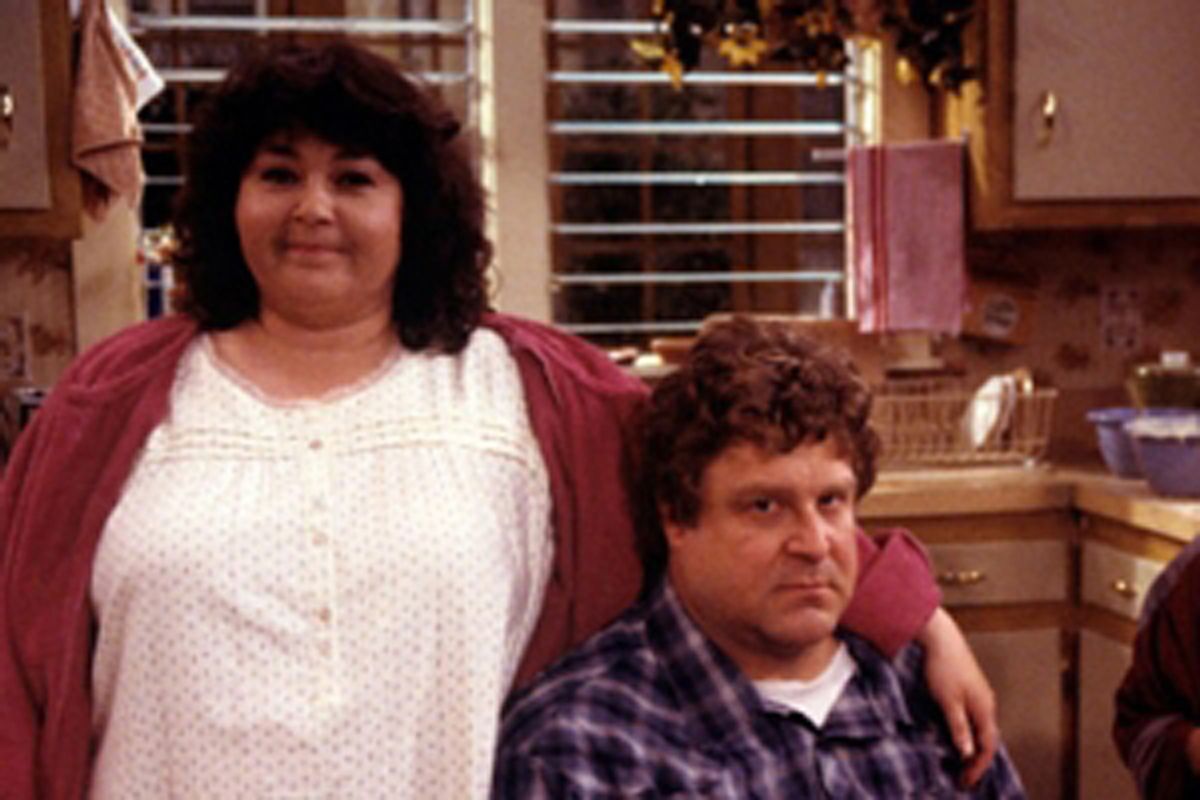
Run, Roseanne, Run!Roseanne Barr and Dan Goodman in a scene from "Roseanne"

Even as I knew it to be an elaborate performance gag, when Roseanne Barr told Jay Leno on “The Tonight Show” last week that she had decided to run for president, I felt a cheer rise in my throat.

I wouldn’t vote for most comedians for condo-board secretary, but I have a soft spot for Roseanne. To me, Roseanne is more than just another entertainer. She was an award-winning, powerhouse champion of the working-class American family while I was growing up in one, portraying a slice of America that the rest of network television tried to pretend away. Years later, that still means something to me. I suspect I’m not alone.

Growing up, I watched a lot of TV, virtually none of it educational in a traditional sense. My parents both worked strange and exhausting hours, so chauffering us to rec league soccer practice and the like was not going to happen. We went home after school and, bored out of our skulls, memorized every re-run of “Night Court.” (We did learn what “solicitation” meant, marking those hours not quite wasted.)

My stepfather worked as a maintenance electrician at a steel mill outside of town. The work was hot and dirty and frankly, beneath his talents and intellect, but a paycheck was a paycheck — and however you looked at it, his laundry still had to be done. That was my job, to monitor his jumpsuits and ensure he always had a clean one for work. More than 20 years later, I can still smell and feel the layer of industrial dust mixed with sweat coating the rough canvas as I stuffed as many as would fit into the washing machine during a commercial break, hoping they would be ready by the time he left for work.

I studied shiny, middle-class TV families like the Cosbys and the Seavers with an anthropologist’s eye, making notes for my future, which I had decided would never put me on the swing shift: graduate school, briefcase, expensive, colorful sweaters.

But I watched “Roseanne” with a sort of religious devotion. Their little house on the corner of Third and Delaware looked like our house: small rooms, mismatched furniture, haphazard quilts. Unlike most TV sets, Lanford looked like my crappy little Heartland town, with similarly dismal prospects for employment and entertainment, the closest city hours away by unreliable car.

And here were parents like my own — a mother frighteningly articulate, hilarious and loud, overworked and underemployed, futilely dieting and heating up fish sticks for dinner; a father who built and fixed things for a living, who wore thick work gloves and steel-toed boots. Kids who were, in the looks and smarts departments, average-to-questionable like me.

It was like discovering home movies you never realized were being made. What could we learn about ourselves in this half-hour every week?

Well, for one thing, we saw that our mother could end up waitressing at the mall if she lost her job at the hospital. (As if I wasn’t enough of an anxious middle child already. ) And yet I continued watching. “Roseanne” was honest, replacement Becky notwithstanding. In the Conner household, name-brand jeans were not a birthright, but a rare treat to be coveted, earned or denied. Dan wasn’t an idiot, Roseanne wasn’t a martyr, and nobody in authority ever tried to reach the kids through an awkward educational rap.

Barr didn’t create the first working-class TV family, but she did create the one that felt like the writers were peering into my kitchen window, taking notes while we fought mercilessly over the last chocolate pudding cup. We often look to art to reflect images of ourselves, and if that image was not always beautiful or orderly on “Roseanne,” it was an image I hungered for — tired people in ugly sweatshirts clocking in at jobs they disliked with a joke on their lips, a reality to balance all the TV fantasy — even as I looked forward to a brighter, college-educated future.

The working-class life is a fragile one, always two lost paychecks and an ER visit away from financial disaster — as those who thought they would always be middle-class have been busy learning in recent years. I am reminded of it now as I file for my own unemployment check and send in my COBRA payment, another laid-off journalist with a creative-writing degree starting over, Darlene all grown up.

I don’t think it’s a coincidence that Barr has resurfaced now, with a new memoir and a Lifetime reality show about wacky adventures on her Hawaii macademia farm to accompany her presidential bid. We’ve missed our fallible yet tough matriarch, and we need her to speak the truth as she sees it now more than ever.

In a May essay in New York magazine about the dysfunction and misogyny behind the scenes of network television, Barr doesn’t points out how her show, 14 years after its end, remains ahead of its time now, “when Americans are, to use a technical term from classical economics, screwed.”

Maybe there are only so many television housewives, real or desperate, we can stomach before we find ourselves longing for images of women who work the line at a plastics factory; women who open a modest sandwich joint rather than a glitzy low-cal margarita line, women who understand the very pointed difference, as the mothers in my neighborhood did, between staying at home and not having a job.

And so if Barr’s candidacy sounds like a joke, it’s a delightful one at least — she told Leno she’d forgive student loans and other debt, legalize marijuana, eliminate taxes and return us to a primitive agriculture-based barter system because, as she zinged, “you can’t eat money.”

On her website, Barr writes, “I’m tired of watching as men destroy all the world. Everything used to be beautiful when women were in charge, and now I, working as the physical manifestation of the goddess Isis and the reincarnation of Cleopatra, have decided to save the world.”

It is unhinged and loopy, as jokes go. And yet. Re-hire Joss Whedon and Judd Apatow, Roseanne, and get Amy Poehler on the line — you have a new “West Wing” to create, starring Isis and Cleopatra at the G-8. Certainly, that fantasy is more appealing than the current reality.

I would watch the hell out of that show — if I still had cable.

Is Stephen Colbert just kidding?

As the comedian holds a South Carolina rally with Herman Cain, an expert unravels what's real and what's satire

  • more
    • All Share Services

Is Stephen Colbert just kidding? Stephen Colbert and Jon Stewart. (Credit: Comedy Central)

Later today, Stephen Colbert will host a rally with Herman Cain in South Carolina. It’s part of his increasingly complicated involvement in his home state’s GOP primary. Colbert wants voters to back Cain as a way of supporting Colbert’s run for “president of the United States of South Carolina.” Write-in candidates aren’t allowed, hence the partnership with the one-time GOP front-runner, who qualified for the ballot before dropping out of the race amid controversy.

Who’s kidding who? Is the joke on Cain? On South Carolina voters? Or is Colbert not joking at all? His super PAC, Americans for a Better Tomorow, Tomorrow — technically now in the capable hands of his colleague Jon Stewart — has run a number of joke ads on TV. (One involves a lengthy attack on Colbert himself: “America is in crisis, and Stephen Colbert is turning our election into a circus. … Why is the ‘t” in his name silent? What else is he silent about? Letting murderers out of jail?”) But Colbert and Stewart also spent a significant segment of Tuesday night’s “Daily Show” explaining the dos and don’ts of super PAC coordination — a satirical cover for discussion of an undeniably serious subject.

Just what is the comedian — or is he a civic activist — up to? Russell Peterson, author of “Strange Bedfellows: How Late-Night Comedy Turns Democracy Into a Joke,” provided some insight into the evolving Colbert phenomenon.

How are Stephen Colbert’s recent and planned political activities — his super-PAC formation, possible run for “president of the United States of South Carolina” and upcoming event with Herman Cain, for example — different from what he has done in the political sphere before (e.g., congressional testimony, public rallies in D.C.)?

His campaign and super PAC activities are different in scale — they’re more sustained efforts, and are bound to get more attention than one-off things like the times he’s testified before Congress — but I think the intentions are the same.

Do these activities count as comedy? Is there something else going on here — a genuine attempt to educate people about the rules of super PACs, for instance, or to seriously sway the electorate? Or is it a mix — some kind of civic-minded performance art?

They are certainly comedy, and on those rare occasions Colbert has been pressed to give a “sincere” (by which I only mean “out of character”) answer as to what he is up to, he seems to suggest that they are only comedy. (From the recent New York Times Magazine piece: “Colbert says that education isn’t his aim with the super PAC — being funny is.”) But a comedian — and a satirist, especially — operates under the professional obligation, when cornered, to claim that he is only kidding. I think your phrase “civic-minded performance art” captures what he is actually doing pretty well. I do think being funny is his first priority, but he is definitely educating people about super PACs and the real-life consequences of the Citizens United decision. And even if he is making sport more than he is crusading, he’s performing a real public service by illuminating this. He has almost certainly done more to educate the public about the campaign ads they see, and how the Citizens United decision has effectively sanctioned what amounts to “money laundering” in hiding the origins of such advertising, than anyone in the mainstream media. This is partly because he can present a potentially dry and confusing topic in an entertaining way. But it is also because he is unhindered by the obligation of “mainstream” journalists and news organizations to maintain the appearance of objectivity.

The subject of campaign finance is fraught with challenges: It’s potentially dry, and a simple explanation doesn’t do much to demonstrate its importance and potential impact on the political process. The best, “straight” way to tell the story would be to focus on one or two examples of the process in action — but that would mean, first of all, “singling out” some candidates’ ads, which is not “balanced.” An even bigger challenge is that the heart of the issue is the lack of transparency. You can’t “follow the money” to get to the bottom of who funds these ads — that’s the whole point. But Colbert is in a position to exploit both his fame and his identity as a comedian to create an example. The whole thing has been an incredibly patient, sustained explication of the process Citizens United has enabled — he’s been at this for months. He created the PAC — hired former McCain campaign counsel Trevor Potter to draw up the paperwork, filed with the FEC, collected contributions, created ads that ran in Iowa (and also on his program, and on cable and network news — where “original” reporting on these issues has been scarce, at best), “transferred” control of the PAC to Jon Stewart, etc. Even if the main intent is to create a kind of running gag for the show and the Colbert character, it is, at the same time, long-form journalism — something that is necessary to really explicate such a complex issue, but also something that is very difficult to pull off in the world of “straight” journalism nowadays, for a lot of reasons.

Do you think people — Colbert fans and general observers — understand what he’s up to? And if they don’t, is this ambiguity intentional?

I think the ambiguity is both a product of constructing this long-form satire somewhat “on the fly” and an intentionally cultivated aspect of the “I’m only kidding” dodge that allows Colbert and his writers/collaborators (including Stewart, Potter — even Cain?) to continue to get away with this. He can’t come out and say, “I’m asking people to vote for Cain because I’m playing an elaborate practical joke,” or, conversely, “I’m trying to shed light on an important issue.” If he, instead, hints at both possibilities (i.e., it’s just a joke, or it’s a kind of activism), he will be allowed to keep doing such things.

It’s tricky to maintain this kind of thing over the long haul. There’s a great book by Will Kaufman called “The Comedian as Confidence Man,” which examines the careers of American satirists from Mark Twain to Lenny Bruce, and finds that nearly all of them eventually succumb to what Kaufman calls “irony fatigue.” This arises, he says, from the frustration that comes from trying to engage in sincere social or political critique while having to maintain that one is “only kidding” in order to continue to be heard. If Colbert suddenly “turned serious” — owned up to having a sincere purpose — he would no longer be granted the kind of indulgence he gets as a comedian. Certainly, those commercials wouldn’t run as “comic relief” on the news channels. “Serious” people like Potter might not feel as safe playing along without the cover of “it’s just a joke.”

But this is where Colbert is in a much better position to really dig deep than any other “political” comedian — even Jon Stewart. Because he’s got this same-named persona, and because his very identity is somewhat ambiguous, he has a great deal of leeway to actually involve himself in the political process, not just stand outside of it and mock it, as Leno, Letterman, Johnny Carson, etc., have traditionally done, and as even Stewart seems somewhat obligated to do, in order to maintain the appearance of being an “impartial referee.” Because Colbert portrays a character that is not exactly “himself,” he is invulnerable to charges that he is just an advocate, or that he is just an entertainer who ought to “shut up and sing,” or that he is being unfair to this candidate or that party. Whatever he’s accused of becomes grist for further satire. If the “real” Colbert is accused of trivializing the process, or smuggling a liberal message, or wasting Congress’ time, or whatever, the “fake” Colbert can respond with mock umbrage, raise the stakes by doing something more transparently outrageous, and make the accusers look like they can’t take a joke in the process.

How have comedians historically performed in public opinion polls? Is it common for them to do well compared to serious political candidates?

The first precedent that comes to mind is, of course, the late Pat Paulsen, who was a “candidate” in six presidential elections, from 1968 until his death in 1997.

Comedians (from joke candidate Paulsen to ex-comedian turned U.S. Sen. Al Franken, D-Minn.), other entertainers (from Frank Zappa, who flirted with the idea, to Ronald Reagan, who made the transition over many years) have “run for” high office, with varying degrees of seriousness and success.

Colbert can be compared to Paulsen in so far as he is “running” with no hope or expectation of actually gaining office, and with the actual purpose of satirizing aspects of the process. But — not to take anything away from Paulsen, whose 1968 “campaign,” launched on “The Smothers Brothers Comedy Hour,” actually made CBS extremely nervous — Colbert’s approach is more specific and more politically engaged. Paulsen mainly attacked the venality and hypocrisy of politicians, which — though worthy of mockery — are timeless, nonpartisan and somewhat safe targets. But by actually establishing what is, in a literal sense, a “legitimate” super PAC, trying to “sponsor” the GOP ballot in S.C. (and making the corporate personhood referendum a condition of that offer), Colbert is intervening in actual issues, rather than just making fun of politics or politicians in general.

What do you think will be the Colbert campaign’s real-world impact?

I think it has already increased awareness of the state of campaign finance, and why the present situation, especially the aspects created by Citizens United, is so awful. I wish I could say that I think this heightened awareness will translate into enough public support that efforts to reform this will succeed. Unfortunately, the best possibility for overturning C.U., or delegitimizing the notion of corporate personhood, seems to be a constitutional amendment of the kind U.S. Sen. Bernie Sanders, I-Vt., and a few others have proposed — and that’s a process for which the bar is set pretty high. Even with the attention he is getting now, Colbert’s audience is pretty small, and a constitutional amendment would require a very high level of public awareness and support to succeed, especially given the forces that would be arrayed against it. Any member of Congress who supported such an amendment would risk losing the financial support, and engendering the wrath, of the beneficiaries of the C.U./super-PAC/corporate personhood status quo. It would be political suicide for most of them, and only worth the risk if there was sufficient public awareness and support to overcome those negative consequences. That, unfortunately, is asking a lot from an electorate that are much more inclined to view politics through the Jay Leno, “they’re all crooks, why care?” lens, if they think about politics at all.

That pessimism aside, I’m a big fan of what Colbert is doing, here. I think comedy like this has tremendous potential to educate people about important issues. Not enough people are getting the message to overcome the obstacles that lie in the way of doing something about it, but it’s at least a start. He’s done more to explicate and call attention to these issues with his half-hour show (that’s not even on a full five weekdays) than the 24-hour “news” networks have done, and he’s “front-paged” it in a way even better news organs, with their focus on daily events, can’t or won’t do.

At what point in his political involvement do you think Colbert might cease to be considered simply a “comedian” (or has he crossed that line already)?

He’s crossed the line repeatedly, beginning with his appearance at the White House Correspondents’ Dinner back in 2006, continuing through his 2008 Doritos-sponsored presidential campaign, through his congressional testimony on migrant labor, and on up through the super PAC stuff and the South Carolina primary. And yet, he’s still, indisputably, a comedian. He’s still funny, and never “preachy” — something you couldn’t say about Stewart or Bill Maher, who have had their preachy moments.

The key is the persona: the deniability of responsibility it gives him, and the ambiguity inherent in having an alter ego with the same name, which puts anyone who tries to call him out for overstepping his comedic bounds on shaky ground.

As I said, he’s got to maintain recourse to that “out” that he is only kidding, or he wouldn’t be allowed to keep intervening in things as he is doing.

But we shouldn’t overlook the fact that he is an incredibly talented writer/performer supported by an incredibly smart and funny staff of writers. He couldn’t successfully maintain the blurriness of that line between “I mean it” and “I’m kidding” if he wasn’t consistently funny when stepping from one side of that line to the other.

Continue Reading Close

Emma Mustich is a Salon contributor. Follow her on Twitter: @emustich.