9/11
Books to enlighten, and help us remember
A preview of several striking new releases timed to coincide with 9/11's 10-year anniversary
Ten years ago this September, the events of a single day simultaneously shattered our national confidence and awakened our collective compassion. Over the past decade, fears that became familiar in 2001 have hardly receded, as the U.S. and our allies have inaugurated controversial international conflicts — and continued to confront an ever-diversifying, never-quite-tangible terrorist enemy.
The 10th anniversary of the attacks will be marked by a library of new books, as well as reissues of several essential titles published over the past 10 years. Notable works in the latter category include updated editions of Jim Dwyer and Kevin Flynn’s “102 Minutes,” the 9/11 Commission Report, David Friend’s “Watching the World Change,” and Noam Chomsky’s “9/11″; they serve to complement 2011′s own explainers, histories and elegies.
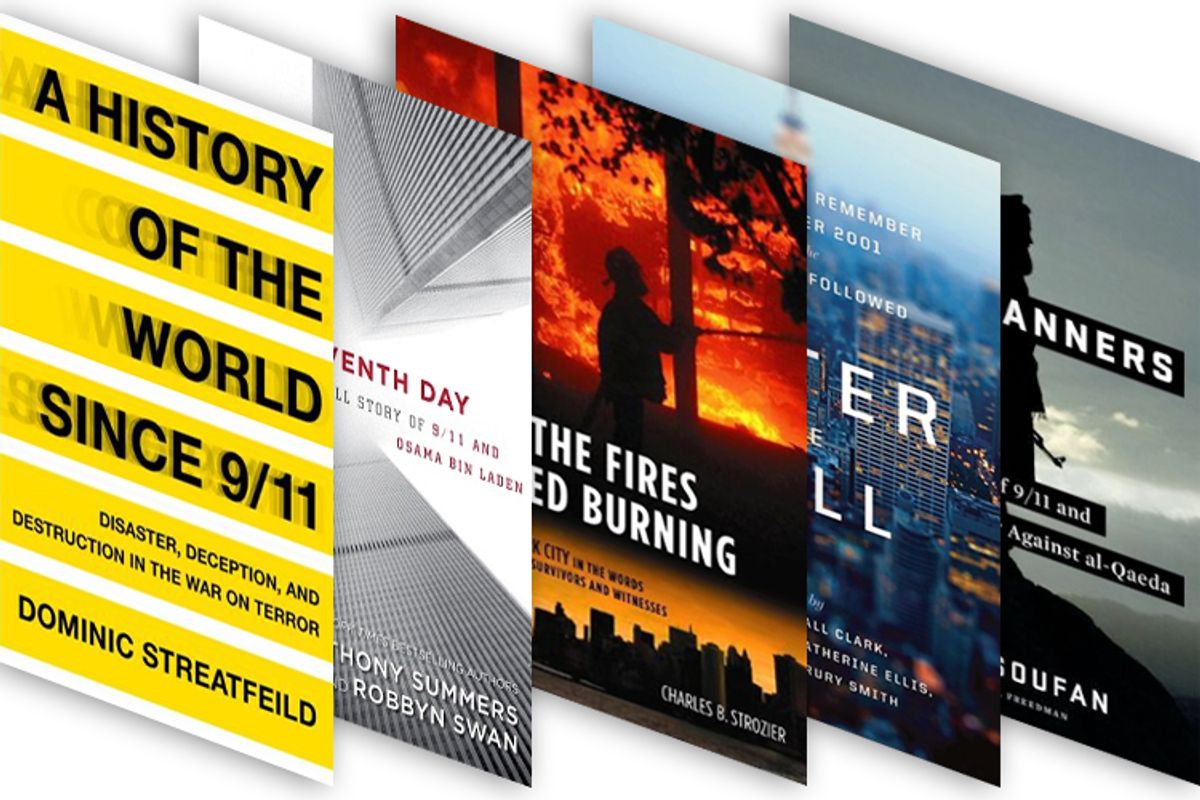
Here are five standout new releases to look out for this autumn:
“After the Fall: New Yorkers Remember September 2001 and the Years That Followed,” edited by Mary Marshall Clark, Peter Bearman, Catherine Ellis and Stephen Drury Smith (New Press, Sept. 6)
“A guiding premise of the oral history archive is that one learns more ‘from traveling through a single land with a thousand pairs of eyes than traveling through a thousand lands with a single pair of eyes,’” write Peter Bearman and Mary Marshall Clark (quoting Proust) in their introduction to this powerful volume based on sources assembled by Columbia University’s Oral History Research Office in the wake of the 2001 attacks. The 19 people whose stories are charted here range from artists and street vendors to paramedics, psychotherapists and priests; their collected conversations root the events of 9/11 in the context of their own lives — and the life of the city itself.
“The Black Banners: The Inside Story of 9/11 and the War Against al-Qaeda,” by Ali H. Soufan (W.W. Norton & Company, Sept. 12)
Writing for the New Yorker in 2006, Lawrence Wright described Ali Soufan — the author of this highly anticipated volume — as “America’s best chance to stop the attacks of September 11th.” (Read Wright’s full profile — and explanation of what went wrong in the months and years before the attacks — here.) This work sees the former FBI special agent give his own uniquely informed, granular take on 9/11 — and the momentous, long decade that has followed.
“The Eleventh Day: The Full Story of 9/11 and Osama bin Laden,” by Anthony Summers and Robbyn Swan (Random House; already available)
This book by husband-and-wife team Anthony Summers and Robbyn Swan seeks to provide a comprehensive and “essential” account, not only of the 9/11 attacks themselves — their planning and enactment — but also of the political and historical forces they set in motion. Particularly impressive is the fact that it incorporates the death of bin Laden (which initially “upended” six years of research, as editor Mark Tavani explained to the Associated Press earlier this year).
“Until the Fires Stopped Burning: 9/11 and New York City in the Words and Experiences of Survivors and Witnesses,” by Charles B. Strozier (Columbia University Press, Aug. 30)
“The tenth anniversary moves personal loss into historical memory,” wrote psychotherapist and professor Charles B. Strozier (who directs the Center of Terrorism at John Jay College of Criminal Justice) on his blog earlier this summer, in a general discussion of the process of dealing with the loss of a loved one. Strozier then compared this personal process to the wider, “collective experience” of remembering 9/11: “After the tenth anniversary, the sense is that we will think differently about 9/11, reflect on it as part of ongoing history, study it more than relive it, a process, needless to say, that is not always welcome by survivors.” Strozier’s own upcoming work, “Until the Fires Stopped Burning,” examines New Yorkers’ diverse experiences of 9/11, exploring the geography of the city’s grief through interviews and original analysis.
“A History of the World Since 9/11: Disaster, Deception, and Destruction in the War on Terror,” by Dominic Streatfeild (Bloomsbury, Aug. 16)
This “crackl[ing],” provocative work — released in Britain this February — sees Dominic Streatfeild put eight separate international incidents under his journalistic microscope to craft a troubling mosaic that illustrates “the sleep of reason and good sense in successive U.S. administrations post-9/11.”
Emma Mustich is a Salon contributor. Follow her on Twitter: @emustich. More Emma Mustich.
Hiding 9/11′s last secrets
The military tribunal for Khalid Sheikh Mohammed means the American people will never know what drove him to terror
(Credit: Reuters//Brennan Linsley) After a Navy SEAL team killed Osama bin Laden at his Pakistan hideout a year ago this week, it flew his body to the Arabian Sea, weighted it down, and slid it silently off an aircraft carrier into the watery depths.
For many Americans, the secret raid provided a measure of revenge and catharsis for the strikes of Sept. 11, 2001. But it didn’t provide the kind of justice and official reckoning that the country needs to gain real closure. Now the government has a chance to achieve that through a full, fair and open trial of Khalid Sheikh Mohammed and four co-defendants, so the world can finally see the evidence against him as the true architect of the attacks on New York and Washington. The trial kickoff — an arraignment for the men — is scheduled for this Saturday at the U.S.-run detention facility in Guantanamo Bay, Cuba.
Continue Reading CloseJosh Meyer is the author, with Terry McDermott, of the new book, "The Hunt for KSM: Inside the Pursuit and Takedown of the Real 9/11 Mastermind, Khalid Sheikh Mohammed.’’ More Josh Meyer.
Marky Mark saves the universe!
The "Contraband" star suggests he could have stopped 9/11 -- and inspires a genius viral art explosion online SLIDE SHOW
(Credit: quickmeme.com) Mark Wahlberg’s insensitive comments about 9/11 have sparked incredulity everywhere from Twitter to the cover of the New York Post. Earlier this week, in an interview with Men’s Journal, the actor seemed to confuse himself with Chuck Norris:
Continue Reading CloseEmma Mustich is a Salon contributor. Follow her on Twitter: @emustich. More Emma Mustich.
An “incredibly close” screening
A preview of “Extremely Loud and Incredibly Close” turns into group therapy for post-9/11 New Yorkers
A movie that asks are we ready to talk about 9/11? I knew all those years of sitting in darkened theaters on sunny afternoons, awash in movies new and old, stale popcorn and gallons of diet soda, would pay off some day. For one, there was the woman I met in 1975 at the late, lamented Carnegie Hall Cinema during a Mel Brooks double feature. She came and sat next to me when a guy kept bothering her during “Blazing Saddles” and we wound up dating — until she lit out for a career in the hinterlands, acting in summer stock.
But as lovely as she was, that’s not the payoff I mean. All that time reading about and watching movies didn’t just prepare me for romance, or Jeopardy and Trivial Pursuit, if it comes to that. (Quick—the address of Charles Foster Kane’s love nest with Susan Alexander? 185 West 74th Street.)
Continue Reading CloseMichael Winship is senior writing fellow at Demos and a senior writer of the new series, Moyers & Company, airing on public television. More Michael Winship.
How the feds fueled the militarization of police
Billions in post-9/11 taxpayer dollars have paid for combat-style gear on display in the Occupy crackdowns
Police in riot gear move to a location at the port facilities in Longview, Wash., Wednesday, Sept. 21, 2011. (Credit: AP/Don Ryan) The militarization of America’s metropolitan police forces was on full display in recent months as police from Los Angeles to New York cracked down on Occupy protests, decked out in full SWAT gear and occasionally using strange pieces of military hardware.
Less well known is that police forces in small towns and far-flung cities have also been stocking up on heavy equipment in the years since Sept. 11, 2001.
Continue Reading CloseJustin Elliott is a reporter for ProPublica. You can follow him on Twitter @ElliottJustin More Justin Elliott.
“Extremely Loud & Incredibly Close”: Post-9/11 trauma, made cute and dull
The sentimental bestseller "Extremely Loud & Incredibly Close" becomes a dreary Tom Hanks-Sandra Bullock weeper
Thomas Horn and Tom Hanks in "Extremely Loud and Incredibly Close" A few weeks ago I wrote a largely negative review of Kenneth Lonergan’s long-delayed “Margaret,” a sprawling and ambitious attempt at weaving a multi-character cinematic tapestry about life in post-9/11 New York. I stand by every word, but I also understand why a group of critics and cinephiles have campaigned to get “Margaret” on the awards-season radar screen, in the face of Fox Searchlight’s evident decision to abandon it on the curb like a stillborn hamster. “Margaret” is coming back to New York’s Cinema Village this weekend, and if you’re in the neighborhood and want to see a flawed, big-hearted, intermittently marvelous and maddening epic about the legacy of 9/11, go check it out. You certainly won’t find any such grand emotions in “Extremely Loud & Incredibly Close,” which renders Jonathan Safran Foer’s best-selling 2005 novel into unconvincing Hollywood mush.
Continue Reading ClosePage 1 of 54 in 9/11