The Help

Judge throws out suit against “The Help” author

Woman who alleged writer Kathryn Stockett used her likeness without permission screams: "She knows she did it"

  • more
    • All Share Services

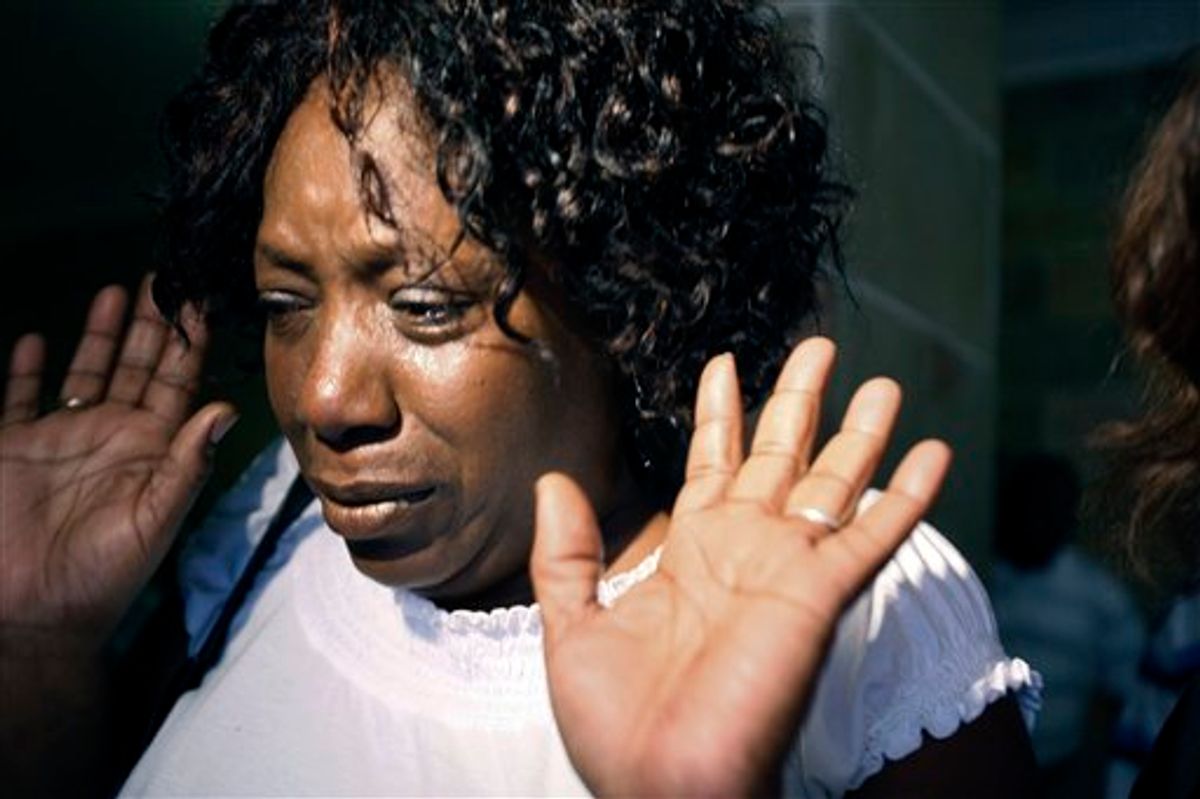
Judge throws out suit against Ablene Cooper leaves a Hinds County courtroom in Jackson, Miss., Tuesday, Aug. 16, 2011, after a circuit judge dismissed her lawsuit against Kathryn Stockett, author of the best-selling novel "The Help." "The Help" was made into a movie that opened last week. It's based on relationships between white families and the African-American women who worked for them in the 1960s. The lawsuit was filed by Cooper, who works for Stockett's brother. She claims a main character, Aibileen, is based on her. Cooper accuses Stockett of using her name and likeness without permission. (AP Photo/Rogelio V. Solis)(Credit: AP)

Did Kathryn Stockett use her brother’s African American maid as the basis for a character in the bestselling novel-turned-movie “The Help?”

For now, that question may go unanswered, by a court anyway.

A Mississippi judge threw out a lawsuit Tuesday in which Ablene Cooper alleged Stockett used her likeness without permission in a book about relationships between white families and their black maids in the segregated South of the 1960s.

Hinds County Circuit Judge Tomie Green granted a motion for summary judgment, dismissing the case because a one-year statute of limitations elapsed between when Stockett gave Cooper a copy of the book and when the lawsuit was filed. The lawsuit sought $75,000 in damages.

Stockett was not in court in Jackson, the same city where the book is set.

Cooper wiped away tears leaving the courtroom and launched into a tirade outside the courthouse.

“She’s a liar. She did it. She knows she did it,” Cooper screamed.

The judge did not make any determination on whether Cooper was the basis for the character, Aibileen, saying the statute of limitations trumped those matters.

Besides the similarities in names, Cooper’s lawsuit says she lost a son shortly before going to work for Stockett’s brother, where she takes care of two children, a boy and a girl. Cooper’s lawsuit says that’s the same as the character portrayed in the book.

Cooper’s attorney, Edward Sanders, told The Associated Press he will consider the legal options available, including an appeal.

Melissa Broder, Stockett’s publicist, had no comment. One of Stockett’s attorneys, Fred Banks Jr., had no immediate comment either, saying he would release a statement later.

Stockett’s defense team argued in court papers that Cooper and the character are not that similar.

“‘The Help’ does not use Mrs. Ablene Cooper’s name. It uses the name Aibileen Clark. It does not paint a picture of Mrs. Ablene Cooper, middle-aged in 2011. It paints the picture of Aibileen Clark, middle-aged in 1962,” the lawyers said in court filings.

Stockett’s attorneys said in court records that Aibileen is based on the late Demetrie McLorn, the Stockett family’s housekeeper, who died when the author was a teenager.

“The Help” was made into a movie that opened last week. It debuted at No. 2 nationwide, bringing in $26 million.

The lawsuit says Stockett’s refusal to acknowledge that she based the character on Cooper’s likeness “is so outrageous in character, and so extreme as to go beyond all bounds of human decency, and is utterly intolerable in a civilized community.”

The suit also says that during a 2009 interview with The Atlanta Journal Constitution, Stockett said: “When I was writing this book I never thought anyone else would read it, so I didn’t get real creative with the names. I just used people I knew. Some of them aren’t talking to me right now, but I feel like they’ll come around.”

After court Tuesday, Cooper’s adult son wrapped his arm around his mother’s shoulders and yelled at a throng of reporters to get out of their way as they walked toward their car.

Cooper has said she’s been embarrassed and distraught by the language used by the character that she says is based on her.

“You see how I’m hurt? You know I’m hurt,” Cooper said outside the courthouse.

The lawsuit quotes passages from the book, including one in which Aibileen’s character describes a cockroach: “He black. Blacker than me.”

The lawsuit says Cooper found it upsetting and highly offensive to be portrayed as someone “who uses this kind of language and compares her skin color to a cockroach.”

Cooper’s lawyer acknowledged in court that Stockett gave her a copy of the book in January 2009, about a month before it was published. The lawsuit was filed in February 2011.

Sanders, Cooper’s lawyer, said a note Stockett wrote to Cooper falsely implied the book had nothing to do with Cooper, so she didn’t read it until later. Sanders argued that the statute of limitations should have begun later, when Cooper eventually read the book.

The judge was not persuaded.

How Viola Davis took Meryl Streep’s Oscar

The outspoken star of "The Help" may have won a lady-like Oscar throwdown -- with her good friend's blessing

  • more
    • All Share Services

How Viola Davis took Meryl Streep's OscarMeryl Streep and Viola Davis(Credit: AP/Chris Pizzello)

When I saw Viola Davis across the room, wearing a shimmering pink sheath dress, I wasn’t quite sure what she was doing there. This was at the New York Film Critics Circle’s awards dinner in January, a relatively intimate event that has a history of bringing out the stars. But it’s not the Oscars or the SAG Awards or the Golden Globes; there are no TV cameras and no red carpet to work. More to the point, the awards are announced in advance, and Davis hadn’t won anything. Maybe she’d have turned up anyway to support Jessica Chastain, her costar in “The Help,” who was winning a supporting-actress award, but Davis was mostly on hand to introduce Meryl Streep, who had won the group’s best actress award for her performance as Margaret Thatcher in “The Iron Lady.”

In a striking kickoff to the two actresses’ back-and-forth awards-season competition, Davis paid a warm tribute to the woman she described as an idol, a mentor and a friend. She spoke openly about the loneliness of being an ambitious African-American actress with very few role models to follow, who had seen talented forerunners like Cicely Tyson and Dorothy Dandridge essentially kicked to the curb by Hollywood. She hadn’t been looking for a Caucasian role model, she said, but the craft and range of Streep’s work on stage and screen had always impressed her, and when they worked together on the 2008 film “Doubt” (for which both were Oscar-nominated) they became good friends. Streep’s example had demonstrated a fearlessness and generosity, Davis told us, that had opened new pathways in her personal and professional life.

Streep then took the stage to deliver a dry comic monologue in which she claimed — incorrectly, I believe — that only a minority of the critics in the room had voted for her. (I’m a member of the group, and I don’t understand its voting procedures, but Critics Circle chair John Anderson has said that Streep won a first-ballot majority.) But before she moved on to that, Streep thanked Davis for her introduction: “How remarkable, and how generous, for you to do that. This is your year.”

That was a heck of a lot of high-class dames in less than five minutes, and we were all appropriately dazzled. But looking back on that event, and Davis’ remarkable speech, I think that Meryl Streep saw what was coming more clearly than the rest of us did. (Furthermore, I think she’s 100 percent fine with it.) At that moment, she looked like the prohibitive favorite to win the best actress Oscar, both because she had given a dominating performance as a major historical figure in a big holiday-season movie, and also because she has been nominated an unbelievable 13 times since her last win (for “Sophie’s Choice,” in 1983) and at age 62 is probably close to the end of her leading-lady career. She went on from the New York critics’ award to win several other prominent critics’ groups, along with the BAFTA Award and the Golden Globe. A shoo-in, right?

Not exactly. Of course I could be proven wrong, but along with virtually everybody else who pays attention to this circus, I’m betting that Viola Davis ends up clutching one of those little gold statues on Sunday night — as much because everybody watching wants to hear her acceptance speech as because of anything she did on-screen in “The Help.” People talk about all the backstage hoodoo that goes into an Oscar campaign, and Harvey Weinstein’s admittedly amazing powers to bend the minds of Academy voters to his will. But I’m not sure we’ve ever seen an actor go out and claim an Oscar during the campaign in quite the forthright and dramatic way that Davis has.

Davis evidently decided that this was her opportunity, after a long career of stage roles and oddball supporting parts and runs on “United States of Tara” and “Law & Order: SVU,” to come out with guns blazing and let the world know who she was and what she thought. It may have been a calculated decision on some level, but she’s a ferocious, intelligent and independent-minded woman as well as an outstanding actor, and there’s nothing strategic about that. She has spoken directly about all the racial and social discomfort caused by “The Help,” and about the yearning for positive role models that sometimes limits the choices of African-American artists.

Most notably, when PBS talk-show host Tavis Smiley told Davis and costar Octavia Spencer (who is also likely to win, for best supporting actress) that he felt ambivalent about the prospect of them winning Academy Awards for playing servants, six decades after Hattie McDaniel, Davis delivered a dressing-down that violated the happy-friendly norms of chat TV. “That very mind-set that you have and that a lot of African-Americans have is absolutely destroying the black artist,” she told Smiley. “The black artist cannot live in a place — in a revisionist place. A black artist can only tell the truth about humanity, and humanity is messy, people are messy.” Smiley was clearly startled — but he was standing on the track in front of the Viola Davis Oscar Express. One can only pity the fool.

Davis has talked openly, but without a hint of self-pity, about the difficulties of being a black actress in an industry that still relies heavily on caricature and stereotype, and even about being a dark-skinned black actress at a time when, as she recently put it, “Halle Berry is having a hard time.” After she brought this up, during a Newsweek panel discussion featuring various Oscar candidates, Charlize Theron jumped in to assure Davis she was “hot as shit,” which was a nice thing to say and all but (as many commentators have observed) massively misses the point. Win or lose at this year’s Oscars, Davis won’t get offered Theron’s wide-ranging dramatic roles, from serial killer to narcissistic sexpot, and won’t get the Vogue covers or Dior endorsement deals either. If it’s any consolation — and it probably is — Theron’s “Young Adult” was a dud, and she was not nominated this year.

As far-fetched as this seems now, when Davis delivered that Manhattan introduction for Streep, she was a long way from being a for-sure nominee herself. She had appeared in a pulpy, controversial hit that had opened well before Oscar season and was aimed 100 percent at female audiences (two doses of poison for the guy-centric Academy), a movie that made a lot of money and ignited a sharply polarized debate on the history of race in America. That’s at least three strikes, maybe four — and then there was the question of whether Aibileen Clark, Davis’ character in “The Help,” even qualified as a leading role. Emma Stone’s crusading white journalist, Skeeter Phelan, is clearly the protagonist, and Aibileen is pretty much the stoical, even-tempered Robin to Skeeter’s hotheaded Batman. On the other hand, while Stone and Spencer and Jessica Chastain and Bryce Dallas Howard and all the other women in the movie chew up the scenery (and often enjoyably so), Davis delivers a performance of tremendous dignity and quiet, almost stillness. Amid all the histrionics and violence and poop-eating, Aibileen is like a Zen monk contemplating the essential emptiness of everything. She knows a great deal more than she says, and Davis communicates that nonverbally, through her carriage, her measured movements, the long pauses before she speaks.

Everything the Academy ever does can, and probably should, be viewed through a cynical lens. Nominating Davis for best actress — along with the supporting nods for Chastain and Spencer — was a way of honoring “The Help” as one of the year’s cultural touchstones while navigating around the racial controversy sparked by the film’s release. The Oscar-season script, a few weeks ago, looked something like this: African-American viewers got a rooting interest in the best actress campaign (while still being permitted, like Tavis Smiley, to deplore “The Help” on various levels), Davis got a major notch in her career belt, and Streep would go on to collect a career-spanning Oscar after a tour de force performance and many years as a bridesmaid.

Instead, Viola Davis has seized the opportunity. Not just the opportunity to stage an unlikely upset and win an Oscar, although she’s probably done that. More important, she has seized the chance to remind us that she is an immensely underutilized and underappreciated actress and one of the most outspoken free thinkers in the closed-mouthed, cliché-spouting world of Hollywood stardom. Should she be playing bigger and better parts than Aibileen Clark? Of course. Was that really the best screen acting performance of the year? Almost certainly not. But the Oscar is always about much more than that, like it or not, and someone with Meryl Streep’s social conscience and sense of drama understands that well. We’ll likely never know what Streep may have told her friend in private, but what she said in public was enough: “This is your year.” She was right.

Continue Reading Close

The Oscars play it safe, nostalgic

Hollywood applauds itself -- but ignores great turns in edgy films like "Melancholia," "Take Shelter" and "Shame"

  • more
    • All Share Services

The Oscars play it safe, nostalgicJean Dujardin and Uggie in "The Artist"

As usual, it all went almost exactly as expected. This year’s Academy Award nominations went to a plethora of already much-accoladed movies and performances, with a rich dose of nostalgia and sentiment. Yet when Academy of Motion Picture Arts and Sciences president Tom Sherak and last year’s best actress nominee Jennifer Lawrence announced the contenders this morning, there were still a few gasps to be had.

The surprises started with the supporting performance nominations. Kenneth Branagh, Jonah Hill and Christopher Plummer (“Beginners”) all seemed likely nominees. But it was the sentimental inclusion of “Extremely Loud and Incredibly Close’s” Max Von Sydow, and left-field nod for Nick Nolte in “Warrior” that roused the crowd.

For the supporting actresses, there were even fewer surprises to be had, with the likes of Bérénice Bejo and Octavia Spencer once again going head-to-head. But the inclusion of this year’s comedic It girl, Emmy winner Melissa McCarthy, for her bawdy, ballsy turn in “Bridesmaids” was a nonetheless sweet moment – and a rare display of evidence that you don’t have to be a glamazon or Dame Judi Dench to be in the running for Oscar. And the best original screenplay nomination for “Bridesmaids” was another encouraging sign, proving at last that women can not only make successful movies involving explosive diarrhea, they can make Academy Award-nominated movies involving explosive diarrhea.

The biggest surprise of the morning might have been the best actor nominations for “A Better Life’s” Demian Bichir and “Tinker Tailor Soldier Spy’s” Gary Oldman — and with them, the shutouts of “Shame’s” Michael Fassbinder and “J. Edgar’s” Leonardo DiCaprio. Or it might have been the best picture nomination for “Extremely Loud and Incredibly Close,” a film that was neither a box office home run nor a critical one — our Andrew O’Hehir called it “unconvincing Hollywood mush” — but happened to feature beloved, Oscar-winning stars Tom Hanks and Sandra Bullock.

What didn’t make the cut this year? Alan Rickman’s heartbreaking swan song as Snape in “Harry Potter and the Deathly Hallows: Part 2.” Albert Brooks’ shockingly malevolent turn in “Drive.” Joseph Gordon-Levitt’s fierce, unsentimental cancer patient in “50/50.” Ellen Barkin’s nightmarish mother in “Another Happy Day.” Olivia Colman’s abused wife in “Tyrannosaur.” Charlize Theron’s overbearing novelist in “Young Adult.” The brilliant end-of-the-world duo of Michael Shannon’s enigmatic father in “Take Shelter” and Kirsten Dunst’s depressed bride in “Melancholia.” And with them, their ignored films.

In the second year of the wider best picture category — and after a few years of some truly bold, innovative movies getting Oscar recognition (“Slumdog Millionaire,” “The Hurt Locker,” “District 9,” “Black Swan,” “Inception”) — the 2011 contenders seem more like a big fuzzy blanket of sweetness and nostalgia. “Hugo,” “The Artist” and “Midnight In Paris” are all, literally, about men stuck in the creative past. They’re all lovely movies. The word we keep hearing is “homages.” But when the most transgressive things on nomination day are a nod for the dude from “Superbad” and a best song nomination for one of the “Flight of the Conchords” guys, it’s a great year for the Oscars, all right. As long as that year is 1925.

Continue Reading Close
Mary Elizabeth Williams

Mary Elizabeth Williams is a staff writer for Salon and the author of "Gimme Shelter: My Three Years Searching for the American Dream." Follow her on Twitter: @embeedub.

“The Help” leads Screen Actors honors with 4 noms

Guild also gives nods to Meryl Streep, George Clooney, Michelle Williams and more

  • more
    • All Share Services

(Credit: DreamWorks Studios)

LOS ANGELES (AP) — The Deep South drama “The Help” cleaned up with four nominations Wednesday for the Screen Actors Guild Awards, among them honors for Viola Davis, Jessica Chastain and Octavia Spencer.

The adaptation of the best-selling novel also was nominated for best ensemble cast, along with the silent film “The Artist,” the wedding comedy “Bridesmaids,” the family drama “The Descendants” and the romantic fantasy “Midnight in Paris.”

Davis is up for best actress and Spencer for supporting actress as black maids who agree to share stories of their tough lives with an aspiring white writer at the start of the civil-rights movement in 1960s Mississippi. Chastain also was nominated for supporting actress as Spencer’s lonely, needy new boss.

“The Artist” ran second with three nominations, including a best-actor honor for Jean Dujardin as a silent star falling from grace amid the advent of talking pictures and supporting actress for Berenice Bejo, who plays a rising sound-era movie star.

Along with Davis, best-actress contenders are Glenn Close as a woman disguising herself as a male butler in 19th-century Ireland in “Albert Nobbs”; Meryl Streep as British Prime Minister Margaret Thatcher in “The Iron Lady”; Tilda Swinton as a grief-stricken woman coping with her son’s horrible deeds in “We Need to Talk About Kevin”; and Michelle Williams as Marilyn Monroe in “My Week With Marilyn.”

Joining Dujardin in the best-actor category are Demian Bichir as a hard-working illegal immigrant father in “A Better Life”; George Clooney as a neglectful dad tending his two daughters in “The Descendants”; Leonardo DiCaprio as FBI boss J. Edgar Hoover in “J. Edgar”; and Brad Pitt as Oakland A’s general manager Billy Beane in “Moneyball.”

The SAG Awards will be presented Jan. 29.

The nominations are among the first major honors on the long road to the Feb. 26 Academy Awards.

___

Online:

Continue Reading Close

Jessica Chastain: The dazzling redhead who's suddenly everywhere

After "Tree of Life" and "The Help" -- and with six more movies on the way -- Jessica Chastain's moment has arrived

  • more
    • All Share Services

Jessica Chastain: The dazzling redhead who's suddenly everywhereActress Jessica Chastain of the U.S. poses for photographers as she arrives on the "Wilde Salome" red carpet at the 68th Venice Film Festival September 4, 2011. REUTERS/Alessandro Bianchi (ITALY - Tags: ENTERTAINMENT PROFILE TPX IMAGES OF THE DAY)(Credit: Reuters)

Jessica Chastain may not yet qualify as a movie star, but within seconds of meeting her you completely understand why every casting agent in Hollywood is convinced she will become one. To put it bluntly, she is dazzling — and I’m talking more about her manner and presence than her beauty, although she’s exceptionally pretty, with flaming red hair and pale, translucent skin. She’s vivacious and charming, seemingly without effort, and has the kind of spectacular smile that uplifts everyone’s spirits within a 50-foot radius.

It makes you wonder where all those casting directors and filmmakers who so desperately want Chastain in their movies now were a few years ago, when she was a little-known television actress whose biggest part had been a four-episode role on “Law & Order: Trial by Jury.” There are no answers beyond the usual clichés: Showbiz is full of pretty faces, and sometimes all it takes is one little break. Chastain’s break was pretty big, and came when Terrence Malick cast her opposite Brad Pitt in “The Tree of Life,” where her shimmering, ethereal presence created a thematic and visual balance to Pitt’s intense, compulsive, authoritarian father-figure.

But “Tree of Life” was only the tip of the iceberg, and the 30-year-old Chastain has most definitely been making up for lost time. In terms of audience appeal, her biggest role has been as Celia Foote in “The Help,” the hapless, white-trash-made-good housewife who was both that film’s comic relief and, in an odd way, its most honest and unaffected white heroine. The scene when Celia insists on eating lunch in the kitchen with her African-American maid (Octavia Spencer) — who is none too sure she wants to be friends with this high-maintenance, neurotic white lady — was arguably more moving than “The Help’s” more histrionic race-relations drama.

It’s not much of an exaggeration to say that Chastain seems to suddenly be in every upcoming film. Within the last year or two, she has played a Mossad agent (the younger version of Helen Mirren) in “The Debt,” a detective in the serial-killer drama “Texas Killing Fields” (out next month), Virgilia in Ralph Fiennes’ version of Shakespeare’s “Coriolanus” (to be released this winter) and Salome in Al Pacino’s meta-theatrical “Wilde Salome,” which premiered in Venice a few days before I met her at the Toronto International Film Festival. Her big-budget Hollywood breakthrough may lie just ahead, since she will reportedly star opposite Tom Cruise and Olivia Wilde in “Horizons,” an interplanetary science-fiction thriller from “TRON: Legacy” director Joseph Kosinski.

Then there’s “Take Shelter,” an intense psychological horror drama from indie director Jeff Nichols — looking for his own breakthrough after the 2008 underground sensation “Shotgun Stories” — which Chastain was promoting in Toronto. I’ll have more to say on this film very soon, but it’s an absolute knockout, one of the best American films of the year. Chastain and the remarkable Michael Shannon play Samantha and Curtis, a married couple in small-town Ohio clinging to the lower edges of the working class. It’s very much a film about this moment in America, a film about economic recession and madness and faith and family, even  climate change and disastrous weather. Samantha must decide whether to cling to Curtis or flee from him as he goes through a breakdown and suffers from disturbing, apocalyptic visions — which may just have some basis in reality.

So, Jessica, you’ve had this amazing run of movies. I understand you can pull up the list in your mind pretty easily.

Yes! Let’s see, there’s “Tree of Life,” “The Help,” “The Debt,” “Take Shelter,” “Texas Killing Fields,” “Coriolanus” and then “Wilde Salome,” which just played in Venice. So six films that have already come out or are coming out, and seven if you include that one.

And you just finished shooting at least one other movie. Or two, if we count Terry Malick’s next film as well.

Yes, I just finished working on “The Wettest County in the World.” I’d be surprised if that came out this year.

That’s John Hillcoat’s film, right? Another collaboration with Nick Cave. (They made the 2006 Aussie western “The Proposition.”)

Yes! And I’m so excited about this film. I keep telling everyone that the acting, across the board is — oh, my gosh — every performance was mind-blowing. It’s got Guy Pearce, Tom Hardy, Shia LaBeouf, Gary Oldman, Mia Wasikowska. The ensemble is sick.

Can you actually keep all these movies clear in your head? I mean you come to a festival to help out some movie you shot a long time ago, and people like me ask you to remember specific episodes or specific scenes.

I mean, sometimes it’s hard. I don’t have a problem remembering the films, because they’re all like children at a certain point. But when people say, “Can you tell me a funny story, something that happened on set?” And you’re like, oh God, from “Tree of Life”? That was three years ago. So trying to think of a funny thing that happened, that’s a bit tough. Other than that, I remember them all like my beloved children.

Right. What about if I’m, like, “What was going through your mind in this scene? Why does your character do that?”

Oh, I’ll remember that forever, yeah. With the characters that I play, I absolutely know them and the psychology of where they come from. What they deal with every day, what their fears are. I don’t think I’ll ever lose that.

Well, you’ve been picking winners. It’s such a terrific list. In “Take Shelter” and “Tree of Life” and “The Help,” you play these really different women who are touchingly, doggedly loyal to very difficult husbands. That’s not much of a connection, maybe, but I do feel a kinship between Mrs. O’Brien in “Tree of Life” and Samantha in “Take Shelter.” Do you see it that way?

You know, I see more difference between these characters, because Mrs. O’Brien in “Tree of Life” is the representation of grace, whereas I feel like Samantha in “Take Shelter” is closer to nature. She has a lot of nature in her. The most dangerous animal in the wild kingdom is the mother grizzly, or, like, the female tiger. They’re the ones who do all the killing. I think Samantha is more like that. Nobody messes with her family, nobody hurts her child. In fact, she reacts with violence, she hits her husband in the face. She’s very, very strong. She’s the head of the household, really. He makes the money, but she makes the rules. For me, they are completely different women, but I can understand what people see there: They’re both women who stick with their husbands, they’re both powerful and committed mothers.

A lot of people talk about Terry Malick’s methods, and about his unwillingness to discuss the film too much. I wonder if that was a big difference between these roles, working with him versus working with Jeff Nichols. Because these are two powerful and disturbing films that have an allegorical quality.

Actually, when we did “Tree of Life” we talked about it a lot. I had the script and I knew exactly what the film was when we were making it. I was very much a part of that conversation. I think people who say they’re not sure are usually people who come in for a couple of days. I just had that experience recently on Terry’s new film. I don’t know what the film’s about, I never read a script, and I came in for less than a week! It was strange going from “Tree of Life” to this thing where I had to say, “I have no idea what I’m doing, but fine!”

“Take Shelter” was really different. We had no time to shoot this film! So we couldn’t have a lot of discussion. We really had to be quick. I met Mike [Shannon] on Saturday night, I think it was. On Sunday, we hung out with Tova Stewart, who plays our daughter, for a little bit, and then on Monday we were filming the doctor scene that comes at the end of the film. We had never met before, and for a movie that Jeff says is about marriage and faith, that’s a scary thing. You go in there and you think, OK, I have to make this relationship as real as possible. We don’t have time to be polite, we just have to be honest.

Did you have to do that classic actor thing, where you identify ways the character is like you, and work from that?

Not really. I kind of felt Sam before, I understood her journey. I’d had the script for a while, but I was mostly concerned with the relationship between Mike and me, between Curtis and Samantha. I mean, the whole film hinges on this relationship. What does this man have at stake, what does he stand to lose? If that’s not there or that’s not strong, then the film doesn’t work. Jeff even told us that there’s a look between Samantha and Curtis at the end of the film, at the very end. And if that look doesn’t work, the whole film falls apart.

I agree with that, and that’s really a devastating moment between them. Talk about the way Samantha changes, and this relationship changes. Because I think this is one of the most interesting screen depictions of marriage I’ve seen in a long time.

What I really like about the dynamics of what we play is that in the very first scene, we don’t even look at each other. It doesn’t mean we’re not in love, but I find that really honest. These are people who’ve been together a long time, they’re going about their day and saying, “Oh, don’t forget to pick up this thing. We’ve got to be here at this time.” There’s no time for, like, “Hello, darling.” Which sometimes you see in films, let’s show that they love each other: “Hello, my love.”

We’re being as realistic as we can, and then at some point there’s this change where she starts to look at him, and realizes something’s wrong. It’s like, how long have I not seen this? How long has this been going on? She’s wondering, have I been taking this relationship for granted? All of a sudden he’s somewhere else, and I don’t know how he got there.

To me, the most important shift in Samantha’s character is after the ambulance comes to the house [after Curtis suffers an apparent seizure in the middle of the night]. Then there’s a scene where Curtis lays everything out on the table. Before that, I think Samantha was heartbroken and thought their relationship was over. There was no communication left, and the closeness they had was gone. After that scene, when he shows such great faith in her, in telling her this and trusting her to be there, she in turn shows great faith in him. Even when something happens later and she feels like he hurts her daughter and she hits him, she still shows faith in this man, like she knows he’s beyond his own actions and behavior.

Often marriage is portrayed in the movies with these very even, steady arcs. Either the people are pulling apart, pulling apart, until it’s over or they have one big crisis and then get back together. This marriage has a lot of wobble, a lot of give and take. It shifts back and forth.

Yeah, absolutely. After that moment where I hit him — and I hated doing that scene, because I hate violence and I love Mike! I don’t want to hit him in the face! — after that scene, when she decides to come back, she lays everything out on the table. It’s not like [overdramatic voice], “I love you, my darling!” I loved that, and it’s not the expected idea of, you know, we just had a fight and let’s make up, in Hollywood. It’s not until the fish-fry scene, when they’re in public and she has demanded that he be there, that she truly understands the place where he has gone. [Curtis suffers a major public breakdown in that scene.] And from then on, she needs to act with the utmost compassion that she can muster.

That scene is something, as people will soon discover. Michael Shannon is a very powerful actor all the time, but that’s like watching a volcano erupt. We’ve been waiting for it and waiting for it, we know it’s going to happen, and then — oh, man.

It was amazing. He’s such a brilliant actor. After the very first take of that scene, all the people applauded. All the extras, and I was like, “No, you’re supposed to be scared of him! Don’t clap!” He’s one of those actors — it’s undeniable, his talent. He has so much intensity and power physically, because he’s a big guy, but also he’s got this great face and these amazing eyes. There’s such strength in him, and that masks this really intense vulnerability, this epic vulnerability. He’s got both, and that’s really exciting — to be in a scene with somebody who can muster such great strength and such vulnerability.

Let me ask this the right way: The end of “Take Shelter” is very ambiguous, and I’d like to hear your opinion. Without giving too much away, is Samantha entering his reality, maybe his madness? Or is what we see happening at the end of the movie really happening in the outside world?

I don’t want to answer that question.

I didn’t really think you would.

No! [Laughter.] I guess it’s because — and I found this out with “Tree of Life” — when I answer questions, it’s not as interesting as an audience member solving it for themselves. I made a mistake at Cannes, after someone saw “Tree of Life” and totally loved it, and then they asked me something. I answered the question and, like, you could see them going, “What?” They were so disappointed with my answer! I was like, whoops, I learned my lesson right now.

Well, if they were asking you the question, it probably means they already thought they knew the answer.

Exactly! They have an opinion about what it is, and they want me to validate their opinion. They want me to agree with them so they can say, “Oh! I was right!” But if you say something else, they’re wondering, maybe I didn’t get the movie, maybe I didn’t understand it. It’s more interesting when we see ourselves in films, when they move us on a personal level. For me to impose what I think it is robs the viewer of that experience.

“Take Shelter” opens Sept. 30 in New York and Los Angeles, with wider national release to follow.

Continue Reading Close

Early signs of a “Bridesmaids” bump

A veteran producer sees not just success for Kristen Wiig's blockbuster, but signs of a lasting legacy

  • more
    • All Share Services

Early signs of a Kristin Wiig in "Bridesmaids" and Viola Davis in "The Help"

Last week, the summer’s surprise blockbuster, “Bridesmaids,” was released on DVD, after a spectacular run both in the United States and abroad. The fortunes of the film, which starred a brace of funny women and dealt equally in fart jokes and friendship, were regarded as crucial to the future of women in entertainment.

Hollywood, perpetually on the verge of never making another movie for anyone but teenage boys, was in need of a slap in the face, reminding it that women buy tickets, fill theaters, tell friends they loved it — and know men who are occasionally eager to see the opposite sex portrayed compellingly on celluloid. “Bridesmaids” delivered a wallop, bringing in more than $280 million worldwide, and drawing an audience reported to be a third male, and largely over 30.

But has it actually whetted the film business’s appetite for more female-driven projects? Salon called Lynda Obst, producer of movies like “Sleepless in Seattle,” “Contact” and “How to Lose a Guy in Ten Days,” the television show “Hot in Cleveland,” the author of “Hello, He Lied” and all-around movie sage, to see what, if anything, has changed in her town this summer.

Did the success of “Bridesmaids” make a difference to your business?

Yes. It had the biggest impact of any women’s movie that I can remember in my career.

In your whole career, which began with “Flashdance” in 1983?

Yeah. It came at a moment when any movies for women, women’s comedies — forget dramas, there are no dramas for anybody — but women’s comedies, women’s thrillers were going to get put by the wayside forever. Women’s projects were dying everywhere. That’s why the opening of “Bridesmaids” was so critical for every woman in features, why its success was attended with such profound interest by every woman writer, producer and director in town.

The second important factor was that there were no stars in the movie and it wasn’t tracking in advance.

And that matters because it means that it was the material, not a movie star, that drew people to theaters?

Yes. Its success wasn’t automatic. A star opens a movie. Sandra Bullock opens a movie. But there was nobody in this movie who had ever been in a movie before, so it’s the hardest kind of movie to open.

It means that its success was due to the fact that people enjoyed it, and gave it good word of mouth once the movie started screening. Which leads us to the gigantic thing, which was the revelation that women can open a movie, and also, that this [women's movie] crossed over. Men came. It drew women of all ages and it drew guys and was a major hit. And not just domestically, which is part two of this gigantic thing, because the movie business right now is being driven by international box office.

Comedy doesn’t usually travel well. Movies that travel are movies with very little dialogue, usually dependent on action or family content or big international stars. But “Bridesmaids” did very well internationally. The concept was easy to understand in all languages. It gave us a clue as to what movies will work internationally with women in them. So what we learned is: Broad comedies will sell abroad, even with broads.

What are the immediate effects of this?

There are suddenly projects for women! I’m pitching one right now that is a female-based comedy and people are really responsive to it. And then my directing debut, which was dead in the water at New Line, went from having no momentum to having momentum, the weekend right after “Bridesmaids” opened. “Bridesmaids” meant that the idea of being able to make a movie about women was resuscitated.

Well, for now. What if the next female comedy flops?

If the next one flops, who knows? Two action movies flop and it means nothing; one women’s movie flops and it’s the end. But “Bridesmaids” was followed immediately by the success of “The Help,” which was terrific because that was driven by women too.

So what we’re finding in the American market is that younger male eyeballs are disappearing in large numbers, going to video games, going to the Internet. But women are going to the movies, if you make movies for them.

Now, does this mean we will stop making movies for the younger male quadrant? No, because the young male quadrant likes the same movies as international audiences — action movies, man movies.

Man movies?

“Ironman,” “Spider-Man,” “Batman.” Man movies.

Are studios pursuing women’s projects or are people just feeling like they can pitch them again?

I think the latter. But I think studios were suddenly receptive to them.

This is not the first time in recent memory that a woman’s movie has done well and studios have failed to notice in any permanent way. “The Devil Wears Prada,” your movie “How to Lose a Guy in Ten Days,” “Sex and the City” have all been big women-driven hits, and yet women’s movies were on the brink of extinction.

Studios have institutionally short memories when it comes to women’s movies. “Sex and the City II” did better internationally than it did domestically, which would have made you think that they would have noticed it. I mean, that’s what inclines Fox to make “Ice Ages”; sequels do so well internationally. But studios don’t seem to generalize by the same rules in women’s movies as they do for other movies.

Every time a woman’s movie does well, it’s a brand-new fact. Every time we rediscover the female audience, it’s astonishing.

So it’s possible that despite “Bridesmaids’” success, four years from now you and I will be having the same conversation about the death of women’s comedy?

Yes.

That’s depressing. But back to the success of “Bridesmaids.” There was a certain amount of social awareness around going to the movie. Because of the press it got, women seemed to be aware that going to see the movie was not just about enjoying it, but about sending a message to Hollywood. Do you think that had an impact on its box office?

Well, I know there was tremendous awareness in Los Angeles that we had to open this movie. I believe it happened in New York too, but I don’t know that that happened nationally.

What happened nationally was that there was a hunger for something for women to relate to, because there’s usually nothing out there for them. It’s what happens with an urban audience with Tyler Perry.

I had a sense from friends in other cities that they were going with their girlfriends and that they knew it was made for them.  It’s so rare that there’s a movie made for them. It generated such excitement.

You would think that that excitement alone would send a message that there is an eager audience out there for material about women.

Well, I think you can see a lot of that reaction on television. It is the year of women on television. Television is much more female-friendly than Hollywood. There are a tremendous number of female executives, and when they see something like “Bridesmaids,” it’s much easier to react fast to it, and there’s less institutional resistance. They love the zeitgeist.

But timing-wise, this season of television was already a done deal before “Bridesmaids” opened, so it can’t have been a reaction, can it?

Well, the [final] decisions about this current fall season were made at the upfronts, which roughly coincided [Editor's note: actually, directly coincided in mid-May] with the opening of “Bridesmaids,” so there actually could have been a connection.

But also, I have just been through the next season of creative development and let me tell you it’s just as female-friendly as the one that’s on air now. There are shows about women and girlfriends and not just couples. There is television about women, for women. Real women.

Continue Reading Close
Rebecca Traister

Rebecca Traister writes for Salon. She is the author of "Big Girls Don't Cry: The Election that Changed Everything for American Women" (Free Press). Follow @rtraister on Twitter.

Page 1 of 3 in The Help