Should doctors treat loved ones?
In film, doctors are often in a race-against-time to save family members. In life, it's a lot more problematic
By Rahul ParikhTopics: PopRX, Editor's Picks, Rise of the Planet of the Apes, Science, Life News
Like many sci-fi films, “The Rise of the Planet of the Apes” stirs up a host of medical and moral issues. The plot kicks into overdrive after a chimpanzee Caesar is given a fictional drug that makes him the smartest Simian on Earth. Regular readers of this column will make the connection to neuro-enhancement drugs like Provigil and Ritalin designed to boost people’s brainpower and awareness.
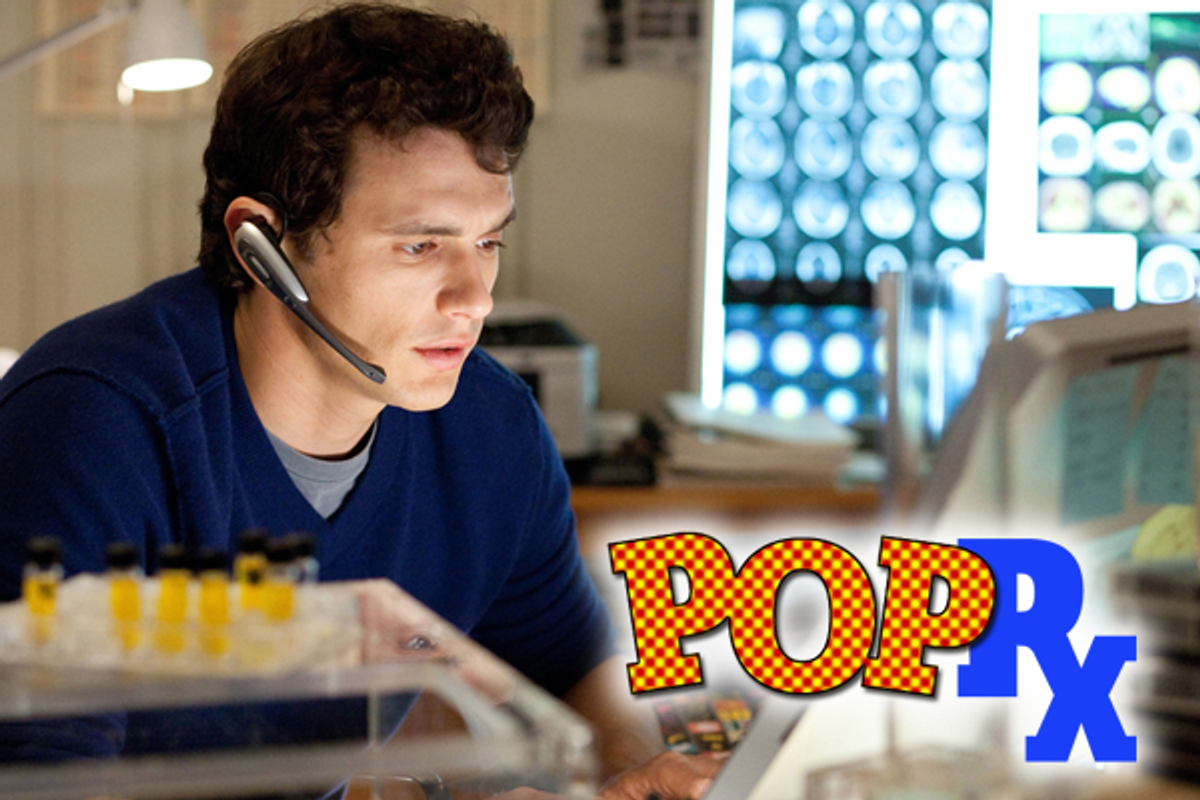
But, as a doctor, I was struck by a more subtle medical conundrum. Toward the beginning of the movie, scientist Will Rodman (James Franco) injects his Alzheimer’s-stricken father (John Lithgow) with the same drug he gave Caesar. In the following scene, Lithgow’s character recovers the memories and mental capacity he lost to dementia. That particular plot point raises a question we as physicians often face: Should doctors treat their own family and friends?
The practice is officially frowned upon. Most medical associations and many state boards consider caring for relatives or friends to be a form of professional misconduct. Insurers don’t support the practice either: To curb fraud, Medicare stopped reimbursing doctors for treating family members nearly two decades ago, and Blue Cross hasn’t paid doctors for taking care of relatives since 1976. And legal issues abound: Physicians can be liable for off-the-cuff diagnoses made at the bequest of family or friends. In 1990, a Chicago doctor was tried for murder after his wife died from complications from liposuction.
But these guidelines and legal ramifications do little to deter us from becoming, literally, the doctor in the house. In 1991, the New England Journal of Medicine published one of the few studies of this practice. It found that 99 percent of surveyed physicians admitted to providing medical care for a family member. Eighty-three percent of physicians had prescribed medication, 80 percent had diagnosed medical illnesses, 72 percent had performed physical examinations and 15 percent had acted as a family member’s primary doctor. And we’re not just talking about treatment of minor scrapes and sniffles: 9 percent of doctors in the study had actually performed surgery on a family member. Others had diagnosed cancer, strokes and other serious illnesses for their relatives. This physician tendency to care aggressively for relatives is echoed by Will Rodman’s behavior in the latest “Apes” film: The drug he gives his father is experimental and hasn’t been approved for human trials.
Dispensing advice to friends and family begins as early as medical school, but the breadth and depth of our involvement grows rapidly. In my own career I’ve given my wife flu vaccines, prescribed steroid ointments for my father, and birth control pills for my cousin. I diagnosed a subtle wrist fracture in my neighbor’s kid and signed a health form over my backyard fence to give another neighbor’s son permission to play basketball (I asked the parents to let me review his chart before I put pen to paper).
It’s hard to turn down a friend or relative asking for basic medical advice, and many physicians (myself included) enjoy this sense of giving something back to our families and communities. But issues arise when we treat people with whom we have personal relationships. For one thing, many such requests often deal with issues outside our area of expertise. As a pediatrician, I don’t always feel qualified to answer questions about adult medical matters.
Even more problematic is our loss of objectivity. Given the added emotional anxiety of caring for a family member, the first diagnosis that pops into my mind when I’m treating a relative is often the worst. Case in point: At 9 months old, my oldest daughter began intermittently vomiting for a few days. Her pediatrician would likely have examined her and told us she had a case of the stomach flu. I, on the other hand, convinced myself she had developed type 1 diabetes or a urinary tract infection. A day or so later, our daughter was back to her usual rambunctious self, but not before I’d ordered costly blood work, and attempted to collect a urine sample using a plastic bag (which you stick to a child’s genitalia) rather than a catheter (which is standard practice for infants). No studies have compared the cost and quality of healthcare doctors give to their patients versus their loved ones and neighbors. But if my experience is any guide, we’re likely to give our loved ones costlier but shabbier care.
These sorts of personal consultations can complicate care for patients as well. Once, the parents of a 7-year-old patient of mine came to see me. Their daughter had developed a fairly serious condition, and they’d been consulting a family friend who was an adult specialist over the phone. True to form, he had suggested a whole battery of tests, including an ultrasound. Based on the child’s story, the diagnosis was pretty clear, and it only required a urine sample and a few blood tests, certainly not a high tech, expensive scan. The parents later told me that their doctor friend had ordered the ultrasound himself. I didn’t want to put the child in the middle of a medical turf war, so I didn’t try to talk them out of it. What bothered me most was that the physician who ordered the test didn’t bother to tell me what the results were (I dug them up on my own). And it easily could have put our patient at risk, had the other physician prescribed medication without my knowledge or needlessly subjected her to radiation from a CT scan.
There are exceptions, like actual emergencies, but as a rule we doctors need to get better at saying no when it comes to treating our friends and loved ones. And it can certainly help to be a medical expert when you’re translating medical information and advocating for a loved one or friend. But boundaries are important. The aggressive urge to ensure that our loved ones are getting the very best, most medically advanced care often ends up doing more harm than good: In “The Rise of the Planet of the Apes,” Will’s father eventually begins to experience unexpected side effects from his son’s miracle drug, and his Alzheimer’s returns.
Now, when I get casual questions from friends and family, I try to stick to general advice and then recommend they visit their own doctor. In our prescription and test-driven healthcare system, the last thing we need is to be encouraging costlier, less effective care.
Rahul K. Parikh is a physician and writer in the San Francisco Bay Area. He wrote the Vital Signs column on Salon in 2008-2009. His pop culture-medical column, PopRx, runs on alternate Mondays. More Rahul Parikh.
Related Stories
More Related Stories
-
Conservatives A-OK with closeted Boy Scouts
-
Horrifying new trend: Posting rapes to Facebook
-
Corporate greed is poisoning America -- literally
-
The new geography of poverty
-
Childhood ADHD linked to obesity in adulthood
-
Obama to all-male university graduates: Be the best husband to "your boyfriend or partner"
-
Chicago man breaks world record with 48-hour Ferris wheel ride
-
I will never be able to afford Angelina Jolie's mastectomy
-
GOP attorney general candidate tried to force women to report miscarriages to police
-
Stephen Colbert to UVA: "You must always make the path for yourself"
-
GOP actually bullies an anti-bullying bill
-
Georgian police slow to react to mob violence at gay rights march
-
1 killed in Oklahoma tornado
-
Thousands treated for sexual abuse-related injuries in military
-
Punk, dance music and drugs
-
My open relationship went awry
-
New York's most persecuted subway artist?
-
What's the Eiffel Tower doing in China?
-
Top 5 investigative videos of the week: Nailing a dictator
-
Will you marry me -- once you're done peeing?
-
My crushing student debt
Featured Slide Shows
The week in 10 pics
close X- Share on Twitter
- Share on Facebook
- Thumbnails
- Fullscreen
- 1 of 11
- Previous
- Next
-
Lisa Montgomery embraces her nephew Thursday after a tornado tore apart her home in Cleburne, Texas. The twister killed six people and destroyed entire swaths of the North Texas town.
Credit: AP/LM Otero -
Jack McMahon, the defense attorney for abortion doctor Kermit Gosnell, speaks outside the Criminal Justice Center in Philadelphia Tuesday. His client was convicted of killing three babies in his clinic, and will serve multiple life sentences.
Credit: AP/Matt Rourke -
A photo taken Monday captures Vice President Joe Biden's response to a Milwaukee second-grader's innovative proposal to end America's epidemic of gun violence. This guy!
Credit: AP/Jenny Aicher -
Sen. Rand Paul, R-Ky., flanked by a grouper-eyed Michele Bachmann, addresses the IRS' admission that it targeted Tea Party groups in advance of the 2012 election. In an op-ed for CNN Thursday, the Kentucky senator slammed the president for his faux outrage.
Credit: AP/Molly Riley -
Ousted IRS chief Steven Miller is sworn in on Capitol Hill Friday. Miller testified before the House Ways and Means Committee on the extra scrutiny the agency gave conservative groups applying for tax-exempt status.
Credit: AP/J. Scott Applewhite -
Attorney General Eric Holder pauses as he testifies on Capitol Hill before the House Judiciary Committee Wednesday. Holder is under fire, among other things, for the Justice Department's gathering of phone records at the Associated Press.
Credit: AP/Carolyn Kaster -
O.J. Simpson sits during an evidentiary hearing at Clark County District Court in Las Vegas, Nev., Thursday. Simpson, who is currently serving a nine-to-33-year sentence in state prison for armed robbery and kidnapping, is using a writ of habeas corpus to seek a new trial.
Credit: AP/Las Vegas Review-Journal/Jeff Scheid -
Major Tom to ground control: On Sunday astronaut Chris Hadfield recorded the first music video from space, a cover of David Bowie's "Space Oddity."
Credit: AP/NASA/Chris Hadfield -
When it rains it pours. President Barack Obama speaks during a news conference Thursday with Turkish Prime Minister Recep Tayyip Erdogan, inexplicably inspiring an #umbrellagate Twitter meme.
Credit: AP/Jacquelyn Martin -
A smoke plume rises high above a road block at the intersection of County A and Ross Road east of Solon Springs, Wis., Tuesday. No injuries were reported, but the the wildfire caused evacuations across northwestern Wisconsin.
Credit: AP/The Duluth News-Tribune/Clint Austin -
Recent Slide Shows
-
The week in 10 pics
-
The week in 10 pics
-
Mobile Entertainment: 9 Amazing Drive-In Movie Theaters Still Standing
-
The week in 10 pics
-
- Share on Twitter
- Share on Facebook
- Thumbnails
- Fullscreen
- 1 of 11
- Previous
- Next
-
The week in 10 pics
-
Mobile Entertainment: 9 Amazing Drive-In Movie Theaters Still Standing
-
The week in 10 pics
-
The week in 10 pics
-
The week in 10 pics
-
The week in 10 pics
-
Netflix's April Fools' Day categories
-
The week in 10 pics
-
The week in 10 pics
-
The week in 10 pics
-
The week in 10 pics
-
The week in 10 pics
-
Slideshow: Nerd Obama
Related Videos
PopRx is a column, running every Monday, that uses pop culture as a jumping-off point to better understand our health. Author Rahul Parikh is a pediatrician in the Bay Area. Send him comments and questions at poprx@salon.com.
Most Read
-
Revenge, ego and the corruption of Wikipedia
Andrew Leonard
-
Obstruction will ruin GOP
Jonathan Bernstein
-
We're living in an Ayn Rand economy
Paul Buchheit, AlterNet
-
Jaron Lanier: The Internet destroyed the middle class
Scott Timberg
-
"Jodorowsky's Dune": The sci-fi classic that never was
Andrew O'Hehir
-
Will you marry me -- once you're done peeing?
Tracy Clark-Flory
-
Temple Grandin on DSM-5: "Sounds like diagnosis by committee"
Temple Grandin and Richard Panek
-
My open relationship went awry
David Farley
-
The man behind Abercrombie & Fitch
Benoit Denizet-Lewis
-
How right-wingers use semantic tricks to kill government
Michael Lind
Popular on Reddit
links from salon.com

377 points378 points379 points | 380 comments
From Around the Web
Presented by Scribol
-
Terry O'Neill: Student Loan Debt -- It's Worse for Women -
Julia Levy: 30 for 30: 30 Dates for My 30th Birthday -
Lisa Bonchek Adams: In Sickness and in Health: What Is It Like for a Mother to Read Her Daughter's Blogs About Stage IV Cancer? - Robert Klitzman, M.D.: Angelina Jolie, Doctors, Patenting Genes, and You
-
How To Be A ‘Woman Programmer'
-
Diane Gilman: Baby Boomers: A New Life-Construct -- From "Invisible to Invincible!" -
Susan Gregory Thomas: Why Divorced Boomer Moms Don't Deserve The Bad Rap -
British Nanny Offered An Annual Salary Of $200,000 -
Arianna Huffington: What I Did (and Didn't Do) On My Summer Vacation -
Vivian Diller, Ph.D.: Maybe Happiness Begins At 50


Comments
8 Comments