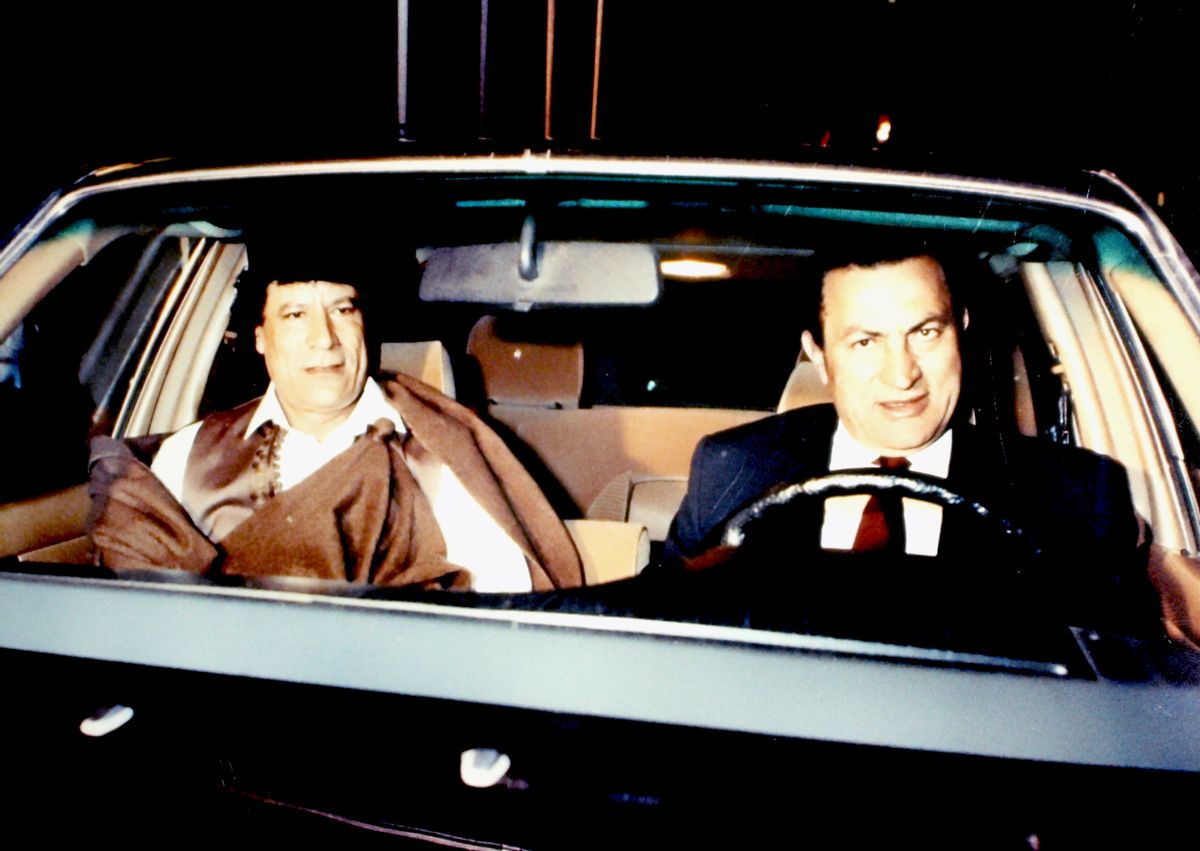
Poor Moammar Gadhafi. Libya’s longtime leader, dubbed "the Mad Dog of the Middle East" by President Ronald Reagan over his support for terrorism, came in from the cold after Sept. 11 by collaborating with the CIA in the fight against al-Qaida and offering American firms access to his oil fields. Look what he got for his good behavior: the enmity of his people and uninvited strangers visiting his seaside villa.
Gadhafi had warmed American hearts in 2004 by normalizing relations with George W. Bush's administration and falling hard for Condoleezza Rice. The colonel was still an SOB, but now he was our SOB.
Then along came the Arab Spring and the colonel’s security forces started cracking heads and killing protesters. Nothing fundamental about Gadhafi had changed -- anyone familiar with his four-decade reign in power knew he would employ violence if his rule were ever challenged -- but with his people in open revolt it became too embarrassing to embrace him any longer. And so, in the manner of past American SOBs -- think Somoza, think Noriega -- U.S. policymakers found it expedient to cut him loose. The problem was that since Gadhafi had been rehabilitated in the Western media as a repentant bad boy, Washington's policymaking agenda needed new narrative: to reestablish Gadhafi’s credentials as villain.
Just the job for a reliably credulous American press corps, whose bosses have grown bored with the details of bloodshed in Iraq and Afghanistan. Washington policymakers know full well that launching war, even an undeclared one like the NATO and U.S.-led overthrow of Gadhafi, cannot be sustained without a good story line.
The formula is not complicated. The two essential components are an evil enemy on one side and heroic, brave and true allies on the other. As the story unfolds, the government serves as the studio, producing and directing the movie while editors and reporters enlist as scriptwriters. These faithful scribes periodically demand their artistic freedom (i.e., by reporting on friendly fire deaths or criticizing an official action) but generally succumb, in the end, to the studio's demands for a neat Hollywood ending.
Many outside the media class see this collaboration as cynical, if not conspiratorial -- and, on the part of the policymaking class, it usually is. Conversations on "deep background" keep the names of policymakers out of the public eye. NATO psychological warfare units, while proud to disclose their leaflet drops, are doctrinally dedicated to pumping out information damaging to the enemy, whether true or false.
On the part of journalists, however, the collaboration is often pathetically idealistic. U.S. policymakers have never had a hard time finding reporters to sign up as wartime scriptwriters. Back in the Reagan years our "freedom fighters" went mano a mano with the Soviet empire, lauded by the likes of Charles Krauthammer. Never mind that these rebels (no, brigands) were cutthroat Islamic fanatics, of whom not a few subsequently joined an emerging organization that came to be known as al-Qaida. That was not a detail to be worried about by smart people in Washington.
No matter that in the mid-1980s the White House-funded contra rebels in Nicaragua, cheered on by the Washington Post and the Washington Times, preferred slaughtering non-combatants to real war and trafficked in cocaine on the side. When Jonas Savimbi, a murderous champagne-swilling Angolan guerrilla leader backed by South Africa’s apartheid government, came to Washington, he could count on a warm reception in the pages of the liberal New Republic.
A competent press corps would know this history and be wary. But then Sept. 11 "changed everything" -- and changed nothing. The U.S. government teamed up with another coalition of Afghan rebels to topple the Taliban. Largely forgotten was that our newfound allies had ruled Afghanistan from 1992 until 1996 and that their thievery, incompetence, squabbling and criminality paved the way for the rise of the Taliban in the first place.
Next to fall out of favor was Saddam Hussein. When he was willing to massacre waves of Iranian child soldiers in the 1980s, the Iraqi dictator was glad-handed by special U.S. envoy Donald Rumsfeld, who quietly orchestrated U.S. financial support for Saddam's government. When Saddam ungratefully invaded Kuwait in 1991, he was transformed from unpleasant U.S ally to official monster.
Media enablers would help. When the Bush administration officials settled on the Iraqi government as a scapegoat for the 9/11 intelligence failure, they were fortunate to find the New York Times correspondent Judith Miller as a witness. She stenographically reported the White House's suspicions of (nonexistent) WMD and (never corroborated) ties to al-Qaida, while touting the virtues of the Iraqi National Congress and its leader Ahmed Chalabi. Back then U.S. officials privately acknowledged that Chalabi always had more influence along the Potomac than along the Euphrates. Today, they admit, he effectively serves as Iran's lobbyist in Iraq.
But no matter, the persistent Judy Miller still advises statesmen on how to Do Good in the world.
Which is not to say that some U.S. enemies were not genuinely evil people. But leave the political and policy questions out of it. Whether or not war in Iraq and Afghanistan was a good idea, the media mythmaking around war proved hazardous to the country's health. A more honest and accurate pre-war assessment of our allies would have made clear that what really matters is not military victory but what comes afterward.
The same holds true for Libya, which is now getting its own Hollywood treatment. Whether Gadhafi is moving from hideout to hideout or hiding out, à la Osama, in plain sight, his ending will be written in a screenplay that has undergone many rewrites over the years.
For most of his career Gadhafi was depicted much as Saddam Hussein would be: a pariah. That began to change in 1999, when he decided to turn over suspects in the Pan Am bombing to Western authorities. A bigger breakthrough in his charm offensive came in 2004 when, in seeking to end his international isolation, he renounced his WMD programs (which were never very far along to begin with).
President Bush soon lifted most U.S. trade sanctions. In 2005 American oil companies funded and founded the U.S.-Libya Business Association to push for improved trade and diplomatic relations with Col. Qaddafi’s regime. David Goldwyn -- who had served at the Energy Department under Bill Clinton and would become the Obama administration’s special envoy on international energy in 2009 -- headed the group.
Gadhafi, the story went, was not a bad buy. Within a few years, Occidental, ConocoPhillips, ExxonMobil, Chevron and other U.S. companies were producing 30 percent of Libya’s daily output.
Gadhafi signed up as a close ally in counterterrorism. He turned over Islamic radicals to neighboring pro-Western governments and in exchange the U.S. handed over to Gadhafi some Libyans captured in the "war on terrorism" and allowed his agents to interrogate Libyans held at Guantánamo Bay. Dick Cheney and Moammar Gadhafi may have disagreed on many points of policy but they were bipartisan on waterboarding: It was not a problem.
By 2008, the U.S. relationship with Libya was blossoming. That year, Congress, in response to lobbying by the oil companies, exempted Libya from a law signed by President Bush that allowed American victims to seize assets of countries found liable for terrorist attacks -- a law that had specifically targeted Gadhafi.
Who really cared that Gadhafi continued to maintain his bizarre personality cult and violate human rights? The U.S. government and media quickly lost interest. "The Americans no longer want to see Gadhafi's regime destabilized," Ashur Shamis, a London-based Libyan dissident, told me back in 2005. "Opponents have written off the possibility of receiving tangible political support from the United States."
It was only when the Libyan people spontaneously rebelled in 2011, and Gadhafi pledged to lay waste to Benghazi, that the U.S. government began to reconsider the wisdom of its newfound friendship. Hollywood screenwriters rarely feel controlled by historical truth and neither, alas, does Washington. The policy agenda needed a storyline that again cast Gadhafi as Evildoer, and the press corps dutifully provided.
The most explosive charge in the Libyan civil war, which originated with the rebels, was that Gadhafi was feeding Viagra to his troops and sending them out to rape women. In June Secretary of State Hillary Clinton solemnly said she was "deeply concerned" about these reports and the media did its part. At CNN the tag team of Wolf Blitzer and Nic Robertson ran a lengthy report on the Viagra charges under the banner of "A tool of massive rape."
Not quite. Several human rights groups launched major investigations into the claim of government-ordered rapes and found no evidence for it. Last week, the New York Times derided the story as one of the rebels "far-fetched claims." Back in June the paper of record published a story saying rebel officials "had discovered condoms and packets of Viagra in tanks and other vehicles captured from Colonel Qaddafi’s soldiers."
Another widely published claim was that, again in the words of Secretary Clinton, Gadhafi was flying in "mercenaries and thugs" to kill his own people. Ali al-Essawi, who resigned as Libyan ambassador to India after Gadhafi cracked down on protesters, told Reuters that the mercenaries were "from Africa, and speak French and other languages."
This story, accepted as true by much of the media, also turned out to be largely, if not entirely, fictitious. Many of the "mercenaries" paraded by the rebels at international press conferences later turned out to be undocumented laborers from other African countries. The story was handy, though, because it purported to explain why Gadhafi, who allegedly had little public support, managed to remain in power for six months despite massive bombardment from NATO aircraft.
The point, systematically deleted from the memory banks of U.S.-based news organizations, is that our overseas allies supported for purposes of (the clinical term) "regime change" always generate propaganda to influence U.S. public opinion. Like the Nicaraguan contras in the '80s and the Iraqi National Congress in the 00s, the Libyan rebels have ample reason to lie to U.S news outlets -- and yet many reporters and editors take their claims at face value.
Fortunately, not by all. As ABC News recently reported, Abdelhakim Belhaj, who led the rebels into Gadhafi's compound, was a founder of the Libyan Islamic Fighting Group, an anti-Gadhafi group whose members fought Soviet troops in Afghanistan alongside Osama bin Laden and whom the Bush administration designated as a terrorist organization in 2004.
Only recently has more attention focused on the fact that the rebels, like Gadhafi, have committed vicious brutalities during the war, and that their own leadership is prone to fierce, internal squabbling. In late July, the Transitional National Council in Benghazi killed (and burned the corpse) of their military leader, Gen. Abdel Fatah Younes, who was suspected of treason. In what journalist Patrick Cockburn called "a masterpiece of mistiming," the assassination was committed on this very day that Britain recognized the rebel government.
And there's one more aspect to the story that has been cut from the current script. Whether he was "our" SOB or "their" SOB, there is no doubt that Gadhafi used his oil revenues to provide far more to his people than many U.S. allies in the region. In the United Nations 2010 report on "Human Development" Libya ranked first in Africa and a respectable 53rd out of 170 countries overall.
Gadhafi’s government had a terrible human rights record but it provided its citizens with free education and healthcare. The World Health Organization says Libya "boasts the highest literacy and education enrollment rates in North Africa." Childhood immunization is close to universal and infant mortality rates are very low. Libya also ranked high on gender equality, and women were prominent in politics. The poor had a degree of protection with subsidized food and fuel. In Libya, "social exclusion due to poverty and lack of access to education is nearly nonexistent," according to this report.
There was nothing in Gadhafi's Libya comparable to the mass poverty of Hosni Mubarak’s Egypt, which has one of the highest adult illiteracy rates in the world. During the revolution in Egypt, breathless reporters on U.S. cable news networks would say that the popular upheaval had "exposed" the appalling circumstances of the Egyptian poor, as if the reality hadn’t been obvious to any sentient observer all along.
Gadhafi was corrupt, but the scale of his thievery does not appear to come close to that of the Mubarak regime in Egypt or the energy-fueled kleptocracies that U.S. policymakers quietly indulge in places like Equatorial Guinea and Turkmenistan. The reports about Gadhafi's decadent lifestyle withered under scrutiny. The New York Times recently ran a story under the headline of "Gilded Traces of the Lives Qaddafis Led," which reported that "as the former subjects of Col. Moammar el-Qaddafi comb through his family’s estates, farms and seaside villas, the properties are revealing the details of lives lived far removed from the people" and "the distance between power and powerlessness." It was so unlike classless America, where the political elite and the working class live together in the same neighborhoods and vacation harmoniously on Martha’s Vineyard.
The facts of the story betrayed the headline. "The residences of the House of Qaddafi were not quite as grand as people might have supposed," the Times acknowledged. The villas of Gadhafi's sons "on a sand bluff overlooking the Mediterranean ... failed to match the ostentation they displayed in other facets of their lives. They were not lavish; the brown paint on the patio decks was peeling, and they had a distinctly 1970s feel."
Such are problems of scriptwriting. In Hollywood, the producers and the screenwriters always disagree. In Washington, the official story always clashes with the irritating reality of facts on the ground. As a state-sponsored media spectacle, the Libya story will conclude when Gadhafi escapes or is captured or killed. For the country where 6.5 million people live, the story line is less certain.
The odds are that a new government, even assuming it is stable, will be dependent on outside support. It will have a very hard time matching Gadhafi’s egalitarian record on economic rights. Democracy is unlikely to flourish any time soon. The rights of women's are endangered. Human rights generally will continue to be violated.
Finally -- and this is the safest bet of all -- U.S. oil companies will get back into Libya as soon as possible. At which time U.S. government and the stenographers of the press corps will not devote a lot of air time or column inches dwelling on human suffering in the post-Gadhafi era. Why bother about such details when there are other important scripts to be polished elsewhere?
Ken Silverstein is an Open Society Institute fellow and contributing editor to Harper's magazine.
Shares