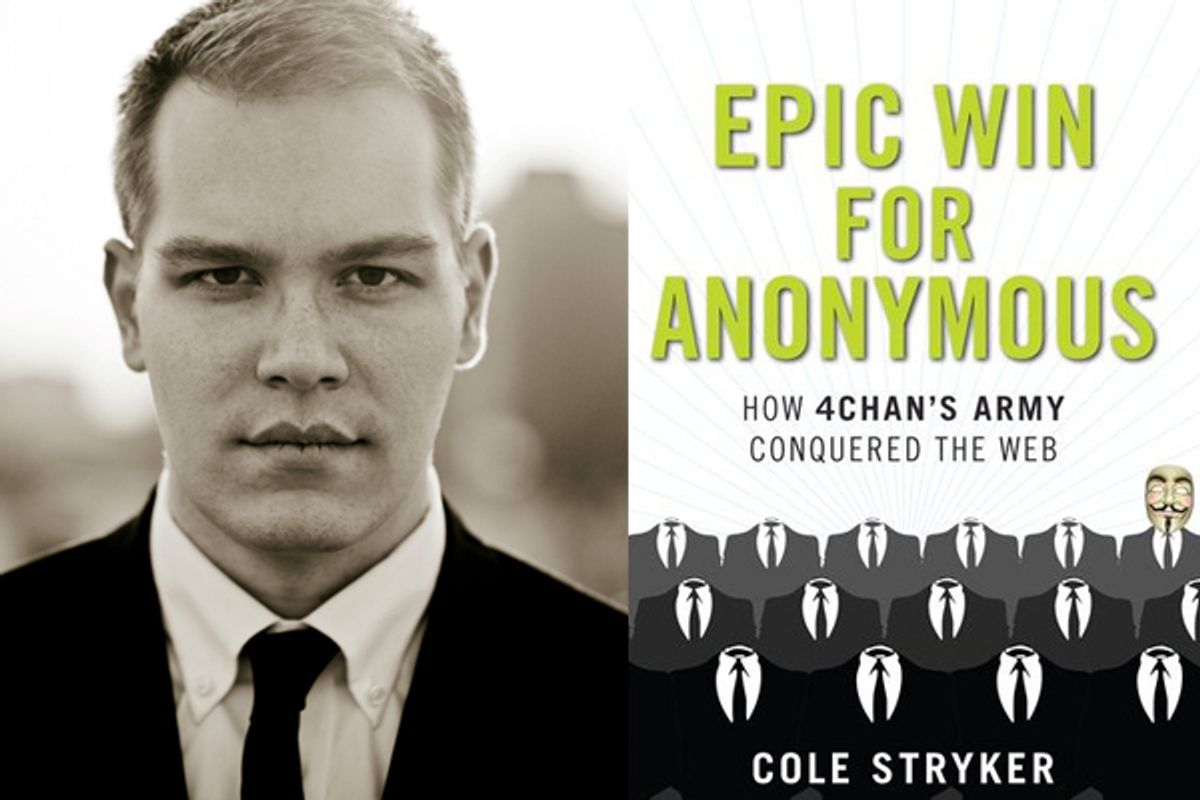
Even the most notorious anti-establishment figures started somewhere. The John Dillingers, Doc Hollidays and Robin Hoods of the world all had origin stories -- and so does Anonymous. But how did the infamous hacker collective develop? That's one of the subjects of writer Cole Stryker's new book, "Epic Win 4 Anonymous."
It's widely believed that the earliest memories of Anonymous can be traced to the website 4chan -- a much-maligned but highly trafficked corner of the Internet most famous for an anarchic image board called "/b/ - Random." Progenitors of many an Internet meme -- and purveyors of adorable kitten photos and child pornography alike -- the anonymous (lowercase "a") denizens of /b/ have done such a thorough job cultivating an aura of lawlessness around 4chan that the site has even garnered the moniker "asshole of the Internet." Anonymous, for its part, has persistently resisted any categorizations, aggressively striking back at those who attempt to explain its mysteries.
That includes Stryker: At his book release party in New York last week, he said that his grandmother received an email that day -- purportedly from "Cole Stryker" -- suggesting that they engage in sexual relations. And that was just one of the many ways in which Internet pranksters have struck out against him.
We spoke with Stryker recently about Anonymous, 4chan, Internet culture and the particularly colorful retribution he's faced for his book.
Anonymous seems to be having some fun targeting you. What else have they done to screw with you?
I just got off the phone with my sister, who's been receiving some Facebook messages from Anonymous members trying to get at me. And someone tweeted my address -- not my full address, but my apartment number. There were some random Anonymous members on Twitter, and it kind of freaked me out because I have no idea how they would have dug up that information. But as long as it's only my building number, I guess it's not too much to worry about.
I kind of saw that coming a long time ago, when I started to work on the project. I'm not too surprised, but I figured it would at least be after the book was released before they started to "dox" me.
So are you infamous now in the Anonymous chat channels?
[laughs] Not yet. I think that yesterday was the first big exposure of me on the Internet, and I think it happened for a couple of reasons. I've been blogging more prolifically, and I guess someone must have just started a thread on 4chan about it, because I got like six messages on Tumblr and a bunch of stuff on Twitter. Basically all my online presences are getting hit with stuff like, "We're going to find out where you live and we're going to kill you." But that's par for the course for these guys. I don't take it too seriously -- yet, anyway.
But no, I'm not a 4chan celebrity yet. It's going to be a while before that happens.
Anonymous is in the title of the book, but "Epic Win" is really about two different things: On the one hand, it's a chronicle of how this funky corner of the Internet called 4chan was born and grew. And maybe more important, it's a primer on why the Internet works the way it does today, thanks in large part to 4chan. That includes, but isn't limited to, the emergence of Anonymous.
How could a place like 4chan be so influential -- yet it's probably the first time a lot of people have ever heard of it?
Well, I think the reason why it's so influential is because it provides something that a certain person is looking for, that I don't think they realized they were after until they've experienced it. The 4chan experience is that, when you're hanging out there, anything can happen. So many interesting threads are happening, and they move so quickly that it's just this constant churn of content that's unclassifiable and would really have no place anywhere else on the Web.
Let's say you're a bored teenager living in suburbia, and you're all caught up in your Facebook status updates, your Twitter and Tumblr, and you've read everything interesting on the Internet that day. 4chan never stops being interesting and shocking and hilarious. It's just this perfect Darwinian "meme pool" -- sort of like how a gene pool would work. Interesting ideas just sort of float up to the top in a way that isn't happening anywhere else.
So how does Anonymous, as we know it today, tie into 4chan? How did this niche message board give birth to something that's become so hugely relevant to the current political landscape? Was it the anonymity factor, or something else?
I think, yes, the anonymity. It couldn't have happened without that. I think that people do things anonymously -- this is an obvious point, but -- they do things anonymously that they wouldn't otherwise do. But more importantly, I think the whole game of 4chan -- where you're just trying to surprise people and come up with something that no one is expecting -- played a big role.
Anonymous really started off as a group that trolled individuals. They would just go into online games and mess with people. For example, on the game Second Life -- which is an open, virtual world -- there was a teleconference happening between an important entrepreneur in the Second Life community, and the website CNET. There were a lot of journalists there, and it was supposed to be this new, innovative platform for having press conferences. And a bunch of hackers somehow got into the system and made giant dancing penises rain down on the stage and bounce off the floor.
That to me is a quintessential example of what early Anonymous was about, before it developed its political angle. And that's total 4chan. You're doing something that's fun and funny and freaking out the straight world a little bit.
Scientology changed everything. An infamous Tom Cruise video came out in 2007, where he was talking about the Church of Scientology. And Anonymous was like, "This is hilarious. We need to target the Church and teach them a lesson." And it was still very Lulz-y in the way the previous attacks were. But I think at that point, certain members of Anonymous realized they had some power to make social change, rather than just doing things for laughs. That was really the turning point. And then Anonymous started targeting small governments and big corporations, with less focus on pranks and more on the perceived social good.
And now it's reached its peak, sort of, with LulzSec. You mentioned that group in the afterword of your book, but when you first started writing, did you have any idea the insanity the hacker world would generate this summer?
When I started working on the book, I had a Google alert set up for 4chan and Anonymous. And I might see five new stories published a day. And this was back in early May. By the time June came around, it had jumped up to maybe 50. Now it's in the hundreds. They aren't all interesting, but I really didn't expect this massive rise of attention that we're seeing now.
Starting with the Sony hack -- which no one is really sure who's responsible for it, still -- it was one of those situations where the media was like, "We've got to be the first to publish information on these groups when they do something." So they're all following the Twitter accounts of all the LulzSec users. And LulzSec was way more open to the press than Anonymous has ever been.
I'm kind of shaking my head at the media at this point.
Do you think, with all the blowback against Anonymous (not to mention the arrests), that they'll start to dial their visibility back?
No. It's so easy to communicate with the press anonymously. Unless there are serious crackdowns beyond what we've already seen, I don't see the activities of Anonymous really falling off. I do see the press's infatuation with them tapering off. They're going to realize that they can't publish every little threat Anonymous makes.
Shares