Movie shorts

“Warrior”: Exciting fight flick with a twisted ideology

Tom Hardy and Nick Nolte are terrific in an ultraviolent mixed-martial arts drama with a creepy subtext

  • more
    • All Share Services

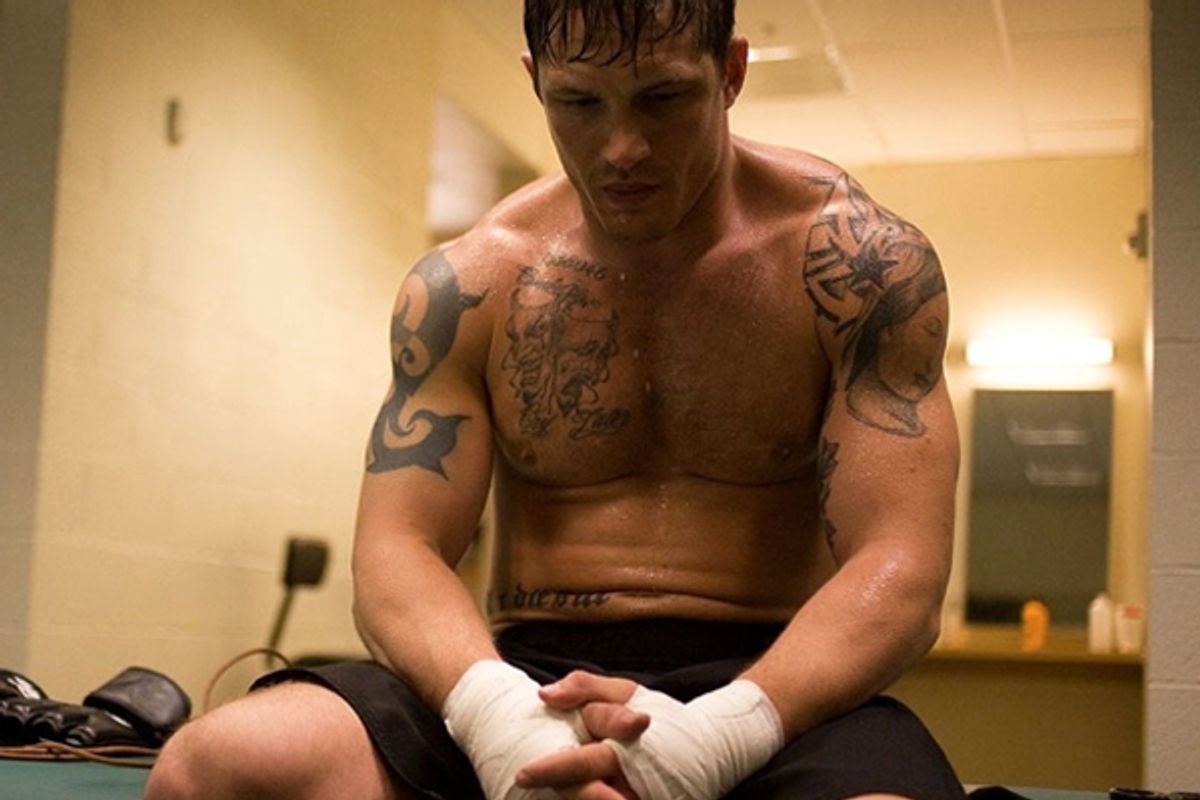
Tom Hardy in "Warrior."

It’s tempting to describe the action melodrama “Warrior” as a multi-platform product launch instead of a movie, but that’s overly cynical in an age when most commercial cinema can be described that way. Most obviously, “Warrior” is an attempt to update the boxing film for younger audiences by translating it into the world of mixed martial arts or MMA, a theatrical hybrid of boxing, wrestling and kung fu that has generated a massive, media-savvy audience. As such, it’s pretty effective: Director and co-writer Gavin O’Connor (of the cop drama “Pride and Glory” and the hockey fable “Miracle”) is a strong craftsman in a mode you might call heightened American realism. He gets powerful performances from Tom Hardy and Joel Edgerton as estranged brothers who wind up fighting in the same Atlantic City single-elimination tournament, with predictable results. There sure is a lot of ass-whipping amid the tween-boy histrionics of MMA (fights literally occur inside a cage; the referee howls, “Let’s go to war!”), and while I’m no expert, the bouts look convincing enough.

I had a striking and peculiar reaction to “Warrior,” in fact. I enjoyed its archetypal heartland hokum a great deal for most of its running time, largely because the characters are more complicated than you expect and because O’Connor and co-writers Cliff Dorfman and Anthony Tambakis are smart enough to leave certain things unsaid. Hardy’s Tommy Conlon is an impressive creation, a bulked-up ex-Marine who’s been hitting the booze and pills hard since getting back from Iraq and is driven by a dark, deep-seated rage he can’t even begin to understand. His brother Brendan (Edgerton), a high-school teacher who goes back into fighting to save his family’s suburban home from foreclosure, is well-rendered but less interesting. As their recovering alcoholic dad, Nick Nolte gives one of the best performances of his growly-bear late career, turning what could have been a generic Irish-American pop into an anguished walking ghost, compulsively listening to an audiobook of “Moby-Dick” on his  cassette Walkman.

But as the chain of clichés, coincidences and unlikely events that form the story of “Warrior” reach critical mass, I ended up feeling almost as bludgeoned by the movie as the opponents Tommy and Brendan must batter into submission on their way to the inevitable confrontation with each other, Dad, God and destiny (and a score that features excerpts of “Ode to Joy”). Yeah, this movie tells virtually the same story as David O. Russell’s “The Fighter,” except that it offers two miraculous palooka comebacks for the price of one, is built around an ultraviolent sport that makes boxing look like a Japanese tea ceremony, and delivers way more ‘roided-up storybook redemption. Of course a movie like this has no official ideology, and to suggest that it does is to be a killjoy. But in search of audience gratification — distributor Lionsgate is hoping for a big hit here — O’Connor chucks away everything that was interesting or dark or subtle in “Warrior” and replaces it with a pseudo-individualist, sub-Freudian, Tea Party-friendly fantasy. Our screwed-up country got you down? Bank coming for your house? Just beat the crap out of some other losers who are in the same pickle, ending up with your own damn brother, and everything will be fine.

“50-50″: What's so funny about cancer?

Seth Rogen finds humor in a possible death sentence, in a buddy movie part "Beaches" and part "Pineapple Express"

  • more
    • All Share Services

You measure your success in five-year increments. Your doctors let you know if your blood counts are high or low. You bite your lip, not sure if you want to know if you’re stage 1, 2, 3 or 4. Cancer — it’s a numbers game. So when I went to Sloan-Kettering last week to discuss a drug that’s effective in 30 percent of patients for my melanoma that has a roughly 10-20 percent survival rate , it didn’t come as much of a surprise when my doctor said, noting proudly that I’ve lasted almost 14 months already, “The odds have been against you from the start.”

It’s clear right from the title that the poignant, funny and profane “50/50″ understands the woozy terror of a life or death crisis. Why then is it being peddled as “the comedy from the guys who brought you ‘Superbad’?” What’s so funny about cancer? Believe it or not, quite a lot.

Joseph Gordon-Levitt is Adam, a tightly wound NPR drone who rhapsodies about Swiffers and refuses to jaywalk even when there isn’t a car in sight. His best friend Kyle, played by Seth Rogen, is a guy whose interests include getting high and talking about blow jobs in the latte line. So what happens to these two kooky fellas when 27-year-old Adam discovers he has a rare form of spinal cancer and just a 50 percent chance at survival?

What ensues is “Beaches” meets “Pineapple Express.” Which, I’ve got to tell you, is pretty much what living with cancer is like. The movie has good reason to resonate so truthfully — it was written by television producer Will Reiser, who himself endured cancer in his mid-20s. Rogen was there for it all. No wonder the movie has such a brutal, honest sting.

Thrust into a world of procedures, treatments, WebMDing, and doctors who say everything much too fast — all while his friends are blithely bar-hopping — Adam must quickly adjust to his strange and frightening new status. Co-workers give unsolicited advice and tearful hugs, his mother (a steely Angelica Houston) flies into drama queen mode, and his girlfriend suddenly keeps him at arm’s length. Kyle, meanwhile, angles the situation into opportunities to smoke dope and get laid.

Gordon-Levitt, combining his “(500) Days of Summer” angst with “Inception” efficiency, does a terrific job of capturing the emotional gamut that is illness. Adam, a control freak in an out-of-control situation, pings between panic and wry amusement at the absurdity of his situation, the humbling awfulness of it all. But the movie’s biggest surprise is the usually one-note Rogen, who manages to be both glib and genuinely vulnerable.

Where “50/50″breaks ground, however, is its understanding that neither illness nor friendship is some pink-ribboned chick thing. This is a film self-aware enough to crack a “Terms of Endearment” joke, to compare its chemo-bald leading man to both Lord Voldemort and Michael Stipe, and to understand that surgical wound care is an awful lot like one of the “Saw” flicks. In other words, dudes, you don’t even have to have cancer to appreciate its vulgar, vulgar heart.

Unsurprisingly, Rogen and company, like true students of the Judd Apatow school of filmmaking, never quite get a grip on their female characters. Anna Kendrick is Adam’s much too young and inexperienced therapist — a girl who serves more as crush object than a real character. And Bryce Dallas Howard, rapidly on her way to becoming Hollywood’s go-to ice bitch, plays Adam’s artist girlfriend Rachel as a hateful little bundle of narcissism.

Rachel does provide one of the film’s most insightful moments. As Adam heads into the hospital for his first chemo session, she opts to sit in the car, explaining that she can’t go into “that world.” Cancer is indeed a different world. And what “50/50″ shows, with great and bittersweet clarity, is that not everyone will be able or willing to go into that world with you.

Rachel’s refusal to mix “the negative with the positive” is at once a stone cold dis and a perfectly logical reaction. Who, after all, would choose to spend time in a cancer ward? Who would consider sickness anything but a negative? But what “50/50″ gets — that poor Rachel doesn’t — is that moments of the greatest joy and connection and unadulterated freedom coexist with the horror and terror and pain. That love and silliness can get you through just about everything. As a woman whose friends have showered her with cakes festooned in expletives and T-shirts bearing the image of Monty Python’s indomitable Black Knight, I can testify that the real Big C — just like “50/50″ — is both a three-hanky weeper and a total farce. And that although every day of life is a gamble, every day is also, amazingly, a gift.

Continue Reading Close
Mary Elizabeth Williams

Mary Elizabeth Williams is a staff writer for Salon and the author of "Gimme Shelter: My Three Years Searching for the American Dream." Follow her on Twitter: @embeedub.

“A Good Old Fashioned Orgy:” Gen Y gets its group grope

"A Good Old Fashioned Orgy" is shameless and unsubtle. So why do we root for these likable losers to get it on?

  • more
    • All Share Services

The latest movie to hop on the R-rated comedy bandwagon is “A Good Old Fashioned Orgy,” and parts of it are terrible. In one scene, an allegedly adult human male jokes about tearing off the “sex bracelet” worn by a teenage ice-cream girl, thus obliging her to perform oral sex on him. He then mimes the act with all the subtlety of an air horn. It’s sleazy, shameful and worst of all not funny — the sort of moment that should cast a raunchy pall over the rest of the film. And yet before long you find yourself rooting for this horndog to fulfill his carnal fantasies during the romp teased in the film’s title. Just not that particular fantasy.

“AGOFO,” in which eight high-school friends now on the cusp of 30 decide to commemorate their fading youth with a little group sex, could have been an utterly puerile waste of time, even by late-summer Hollywood standards. Thanks largely to its cast, however, it’s transmuted into an utterly puerile 90 minutes that fit the brain-dead zeitgeist of Labor Day weekend in a snug and mostly pain-free manner.

Leading this pack of perverted Peter Pans is Eric (Jason Sudeikis), who hosts alcohol-soaked, bacchanalian costume parties such as the White Trash Bash (complete with lawn-mower races and bean dip served in a toilet bowl) at his dad’s Hamptons estate. When pop (Don Johnson, in a nice cameo) decides to sell the place, Eric takes the impending loss of this rent-free paradise as a violation of his inalienable right to reign over a compound that makes the Delta House at Faber College in “Animal House” seem like an Amish nursing home.

Eric, on paper, is just another in the long line of Apatow-ian man-boys. But Sudeikis has a quality that seems more and more necessary to be a successful comic actor today: the ability to make this sort of repulsive cad actually palatable. You know, that thing that Jonah Hill can’t quite do.

If taking the loss of his own personal party palace as an affront isn’t bad enough, Eric and his requisitely rotund sidekick McCrudden (Tyler Labine) also view themselves as AIDS victims. Since the generation before them enjoyed risk-free screwing, and for the sex-braceleted kids today, “blow jobs are the new French kiss,” these Gen-Yers have clearly been deprived of their fair share of the guilt-free nasty. The solution, naturally, is an intimate Labor Day weekend of naked shenanigans, with a Kama Sutra theme. You know, to keep it classy.

The next step is to convince the rest of the gang of bangers, each of whom is defined by one particular hangup. There’s the indecisive aspiring musician (Martin Starr), the know-it-all psychologist (Lake Bell), the one with body-image issues (Lindsay Sloane), the uptight, career-obsessed one (Nick Kroll), and the one who has harbored a crush on Eric for years (Michelle Borth). One by one, each signs on, and even the one married, kid-having couple in the clique (Will Forte and Lucy Punch) eventually insist on being included.

With the house on the market, Eric and company split their time between trying to foil the snooty older realtor’s sales efforts until after Labor Day (apparently rescheduling the orgy wasn’t possible) and doing research, which involves a predictable but amusing visit to a swingers’ club in the backroom of a furniture store. (“They don’t sell these beds, do they?”) Meanwhile, Eric finds himself smitten with the younger, perkier realtor, Kelly (Leslie Bibb). Of course, he doesn’t want her to know about the upcoming sexcapade, but he also can’t sleep with her beforehand, because that would be uncool. Oh, the dilemmas of youth!

When that first weekend in September finally rolls around, of course, everything turns out to be even more awkward than imagined, at least at first. Maybe that’s because, despite all that research, they don’t really know what they’re doing. First, they kick the evening off with shots of absinthe, which is just about the stupidest way to ingest absinthe without a syringe. They continue to consume massive amounts of alcohol, which, from what I’ve heard, probably isn’t a surefire path to an all-night bout of coitus. (Have these folks never heard of Ecstasy, or even Viagra? It’s R-rated — why skimp?) And then there’s that whole weirdly incestuous seeing-your-good-friends-naked thing, which most of us got out of our systems sophomore year.

In short, these immature, fairly pitiable protagonists go about their absurd project in all the wrong ways. But you just keep rooting for them. This is the thing Sudeikis and many of his costars have, and it’s not acting ability. It’s not even “star power.” It’s sort of an id-based aspirational aura, the slight lopsided smirk of self-awareness that makes Sudeikis seem like Jason Bateman’s scruffier younger brother (and makes him a good Joe Biden impersonator on “Saturday Night Live”). Compared to his recent roles in “Hall Pass,” as an aspiring adulterer, and “Horrible Bosses,” as an aspiring murderer, Eric is a relative angel. But they are ultimately all of a piece, personifying a template you might call, in deference to another Sudeikis “SNL” creation, the Affable A-Hole.

Continue Reading Close

Cameron Crowe revisits “Say Anything”

The director releases new scenes from the '80s teen romance and countless John Cusack crushes are renewed

  • more
    • All Share Services

Cameron Crowe revisits John Cusack in "Say Anything"

For Gen-Xers still under the spell of Lloyd Dobler, the boombox-hoisting, trench coat-wearing antihero played by John Cusack in Cameron Crowe’s 1989 teen romance “Say Anything,” it’s been a pretty eventful summer.

While discussing his upcoming films “Pearl Jam Twenty” and “We Bought a Zoo” at the Television Critics Association press conference in July, Crowe said he’d consider a “Say Anything” sequel. But just as fans started getting excited about Dobler Part Deux, they suffered a collective buzz kill Monday when Crowe told IFC that while he thinks about what might have happened to the film’s characters, a sequel remains a pipe dream.

As proof that “Say Anything” is on his mind, Crowe has been posting a number of extended and deleted scenes from the movie all week on his website, theuncool.com. Granted, these aren’t actual filmed scenes — they’re just portions of the script, words on a page. But if there’s anybody who knows a thing or two about words on a page, it’s Cameron Crowe. And to the legions of “Say Anything” devotees, the ones who dress up like Lloyd for Halloween, the release of these new scenes is exciting enough that we’re forced to remember Lloyd’s famous directive: “You must chill!”

The newly unearthed scenes include one in which Ione Skye’s character, Diane Court, is hit on by one of her teachers but gracefully thwarts his advances, and an extended version of the graduation scene — Diane’s valedictorian speech originally included a rather ’80s-centric musing on her future: “Will I live in the suburbs, and drive a BMW?”

There’s also an extended version of the dinner party scene in which Lloyd gives his famous “I don’t want to sell anything bought or processed” speech. Turns out the longer version of the scene included a line in which Lloyd actually talks about wanting to marry Diane one day (pretty heady stuff), and the scene also provided a more detailed glimpse into the financial wrongdoings of Diane’s father, Jim Court (played brilliantly by veteran actor John Mahoney). I was particularly intrigued by a stage direction for Lloyd that Crowe had included in the script at the end of the scene: “He wipes his hand, offers it to [Jim] Court.”

Crowe had based the Lloyd character on a real-life man named Lowell Marchant, who was his neighbor in Santa Monica during the time he was working on this script. Marchant was an optimistic 19-year-old kickboxer from Alabama, who, as Crowe told me when I interviewed him for my book “You Couldn’t Ignore Me If You Tried,” “would knock on the doors of his neighbors to make friends. And you’d answer it, and he’d be like, ‘Good afternoon, I’m Lowell Marchant. And I would like to meet you. I’m your neighbor, and I’m a kickboxer. Do you know about kickboxing?’ And he would wipe off his palm on the side of his pant leg, and shake your hand. And it was just such a great thing.” Crowe told me that Marchant’s simple, thoughtful gesture of wiping his palm before going for the handshake “was the first little spark for the bonfire that would become getting the character right.”

But what struck me as perhaps the most interesting and most significant finding in all the newly released material was this: Originally, Lloyd had a line at the very beginning of the film in which he asks one of his friends, “Did [Diane] ever say anything about me?” The line was ultimately scrapped, which may seem insignificant if not for one thing: That was the only time that Cusack’s character ever uttered the phrase that was the title of the film. As it stands, that phrase, “say anything,” is spoken many times — but only by Diane and her father.

Whenever people wax nostalgic about “Say Anything” and the lessons it taught them, those lessons almost always have to do with romance, thanks to the startlingly honest and palpably powerful love shared between Lloyd Dobler and Diane Court. But there’s another essential thread to the film’s narrative as well — the complicated, strained but ultimately beautiful relationship between Diane and her dad, the morally challenged man who loves his daughter so blindly that he steals money from the residents of the nursing home he owns so that Diane never wants for anything. “He was willing to sacrifice anything and everybody to make sure that she got what she wanted,” Mahoney told me. “A lot of teenage films turn the parents into cartoons — this was a real flesh-and-blood person who turns out to be extremely flawed.”

Jim is proud of the close bond he shares with his daughter, and is fond of telling her often that she can “say anything” to him. But the movie’s title has within it, suggests Mahoney, the contrast between the way Jim Court loves Diane, and the way Lloyd Dobler loves her. In terms of Lloyd, ‘say anything,’ Mahoney reasoned, “means, ‘I will always understand you.’” As opposed to what it means to her father, who will listen to her, but still get her to do things his way.

The last time we hear the movie’s title used in the film’s dialogue, Diane Court is confronting her father after learning he’s been deceiving her for years: “I don’t want to leave something out, because I know I can say anything to you,” she tells him. “You’re a liar, and a thief.” Happily (spoiler alert), by movie’s end, Diane learns to forgive her father, and begins a new life with Lloyd, the man who truly loves her best.

Mahoney told me that when people come up to him and talk about his movies, they almost always want to talk about “Say Anything,” and how much it matters to them. “It hit a chord,” he said, “and it resonates still.”

According to Crowe’s site, more extended scenes — from the final shooting script dated Jan. 18, 1988 — may still be posted in upcoming days.

Continue Reading Close

Susannah Gora is the author of "You Couldn't Ignore Me If You Tried: The Brat Pack, John Hughes, And Their Impact on a Generation"

“Seven Days in Utopia”: Bland Christian film squanders Oscar-winning cast

"Seven Days in Utopia" squanders an Oscar-winning cast, including Robert Duvall and Melissa Leo

  • more
    • All Share Services

Robert Duvall and Melissa Leo in "Seven Days in Utopia"

It may be easy (and perhaps un-Christian) to be cynical toward faith-based filmmaking. But “Seven Days in Utopia” is flawed in so many ways — the editing, writing, acting and Matthew Dean Russell’s direction are uniformly weak — that this well-intentioned film does its positive messages a disservice.

This sermon masquerading as a sports film is focused on building confidence in all those young Christian soldiers who probably passed on the female-centric “Soul Surfer” earlier this year — another mainstream family film with Christian themes that relies on cheap sentiment and fails to challenge audiences at all. This one also squanders the presence of Oscar winners Robert Duvall and Melissa Leo.

Russell cudgels viewers with inspirational homilies, uplifting music — one song is actually called “Born Again” — and visuals that have a honeyed Texas glow. There are at least a dozen references to God, and the big dramatic golf game is described by one sportscaster as “a real David vs. Goliath match.” Subtle it ain’t.

The story begins when Luke Chisholm (Lucas Black), an up-and-coming pro golfer, suffers an embarrassing meltdown on the green. After the game, he hits another hazard when his car crashes through a fence in the title Texas town. Luke is literally and spiritually saved by Johnny Crawford — note his initials — played by Duvall, who teaches him to “See, Feel and Trust.”

The bulk of “Seven Days in Utopia” consists of a series of scenes where Johnny instructs Luke “Mr. Miyagi-style.” He takes the golfer fly-fishing so he can practice rhythm, balance and patience. He forces Luke to land a plane to teach him grace under pressure. Yet these scenes, designed to prepare Luke for the unexpected, are entirely predictable and clumsily presented.

Only slightly less understated is a metaphoric scene in which the comely horse-whisperer Sarah (Deborah Ann Woll) demonstrates the idea of freedom to Luke by releasing fireflies trapped in a jar. Sarah is Luke’s would-be love interest, except that she tells him “Not yet” when he leans in for a kiss. Then, in the film’s most unintentionally hilarious line — no doubt intended to suggest the sacredness of abstinence — she adds, “That doesn’t mean never.”

The lame script aside, perhaps the biggest drawback is that the protagonist is about as edgy as his golf ball. Black makes Luke’s transformation go from bland to blander. In order for his deliverance to work, the character needs to start out as a smug/cocky good ol’ boy — think Matthew McConaughey or George W. Bush. Black reads more like he’s trying to beat out Kirk Cameron for altar boy.

And it’s simply depressing to watch the aging Duvall — Black’s “Get Low” costar –slumming here, yet again playing an ex-alcoholic. Viewers will long for his far superior spiritual film, “The Apostle.” Melissa Leo is also wasted in her few scenes as Sarah’s mother, who does little more than smile beatifically. One of the film’s pressing questions may be this: Why did these talented performers agree to appear in this piece of hokum?

The other question comes at the end of the film, with a link to a website that appears on the screen in the hope of continuing the conversation about an ambiguous plot point. That site might provide viewers with golf tips. But it’s more likely that it directs folks to their nearest mega-church. 

Continue Reading Close

The latest “Game of Thrones” casting news

Gwendoline Christie, Natalie Dormer join with houses of Tarth and Tyrell

  • more
    • All Share Services

The latest British actress Gwendoline Christie, a new "GoT" cast member.

George R.R. Martin’s blog, “Not a Blog” (it’s a LiveJournal), posted a cryptic message yesterday, about bunnies and Aussies and barbicans.

Since the tag was “Game of Thrones” and “HBO,” the collective Internet began salivating as it tried to unravel the mystery. Surprisingly, some people got it.

Turns out all these references were clues about the casting of Brienne, Maid of Tarth, a character that appears in the second “A Song of Fire and Ice” book. British actress Gwendoline Christie snagged the coveted role of a woman described as “piggish” and “awkward” in the books, who is mocked with the nickname “Brienne the Beauty” because she is well … not.

Christie however, is quite a looker, though I see where Martin saw the female knight in her: The actress is 6’3.

Martin revealed the meaning of his riddle later that night:

As for my clues … Christie played in a music video called DAMARIS, which includes a song about Isabelle, the She-Wolf of France (wife of King Edward II, for the history nerds out there), and played in Shakespeare’s CYMBELINE at the Barbican theatre. She also posed for Australian photographed Polly Borland for a show called “Bunny.”

She also appears in the recent Imaginarium of Doctor Parnassas, though I did not use that one in my clues.

Here’s Gwendoline in action, in a (very) short NOMAD film called “Ourhouse.”

Oh yeah, she’s going to be great.

An earlier announcement has pegged “The Tudors” actress Natalie Dormer to play 16-year-old Margaery Tyrell.

Continue Reading Close

Drew Grant is a staff writer for Salon. Follow her on Twitter at @videodrew.

Page 1 of 2 in Movie shorts