SALON

Obama’s jobs plan isn’t enough

The president gets points for style and rhetoric, but $450 billion can't kick-start the economy

Topics: Unemployment, War Room, Barack Obama, Great Recession, U.S. Economy,

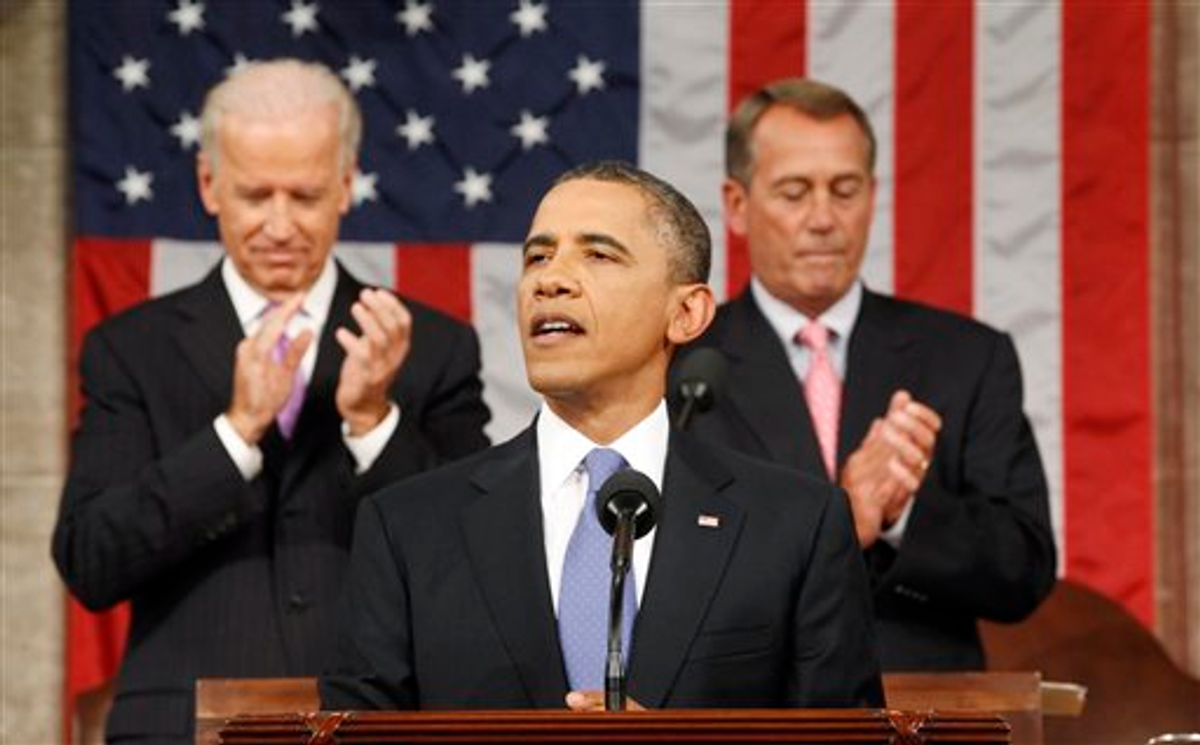
Obama's jobs plan isn't enoughPresident Barack Obama delivers a speech to a joint session of Congress at the Capitol in Washington, Thursday, Sept. 8, 2011

Two cheers for the President and his America’s Jobs Act. Cheer Number One: In presenting it to a joint session of Congress, he sounded as passionate and determined as he’s ever sounded.

Second cheer: He laid out the problem correctly and effectively. He explained why jobs and growth must be the nation’s first priority now — not the federal deficit. The economy is in crisis. People are hurting. So government must act, and act quickly. It’s irresponsible at a time like this to suggest that government should simply close down.

But a jeer because the jobs plan he presented isn’t nearly large enough or bold enough to make a major dent in unemployment, or to restart the economy.

$450 billion sounds like a lot — and is more than I expected — but some of this merely extends current spending (unemployment benefits) and tax cuts (in Social Security taxes), so it doesn’t add to aggregate demand.

The net new boost to the economy is closer to $300 billion. That doesn’t approach even half the gap between what the economy is now producing and what it could produce at or near full employment.

And much that $300 billion is in the form of temporary tax cuts to individuals and companies. Some of these make sense — enlarging the Social Security tax cut, extending it to employers, and giving small businesses a tax holiday for new hires.

But temporary tax cuts haven’t proven to be particularly effective in stimulating new spending in times of economic stress. People tend to use them to pay off debts or increase savings. Companies use them to reduce costs, but they won’t make additional hires unless they expect additional sales — which won’t occur unless consumers increase their spending.

That leaves some $140 billion for infrastructure — improving outworn school buildings, roads, bridges, ports, and so on. And $35 billion to help cash-starved states avoid more layoffs teachers. Both good and important but still small relative to the overall need.

Why did the President include so many tax cuts, and why didn’t he make his proposal sufficiently large to make a real impact on jobs and growth? Because he crafted it in order to appeal to Republicans. To get it enacted, he needs their votes.

I’m having a dizzying sense of déjà vu. The first $800 billion stimulus (spread over two years) wasn’t nearly large enough given the drop in aggregate demand. And half of it was in the form of tax cuts. The reason it wasn’t bigger and contained so many tax cuts was to get Republican votes. But its apparent ineffectiveness — it saved around 3 million jobs, but that didn’t save it from appearing to fail — made it harder for the White House to do anything more to stimulate the economy, and ward off what’s likely to be a double dip.

That’s been the heart of Obama’s dilemma. Big and bold enough to make a difference, and Republicans are certain to reject it. Small and focused on tax cuts, and maybe Republicans will bite. But even if they sign on, what’s the point of the exercise if it won’t have a measurable effect on jobs and growth?

And why would they sign on this time, anyway?

Republican Senate leader Mitch McConnell scoffs “This isn’t a job plan. It’s a reelection plan.” That’s precisely the problem. McConnell and company have stated publicly that their number-one objective is to unseat Obama and regain the presidency in 2012. They don’t want to give the President anything he could possibly claim as a victory. And they’re not terribly worried if the economy stays awful through Election Day because that’s the best way to fulfill their number-one objective.

The President would have done better with a plan that was big enough to make a real difference. And then, when Republicans rejected it, campaign on it.

So two cheers — for both the President’s style and his words. And one jeer: He failed on substance and strategy.

Robert Reich, one of the nation’s leading experts on work and the economy, is Chancellor’s Professor of Public Policy at the Goldman School of Public Policy at the University of California at Berkeley. He has served in three national administrations, most recently as secretary of labor under President Bill Clinton. Time Magazine has named him one of the ten most effective cabinet secretaries of the last century. He has written 13 books, including his latest best-seller, “Aftershock: The Next Economy and America’s Future;” “The Work of Nations,” which has been translated into 22 languages; and his newest, an e-book, “Beyond Outrage.” His syndicated columns, television appearances, and public radio commentaries reach millions of people each week. He is also a founding editor of the American Prospect magazine, and Chairman of the citizen’s group Common Cause. His widely-read blog can be found at www.robertreich.org.

Next Article

Related Stories

Featured Slide Shows

The week in 10 pics

close X
  • Share on Twitter
  • Share on Facebook
  • Thumbnails
  • Fullscreen
  • 1 of 11
  • Lisa Montgomery embraces her nephew Thursday after a tornado tore apart her home in Cleburne, Texas. The twister killed six people and destroyed entire swaths of the North Texas town.
    Credit: AP/LM Otero

  • Jack McMahon, the defense attorney for abortion doctor Kermit Gosnell, speaks outside the Criminal Justice Center in Philadelphia Tuesday. His client was convicted of killing three babies in his clinic, and will serve multiple life sentences.
    Credit: AP/Matt Rourke

  • A photo taken Monday captures Vice President Joe Biden's response to a Milwaukee second-grader's innovative proposal to end America's epidemic of gun violence. This guy!
    Credit: AP/Jenny Aicher

  • Sen. Rand Paul, R-Ky., flanked by a grouper-eyed Michele Bachmann, addresses the IRS' admission that it targeted Tea Party groups in advance of the 2012 election. In an op-ed for CNN Thursday, the Kentucky senator slammed the president for his faux outrage.
    Credit: AP/Molly Riley

  • Ousted IRS chief Steven Miller is sworn in on Capitol Hill Friday. Miller testified before the House Ways and Means Committee on the extra scrutiny the agency gave conservative groups applying for tax-exempt status.
    Credit: AP/J. Scott Applewhite

  • Attorney General Eric Holder pauses as he testifies on Capitol Hill before the House Judiciary Committee Wednesday. Holder is under fire, among other things, for the Justice Department's gathering of phone records at the Associated Press.
    Credit: AP/Carolyn Kaster

  • O.J. Simpson sits during an evidentiary hearing at Clark County District Court in Las Vegas, Nev., Thursday. Simpson, who is currently serving a nine-to-33-year sentence in state prison for armed robbery and kidnapping, is using a writ of habeas corpus to seek a new trial.
    Credit: AP/Las Vegas Review-Journal/Jeff Scheid

  • Major Tom to ground control: On Sunday astronaut Chris Hadfield recorded the first music video from space, a cover of David Bowie's "Space Oddity."
    Credit: AP/NASA/Chris Hadfield

  • When it rains it pours. President Barack Obama speaks during a news conference Thursday with Turkish Prime Minister Recep Tayyip Erdogan, inexplicably inspiring an #umbrellagate Twitter meme.
    Credit: AP/Jacquelyn Martin

  • A smoke plume rises high above a road block at the intersection of County A and Ross Road east of Solon Springs, Wis., Tuesday. No injuries were reported, but the the wildfire caused evacuations across northwestern Wisconsin.
    Credit: AP/The Duluth News-Tribune/Clint Austin

  • Recent Slide Shows

  • Share on Twitter
  • Share on Facebook
  • Thumbnails
  • Fullscreen
  • 1 of 11

Comments

87 Comments

Comment Preview

Your name will appear as username

You may use these HTML tags and attributes: <a href=""> <b> <em> <strong> <i> <blockquote>