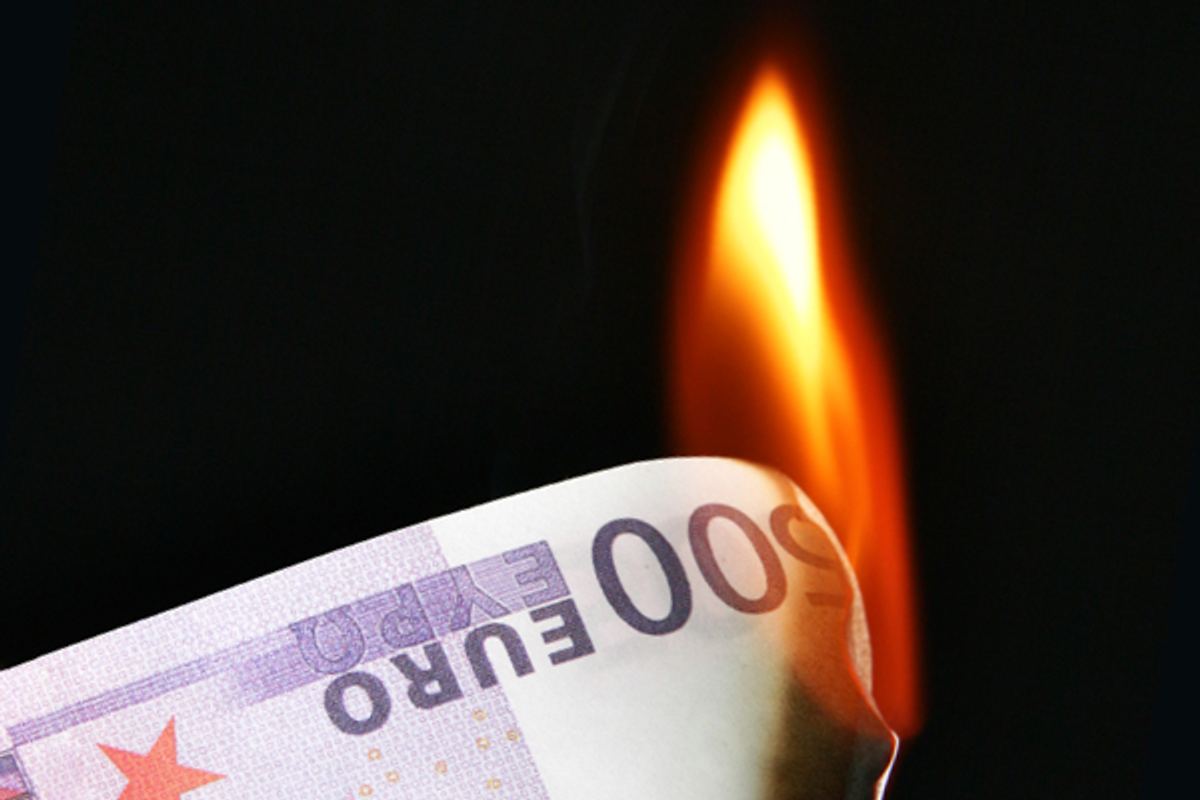
BOSTON -- The once bright dream of the common European currency looks increasingly bleak this week as fears escalate that that the 17-nation euro zone won't survive in its current form long enough to celebrate the 13th anniversary of the euro's debut on January 1, 1999.
 Most Americans, awash in their own fears of renewed recession, unyieldingly high unemployment, and unprecedented political dysfunction in Washington have little emotional room left to worry about their Atlantic partners.
But the ties of history and our intertwined economies strongly suggest that worry America must. If Europe falters and fragments, an economic tsunami will hit our shores at precisely the worst possible moment for the United States.
Stock markets fell steeply last week in both Europe and the United States on renewed worries that the continent's sovereign debt problems cannot be contained and will swamp one or more of the big euro zone banks. And this week is beginning with steep new declines in European stock markets. Germany's DAX is off 15 percent in the past month alone, a stunning drop.
As it has been for more than a year, Greece is at the center of the storm as the country continues to struggle to meet commitments to its European partners to cut budget deficits and the national debt. Greek Prime Minister George Papandreou has promised to meet new budget-cutting goals despite his country's declining economy and persistent street protests. Greece's finance minister said over the weekend that the country's economy would contract by more than 5 percent this year, a punishing decline for the Greek people.
Can the euro be saved? At this moment, it's very hard to be optimistic and Greece may have no choice but to return to its old currency, the drachma, as enormously painful as that step would be.
Europe's problems, not unlike our own in America, include enormous debt in the weaker countries, slowing growth in the stronger nations, and credible fears that some European banks may fail because they are overweight in ownership of sovereign debt of other euro zone nations, especially Greek bonds.
Perhaps most important of all, there is mounting public anger and frustration over the impact of the debt crisis. Citizens of Greece, Ireland, Spain and other countries are seeing their economies and their living standards decline. Citizens of the wealthier nations are angry about the need to underwrite costly bailouts for problems they did not create.
Hailed as a bold new step toward the creation of a United States of Europe, the euro started life with great promise and opened strongly against the U.S. dollar at its birth in January 1999. Then, one euro was worth $1.18. Five years later, on September 12, 2006, the euro was worth $1.27; and last week it closed at $1.37. Not so bad for a currency threatened by huge debts throughout the euro zone.
Eleven countries signed up for the euro at its birth. Notably, Britain, Sweden and Denmark chose to keep their own currencies. Looking back today, it seems clear that they made wise decisions. Greece wanted to join the euro zone in 1999 but, in an ironic prophecy of what was to come many years later, it initially failed to meet the financial criteria.
Today, there are 17 nations in the euro zone from Austria to Spain, from Finland to Ireland, from the Netherlands to Cyprus. Three small states -- Vatican City, San Marino, and Monaco -- have agreements with the European Union to use the common currency but are not formally part of the euro zone; and Kosovo and Montenegro adopted the euro without agreement. It's a stunningly diverse group of countries by culture, history, language and economic wealth -- 308 million people in all, almost exactly the same size as the United States.
It's easy to forget that nearly all of the euro zone countries are quite wealthy when measured by gross domestic product (GDP) with Luxembourg at the top at $109,000 per person, the Netherlands at $47,000, and Germany at $41,000. Even much maligned Greece's GDP per person is $27,000 and Portugal's is $22,000, according to 2010 figures from the International Monetary Fund (IMF).
The only real hope for a long-term solution is for Europe to adopt the United States model with true fiscal consolidation. What the 17 euro zone nations lack is a central financial authority with the power to set national budgets and to impose taxes. Yet such far-reaching change will be enormously difficult to achieve in a Europe divided in so many ways.
Christine LaGarde, head of the IMF, argues that "credible, medium-term fiscal consolidation" among the euro zone countries combined with "aggressive" ways to support short-term economic growth is the path out of the current crisis. But any change that gave some central authority the power to set national budgets and impose taxes would require approval by the parliaments of each of the 17 euro zone nations and it would probably also have to go to the voters in each country. It is almost inconceivable that such approval could be achieved.
We can only pray that new short-term measures by European leaders will forestall a Greek default and prevent a global banking crisis. But the best days of the euro appear to be behind us.
Shares