Iraq
Obama poised to break Iraq pullout promise
The president promised early on to withdraw all U.S. troops from Iraq by the end of 2011. What changed?
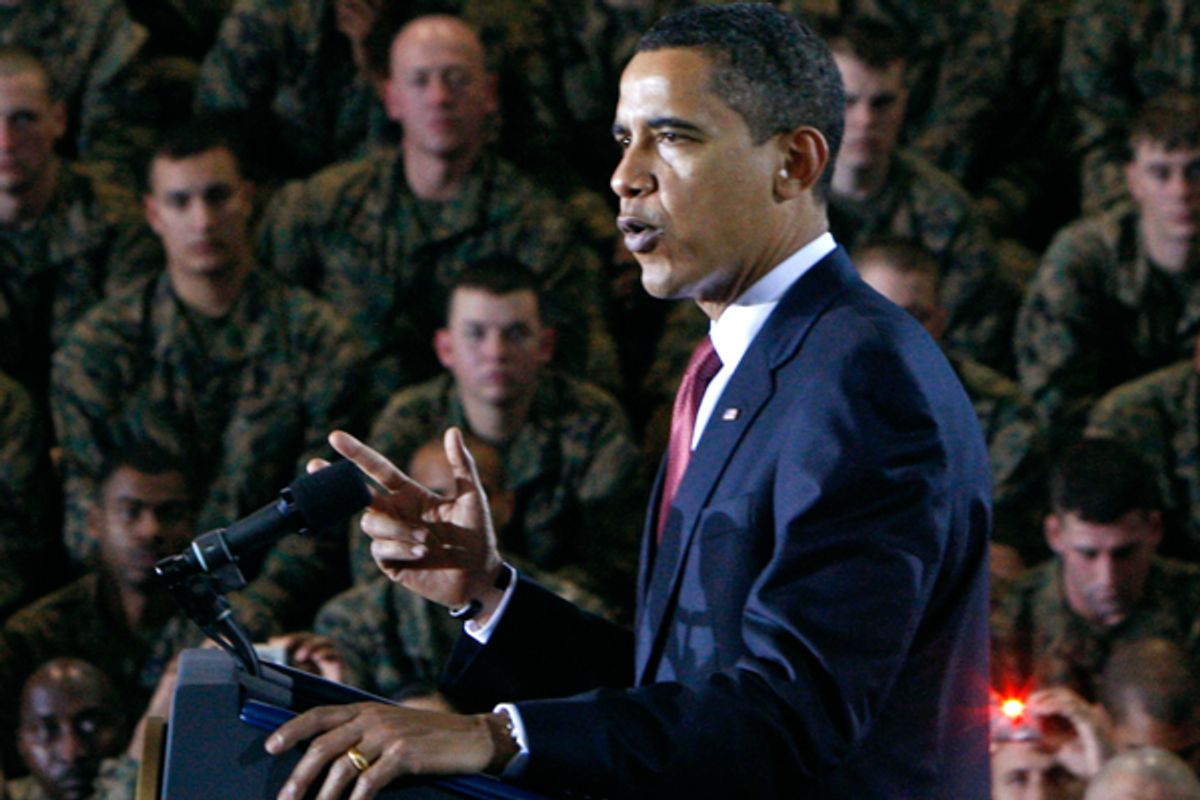
President Obama speaks to Marines at Camp Lejeune in February, 2009. A debate is unfolding in official Washington about whether the Obama administration should leave any troops in Iraq, and, if so, how many. Negotiations are ongoing between the U.S and Iraqi governments on the issue, as a 2008 agreement requires that all American troops leave by the end of the year.
But largely missing from the discussion is the fact that if Obama leaves any troops in Iraq, he will be violating one of the first major promises of his presidency. In February 2009, just a month into his tenure, Obama delivered an Iraq speech at Camp Lejeune, North Carolina, declaring:
“I intend to remove all U.S. troops from Iraq by the end of 2011. We will complete this transition to Iraqi responsibility, and we will bring our troops home with the honor that they have earned.”
Obama is now poised to break that promise. Administration and military officials have talked about leaving anywhere between 3,000 and 17,000 U.S. troops in the country. There are currently 45,000 troops still in Iraq, according to the AP.
Obama’s original promise about withdrawing all troops was always a bit of a red herring. As the New York Times recently reported, all sorts of armed U.S. personnel and contractors will be staying in Iraq well beyond 2011, no matter how many uniformed military stay behind:
Even as the military reduces its troop strength in Iraq, the C.I.A. will continue to have a major presence in the country, as will security contractors working for the State Department.
And of course there is still the American mega-embassy in Baghdad:
In some ways, the debate over an American military presence is a rhetorical one. The administration has already drawn up plans for an extensive expansion of the American Embassy and its operations, bolstered by thousands of paramilitary security contractors. It has also created an Office of Security Cooperation that, like similar ones in countries like Egypt, would be staffed by civilians and military personnel overseeing the training and equipping of Iraq’s security forces.
For a man who built his political career and his candidacy for president on his opposition to the Iraq war, this seems like a significant shift. Here’s a flashback to candidate Obama in October 2007, promising to bring the troops home:
Justin Elliott is a reporter for ProPublica. You can follow him on Twitter @ElliottJustin More Justin Elliott.
Our real Iraq losses
We left their nation in turmoil and our own country entangled in an endless "national security" nightmare
A man, left, inspects his destroyed vehicle at the scene of a car bomb attack in Ramadi, 70 miles (115 kilometers) west of Baghdad, Iraq, Tuesday, March 20, 2012. Officials say attacks across Iraq have killed and wounded scores of people in a spate of violence that was dreaded in the days before Baghdad hosts the Arab world's top leaders. (AP Photo) (Credit: AP) People ask the question in various ways, sometimes hesitantly, often via a long digression, but my answer is always the same: no regrets.
In some 24 years of government service, I experienced my share of dissonance when it came to what was said in public and what the government did behind the public’s back. In most cases, the gap was filled with scared little men and women, and what was left unsaid just hid the mistakes and flaws of those anonymous functionaries.
What I saw while serving the State Department at a forward operating base in Iraq was, however, different. There, the space between what we were doing (the eye-watering waste and mismanagement), and what we were saying (the endless claims of success and progress), was filled with numb soldiers and devastated Iraqis, not scaredy-cat bureaucrats.
Continue Reading ClosePeter Van Buren spent a year in Iraq as a State Department Foreign Service Officer serving as Team Leader for two Provincial Reconstruction Teams (PRTs). Now in Washington, he writes about Iraq and the Middle East at his blog, We Meant Well. His book, We Meant Well: How I Helped Lose the Battle for the Hearts and Minds of the Iraqi People (The American Empire Project, Metropolitan Books), will be published this September. More Peter Van Buren.
Shaima Alawadi’s murder: Hate crime or honor killing?
The murder of an Iraqi immigrant in California has stirred rumors of both a hate crime and an honor killing
Fatima Alhimidi weeps over her mother Shaima Alawadi's coffin as it arrives in Najaf, Iraq. (Credit: AP/Alaa al-Marjani) EL CAJON, Calif. – On March 21, an unknown assailant shattered Shaima Alawadi’s skull with a tire-iron-like weapon in the living room of her home. An Iraqi immigrant and mother of five, Alawadi was found by her 17-year-old daughter, Fatima, who said she was “drowned in her own blood.” Alawadi was rushed to the hospital, still alive, but she was soon taken off life support and died March 24. It was, by all accounts, a heinous crime. But was it a hate crime?
After her mother’s death, Fatima said she found “a letter next to her head saying, ‘Go back to your country, you terrorist.’” The accusation sparked outrage and brought national media attention to the murder. And yet, within days, publicity-craving Islamophobes Pamela Geller and Robert Spencer were pushing an alternative motive: that Alawadi’s death was, in fact, an “honor killing.” Geller crowed, “I surmised that the murder of Shaima Alawadi appeared to be Islamic, rooted in Islamic teachings and culture …”
Continue Reading CloseArun Gupta, a New York writer and co-founder of Occupy the Wall Street Journal, covers the Occupy movement for Salon. More Arun Gupta.
In Iraq and on “The Wire,” it’s all acting for Benjamin Busch
In a lyrical memoir, a novelist's son discusses his strange path into war -- and David Simon's TV masterpiece
Benjamin Busch Benjamin Busch’s “Dust to Dust” is a remarkable book — part military memoir, part childhood reminiscence, and also an effort to explain his relationship with his father, the celebrated novelist Frederick Busch.
And yet it is also more than all of those things. Busch is filled with complicated and fascinating contradictions. Yes, he’s the son of a famously introspective and domestic writer, who grew up in rural New York obsessed with toy guns and building massive military forts. But he studied visual arts at Vassar, where he confused everyone by joining the Marine reserves — especially his commanders, when he accidentally announced himself in a roll call as part of the “Vassar infantry.”
Continue Reading CloseDavid Daley is the senior culture editor of Salon. More David Daley.
Iraq war booster urges Syria intervention
Kanan Mikaya insists we must save a besieged people, but that's what he said about Iraq in 2003. Should we listen?
Kanan Makiya (Credit: AP/Manish Swarup) Outside of the fraudulent Ahmed Chalabi, Kanan Makiya was the Iraqi exile most influential in driving America to war with Iraq in 2003. His 1989 book “Republic of Fear” was arguably the greatest effort to chronicle and categorize the horror of Saddam Hussein’s Iraq. His 1993 work “Cruelty and Silence” was a devastating broadside aimed at the Arab intelligentsia’s refusal to admit the horrors of Saddam. Makiya’s unique credibility and eloquence (he is now a professor at Brandeis University) made him a singularly powerful voice among those who believed it was a moral imperative to overthrow Saddam and democratize Iraq. He met with President George W. Bush and spoke at the right-wing American Enterprise Institute to make his case, promising that American troops would be greeted as liberators. Peter Beinart, in his final column as editor of the New Republic, wrote in regret that he supported the war primarily “because Kanan Makiya did.”
Continue Reading CloseJordan Michael Smith writes about U.S. foreign policy for Salon. He has written for the New York Times, Boston Globe and Washington Post. More Jordan Michael Smith.
Iraq vets on the road to recovery
Sometimes the best treatment for war wounds is a long bike ride
On the road to recovery Last September, I was in the saddle of my bicycle somewhere in the middle of Pennsylvania. Dark green farms materialized from the mist as one hill rolled into another. Somewhere out here, United Airlines Flight 93 crashed.
In about a day, I would be at the exact place where the plane went down, by the sides of dozens of troops who were injured in the wars in Afghanistan and Iraq. I was chronicling a solemn moment on the 10thanniversary of the 9/11 attacks for “Recovering,” the documentary film I’m directing about troops who have turned to an unlikely recreation, bicycling, to heal from wounds such as post-traumatic stress disorder and lost limbs.
Continue Reading CloseMichael de Yoanna is a journalist and documentary filmmaker who won an Edward R. Murrow award for investigative radio journalism in 2011. You can view his past work at Salon here, visit his personal website here, and follow him on Twitter @mdy1. More Michael de Yoanna.
Page 1 of 255 in Iraq