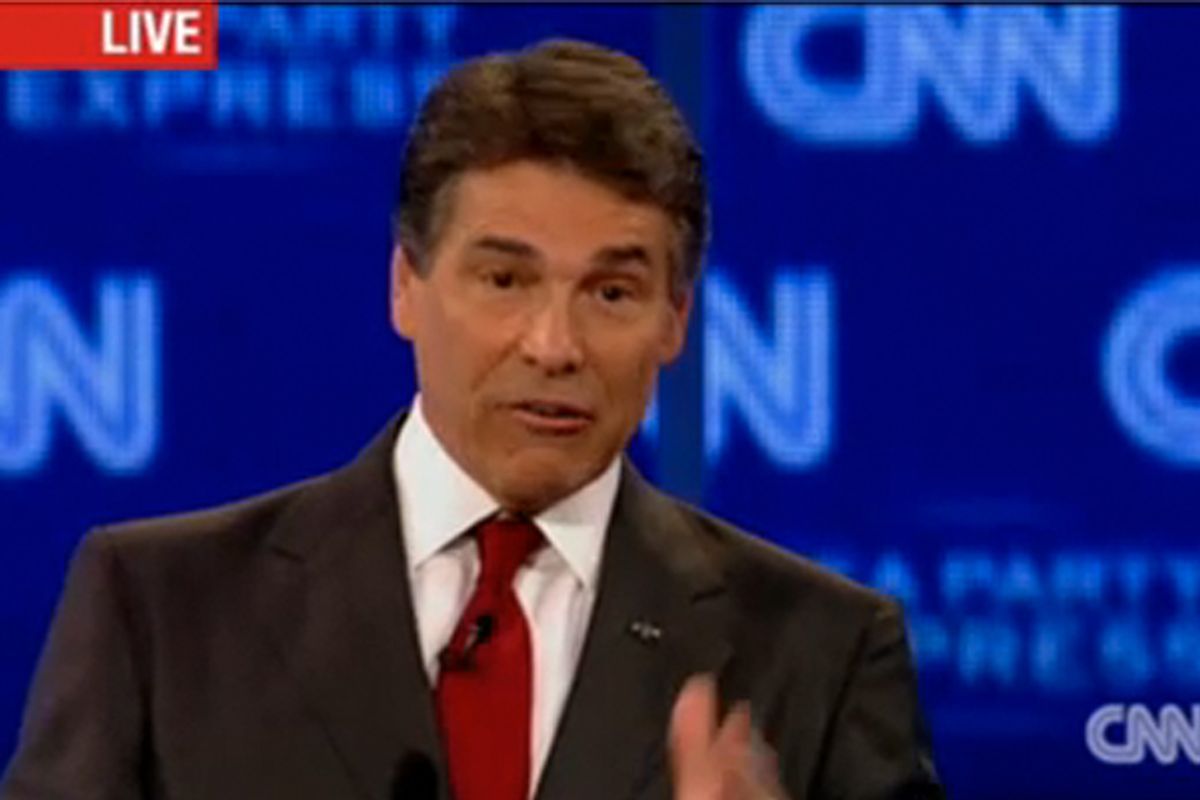
As with his wobbly showing in his debate debut last week, there was nothing in Rick Perry's performance on Monday night that will by itself derail his campaign for the GOP nomination.
But for Republicans who don't want the Texas governor to run as their presidential candidate, the CNN/Tea Party debate may have provided a very useful guide for how to go about cutting him down to size -- and how not to.
The "how not to" part was covered in the first few minutes, when the conversation focused on Social Security, a program Perry called a "monstrous lie" and a "Ponzi scheme" during last Wednesday's showdown. Those comments, which echoed Perry's previous critiques of the popular entitlement program, had dominated the GOP campaign conversation since then, with Mitt Romney arguing that Perry's position is far removed from the mainstream and would frighten general election voters.
But even before the candidates assembled Monday night, it was becoming clear that Romney wasn't getting much traction within the party. In part, this may be because a fair chunk of the GOP's hardcore base actually agrees with the basic sentiment Perry expressed. But the bigger problem for Romney was that influential conservative leaders were giving Perry cover and arguing that Romney was employing the same scare tactics that Democrats are so fond of. This is no small matter for the average Republican activist, who in just the last 15 years has seen Democrats use entitlements to scare swing voters away from the Gingrich Congress, George W. Bush, and Paul Ryan's Medicare plan.
That Romney was coming at Perry from the wrong angle became clear right away on Monday. Perry began by adjusting his rhetoric, claiming that no one who currently receives Social Security benefits would have anything to worry about under a Perry presidency and that his only interest is in guaranteeing the program's long-term solvency. Romney pointed out that Perry has gone much farther than that in his past comments, calling Social Security a "mistake" and arguing it shouldn't be a federal program.
In theory, this was a good point. But Romney seemed to get nowhere with it. Instead, Perry turned it into an attack on the New Deal: "If what you're trying to say is that back in the '30s and '40s the federal government made all the right decisions, I disagree with you." The audience, which was apparently composed of Tea Party activists (moderator Wolf Blitzer boasted that CNN had worked with 60 Tea Party groups to organize the debate), applauded. Romney pressed him: Does he think Social Security shouldn't be a federal program? But Perry dodged the question and accused Romney of "scaring senior citizens." The audience roared. This doesn't seem like an argument Romney can win, at least not within the GOP universe. It's too easy for Perry to deflect it as a Democrat-style smear -- and too many opinion-shaping conservatives will back Perry up on it.
Thus, midway through the debate, Perry seemed to be in great shape. But then came the question about Gardasil.
That would be the HPV vaccine that Perry used a 2007 executive order to mandate that every girl in Texas receive (a decision that was ultimately overruled by the Legislature). It came up briefly in the first debate, but only on Monday night did we begin to see how seriously it could threaten Perry's campaign.
As he did at last week's debate, Perry argued that he was simply trying to save lives: "At the end of the day, it was about trying to stop a cancer." And as she did last week, Michele Bachmann criticized his decision. But this time she did it directly, passionately and unrelentingly. "To have innocent little 12-year-old girls be forced to have a government injection through an executive order is just flat-out wrong," she insisted. "It should never be done."
She went further and challenged Perry's motives. His former chief of staff, she noted, had taken a job with Merck, the maker of Gardasil, just before the executive order was signed, while Merck had also donated money to his 2006 gubernatorial campaign. "Was this about life or was this about millions of dollars or potentially billions of dollars for a drug company?" she asked. Perry responded that Merck gave him only $5,000 -- a drop in the bucket compared to his entire campaign treasury. He tried to make a joke: "If you’re saying I can be bought for $5,000, I'm offended." But the audience wasn't laughing, which made it easy for Bachmann to fire back with what may have been the single biggest applause line of the night.
"I'm offended for all the little girls who didn’t have a choice," she told Perry.
(For what it's worth, the actual amount of money Merck gave to Perry in 2006 appears to be $16,000.)
The exchange was significant for two reasons. The first is obvious: Perry may have a real problem on an issue that matters deeply to religious conservatives. The promise of his candidacy is that he'll provide these voters with a comfortable home, helping him to marginalize Bachmann, unite the conservative base and knock off Romney. But the more attention it receives, the more the Gardasil executive order threatens this strategy. The other (related) threat is that it might help Bachmann get back in the mix. This was definitely the case Monday night. Before Gardasil came up, she seemed to be fading into the background for the second straight debate. But Gardasil gives her a powerful way to force herself back into the conversation and potentially reclaim some of the religious conservatives she's lost to Perry in the last month. Even if she's an afterthought in national polls, Bachmann can still do serious damage to Perry's candidacy simply by faring well in Iowa.
Believe it or not, things got worse for Perry when the subject changed. That's because he's also vulnerable on immigration, thanks to his decision in 2001 to sign what is essentially a Texas version of the Dream Act. This put Perry in the awkward position of defending in front of a Tea Party crowd a law that grants in-state tuition to any high school graduate in Texas who has been in the state for three years. Which meant that he was in the akward position of being booed by the same crowd that had rallied to his defense on Social Security just an hour earlier.
While Romney sat out the Gardasil discussion, he was happy to jump in here, arguing -- to loud applause -- that "of course we do not give in-state tuition to people who are here illegally." This also gave Romney a chance to brag about a completely meaningless executive order he signed in his final days as Massachusetts governor in 2006 deputizing the State Police to round up illegal immigrants. It was immediately overturned by Romney's successor -- not that Romney much cared: He just wanted nice talking point for occasions just like Monday night.
Suddenly, Perry was reduced to pleading the Tenth -- arguing that he was guilty only of handling immigration in a way that worked for his state and stressing that he vehemently opposes a national version of the Dream Act. Of course, this is the same basic defense that Romney offers Republicans whenever his Massachusetts healthcare law is attacked. I did what was right for my state, but believe me I hate ObamaCare just as much as you do. And whenever Perry says or does anything that makes him seem more like Romney and less like the "pure" conservative alternative, well, it's probably a good moment for Romney.
After last week's debate, we wondered how badly Social Security might hurt Perry's nomination chances. But Monday night we may have seen the real threats.
Shares