
Toronto International Film Festival

“Shame”: Michael Fassbender’s full-monty skin flick

Toronto: The Irish star strips down in "Shame," Steve McQueen's devastating sex-addiction drama

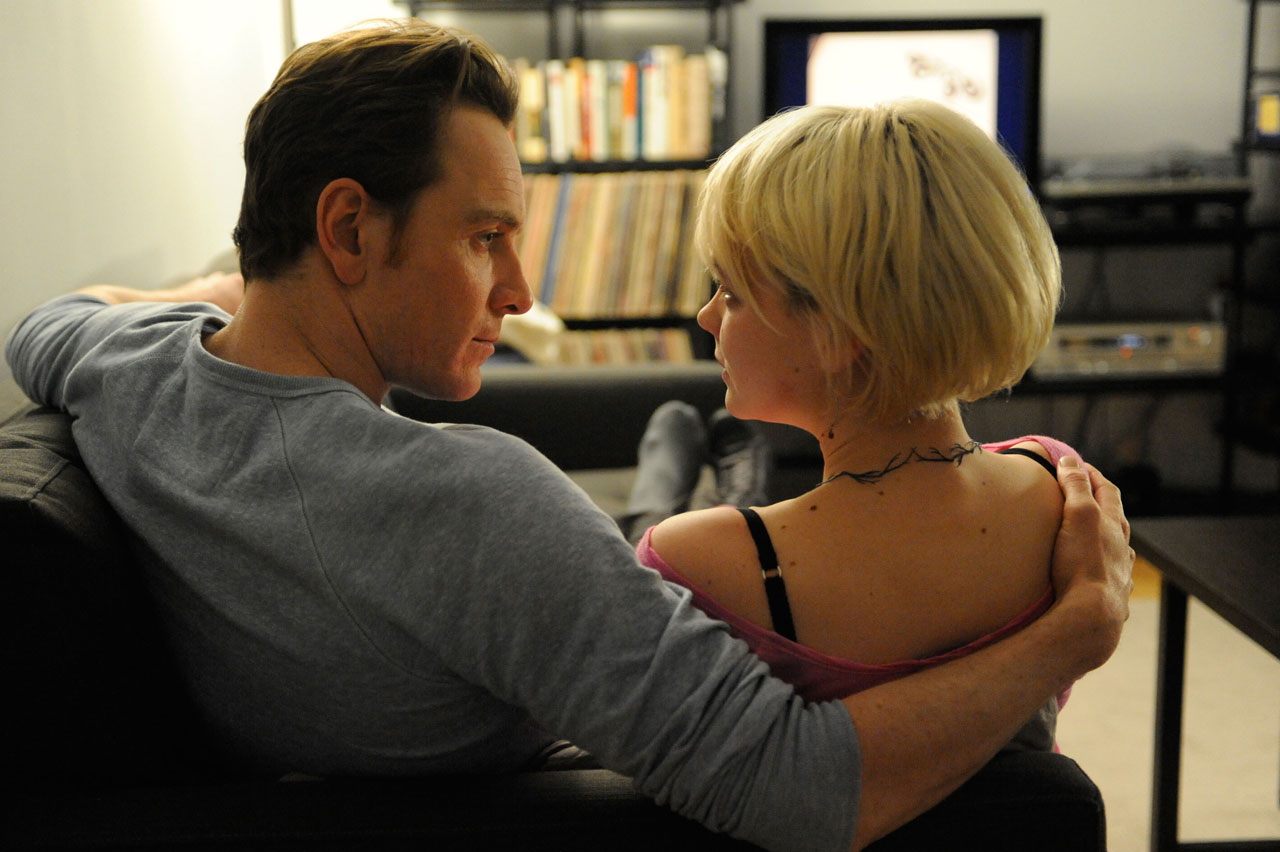
Michael Fassbender and Carey Mulligan in "Shame"

TORONTO — If the first few days of the 2011 Toronto International Film Festival have failed to produce any major hits to set the cognoscenti and Oscar-bloggers buzzing, it’s got three things in spades: 1) terrific roles for women; 2) sexual frankness, often taken to an anti-erotic level, and 3) movies that get people talking. You get all three and more in English artist-turned-filmmaker Steve McQueen’s sex-addiction drama “Shame,” which screened for the press here on Monday morning. If you don’t know McQueen (other than as the namesake of a legendary ’70s movie star), his debut feature was “Hunger,” an extraordinary sound-and-vision experience that starred Michael Fassbender as IRA hunger striker Bobby Sands, and that seemed more like a transmission from an alien planet than a historical drama.

Fassbender is a medium-big celebrity and cover boy in the wake of his “X-Men” role, while it’s hard to imagine McQueen’s films ever becoming multiplex fare. I hope fame doesn’t split them up, because the Scorsese-De Niro relationship (or maybe even Dietrich-von Sternberg relationship) between the big, sexy Irishman and the garrulous black Londoner is clearly a powerful thing. “Shame” was acquired by Fox Searchlight just after its world premiere last week in Venice, and the studio’s principal marketing question will be whether to release it unrated or slap an NC-17 on it. (In either case, many newspapers won’t advertise it and many theaters won’t show it.) As a Manhattan executive in some unnamed but horrible-seeming profession who measures his days and nights by anonymous sexual conquests — not to mention dates with hookers, online chat sessions and regular old porn-fueled masturbation — Fassbender is stripped naked in “Shame,” in every sense of the word. (If you’ve heard Twitterific gossip about the full-monty nudity in this movie, it’s all true.)

“Shame” hints at a conventional movie narrative a fair bit more than “Hunger” does, but it’s first and foremost a visual and sonic symphony, and a Dante-esque journey through a New York nightworld where words are mostly useless or worse. (The credits say the movie was “based on a screenplay by” McQueen and Abi Morgan, which suggests that what we see on screen was largely improvised.) I would say we get 12 or so minutes into the film before anyone says anything, most of it a tense and powerful scene of Brandon (Fassbender) trying to pick up a married woman on the subway. Even then, it’s only him asking a co-worker what happened to his porn-infested computer. (A man has to have his priorities straight.) Whatever garbage in their past has driven Brandon and Sissy (Carey Mulligan), his drunken, slutty and suicidal sister, onto their self-destructive paths, we never learn about it and don’t need to. (Can we revise Tolstoy’s famous maxim so it observes that all family dysfunction is roughly the same?)

A bottle-blond cabaret singer who shows up from L.A. to camp on Brandon’s couch, Sissy somehow catalyzes a crisis in his life of unrepentant, beyond-compulsive horndoggery. Again, we don’t exactly know how, and I would argue we don’t need to; perhaps because of his career working in largely or entirely nonverbal media, McQueen feels no urge to overexplain. Sissy sings a killer cool-jazz rendition of “New York, New York” that reduces Brandon to tears, and then goes home with his married boss, who’s way more of a loser than Brandon is. Brandon tries to go cold turkey, stuffing all his porn — and even his laptop — into trash bags and going on an actual date with an attractive woman from work who actually seems to like him. But he can’t even fake an interest in the normal rituals of courtship. When his date (the African-American actress Nicole Beharie) asks him about his longest relationship, he says it lasted four months, but we suspect it was more like four hours, or $400.

I shouldn’t delve too much further into a film that probably won’t hit theaters until the Christmas season — and what a Jingle Bells it will be. Fassbender and Mulligan both give massive, irresistible performances (the former won the acting prize in Venice) as people drowning in a hostile sea of commodified sexuality and self-hatred. (For all the nakedness and all the screwing, if you go to “Shame” hoping for a prurient spectacle you’ll be disappointed.) McQueen combines ’80s disco-pop and 19th-century Romantic music brilliantly, in one of the best soundtracks of the year, and his cinematographer, Sean Bobbitt, uses the antiseptic interiors of contemporary Manhattan as no one has since Mary Harron’s “American Psycho.” “Shame” isn’t an easy film to sit through, to describe or to figure out, but it’s riveting, spectacular, passionate cinema.

“The Way”: On a pilgrimage with Martin Sheen

The "West Wing" president and his son, Emilio Estevez, discuss their spiritual road movie made for tough times

Martin Sheen and Emilio Estevez

When I showed up for breakfast with Martin Sheen and Emilio Estevez at their Toronto hotel, the Latin American immigrant who brought us coffee and pastries was clearly tickled to find out whose suite he was visiting. A few days earlier, the 71-year-old Sheen, a board member of the Screen Actors Guild and a lifelong labor activist, had been out on the sidewalk in front of the lakefront luxury hotel, walking a picket line with the union employees. (They held a one-day strike to protest what they consider unfair working conditions.)

Sheen took several minutes to talk to the guy, and ended up giving him a tip that consisted of all the Canadian money he had on him. (He wasn’t going to need it back in California.) Limousine liberalism? Maybe, but the only conclusion you can draw after meeting Sheen is that he’s insatiably interested in people. In the course of a half-hour conversation that was supposed to be about “The Way,” a spiritual-seeker road movie directed by Estevez in which Sheen stars, he asked me about my parents, my Irish ancestry, my hometown, my education and my attitudes about religion. I’ve never been so thoroughly interviewed by a girlfriend’s dad, let alone a movie star.

Estevez, Sheen’s elder and significantly less notorious son, is pushing 50 but looks only slightly older (and a bit shaggier) than he did as the 23-year-old star of “The Breakfast Club” in 1985. He’s a more reserved character with a dry wit, content to let his dad do most of the talking. He’s been pursuing a filmmaking career, on and off, for more than two decades, but “The Way” is only his fifth feature, and the first since the sprawling, Altman-esque “Bobby” in 2006. It’s unmistakably the result of Sheen and Estevez’s intertwined sensibilities: the extroverted people-pleaser (and devout Catholic) on one hand, the more detached aloof observer (and agnostic) on the other.

This rambling but irresistible tale is about Tom (Sheen), a golf-playing Republican ophthalmologist from suburban California who takes the 500-mile pilgrimage known as the Camino de Santiago, or the Way of St. James, from the French Pyrenees to Santiago de Compostela in northwestern Spain, carrying his son’s ashes in a box. Tom’s various companions include Deborah Kara Unger as a salty Canadian backpacker, the highly enjoyable Yorick van Wageningen as a beefy Dutchman, and Irish actor James Nesbitt as a struggling writer. (All have their own reasons for the journey, of course.) Estevez himself appears as Tom’s late son, Daniel, but only in flashbacks and dreamlike apparitions. If “The Way” is sometimes shaggy and inelegant, and flirts with sentimentality the whole way through, I was finally overcome by its dignity and sincerity, and by the rough, rude, gorgeous magic of its journey. (And that was before Estevez explained that in some sense it’s a remake of “The Wizard of Oz.” More on that below.)

I’m no good at gauging public reaction in advance but “The Way” has definite dark-horse potential to connect with soul-searching, recession-era audiences on an intimate level, something like a more relaxed, more guy-friendly and arguably more coherent “Eat, Pray, Love.” As Estevez notes, it might also do wonders for the innkeepers and tavern owners along the Camino de Santiago, a series of linked pilgrimage routes, with origins deep in the Christian past, that had fallen into obscurity by the 1980s but is expected to attract more than 200,000 travelers this year.

This isn’t the first time you guys have worked together on a movie. What’s the relationship like on the set? Martin, when you’re the actor and he’s the director, do you have to stop being dad?

Martin Sheen: I don’t even know him on the set! [Laughter.] You know, our relationship is so cemented. I’ve never really thought of him as my son, I’ve always thought of him as my brother. I was 21 when he was born. He showed up and I was like, “OK, you’re the guy.” He got short shrift in the early years. He was born in the Bronx and we got evicted when he was a baby. We lived in every borough but Queens. He got mugged in front of our apartment building in Manhattan a few years later. The other kids have no memory of the hard times — or maybe their hard times are a different story. But this guy knows me in ways I don’t even know myself.

What happened with this character was — you know, I’ve been doing this all my adult life. I’ve got my bag of tricks. So it’s like, which one do I do now? OK, number eight. I got it.

Emilio Estevez: Yeah. I know ‘em all.

M.S.: Yeah, he ain’t having it. We shot the film in sequence, so on the first day I’m out there speaking a little Spanish and talking to people. He took me aside and said, “This is Martin. He’s not welcome here. You’re Tom. Tom voted for Richard Nixon and George Bush twice. You belong to a country club and you think it’s great! You don’t do any charity work. You’re not a nice guy! You’re a moron! It hasn’t happened for you yet! You don’t even see these people! Dismiss them!” And that was it, man. Every time I was Martin …

E.E.: “Cut! Stop! You’re wasting everybody’s time.”

M.S.: You know what he said the other day? I hesitated to agree although I thought so all along. He said it’s the best thing I’ve done since “Apocalypse Now.” And if that’s true, it belongs to him.

E.E.: No, that’s yours. All I did was get out of your way. That’s a director’s main job after the casting, which is maybe 90 percent of it.

Tell me about the Camino de Santiago. Have you guys known about it for a long time? What got you started on this road?

M.S.: My father was a Gallego [a native of Galicia, in northern Spain]. He grew up in a village very close to Santiago de Compostela.

E.E.: I’d never heard you talk about this until, like, seven years ago. You went to that reunion in Ireland.

M.S.: To my mother’s village, in Tipperary. May 22, 2003. She would have been 100 years old. She died in 1951, when she was only 48. By that time we were losing siblings by the score: My mother had 12 pregnancies, and 10 survived. When there were only five of us left, I said no more funerals before we have the celebration. So we gathered in this little village, we had this great celebration, and I said: “I’m going to Spain, and I’m inviting everybody to do the Camino.”

It was Emilio’s son [Taylor Estevez, an associate producer on "The Way"] who was kind of compelled to go. He was working as my assistant and he spoke Spanish, so he became my guide. And one of my oldest friends, Matt Clark, who plays the “rabbi priest” in the film, he went too. I had about 10 days until I had to get back and start filming for the new season on “The West Wing.” We thought about doing it on horseback, but you’ve gotta take all your stuff and bring mules to carry it. We thought about renting bicycles. Finally we thought, hmm, we’ll do it the all-American way. We rented a car. [Laughter.] The miracles began to happen instantly. Emilio’s son met his future wife at the first place we stayed, in Burgos. Where the little boy steals the backpack, in the film? That’s where Taylor lives now. You can see his in-laws in the film. Julia was working that night, and she and Taylor hit it off. They’ve been together ever since.

E.E.: He’s been living there for seven years. He’s totally assimilated into the Spanish culture and lifestyle. They got married last August.

What an awesome story! But how did you get from Taylor falling in love with a Spanish girl to making a movie about the Camino?

M.S.: So originally we were thinking about a documentary tone. I was saying, “Emilio, man, this place is filled with miracles. It’s just magical out there, you’ve got to write a story.” He was doing another story, and I was bothering him. [Laughter.] I thought it was a story about two old guys out on the road, and a young girl who falls in love.

E.E.: I said his idea was too sentimental. So the conversation continues, and I said, “I think I’ve got it. It’s about a father and son.” Usually, the father-son dynamic in films, it’s about the ghost of the father. It’s “Hamlet.” And the son becomes the father, or some reasonable facsimile. This is the reverse. By the end of the film, Tom has in fact become Daniel, and become free.

Talk a little bit about how you assembled the group who travel with Tom on this journey. It’s such a nice collection of characters.

E.E.: Well, I had a Dutch friend who lives down the street. He’s big, larger than life, a wonderful drunk. So he was an inspiration for Joost [van Wageningen's character]. And I met Deborah Kara Unger while I was writing the script, and I said OK, we’re gonna make the female character Canadian.

She’s a total pistol in that role. Just so completely angry at the world. I loved her.

E.E.: She’s terrific. Really, really broken and terrific. And then I was in a bookstore in New Mexico, and I bumped into the Jack Hitt book, “Off the Road,” which is different stories from the Camino. I read it, and I said, OK, here’s our fourth character. [Jack, the Irish writer played by James Nesbitt.] Here’s our Scarecrow. Because essentially — I’ve sort of kept the lid on this, but it really is “The Wizard of Oz.”

You’re kidding! I hadn’t thought of that, but it’s so true.

E.E.: Yorick is the Cowardly Lion. Deborah’s the Tin Man with the broken heart. Martin is Dorothy. And I’m in the box. Daniel in the box is like Toto in the basket, because he keeps getting away. “Come back, Toto!” [Laughter.]

It’s safe to say this was a different scale of production than “Wizard of Oz.”

E.E.: Well, you saw the size of our crew. It was like doing a Wim Wenders film. We traveled 800 miles, shot on super 16. We shot the whole thing in sequence, using mainly available light. We were on the go the whole time. It allowed us to develop and discover things along the way, and have it happen organically.

M.S.: I think our crew was smaller than the one we had making “Badlands” with Terry Malick, or about the same size.

I think this story taps into something that’s clearly out there in the culture right now, but can be difficult to put into words without sounding dumb. We’re all stressed out and surrounded by electronic gizmos, we’re all facing economic hardship, and however we choose to articulate it, we’re looking for something more.

M.S.: Everything’s being ripped away. You’re losing the house, you’re losing your job, and yeah, you’re right, people are beginning to focus on what’s really important. As Americans, we’ve been told, “You can do it.” We’re told to be macho and take responsibility and conquer the world and all this. We don’t give any support to community. Community is an afterthought, but when we get in touch with our loneliness and our guilt and all of these things that are so human, we begin to realize that until you start relating to other people’s brokenness, you can’t heal your own. That’s the beginning of community, I think.

Some people may go into this thinking that the Camino is only for the most intense kinds of Catholics, or anyway for believing Christians.

M.S.: Oh, no. We met maybe a half dozen of those, at most.

E.E. That doesn’t describe anybody in our little group. Martin’s character is lapsed, Jimmy’s a nonbeliever, Deborah’s character is out there hiding out, and Yorick is just a fat Dutchman trying to lose weight. A lot walk the Camino as a sport, or for exercise, or because their friends and family are doing it. There isn’t necessarily any religious motivation at all.

M.S.: You know what’s interesting about the Camino? Like the French guy says in the beginning, you go on your own. It’s for yourself. And 90 percent of the time, you see us walking in single file. It’s very rarely four abreast or all together. It’s so deeply personal. Some people are praying, some people are reflecting. They’re together for meals and sleeping, they aid each other. But when people are walking, they’re alone and you don’t bother them.

I really appreciate that you’re trying to deal with religion and spirituality in this movie in an open-minded, non-cynical fashion, without totally embracing it or totally rejecting it. That’s not an easy thing to do. Our country is so messed up around religion.

M.S.: No kidding! [Laughter.]

You guys are calling our attention here to a tradition of Western spirituality that’s very old and doesn’t have much to do with organized religion. The Camino de Santiago is a perfect example. So many educated Westerners go toward the Eastern spiritual traditions partly because they don’t see that stuff available in the West, or don’t understand it.

E.E.: Sure, they want a response to the dogma of Christianity. They go to Hinduism, they go to Buddhism, just because it’s something different than their parents. They want to get away from that. I think it’s a knee-jerk reaction.

M.S.: Religions separate us, by their very nature. Spirituality unites us. That’s the key, and if spirituality is not about humanity, it’s not spiritual. I am a practicing Catholic. I love the faith. I’m not nuts about the institution, but the faith is mine, everywhere I go in the world. The belief that God became human — that’s genius, man. And that God would choose to dwell where we would least likely look, inside ourselves and each other. The genius of God in our humanity, I love that.

Every culture has that — the Hindus, Muslims, all of them have it. That’s the fundamental belief in all true believers, that God is present, God suffers and is broken with us. That’s why the Catholics never removed the corpse from the cross. Our hero is a convicted criminal. He was tried and convicted in a kangaroo court and then he was murdered. That’s God. We’re embraced by that. The most fundamental, most basic, most sincere beliefs — that’s not religion. It’s spirituality. It’s transcendence. People are looking for transcendence now more than ever, I think. Sometimes our transcendence becomes drugs, alcohol, money, power, sex, and they’re so shallow. It’s we ourselves. We must surrender ourselves to our brokenness. That’s the beginning of community, and that’s what this film is all about.

“The Way” opens this week in New York, Los Angeles and other major cities, with wider release to follow.


Continue Reading Close

“Ides of March”: Clooney and Gosling’s Oedipal struggle

Idealism and politics as usual -- plus two smokin' stars -- square off in the thought-provoking "The Ides of March"

George Clooney in "The Ides of March"

Editor’s note: This review, although rewritten and expanded, reuses material from Andrew O’Hehir’s original review of “The Ides of March” from the Toronto International Film Festival.

George Clooney’s film “The Ides of March” is an ingenious construction, much cleverer in psychological and symbolic terms than the story it tells, which mixes a schematic thriller and an on-the-nose fable about the corruption of American politics. The movie revolves around three confrontations between Clooney himself, playing a Pennsylvania governor turned presidential candidate named Mike Morris, and Ryan Gosling, as his hotshot, 30-year-old media strategist, Stephen Meyers. Only the last of those meetings is crucial to the ostensible plot of “The Ides of March,” which is about Stephen’s seduction and betrayal by pretty much everyone else in the movie (and most of all by himself). Taken together they tell the whole story.

Many critics, including me, have observed that Gosling plays something like a “George Clooney character” in this picture, while Clooney, as has become customary in his directorial efforts, consigns himself to a supporting role — in this case an instrumental but mysterious one. It will be lost on exactly nobody that these Gosling-Clooney scenes have an Oedipal character, both within the world of the movie and within the meta-universe of movie-star culture. In the first face-to-face between Stephen and Morris, at a crowded staff meeting where the strategist convinces the candidate to make an important policy shift, their mutual admiration is evident — but so is the tension, and the unstable power dynamic. Clooney’s Morris regards his young protégé with a hooded poker player’s smile; he admires the younger man’s energy and enthusiasm, but knows something he doesn’t. Gosling’s Stephen looks at his candidate with love — there’s no other word for it — but it’s the jealous, ambitious love of a favorite son. He sees Morris as the man he would like to become someday. By the end of the film, when the two meet in a darkened restaurant kitchen to strike the shadiest of backroom deals, Stephen sees Morris as the man he will become, or has already become. It isn’t pretty.

Then there’s the middle scene between Stephen and Morris, an apparent throwaway where the two of them have a brief conversation during a patch of turbulence on a chartered campaign jet. Stephen’s a nervous flier who clings to his armrests; Morris, a cool customer with a permanently sardonic demeanor — he’s an unlikely candidate for all kinds of reasons, and that’s only one — barely notices the bumps and stays focused on the papers in front of him. Stephen tells his boss that at moments like this he clings to the faith that they’re doing the right thing and fighting the good fight, and if you do that nothing bad can happen. Morris barely looks up. “Is that your personal theory?” he asks derisively. “Because I could shoot some holes in it: Roberto Clemente, on a humanitarian flight?” (At the risk of being condescending, I’ll elaborate: Clemente was a beloved baseball superstar who died in a 1972 plane crash, on his way to deliver emergency earthquake aid to Nicaragua.)

If you view Morris’ Clemente story as a parable — God offers no guarantees, and Stephen’s idealism is misplaced — it tells you almost everything you need to know about the politics of “The Ides of March.” Another of the terrific supporting characters in this movie, a battle-hardened New York Times reporter named Ida Horowicz (Marisa Tomei, for once getting a role where her sex appeal is irrelevant), sums it all up in an early scene with Gosling’s Stephen. “You’ve really drunk the Kool-Aid!” she tells him, amazed. “I have, and it’s delicious,” Stephen responds. He doesn’t care whether Morris can win, according to conventional wisdom; he believes that Morris must win, for the good of the country. Ida laughs, and assures him that who wins or loses makes no difference to ordinary people. The results will decide whether Stephen works in the White House for a few years or retreats into a K Street consulting firm, but that’s about it. “He will let you down,” she says. “They all let you down, sooner or later.”

Clooney’s title refers to the assassination of Julius Caesar in 44 B.C., which is sometimes understood as an effort to overthrow despotic rule and restore the Roman Republic. You can say that “The Ides of March” (adapted from Beau Willimon’s play “Farragut North”) depicts a more mundane kind of political coup, and a society moving in the same decadent direction, but it’s not at all clear where Clooney sees the parallel, or who in the film plays the roles of Caesar and Brutus. This is Clooney’s fourth feature as a director, and he’s developed into an understated craftsman with good storytelling instincts, an old-style Hollywood desire to let his actors tell the story and an interest in exposing the backstage machinery behind social spectacles. (“Confessions of a Dangerous Mind” was about television, “Good Night, and Good Luck” about the intersection of TV news and politics, and “Leatherheads” about the early years of professional football.)

Clooney’s character here, a populist Democrat who’s leading a tight race heading into the Ohio primary, suggests a combination of Barack Obama, Bill Clinton and John Edwards. (If that verges on being a spoiler, forget I said anything.) He plays the role of a fire-breathing populist revolutionary in public, but maintains an acerbic distance from even his closest advisors. At first glance, and even at second, Morris is a dream candidate, a sitting governor who has balanced his state budget and advocates an ambitious program of national renewal: mandatory service for high-school graduates, balanced with free college tuition and healthcare for all. He’s pro-gay marriage and wants to jack up taxes on the rich, and he’s an agnostic or atheist who declines to discuss religion, which may be the most unlikely element of all. If Morris may not entirely be what he seems to be — or at least as the star-struck Stephen views him — what candidate ever is? Clooney may be inviting us to consider whether that really matters, or suggesting that in the contest between idealism and pragmatism, one side is always sacrificed to the other. (Clooney gets a screenplay credit, along with co-producer Grant Heslov and playwright Willimon.)

What you get out of “The Ides of March” largely depends on what you bring into it. If you already believe that American electoral politics is a hopelessly cynical and corrupt shadow-play, where high-minded rhetoric is used to conceal a naked power struggle for the reins of a decaying state apparatus and the results (as Horowicz says) don’t matter to most citizens outside the Beltway, then that’s what the movie’s about. Other conclusions are possible: Maybe electing somebody with Mike Morris’ positions is important even if he’s a ruthless, calculating, lying bastard in private; maybe our focus on political buzzwords like “character” and “integrity” is where the real hypocrisy lies. I once had a conversation with Bill Moyers where he told me that he was never much concerned with a politician’s personality or private life; he had worked for Lyndon Johnson, who was (to put it generously) a mean-spirited and difficult person with numerous private failings, but also a highly effective president. We see Morris in pieces, some of them damning and others endearing (there’s a brief and wonderful scene in a limo between Clooney and the terrific Jennifer Ehle, who plays his wife), but we don’t get to know him well enough to render a final judgment.

As I said earlier, “The Ides of March” is the story of a young innocent’s seduction and betrayal, and I’m not talking about the comely 20-year-old intern named Molly (Evan Rachel Wood), with whom Stephen winds up in bed a few days before the Ohio primary. (She is no more than a contrivance, and one of the movie’s biggest weaknesses.) By Ryan Gosling standards, Stephen is a highly distracted playboy; even while they’re in the supposed throes of passion, Stephen can’t keep his eyes off the TV set, where Morris is refining his position on gay marriage. (Yeah, that’s a nice touch!) Morris is locked in a neck-and-neck contest in the Buckeye State with his last remaining challenger, an Arkansas senator named Ted Pullman who plays no role in the story. (Once again, the politics seem pretty vague: Pullman is described as a “tax-and-spend liberal,” but also one who taunts Morris for his lack of religiosity.) In this moody landscape of jargon-rich, warlike dialogue and gray, end-of-winter Cincinnati streets — the superb cinematography is by Phedon Papamichael — Stephen’s big crisis blows past so fast, like a truck on the interstate, that neither he nor we notice it till it’s gone.

Morris’ bulldog campaign manager, Paul Zara, is another great, gruff, growly role for Philip Seymour Hoffman, who might just fill up the supporting-actor category in this year’s Oscars all by himself (after his role in “Moneyball” as Oakland A’s manager Art Howe). He relies on Stephen, who is younger, better looking and arguably more intelligent, without remotely trusting him. Meanwhile, Pullman’s campaign manager, Tom Duffy (the terrific Paul Giamatti, smooth as a buttered walrus), makes a devious play to lure Stephen to his side, hinting that things he doesn’t know about yet will sink the Morris campaign. As soon as Stephen meets Duffy in a deserted Cincinnati sports bar for a bit of ass-kissing and horse-race chatter, events are set in motion that no one can control. Throw in Tomei’s ruthless Timester, who befriends Stephen before she backstabs him, and Jeffrey Wright as a thoroughly loathsome North Carolina senator who has dropped out of the race but controls 350-plus crucial delegates, and it all becomes a baffling, fast-moving game of who’s playing whom, and to what end. Stephen, Morris, the two campaign managers and Molly are all plunged down the slippery slope of sleaze and tragedy.

I’m not quite sure whether to describe the ambiguity and/or irresolution at the heart of “The Ides of March” as a strength or a weakness. The movie has nothing to say about American politics we don’t already know, i.e., the system is broken and dirty, and those who enter it are soon stripped of their ideals and reduced to viciousness. Maybe it’s perfectly fine for Clooney to suggest two contradictory conclusions; he’s trying to make stylish, thought-provoking pop entertainment, not write an essay for Harper’s. On second viewing, though, I’m not sure “Ides of March” is about politics at all. Its dense drama and characters and atmosphere all orbit its two dark pole stars, the twin ladykillers of different generations, both so grave and so ironical, both desired and/or envied by the rest of us. They gaze into each other like Narcissus looking into the pool, one of them a young man who still looks into the future with hope, the other an older man who knows better.

“The Ides of March” opens this week nationwide.

Continue Reading Close

Pick of the week: “Take Shelter,” a potent fable of marriage and madness

Pick of the week: The gripping "Take Shelter" channels Malick, Kubrick and the Coen brothers

Michael Shannon in "Take Shelter"

An intense psychological thriller that builds toward an explosive conclusion, indie writer-director Jeff Nichols’ “Take Shelter” may be the most powerful American film I’ve seen this year. Having said that, I want to manage expectations a little bit. One can argue, and I will, that “Take Shelter” is a terrifically crafted little movie that bounces off current events and the nation’s downbeat mood ingeniously, and that it variously suggests comparisons with the early work of Terrence Malick, Stanley Kubrick and the Coen brothers. Yeah, I think it’s that good, but please note that I also said “little.” This is a modestly scaled, character-based drama, shot quickly on a low budget in heartland locations. So don’t go expecting big-screen spectacle, and don’t complain to me about the limited production values or the imperfect CGI effects (although both are actually fine). I should add that I saw this movie while soaking wet, after walking through the residue of a recent tropical storm, and that given its obsessive depiction of extreme weather, that definitely heightened the firepower.

To some viewers — maybe quite a few — “Take Shelter” will look more like an above-average genre film, somewhat in the M. Night Shyamalan mode (before Shyamalan inflated into a Macy’s Thanksgiving Parade balloon version of himself), with a bit more grit and realism. It’s not an unfair comparison; “Take Shelter” revolves around Curtis (Michael Shannon), an ordinary Ohio husband and father, who begins having a series of apocalyptic, and increasingly terrifying, visions and nightmares. But Nichols, a 31-year-old Arkansas native who previously made the no-budget underground hit “Shotgun Stories” (also starring Shannon), is after something more complicated than the Scooby-Doo parlor trick of most Shyamalan-style films, where the spooky narrative events are eventually explained through a big “reveal.” Curtis believes throughout the film that he’s suffering a psychotic breakdown, and the possibility that there’s some objective, external, parascientific explanation for his midnight terrors (and midday ones too) is kept locked away until the story requires it.

If there’s a strong horror-movie undertow right under the surface of “Take Shelter,” its main text is a recession-era marriage drama about a family struggling to cling to the lower edge of the middle class. Curtis has recently been promoted to a supervisor position at his construction firm, and his wife, Samantha (Jessica Chastain, of “The Help” and “The Tree of Life”), is increasingly anxious about how his wobbly personal behavior will affect their financial future. If Shannon’s anguished, brooding performance as a man who’s petrified by what he finds in his own head is very much the movie’s centerpiece (and while Shannon gets a certain amount of stick for overacting, I think he’s almost always good), Chastain provides its moral tether. Samantha is keenly aware that if Curtis loses his job, they lose their house, their deaf daughter (Tova Stewart) won’t get cochlear implant surgery, and the family will slide into the chaos of poverty.

What makes this gripping and compact tale of marriage, faith, madness and possible apocalypse so unusual is the fact that it works so well on all levels. Nichols and cinematographer Adam Stone capture the undramatic Ohio landscape and wide Midwestern sky in almost lyrical compositions, and the rituals of Curtis and Samantha’s days and nights are captured with no hint of anthropological condescension. Yet as Curtis’ visions become more pronounced and more troubling — they almost always begin with eerie and unexpected storms, involve unseen but dangerous intruders, and often end with someone he loves or trusts turning against him violently — the sense that something shocking lies just below the film’s everyday realism becomes almost unbearable. And with no more than a few deft allusions, Nichols makes the point that the pressure on Curtis and Samantha is coming from all directions, and is not purely psychological: Extreme weather and climate change, bad economic news, vanishing healthcare and the prospect of unemployment and bankruptcy are all very real threats for this family and millions of others. (Even the painfully inadequate mental-health services available to someone in Curtis’ position play an agonizing role in the story.)

In an Oscar race that’s likely to feature Brad Pitt, George Clooney and Ryan Gosling, an eccentric outsider like Shannon probably doesn’t stand a chance. But I’d like to think this enormous, marvelously compassionate performance will put him in the running. Always a commanding physical presence, Shannon displays a gravity in this role, a gut-wrenching sense of inner turmoil, that I haven’t quite seen before. Curtis is an intelligent but uneducated guy who’s struggling to understand something no one can understand (the deepest mysteries of our own minds), and profoundly grieving for the loss of his own sense of self as a competent husband and father. He checks out books from the public library, tries to confide in his best friend (Shea Whigham), even goes to see a sympathetic counselor (a nice bit part for Lisa Gay Hamilton). When he borrows money to build out the underground storm shelter in his backyard, it’s partly because he feels an irresistible compulsion to do so, even though he knows it’s irrational. But he also does it because it’s something he knows how to do; his relief at handling practical and logistical problems, rather than the murkier ones raised by faith and psychology, is tangible.

“Take Shelter” culminates with an escalating series of crises and explosions, the biggest of them when Curtis goes off, with all the pent-up fury of a volcano releasing magma, at a local fish fry full of whispering, gossiping neighbors. All I’ll say is that Curtis and Samantha and their daughter will indeed wind up down in that storm shelter, but that even then the question of what Curtis’ visions mean, or what’s “really happening,” is very much up in the air. When I talked to Jessica Chastain about the movie, she declined to offer any explanation for its breathtaking final scene, but she’s right that the key to that ambiguous ending, and to the whole film, lies in the look that passes between the couple. It’s that look that allows Nichols to end his terrifying tale of American apocalypse on a hopeful note: Whatever storm is coming, these two will face it together.

“Take Shelter” is now playing in New York and Los Angeles, with wider national release to follow.

Continue Reading Close

Jessica Chastain: The dazzling redhead who's suddenly everywhere

After "Tree of Life" and "The Help" -- and with six more movies on the way -- Jessica Chastain's moment has arrived

Actress Jessica Chastain of the U.S. poses for photographers as she arrives on the "Wilde Salome" red carpet at the 68th Venice Film Festival September 4, 2011. REUTERS/Alessandro Bianchi (ITALY - Tags: ENTERTAINMENT PROFILE TPX IMAGES OF THE DAY)(Credit: Reuters)

Jessica Chastain may not yet qualify as a movie star, but within seconds of meeting her you completely understand why every casting agent in Hollywood is convinced she will become one. To put it bluntly, she is dazzling — and I’m talking more about her manner and presence than her beauty, although she’s exceptionally pretty, with flaming red hair and pale, translucent skin. She’s vivacious and charming, seemingly without effort, and has the kind of spectacular smile that uplifts everyone’s spirits within a 50-foot radius.

It makes you wonder where all those casting directors and filmmakers who so desperately want Chastain in their movies now were a few years ago, when she was a little-known television actress whose biggest part had been a four-episode role on “Law & Order: Trial by Jury.” There are no answers beyond the usual clichés: Showbiz is full of pretty faces, and sometimes all it takes is one little break. Chastain’s break was pretty big, and came when Terrence Malick cast her opposite Brad Pitt in “The Tree of Life,” where her shimmering, ethereal presence created a thematic and visual balance to Pitt’s intense, compulsive, authoritarian father-figure.

But “Tree of Life” was only the tip of the iceberg, and the 30-year-old Chastain has most definitely been making up for lost time. In terms of audience appeal, her biggest role has been as Celia Foote in “The Help,” the hapless, white-trash-made-good housewife who was both that film’s comic relief and, in an odd way, its most honest and unaffected white heroine. The scene when Celia insists on eating lunch in the kitchen with her African-American maid (Octavia Spencer) — who is none too sure she wants to be friends with this high-maintenance, neurotic white lady — was arguably more moving than “The Help’s” more histrionic race-relations drama.

It’s not much of an exaggeration to say that Chastain seems to suddenly be in every upcoming film. Within the last year or two, she has played a Mossad agent (the younger version of Helen Mirren) in “The Debt,” a detective in the serial-killer drama “Texas Killing Fields” (out next month), Virgilia in Ralph Fiennes’ version of Shakespeare’s “Coriolanus” (to be released this winter) and Salome in Al Pacino’s meta-theatrical “Wilde Salome,” which premiered in Venice a few days before I met her at the Toronto International Film Festival. Her big-budget Hollywood breakthrough may lie just ahead, since she will reportedly star opposite Tom Cruise and Olivia Wilde in “Horizons,” an interplanetary science-fiction thriller from “TRON: Legacy” director Joseph Kosinski.

Then there’s “Take Shelter,” an intense psychological horror drama from indie director Jeff Nichols — looking for his own breakthrough after the 2008 underground sensation “Shotgun Stories” — which Chastain was promoting in Toronto. I’ll have more to say on this film very soon, but it’s an absolute knockout, one of the best American films of the year. Chastain and the remarkable Michael Shannon play Samantha and Curtis, a married couple in small-town Ohio clinging to the lower edges of the working class. It’s very much a film about this moment in America, a film about economic recession and madness and faith and family, even  climate change and disastrous weather. Samantha must decide whether to cling to Curtis or flee from him as he goes through a breakdown and suffers from disturbing, apocalyptic visions — which may just have some basis in reality.

So, Jessica, you’ve had this amazing run of movies. I understand you can pull up the list in your mind pretty easily.

Yes! Let’s see, there’s “Tree of Life,” “The Help,” “The Debt,” “Take Shelter,” “Texas Killing Fields,” “Coriolanus” and then “Wilde Salome,” which just played in Venice. So six films that have already come out or are coming out, and seven if you include that one.

And you just finished shooting at least one other movie. Or two, if we count Terry Malick’s next film as well.

Yes, I just finished working on “The Wettest County in the World.” I’d be surprised if that came out this year.

That’s John Hillcoat’s film, right? Another collaboration with Nick Cave. (They made the 2006 Aussie western “The Proposition.”)

Yes! And I’m so excited about this film. I keep telling everyone that the acting, across the board is — oh, my gosh — every performance was mind-blowing. It’s got Guy Pearce, Tom Hardy, Shia LaBeouf, Gary Oldman, Mia Wasikowska. The ensemble is sick.

Can you actually keep all these movies clear in your head? I mean you come to a festival to help out some movie you shot a long time ago, and people like me ask you to remember specific episodes or specific scenes.

I mean, sometimes it’s hard. I don’t have a problem remembering the films, because they’re all like children at a certain point. But when people say, “Can you tell me a funny story, something that happened on set?” And you’re like, oh God, from “Tree of Life”? That was three years ago. So trying to think of a funny thing that happened, that’s a bit tough. Other than that, I remember them all like my beloved children.

Right. What about if I’m, like, “What was going through your mind in this scene? Why does your character do that?”

Oh, I’ll remember that forever, yeah. With the characters that I play, I absolutely know them and the psychology of where they come from. What they deal with every day, what their fears are. I don’t think I’ll ever lose that.

Well, you’ve been picking winners. It’s such a terrific list. In “Take Shelter” and “Tree of Life” and “The Help,” you play these really different women who are touchingly, doggedly loyal to very difficult husbands. That’s not much of a connection, maybe, but I do feel a kinship between Mrs. O’Brien in “Tree of Life” and Samantha in “Take Shelter.” Do you see it that way?

You know, I see more difference between these characters, because Mrs. O’Brien in “Tree of Life” is the representation of grace, whereas I feel like Samantha in “Take Shelter” is closer to nature. She has a lot of nature in her. The most dangerous animal in the wild kingdom is the mother grizzly, or, like, the female tiger. They’re the ones who do all the killing. I think Samantha is more like that. Nobody messes with her family, nobody hurts her child. In fact, she reacts with violence, she hits her husband in the face. She’s very, very strong. She’s the head of the household, really. He makes the money, but she makes the rules. For me, they are completely different women, but I can understand what people see there: They’re both women who stick with their husbands, they’re both powerful and committed mothers.

A lot of people talk about Terry Malick’s methods, and about his unwillingness to discuss the film too much. I wonder if that was a big difference between these roles, working with him versus working with Jeff Nichols. Because these are two powerful and disturbing films that have an allegorical quality.

Actually, when we did “Tree of Life” we talked about it a lot. I had the script and I knew exactly what the film was when we were making it. I was very much a part of that conversation. I think people who say they’re not sure are usually people who come in for a couple of days. I just had that experience recently on Terry’s new film. I don’t know what the film’s about, I never read a script, and I came in for less than a week! It was strange going from “Tree of Life” to this thing where I had to say, “I have no idea what I’m doing, but fine!”

“Take Shelter” was really different. We had no time to shoot this film! So we couldn’t have a lot of discussion. We really had to be quick. I met Mike [Shannon] on Saturday night, I think it was. On Sunday, we hung out with Tova Stewart, who plays our daughter, for a little bit, and then on Monday we were filming the doctor scene that comes at the end of the film. We had never met before, and for a movie that Jeff says is about marriage and faith, that’s a scary thing. You go in there and you think, OK, I have to make this relationship as real as possible. We don’t have time to be polite, we just have to be honest.

Did you have to do that classic actor thing, where you identify ways the character is like you, and work from that?

Not really. I kind of felt Sam before, I understood her journey. I’d had the script for a while, but I was mostly concerned with the relationship between Mike and me, between Curtis and Samantha. I mean, the whole film hinges on this relationship. What does this man have at stake, what does he stand to lose? If that’s not there or that’s not strong, then the film doesn’t work. Jeff even told us that there’s a look between Samantha and Curtis at the end of the film, at the very end. And if that look doesn’t work, the whole film falls apart.

I agree with that, and that’s really a devastating moment between them. Talk about the way Samantha changes, and this relationship changes. Because I think this is one of the most interesting screen depictions of marriage I’ve seen in a long time.

What I really like about the dynamics of what we play is that in the very first scene, we don’t even look at each other. It doesn’t mean we’re not in love, but I find that really honest. These are people who’ve been together a long time, they’re going about their day and saying, “Oh, don’t forget to pick up this thing. We’ve got to be here at this time.” There’s no time for, like, “Hello, darling.” Which sometimes you see in films, let’s show that they love each other: “Hello, my love.”

We’re being as realistic as we can, and then at some point there’s this change where she starts to look at him, and realizes something’s wrong. It’s like, how long have I not seen this? How long has this been going on? She’s wondering, have I been taking this relationship for granted? All of a sudden he’s somewhere else, and I don’t know how he got there.

To me, the most important shift in Samantha’s character is after the ambulance comes to the house [after Curtis suffers an apparent seizure in the middle of the night]. Then there’s a scene where Curtis lays everything out on the table. Before that, I think Samantha was heartbroken and thought their relationship was over. There was no communication left, and the closeness they had was gone. After that scene, when he shows such great faith in her, in telling her this and trusting her to be there, she in turn shows great faith in him. Even when something happens later and she feels like he hurts her daughter and she hits him, she still shows faith in this man, like she knows he’s beyond his own actions and behavior.

Often marriage is portrayed in the movies with these very even, steady arcs. Either the people are pulling apart, pulling apart, until it’s over or they have one big crisis and then get back together. This marriage has a lot of wobble, a lot of give and take. It shifts back and forth.

Yeah, absolutely. After that moment where I hit him — and I hated doing that scene, because I hate violence and I love Mike! I don’t want to hit him in the face! — after that scene, when she decides to come back, she lays everything out on the table. It’s not like [overdramatic voice], “I love you, my darling!” I loved that, and it’s not the expected idea of, you know, we just had a fight and let’s make up, in Hollywood. It’s not until the fish-fry scene, when they’re in public and she has demanded that he be there, that she truly understands the place where he has gone. [Curtis suffers a major public breakdown in that scene.] And from then on, she needs to act with the utmost compassion that she can muster.

That scene is something, as people will soon discover. Michael Shannon is a very powerful actor all the time, but that’s like watching a volcano erupt. We’ve been waiting for it and waiting for it, we know it’s going to happen, and then — oh, man.

It was amazing. He’s such a brilliant actor. After the very first take of that scene, all the people applauded. All the extras, and I was like, “No, you’re supposed to be scared of him! Don’t clap!” He’s one of those actors — it’s undeniable, his talent. He has so much intensity and power physically, because he’s a big guy, but also he’s got this great face and these amazing eyes. There’s such strength in him, and that masks this really intense vulnerability, this epic vulnerability. He’s got both, and that’s really exciting — to be in a scene with somebody who can muster such great strength and such vulnerability.

Let me ask this the right way: The end of “Take Shelter” is very ambiguous, and I’d like to hear your opinion. Without giving too much away, is Samantha entering his reality, maybe his madness? Or is what we see happening at the end of the movie really happening in the outside world?

I don’t want to answer that question.

I didn’t really think you would.

No! [Laughter.] I guess it’s because — and I found this out with “Tree of Life” — when I answer questions, it’s not as interesting as an audience member solving it for themselves. I made a mistake at Cannes, after someone saw “Tree of Life” and totally loved it, and then they asked me something. I answered the question and, like, you could see them going, “What?” They were so disappointed with my answer! I was like, whoops, I learned my lesson right now.

Well, if they were asking you the question, it probably means they already thought they knew the answer.

Exactly! They have an opinion about what it is, and they want me to validate their opinion. They want me to agree with them so they can say, “Oh! I was right!” But if you say something else, they’re wondering, maybe I didn’t get the movie, maybe I didn’t understand it. It’s more interesting when we see ourselves in films, when they move us on a personal level. For me to impose what I think it is robs the viewer of that experience.

“Take Shelter” opens Sept. 30 in New York and Los Angeles, with wider national release to follow.

Continue Reading Close

Best of Toronto: Oscar candidates and indie breakouts

The Academy Award race gets underway in Toronto, and Clooney, Pitt and Knightley jump to the front of the pack

Clockwise, from top left, scenes from "Think of Me," "The Descendants," "A Dangerous Method," "Moneyball"

One journalist friend of mine describes the Toronto International Film Festival as an exercise in chaos theory or, to put it another way, a gigantic real-world game of Tetris. No other festival in the world has so many simultaneous identities or fills so many niches: Toronto hosts a number of major Hollywood premieres and kick-starts the Oscar season, serves as the North American entry point for adventurous cinema from all over the world, rivals Sundance as a marketplace for American indies and is the principal showcase for Canadian film, all at the same time.

So no matter how many movies you see at Toronto — and I’ve seen plenty over the past week — you come home wishing you could have stayed longer, slept even less or sternly said no to party invitations. Among the films I didn’t see, I particularly regret Jennifer Westfeldt’s suddenly hot indie comedy “Friends With Kids,” Andrea Arnold’s reportedly abstract take on “Wuthering Heights,” Spanish director Juan Carlos Fresnadillo’s horror film “Intruders,” the ass-kicking Indonesian action film “The Raid,” Woody Harrelson’s star turn as a corrupt cop in “Rampart,” Japanese master Hirokazu Kore-Eda’s “I Wish” … the list doesn’t stop.

All that said, here are 10 movies that were much discussed at Toronto and will definitely make news in the months ahead. The first five are highly plausible or possible Oscar contenders and likely box-office winners, and the second tier consists of “specialty audience” films, as they diplomatically say in the biz. (In English, that means they’ll do well in college towns, but there’s no point booking ‘em in the shopping malls.)

MAJOR BRANDS

The Descendants This leisurely and rather quiet family tragicomedy from writer-director Alexander Payne (his first film since “Sideways” in 2004) gets by on George Clooney’s restrained and nuanced performance as a battered middle-aged dad and its unusual depiction of Hawaii as a place where people actually live, rather than a tourist destination. But it’s grown on me since I first saw it, and Payne and Clooney are both in line for multiple awards nominations. I expect to see a critical backlash on “The Descendants” in the not-too-distant future, simply because it’s an audience-friendly film that doesn’t have tremendous cinematic ambition and tells a predictable story of crisis and redemption. I don’t suspect Clooney admirers, ordinary moviegoers or Oscar voters will care too much.

A Dangerous Method Another picture that was more subdued and straightforward than many viewers expected or hoped, David Cronenberg’s drama about Carl Jung (Michael Fassbender), Sigmund Freud (Viggo Mortensen) and Sabina Spielrein (Keira Knightley), the patient-turned-therapist who came between them, remains a commercial question mark. This is a talky, elegant drama for grown-ups, largely shot in the actual European locations where Freud and Jung lived, not a twisted Cronenbergian psychodrama of orifices and nightmares. But I enjoyed its wit and vigor immensely, and suspect I’ll like it even better on second viewing. Brace yourselves, Keira-haters; Knightley is absolutely terrific as the brilliant femme fatale (and pioneering sexual masochist) who got elided from the history of psychiatry. If there’s an Oscar in this film, it’s probably hers.

Shame Arguably English artist-turned-filmmaker Steve McQueen’s Dante-esque odyssey through sex addiction, with Michael Fassbender and Carey Mulligan playing a tormented brother and sister, belongs in the art-house category. (For one thing, “Shame” will require either an NC-17 rating or none at all, which will sharply limit its theatrical potential.) But given the star power, the brilliant acting and McQueen’s audacious filmmaking, there’s at least some chance “Shame” could become this year’s “Black Swan,” albeit on a smaller commercial scale. Fassbender won the acting award at Venice for this role, and an Oscar nod is completely plausible.

Moneyball I’ll be reviewing Bennett Miller’s adaptation of Michael Lewis’ stats-obsessed baseball best-seller next week, but it’s one of the fall season’s great unknowns. Baseball movies have long been tough sells to mass audiences, and for obvious reasons don’t play well internationally (except in Latin America and Japan). Still most people who saw “Moneyball” in Toronto report that it tells an engrossing story, and that Brad Pitt’s portrayal of innovative Oakland A’s general manager Billy Beane could put him in the Oscar race — but if, and only if, enough people see the movie. Jonah Hill’s first major dramatic performance, as Beane’s assistant, might also be an awards candidate.

The Ides of March George Clooney’s cool and stylish political drama, starring the immensely hot Ryan Gosling as an idealistic media whiz facing the first major moral crisis of his young career, got mixed reviews in Toronto and arguably isn’t as distinctive as Clooney’s Oscar-nominated McCarthy-era yarn, “Good Night, and Good Luck.” But this is another case where the so-called smart people need to wait and see how ordinary viewers react. The movie’s beautiful to watch, capturing wintry Cincinnati landscapes as a sort of external corollary to its grim psychological landscape, and Gosling’s grave, measured performance — I’m tempted to call it a George Clooney performance by other means — is a memorable, artful construction. Paul Giamatti and Philip Seymour Hoffman could wind up battling each other in the supporting-actor race.

OUTSIDERS

Take Shelter Writer-director Jeff Nichols’ creepazoid psychological thriller, with Michael Shannon as a working-class Ohio man who becomes possessed by dreams and visions of apocalyptic storms, has been playing the festival circuit all year — and will finally be released just as this fall’s hurricane season winds down. I’ll be reviewing this soon, but here’s the two-second version: Holy cow! Made on a low budget and pitched halfway between a Terrence Malick or Stanley Kubrick nightmare and, say, M. Night Shyamalan, “Take Shelter” looks to me like one of the most memorable American films of the year. Shannon could be an Oscar dark horse — and certainly deserves to be — and the ubiquitous Jessica Chastain is very good as his troubled wife.

Your Sister’s Sister Seattle-based filmmaker Lynn Shelton made the festival hit “Humpday” a few years ago, which utterly failed to cross over to mainstream audiences despite tons of media chatter. Here she tries again, sticking to the improvisation-based relationship yarn but moving up in budget and in star quality. Emily Blunt and Mark Duplass play a pair of close friends with a complicated past (she was his late brother’s lover) who are clearly being drawn together, only to have the ever-terrific Rosemarie DeWitt, playing Blunt’s dogmatic vegan-lesbian sister, come between them unexpectedly. Comedy turns to darkness and then to some degree of redemption, and even in the overcrowded indie market, this satisfying and highly authentic-feeling indie could be Shelton’s breakthrough.

The Eye of the Storm Literary, dense and loaded with sharp observations, veteran Australian director Fred Schepisi’s adaptation of a novel by Nobel laureate Patrick White (a terrific writer not well known outside Australia) was my personal Toronto discovery. There’s nothing trendy or fashionable about “Eye of the Storm,” but check out the cast: Geoffrey Rush as a fading, horndog Australian actor and Judy Davis as his brittle, neurotic sister, a bankrupt Parisian divorcee with a ludicrous aristocratic title. They come home to Sydney to confront their immensely rich mother (Charlotte Rampling), who is near death and views them both with varying degrees of contempt. Add a delicious supporting cast and a hilarious portrayal of Aussie society circa 1972, and you have — well, you have something that I liked a lot, and I suspect, perhaps naively, that a grown-up, book-readin’-type audience is still out there somewhere.

Think of Me Lauren Ambrose, who played the red-haired teenage daughter on “Six Feet Under,” has been waiting for her breakout role as an adult, and if writer-director Bryan Wizemann’s downbeat single-mom drama isn’t quite that, it’s pretty close. As a struggling Las Vegas single mom named Angela, Ambrose walks the line between likable and utterly intolerable. Angela turns tricks (sometimes ineptly), works two jobs (not very well) and drags her 8-year-old daughter from one perilous situation to the next. Ambrose is on-screen for virtually every second, emanating a gorgeous, doomed charisma, and holds you in suspense the whole way. Ultimately, I suspect that “Think of Me” is too depressing to offer Ambrose her “Winter’s Bone” moment, but it’s a worthwhile recession-era drama built around a terrific performance.

The Loneliest Planet OK, I haven’t yet seen the newest film from ultra-smart indie auteur Julia Loktev, who made the strange and powerful terrorism drama “Day Night Day Night” in 2007, but I’m going to crawl out on a limb for it anyway. (It will screen at the New York Film Festival in a few weeks.) Gael García Bernal and Hani Furstenburg play a gorgeous and privileged couple who go hiking in the Caucasus, with explosive and unexpected consequences. Inspired by a Tom Bissell short story that was itself inspired by a Hemingway story, “The Loneliest Planet” will probably end up as a modest theatrical or VOD release — but everybody I know who saw it in Toronto said it was remarkable.

Bonus Pick: Take This Waltz I’ve already written a lengthy review of Sarah Polley’s potent, sexy, audience-dividing relationship flick, which stars Michelle Williams in one of her best performances. There’s still no news on an American distributor, and the Toronto scuttlebutt suggests this may not be released until 2012, to avoid competition with Williams’ presumed award-candidate role in “My Week With Marilyn.” It’s still great! But we’ll have to adjourn the debate for another occasion. 

Continue Reading Close

Page 1 of 5 in Toronto International Film Festival

www.salon.com/topic/toronto_international_film_festival/