
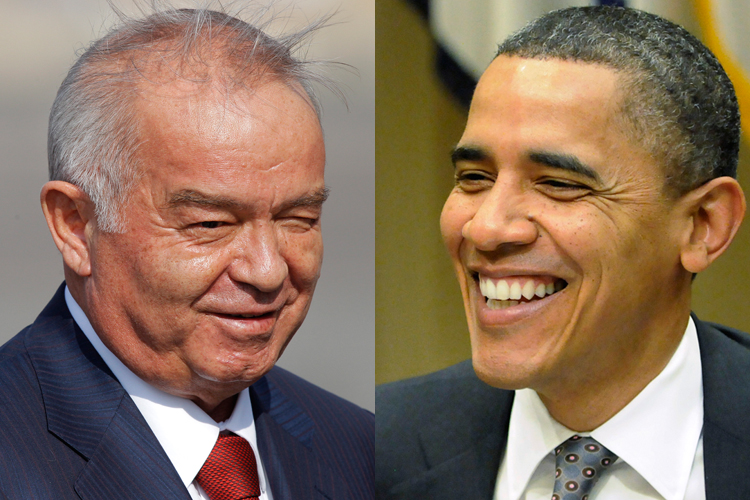

It’s generating few headlines, but Operation Enduring Freedom — otherwise known as the war in Afghanistan — could soon result in less freedom for the people of Uzbekistan, if the Obama administration gets its way.
The ruling dictatorship of Uzbekistan, which borders Afghanistan to the north, has been a kind of beneficiary of the war and the American need to transport supplies and troops in and out of Afghanistan. (See a map of the supply routes here.)
Prompted by the the current crisis in U.S.-Pakistani relations, the Obama administration has reportedly shifted supply lines to rely even more on the Central Asian corridor. And in an effort to improve relations with Uzbekistan, it is now asking Congress to OK military aid to that country, over the furious objections of human rights groups. Several groups signed a strongly worded letter to senators this week, asking that they turn down the administration’s requests for aid.
The administration, for its part, has not been commenting on the matter on the record.
To learn more, I spoke to Steve Swerdlow, Uzbekistan researcher at Human Rights Watch.
Who is Islam Karimov, and what sort of regime are we dealing with here?
The Uzbek government is one of the most repressive in the world. It’s commonly rated as such on Freedom House’s annual list. It’s known for the systematic use of torture throughout its criminal justice system. I was there as the HRW representative last year for several months, and we documented widespread torture both in pretrial detention and in prisons. It is used against political opponents, dissidents and even so-called common criminals. Several dozen activists, human rights defenders, journalists and opposition figures are languishing in prisons for their beliefs or activism. There is no free press. The government last year denied my visa and expelled Human Rights Watch from the country for our work in documenting human rights abuses. It has also kicked out international media outlets in recent years following the killing of protesters by government forces in 2005.
And how long has Karimov been in control?
He has ruled with an iron fist for over 22 years. He is the former secretary of the Communist Party in Uzbekistan before it was an independent country. And he was quickly elected president when it became a country in 1991. Since that time, he has been the singular figure in charge.
What is the issue facing Congress and the Obama administration right now?
Congress is reviewing whether or not to grant the president the power to waive existing restrictions on giving assistance to Uzbekistan — and that includes military aid to the government. Since 2004, there have restrictions on what sorts of military equipment can be sold to the Uzbek government. The Obama administration, including the Pentagon, is strongly lobbying Congress at the moment to drop these restrictions. That would allow Uzbekistan to buy supposedly nonlethal or defensive military equipment such as shields, armor, et cetera.
And the reason that they’re lobbying for this is to gain greater access to Uzbekistan as a transshipment point for the war in Afghanistan?
Our understanding from congressional sources is that in exchange for granting U.S. and NATO sources authorization to transit supplies and maybe even troops out of Afghanistan northward through Uzbek territory, the Uzbek government wants these human rights restrictions dropped. That’s both because the Uzbek government is interested in buying military equipment and it wants to have the American stamp of approval that it is no longer being classified as a serial human rights violator.
Throughout the Afghan war period, hasn’t here been a relationship between the U.S. and Uzbekistan at least on and off?
It’s gone through hot and cold periods. The first was 2001 to 2005, when the U.S. government was closely cooperating with the Karimov government, which allowed the U.S. to use an air base known as K2. In 2004, in light of the deteriorating situation around the freedom of expression, the persecution of human rights defenders and the crackdown on civil society in general and religious believers, Congress enacted these restrictions. In 2005, there was a major uprising in the eastern Uzbek city of Andijan. The Uzbek government forces surrounded a square where mostly peaceful protesters had gathered. There had been an armed element in the uprising for part of the day, but many more peaceful civilians joined in. Uzbek forces surrounded the crowd and opened fire, killing hundreds of civilians. After that, the relationship between the U.S. government and Uzbekistan changed rapidly. The U.S. was instrumental in helping to resettle some of the refugees that had fled the violence, and in response the Uzbek government blocked access to the air base.
So what has happened under President Obama?
As the war in Afghanistan grew more complicated and the need to supply forces there became greater, the U.S. started making overtures to the Uzbek government. That started in 2007 and increased in 2008 through 2010 as the U.S. developed the so-called Northern Distribution Network, which is a transit corridor that extends all the way from the Baltic states, down through Russia and Kazakhstan to Uzbekistan. It is used to supply troops in Afghanistan. The Uzbek government has been able to profit handsomely from this arrangement; it receives compensation for allowing transit through Uzbek territory, and Uzbek firms that are closely linked to the Karimov family have produced some goods and performed services for U.S. and NATO forces.
When it comes to the current lobbying by the administration, what’s going to happen next?
Our understanding is that things are moving very rapidly, especially since the fallout between Pakistan and the U.S. after the killing of Osama bin Laden. It seems like the fragility of that relationship created a sense of urgency and maybe an opening for the Obama administration and the Pentagon to push now for a waiver on human rights restrictions. Our understanding is that various senators and members of Congress are being approached and briefed by Pentagon officials and maybe White House officials on the need to give this free pass to Uzbekistan, and that they’re looking to seal it up this month.
At Human Rights Watch, we’re taking the position not that U.S. troops shouldn’t be supplied through the Northern Distribution Network, but that the U.S. shouldn’t relinquish its tremendous leverage for a short-term goal. The larger lesson is that doing business with extremely abusive dictators is not a smart policy from the perspective of human rights or security. Dropping all restrictions on aid, including military aid, without insisting on concrete improvements in Uzbekistan’s human rights record is a huge windfall for an extremely repressive government and may ultimately create long-term instability in Uzbekistan and Central Asia. It also sends the detrimental message to ordinary Uzbeks that despite its pronouncements on the Arab Spring and democratic change, the Obama administration is more interested in narrow security interests in Afghanistan than in supporting the fundamental human rights of the Uzbek population.
