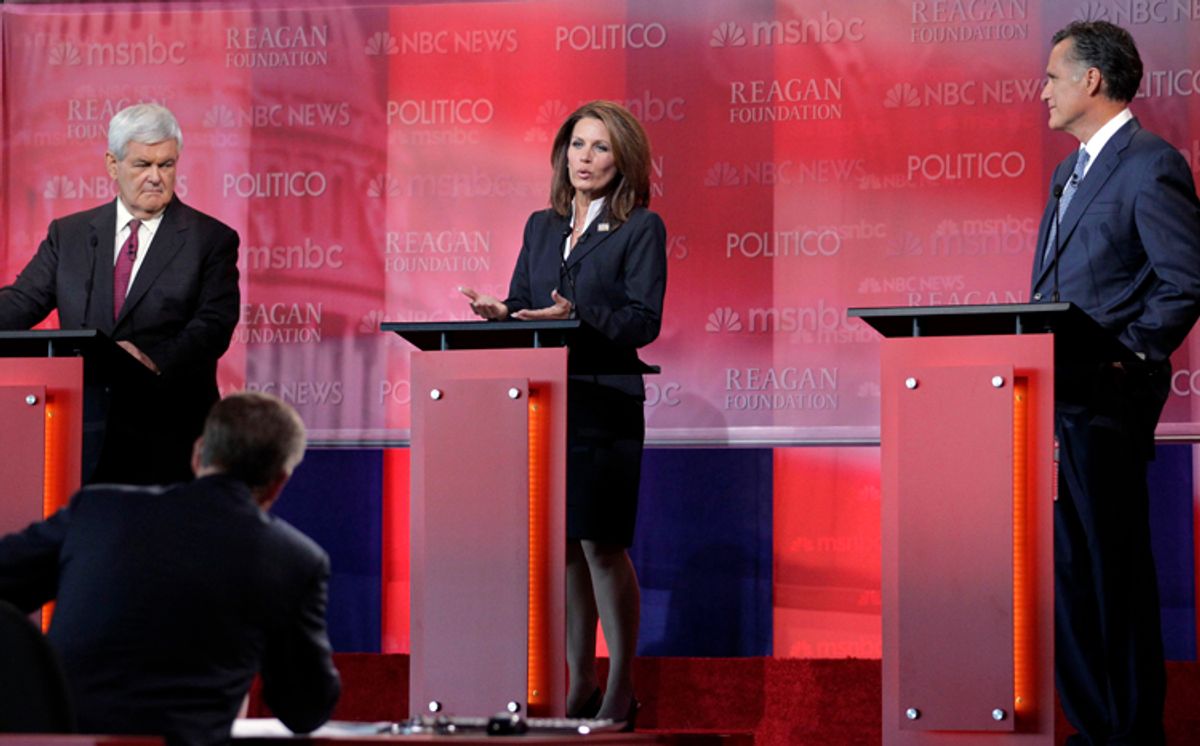
Newt Gingrich may be a joke of a candidate, but he made a serious point the last time Fox News sponsored a presidential debate: Moderator Chris Wallace should "put aside the gotcha questions." With Fox News (and Google) sponsoring Thursday's night's debate, there is a risk of another gotcharama. A semi-scientific review shows that Fox and MSNBC are more likely to play gotcha. If you want to hear what the candidates have to say about public policy, wait for a debate sponsored by CNN.
Sparked by Newt's complaints -- and my own sense that the debate questions were poorly done -- I went back and coded the questions in each debate. I divided them into five categories:
• Basic policy questions, which simply ask the candidates their positions on issues of public policy. For example, Tea Party voter Sandra Jones asked: "What would you do to get the economy moving forward? Do you have a plan? And, if so, what is it?"
• Gotcha questions, which challenge candidates by comparing a past statement or a policy position with some evidence that seems to contradict that statement. Fox's Bret Baier asked Gingrich: "You said, quote, 'exercise a no-fly zone this evening, communicate to the Libyan military that Gadhafi was gone, and that sooner they switched sides the more likely they were to survive.' After the president launched military action a few days later you said, quote, 'I would not have intervened. I think there were other ways to affect Gadhafi.' Are you certain about the way forward in Libya and where it stands now?"
• Political questions, which quiz the candidates about the horse race or what will play well with the electorate. In the first CNN debate, John King asked Pawlenty about V.P. choices ... last time around. Or, in other words, to comment on Sarah Palin: "President Obama made a pick. Sen. McCain made a pick. Who made the best choice?"
• Invitations to attack another candidate. Moderators spend quite a bit of time encouraging candidates to pick fights with each other, and selecting the topics. At the Reagan Library, Brian Williams asked Jon Huntsman, "Gov. Romney's new economic plan calls for the U.S. government to officially label China a currency manipulator, but the Wall Street Journal editorial page says such a move would cause a trade war, perhaps. You're a former ambassador to China. You have served four U.S. presidents. In your view, what does Gov. Romney not get about China?"
• A final category were personal questions asked of the candidates, a CNN specialty; in the first CNN encounter King asked each candidate a question such as "Leno or Conan," and the next time Wolf Blitzer asked them what physical changes they would make to the White House.
I didn't include the times when the moderator simply directed the same question to a new candidate or allowed a candidate a chance for a rebuttal. However, I did include it if the moderator reworded or reframed the original question. Obviously, some of these were judgment calls that others might decide differently. But overall I'm confident in my general conclusions -- which match up nicely, for what it's worth, with Newt Gingrich's complaint.
The results? Fox asked quite a few basic policy questions -- about two in five, while those topics were over half the questions asked in the other three debates. Instead, almost 30 percent of Fox's questions were "gotchas," as Newt correctly recognized.
CNN was lightest on the gotchas, but did ask a high number of political questions in the first debate, and had the peak number of invitations to hit others in the Tea Party debate. CNN also topped the "personal" category in its first debate, with the "Leno or Conan" questions.
So Newt is right that the moderators are asking a whole lot of gotcha questions and other items that do not simply call for policy positions.
Is he right that they should? I suspect most journalists would not agree; indeed, my reporter-heavy Twitter feed during these debates regularly filled up with criticisms of "softball" questions. And reporters are right: It should be a lot easier for a candidate to recite his or her policy positions than to explain, as Mitt Romney was asked to do, whether it constituted "leadership" for him to wait until the last minute to take a position on the debt limit talks.
But easy doesn't necessarily mean most informative. If the audience for these debates is partisans just tuning in to the presidential contest and eager to choose between the contenders, which helps them more: learning the candidates' basic issue positions, or seeing how they handle tough questions?
I'm even less enthusiastic about the political questions. Rick Santorum was asked whether his views on abortion are "too much, even for many conservatives to support." For that, I'd say he's not even qualified to answer (I'd much rather hear from a pollster), and at any rate I'm not sure that anyone is interested in his views on the subject.
As for invitations to attack, it's natural for the moderators to give them an opportunity to confront each other, as CNN did for Tim Pawlenty and Mitt Romney after Pawlenty debuted his "Obamneycare" line. But my sense is that candidates who want to attack each other have plenty of opportunity in response to basic policy questions. It doesn't add anything to push them to do so.
Personal questions, and even of the "Leno or Conan?" variety, are defensible. There were very few questions asked about how the candidates would conduct themselves in the White House, or how their experience made them likely to be a good president, and yet especially in nomination contests it's likely that how they go about doing the job is probably more important than specific issue positions. Even CNN's gimmick questions had the modest virtue of allowing the candidates to speak as real people.
The truth is that the kinds of questions that debate moderators are often drawn to are especially good for one thing: They avoid boredom for people who follow the process closely and already know each candidate's standard stump speech and talking points. Which is fine for them -- I should say, for us, since I'm certainly someone who has heard what these folks have to say -- but must make for an odd experience for anyone who is just tuning in and actually wants to use the debates to educate themselves about the candidates.
If we are to have debates, however, I think the network commentators should stick to policy and personal questions. The press normally has many chances to quiz the candidates, but the debates are really a rare opportunity for the candidates to react to each other -- and the more we can get that, and the less we get of the moderators, the better. That doesn't mean that questions should all be as broad as the Tea Party question about the economy quoted above; a good moderator can balance broad areas of interest with specific topics in order to elicit answers that really can distinguish candidate positions.
But save the gotchas for when the candidates come on the Sunday chat shows and the rest of us are sleeping in.
Shares