
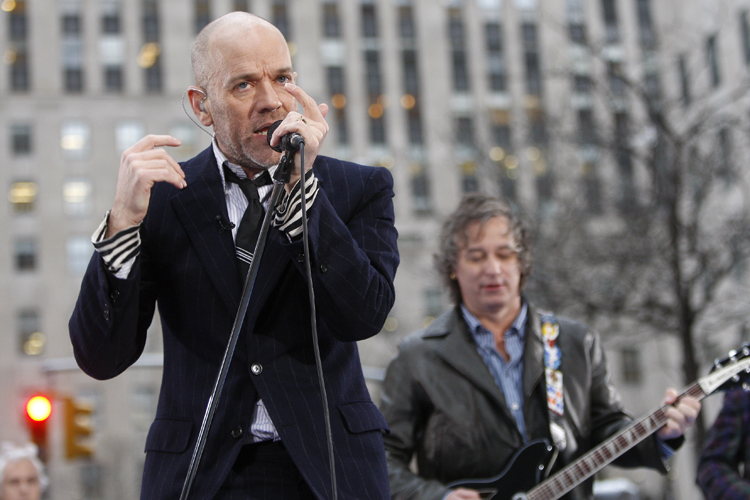

After 31 years together, R.E.M. announced their breakup Wednesday with a brief note on their website. It was a sad, but not exactly surprising, announcement: Although vocalist Michael Stipe, bassist Mike Mills and guitarist Peter Buck always had non-R.E.M. musical activities going even at the height of their popularity — everything from collaborations with Warren Zevon to guest appearances on Indigo Girls, Billy Bragg and Replacements songs — in recent years, these extracurricular pursuits seemed to overshadow their main band. When R.E.M. chose not to tour after the release of this year’s “Collapse Into Now” — a raucous rock album that seemed calibrated for the stage — fans could tell something seemed amiss in the band’s universe.
But more than anything, breaking up was a typically brave move for the Rock And Roll Hall of Famers. When you’re a successful band for over three decades, actively deciding to split up is the more difficult path. It’s far easier to rest on your laurels (and your back catalog) and let sluggish inertia (and reissues of said back catalog) propel you forward. After all, veteran successful bands don’t maintain the frenetic pace younger groups do; they can get away with years-long gaps between albums, occasional interviews and sporadic website updates. They have the luxury of doing their main project only whenever they feel like it. So to assert, as R.E.M. did, that they don’t want to do this anymore — well, that’s bold.
Taking a stand was something R.E.M. did very well during their career. In the early days, Stipe was firmly against lip-syncing; he famously sang live over pre-recorded music in the band’s “So. Central Rain” video. They were stridently political — whether they were supporting issues in their hometown of Athens, Ga., campaigning for Democratic presidential candidates or espousing causes such as voter registration and human rights. If you’d visited their website last week, lyrically, they touched on specific topics — U.S. presence in Central America (“Welcome to the Occupation”), the Vietnam War (“Orange Crush”) and environmental concerns (“Cuyahoga”) — alongside more general takes on revolution and oppression.
And musically, R.E.M. were very firmly aligned against the status quo: When disco leftovers, plastic synthpop and gooey soft-rock ruled the mainstream, they took inspiration from ‘60s pop (the Monkees, the Hollies), folksy rock (the Byrds, Creedence Clearwater Revival), anxious jangle-strum (the Feelies, Television) and New York icons (Velvet Underground; Patti Smith, Stipe’s longtime idol). It’s easy to see why R.E.M. quickly started to resonate with fans; there was something very real and relatable about the music they made. Their debut full-length album, 1983’s “Murmur,” was enigmatic and welcoming all at once, brimming with old-soul wisdom and electric energy. 1984’s warmer, more cohesive “Reckoning” focused on homesick, road-worn jangle-rock, while the pastoral-tinged murk of 1985’s American-South-steeped “Fables of the Reconstruction” brooded in all the right ways.
Even as the band’s popularity increased — Top 10 Billboard hits, MTV heavy rotation, arena tours, mainstream radio airplay — there was nothing overtly contemporary about their music. A cheesy saxophone in 1987’s “Fireplace” and 1991’s “Radio Song,” which featured rapper KRS-One, were about as close as the band got to trend-assimilating until 1994’s “Monster.” (And “Radio Song” came on the heels of their biggest hit, “Losing My Religion,” whose primary riff was played on mandolin.) 1991’s multi-platinum “Out of Time” was full of lush, orchestrated songs — “Love songs,” Stipe once said — which felt like delicate antiques. And at the height of grunge’s churning angst, R.E.M. released 1992’s gorgeous “Automatic for the People,” which featured introspective ruminations on mortality and majestic, melancholy strings.
But to many critics of the band, “Monster” signaled a turning point. Distorted and brash, the album went for the rock-radio jugular and succeeded mightily, although in hindsight it was R.E.M.’s first album that felt of its time. 1996’s “New Adventures in Hi-Fi,” despite being well-received and wildly creative — the piano-dazzled “Electrolite” remained a live staple — didn’t seem as talked-about or vital as the previous albums.
The R.E.M. mythology inexorably cracked after drummer Bill Berry left the band in 1997, several years after he suffered a brain aneurysm while onstage in Switzerland. Many almost seemed to resent the band for continuing on after Berry left; in fact, at least in America, R.E.M. has been out of fashion and unpopular for a long time. Although a fan favorite — and in hindsight, a touching collection on how to love even as you grieve and mourn — 1998’s dark, keyboard-burnished “Up” is often considered too forced. (Out of R.E.M.’s albums, “Up” is perhaps the one overdue for critical reappraisal; in particular, the buzzing, Leonard Cohen-inspired “Hope” and slow-burning “Walk Unafraid” are gems.) 2001’s Beach Boys-inspired “Reveal” again felt askew, its gauzy harmonies and soft-glow riffs too detached and emotionally inconsequential to linger. But perhaps most maligned is 2004’s “Around the Sun.” The band has admitted the album’s shortcomings; Buck once said it “wasn’t really listenable, because it sounds like what it is, a bunch of people that are so bored with the material that they can’t stand it anymore.” The indifference toward — if not abject hatred for — the album had a mortal effect on R.E.M.’s momentum.
Now, many artists make bad records — some artists have made many bad records — and they’re not shunned. Yet R.E.M.’s status as a pariah felt confirmed in the wake of yesterday’s breakup. Snark and vitriol poured forth from the Internet peanut gallery — variations on sentiments such as, “They haven’t made a good record in 15 years” and “They should’ve broken up years ago.” (More stinging, however, was this nugget: “I thought they broke up years ago.”) All of the goodwill R.E.M. built up in the ‘80s and ‘90s due to their activism, concerts and music seemed forgotten. That the group had released two solid, at times magical, records in the last three years — “Collapse Into Now” and its barnstorming sonic predecessor, 2008’s “Accelerate” — barely registered.
Still, for longtime fans, for those who took to Facebook yesterday with memories and old performance clips, yesterday’s breakup felt like a death in the family. R.E.M. were more than just a band; they represented an aesthetic preference. In contrast to U2, the kings of secular sincerity, R.E.M. made themselves vulnerable in a very human way. They were a smart band who stood for substantial things and weren’t afraid to be totally, delightfully weird. The group’s stubborn unorthodoxy resonated with the kids who didn’t fit in — the ones who were too smart, too unconventional, too geeky, too philosophical, too artsy. Hardcore fans naturally gravitated toward one another: If you saw someone wearing an R.E.M. shirt, you just knew on a subconscious level you’d probably be friends.
R.E.M.’s alchemy never felt more alive than it did onstage. Rail-thin Michael Stipe was all gawky elbows flailing around and Gumby-like fluidity. His bald head, sometimes augmented by bold makeup, only made him seen more alien-like. Mike Mills attacked the bass with stoic precision; his occasional propensity for sporting Nudie Suits only enhanced his cowboy-like demeanor. Drummer Bill Berry was a steady, calm presence, barely breaking a sweat as he kept time like a metronome. And Peter Buck always came off like a wild stallion as he slashed his guitar, grimaced as if he was in pain and contorted his body with constant jumps and spin-kicks.
In a way, R.E.M.’s breakup is fitting: The band were scrappy road dogs clawing for respect when they started 31 years ago, and they ended their career in a similar position. But it feels like a safe time for the band to end, because their legacy is in good hands: In 2011, everything upon which the band built a career — mystery, simplicity, substance, sincerity — live on in groups such as Arcade Fire, Wilco, Radiohead and the National. Despite their continued presence, R.E.M. long ago had ceded their position of influence to a new generation — and thankfully, they’ve chosen to bow out before they overstayed their welcome. “A wise man once said, ‘the skill in attending a party is knowing when it’s time to leave,'” Michael Stipe said on R.E.M.’s website. “We built something extraordinary together. We did this thing. And now we’re going to walk away from it.”
