Quick Takes

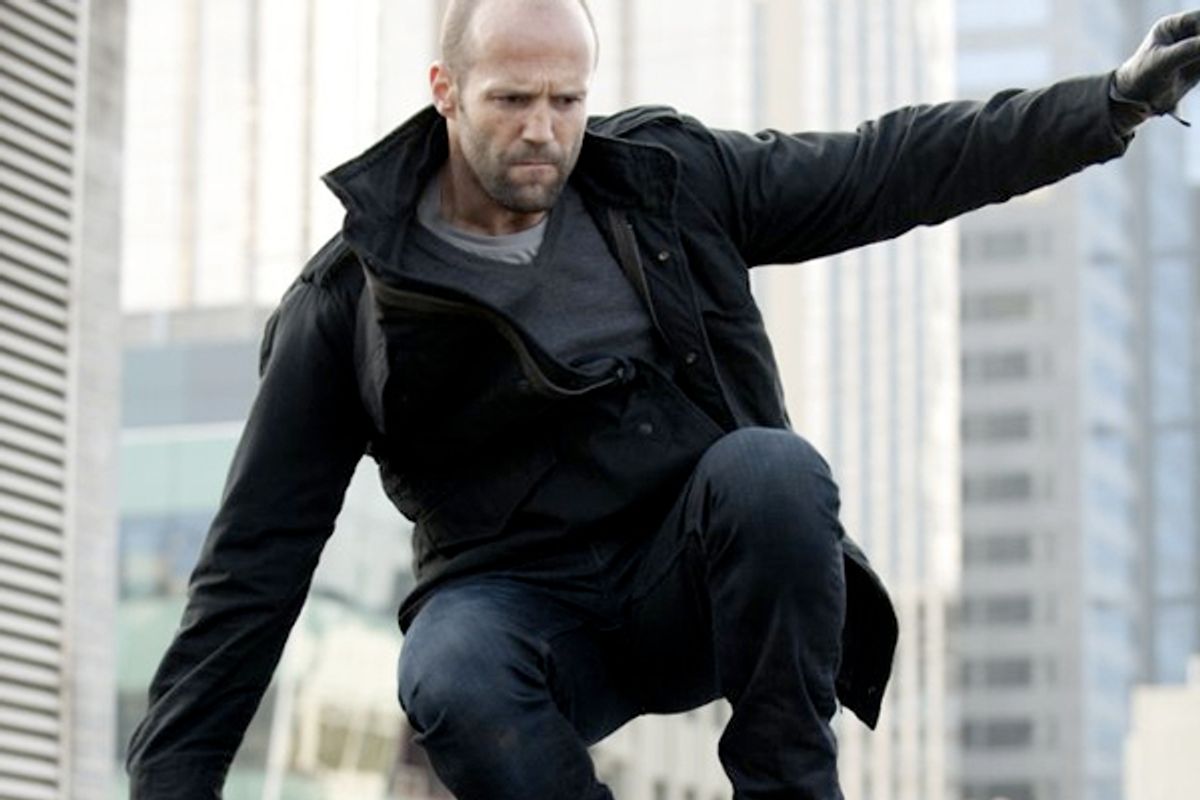
“Killer Elite”: Jason Statham and Clive Owen's dark, stylish thriller

Trashy, semi-coherent and amoral, "Killer Elite" is an enjoyable dose of bewildering '80s espionage

  • more
    • All Share Services

Jason Statham

I somehow keep forgetting that the spy thriller called “Killer Elite” actually exists and that I’ve seen it. That probably reflects the fact that it’s a generically enjoyable action film with a bit of hardboiled based-on-a-true-story-ness about it, and since it’s set in the ’80s and feels like an ’80s movie, it seems a lot like something you must have seen years ago. This is shaping up as an awfully tepid endorsement, isn’t it? But I had a reasonably good time, on the whole; if you’d enjoy watching Jason Statham and Clive Owen blow things up, and the idea of a movie that splits the difference between, say, Statham’s “Transporter” films and the cynical espionage universe of John le Carré’s “Tinker Tailor Soldier Spy” appeals to you, then this is a highly viable Saturday night option. Put that on your poster!

What makes Statham such an enjoyable action star, I think, is the fact that he looks like the most evil and disreputable kind of hooligan but manages to convince us that there’s a decent guy in there somewhere. In “Killer Elite” (adapted from Ranulph Fiennes’ novel “The Feather Men” by director Gary McKendry and co-writer Matt Sherring), he plays a onetime super-secret British SAS fighter named Danny who’s retired himself back to the Australian outback, where the girl he grew up with (Aussie model/actress Yvonne Strahovski) is hanging around waiting for him in various fashion-shoot locations. Of course that won’t last, and when Danny’s onetime Yank mentor Hunter (it’s Robert De Niro, in one of those baffling recent De Niro performances that’s above a cameo but not quite an actual role) gets taken prisoner by some mysterious Middle Eastern potentate, we’re off on an exceptionally convoluted journey from Oman to London to Paris, full of bombs, guns, period automobiles and double-crosses.

I’m not sure I can explain the plot, and not totally convinced that McKendry could either. (This is his feature-film debut, and I look forward to much more morally ambivalent but highly watchable trash from him.) That also may not be a liability; Fiennes’ novel — which is supposedly based on real Cold War-era history — is an ultra-tangled yarn of mercenaries, defrocked agents gone rogue, reactionary conspiracies, vengeful Arab sheiks and a British military campaign in the Middle East so secret it remains blacked out today. Part of the idea in “Killer Elite” is that Danny, Hunter and Spike (Owen), the shadowy British agent who’s pursuing them, do not themselves understand the larger parameters of the game they’re playing. Which certainly does not stop them from striking cool poses, wearing vintage shades and spreading mayhem across two continents, in a movie that might not have too much intelligence, coherence or morality but is nonetheless confident, sneaky, stylish and never boring.

A charming romantic comedy with wide appeal

He's 19, she's 35 -- but which of them is more mature? Todd Louiso's "Hello I Must Be Going" is a Sundance winner

  • more
    • All Share Services

A charming romantic comedy with wide appealMelanie Lynskey in "Hello I Must Be Going"

PARK CITY, Utah — In keeping with Robert Redford’s stern opening-night admonition that his festival is “all about independent filmmaking artists — we always have been and we always will be,” here’s a Sundance item bereft of color commentary, celebrity sightings or observations about the Utah weather (which remains unseasonably mild). Todd Louiso’s wry, sharply-observed romantic comedy “Hello I Must Be Going” premiered late on Thursday night, and if it’s too subtle (and too similar to several other low-key indie romcoms) to make a big splash, it’s got lovely performances and really builds strength as it goes along.

If Louiso’s name rings a dim and distant bell in your mind, it may be because of his quasi-legendary supporting performance as a know-it-all record-store clerk in Stephen Frears’ “High Fidelity,” lo, these many years ago. He’s now primarily a director, and on the evidence quite a skilled one. The problem with “Hello I Must Be Going” is that Sarah Koskoff’s screenplay starts out so modestly: You think it’s just going to be a female early-midlife-crisis movie, or an older-woman/younger-guy love story, and, heck, it is both of those things. But to my taste, as the movie goes along it becomes much richer and funnier than that summary suggests, painting a satirical but sympathetic portrait of upper-crust family life in Westport, Conn., a rather toff and beachy New York suburb.

New Zealand actress Melanie Lynskey is terrific as a depressed, 30-something recent divorcee named Amy, who has moved back in with her Westport parents, who simultaneously support and undermine her in all the wrong ways. Her hypercritical mom is Blythe Danner and her willfully blind high-end lawyer dad is John Rubinstein, and each of them is worth the price of admission by themselves. Amy’s life of watching TV and eating cookies is upended by the handsome and thoughtful Jeremy (Christopher Abbott), a fast-rising young actor known for his recent largely-nude performance in a play about Robert Mapplethorpe. Everyone around Jeremy, especially his therapist mom (the hilarious Julie White) assumes he’s gay, but once he’s one-on-one with Amy, that proves to be untrue. Jeremy is arguably much more mature and together than Amy is, but the fact remains that he’s also 19 years old.

Louiso plays out this scenario both sweetly and plausibly, and as I’ve suggested, gets the biggest laughs from the situation late in the game. I’m pretty sure some distributor will eventually take a flyer on “Hello I Must Be Going,” and I only hope they market it tenderly and carefully. The odds are always against an indie drama that lacks big stars or a headline-grabbing hook, but nurtured carefully this one could have relatively wide appeal.

Continue Reading Close

“The Bride Wore Black”: Truffaut’s delicious homage to Hitchcock

Jeanne Moreau plays the ultimate femme fatale in a summery, deceptive fable of a woman's murderous revenge

  • more
    • All Share Services

Jeanne Moreau in "The Bride Wore Black"

What begins as a French cinephile’s almost obsessive tribute to Alfred Hitchcock becomes progressively weirder, wittier and more Continental in François Truffaut’s 1968 “The Bride Wore Black,” which begins a New York run this week and will then play in many other cities. Truffaut is sometimes viewed as a relative lightweight among the company of big-name ’60s and ’70s European directors, and there’s no doubt his work is uneven. But I find myself appreciating his double-edged, seductive films more and more on repeat viewings. With its summery, Mediterranean surface, Jeanne Moreau as the ultimate femme fatale heroine and a knife-twisting tale of murderous revenge and unexpected romance, “The Bride Wore Black” is well worth rediscovering.

The first thing we see in “The Bride Wore Black” is a printing press churning out black-and-white images of a topless Moreau, but that’s one of several misdirections in this movie, since the story is almost entirely chaste, and the color photography of famed cinematographer Raoul Coutard (who shot Godard’s “Breathless,” Truffaut’s “Jules and Jim” and numerous other New Wave classics) is brilliant. With a deliberately obtrusive Bernard Herrmann score and its roots in a novel by Cornell Woolrich (whose short story “It Had to Be Murder” was the basis for “Rear Window”), “The Bride Wore Black” is more like a Hitchcock movie than some of Hitchcock’s actual movies, at least at first.

Moreau plays a woman named Julie Kohler, who leaves home after a failed suicide attempt and begins hunting down a list of apparently unconnected men, whom she has never met. To a consummate lady-killer on the Riviera, she appears as a potential conquest in a white evening gown; to a lonely, middle-aged bachelor, she’s the fairy princess he’s been waiting for; to a bourgeois politician (the outrageously young Michael Lonsdale), she’s his young son’s schoolteacher. Julie’s plot is ridiculous, and the tragedy she’s avenging is even more so, but as in many Hitchcock pictures, those things are excuses for a cinematic exploration of the war between the sexes that is ambiguous, more than a little mean-spirited and ultimately surprising.

“The Bride Wore Black” is now playing at Film Forum in New York. It opens Nov. 25 at Northwest Film Forum in Seattle and Dec. 9 at Pacific Cinémathèque in Vancouver, Canada. Also coming soon to Berkeley, Calif., Huntington, N.Y., St. Louis, Milwaukee, Pleasantville, N.Y., and Houston. Check website for details.

Continue Reading Close

Pacino’s violent new cop drama

"The Son of No One" has a great cast and terrific scenes -- so why doesn't it all add up?

  • more
    • All Share Services

Pacino's violent new cop dramaAl Pacino in "The Son of No One"

The world’s three great cinematic cities — I mean Los Angeles, New York and Paris, and don’t get all pissy with me if you want to argue for someplace else — all provoke plenty of sentimentality. But I honestly think the Big Apple, with the intense feelings of love and hate it provokes in its denizens and exiles, has the others beaten in that category. Which brings us to this year’s competition in the “25th Hour” Memorial Cup competition, to identify the grandest attempt at a cinematic allegory about the fate of New York in the years after 9/11. Recently I labored long and hard over a thoughtful piece about Kenneth Lonergan’s long-delayed film “Margaret,” and while almost nobody read my review, it was still a larger number than actually paid to see the movie. I have learned my lesson and promise to put in much less effort on this week’s entry, a brooding, baffling cop drama called “The Son of No One” from writer-director Dito Montiel.

A one-time punk musician and Versace model, Montiel has NYC street cred to burn — and pretty much burned it all in “A Guide to Recognizing Your Saints,” an autobiographical, nostalgia-infused drama based on his own memoir about his misspent youth on the somewhat mean streets of Astoria, Queens. (Today that’s a majorly gentrified neighborhood, but what the hell isn’t?) It was alternately highly compelling and sludged up with half-baked artistic pretension, and was overpraised (in my view) partly because of the potential it displayed and partly for the terrific ensemble of actors. Maybe the best of those performances belonged to Channing Tatum as a doomed supporting character, and the Alabama-born hunk returns in “The Son of No One” as Jonathan White, aka “Milk,” a kid who grew up in the sprawling Queensbridge projects (largest public housing development in the United States, for you factoid mavens) but has left his wild-ass youth behind for a respectable life as a family man and police officer.

Or so he thinks! A decent way to explain “The Son of No One” is to say that if you thought “A Guide to Recognizing Your Saints” was terrific (and a lot of people did) then you’ll like this one too, but maybe a little less. It starts with a bang, quite literally, and is basically the same grotesque and violent fable about how the past never lets go of you, translated into the language of cop-corruption dramas. In both movies, Montiel’s grimy, yellow-tinged scenes set in the ’80s have a dismal but compelling intensity, while the material that’s more contemporary — this film’s present tense is 2002, with 9/11 looming huge in the rearview mirror — is full of old-school TV histrionics, with people planting their feet and explaining things. Jonathan’s wife, played by Katie Holmes, keeps screaming at him, his 5-year-old daughter has weird seizures, and his evil, smarmy police captain boss is played by Ray Liotta, who seems to be doing his best William Shatner impression. (That may be an entirely redundant remark.)

Al Pacino is also in this movie, looking almost exactly the same in scenes that are supposedly 16 years apart. It’s kind of fun to watch Pacino and Liotta and Tatum and James Ransone, as Jonathan’s foulmouthed partner, as they roar at each other and suck the marrow from the hambone. You can see why actors want to work with Montiel, but actors are notoriously bad judges of whether good scenes will ever add up to a worthwhile movie, which is exactly the problem here. Casting French cinema goddess Juliette Binoche as the editor of a Queens neighborhood newspaper, on the other hand, falls under the heading of Anybody Who Thought That Was a Good Idea Is Stupid. When you think hard-as-nails, outer-borough investigative reporter, that’s who comes to mind, right? You’re all like, “Get me the neurotic chick from Kieslowski’s ‘Three Colors’! She’s perfect!

“The Son of No One” doesn’t make much sense on a basic narrative level, going back to the dastardly deed from 1986 that will supposedly ruin Jonathan’s life and career if it gets out, and including the convoluted present-day skulduggery of Liotta and Pacino, who play mid-level NYPD brass. Furthermore, for a New York native, Montiel makes peculiar geographical gaffes, claiming repeatedly that it takes two hours to drive from Queensbridge to Staten Island (I mean, it could, but that’s a distance of 30 miles or less) and having Ransone’s character refer to the latter borough as “the Island,” something I’ve never heard a New Yorker say. (The Island always means the eastern suburbs of Long Island.) All that would matter a lot less if the movie didn’t wear you out with its relentless depiction of depravity, desperation and mental illness, its essentially romantic insistence that the city is a bottomless moral cesspool and that to believe otherwise is to be massively uncool.

“The Son of No One” opens this week in major cities, with wider release to follow (or not).

Continue Reading Close

“Janie Jones”: Smirky rock star upstaged by kid

Terrific performances and a big heart rescue father-daughter fable "Janie Jones" from rock 'n' roll cliché

  • more
    • All Share Services

Abigail Breslin and Alessandro Nivola in "Janie Jones"

When a hulking, bearded road manager played by nifty character actor Peter Stormare comes backstage before a gig to tell mid-level indie-rock frontman Ethan (Alessandro Nivola) something important, the musician insists he share the bad news with the whole band. “We’re a family,” intones Ethan, a smooth, hard-partying character with a permanent smirk and a prep-school slouch. That word’s about to bite him in the ass, since the news is that a junkie ex-girlfriend Ethan claims not to remember (a nice little cameo for Elisabeth Shue) has shown up with a teenage daughter he never knew existed. What’s more, the ex is heading for rehab, or so she says, and young Janie (Abigail Breslin) has nowhere else to go.

That’s the setup for writer-director David M. Rosenthal’s “Janie Jones” — “just like the Clash song!”, as one of Ethan’s bandmates says brightly — which may bear a general resemblance to other indie dramas about screwed-up parenting or the rock ‘n’ roll lifestyle, but is very much its own sharp and funny creation. Maybe it won’t hurt “Janie Jones” too much that it hits less than a year after Sofia Coppola’s “Somewhere,” in which Elle Fanning’s deadbeat dad was Stephen Dorff’s soulless movie star, given that nobody went to see that. If the emotional music of Rosenthal’s film seems familiar, as Ethan’s relationship with Janie moves from utter denial to grudging acceptance to a strange dependence, the movie works because it’s essentially an old-fashioned two-hander for a couple of subtle and terrific actors.

At first Ethan claims that he can’t possibly have a kid, and only takes Janie under significant duress from an Arkansas cop, who is otherwise going to summon family services and order a paternity test. At the same time, you see him sizing Janie up, a troubled expression moving across his messed-up, pretty-boy face. (I think Nivola is just too snaky and intelligent-looking to be a movie star, despite his abundant talent; he’s like Bradley Cooper for nihilists.) Looking at her, Ethan sees an alternate existence as a dad, husband and reasonable adult that he completely missed, and is forced to confront the usually rhetorical question of what the point of it all was in highly concrete form.

As for Breslin, she redeems the slightly underwritten role of Janie, who’s already had to grow up too fast and is meeting her supposedly famous father just in time to watch his career hit the rocks. From almost the moment they meet, it’s Janie’s shy, resilient toughness that sustains Ethan, rather than the other way around. Her prickly humor and refusal to be wounded are what convince him, more than anything else, that she must he his daughter. She rescues him from an ass-kicking in a biker bar, joins him on stage after he’s driven his entire band away, and gives him a hard time about flirting with “the cougars of the Plains states.” (Ethan, offended: “They weren’t cougars!” Janie: “Oh, yes they were!”) Janie also proves to be an asset, in the most literal way possible, during Ethan’s tense reunion with his estranged mother, a Chicago society woman named Lily (another terrific cameo, this one from Frances Fisher).

Nivola and Breslin perform their own songs creditably, both separately and together, and “Janie Jones” depicts the actual tedium of a grade-B rock tour as no movie has since Bruce McDonald’s justly legendary “Hard Core Logo.” Coming up with the right balance of redemption and realism to conclude this improbable father-daughter fable was always going to be tough, and Rosenthal’s ending feels a bit too contrived for these immensely convincing, human, damaged characters. That aside, “Janie Jones” is a compelling and unpretentious indie built around two wonderfully layered performances and straightforward storytelling. Give it a listen.

“Janie Jones” is now playing in New York and Seattle, and opens Nov. 4 in Los Angeles, with other cities to follow. It’s also available on-demand from many cable and satellite providers.

Continue Reading Close

“My Joy”: Nightmare voyage into the Russian heartland

Avoid cops, hookers and horny Gypsies! Country drive turns death trap in a dark fable of Russian history

  • more
    • All Share Services

A still from "My Joy"

I’m startled to report that one of the darkest Russian films I’ve seen in a career of watching dark Russian films, Sergei Loznitsa’s black-comic backwoods odyssey “My Joy,” will actually play American theaters (no doubt briefly) before moving on to a somewhat longer life as a home-video cult object. This mordant, slow-motion horror film about a truck driver’s journey into hell — the title is 100 percent sardonic, maybe more so — was the most unexpected and arresting picture in the 2010 Cannes competition. Despite what you might believe about that festival, audiences there generally flock to lighter fare, and few seemed to appreciate that “My Joy” had a bleak, grotesque, near-perfect poetry in its soul.

We never learn much about Georgy (Viktor Nemets), who picks up a load of flour one morning in an unnamed city and sets off into the vast Russian interior. He seems a decent enough guy, actually — he leaves some money and a note for his wife, and picks up a teenage hooker largely to get her off the road (which she bitterly resents). Whether Georgy is a good guy or a bad guy, he couldn’t possibly deserve what’s coming. From the moment he stops at a checkpoint run by a pair of lecherous, sadistic, beyond-corrupt cops, he seems to have wandered into an episode of “The Twilight Zone” authored by Gogol. Loznitsa’s portrait of Russian existence is one of perpetual gloom punctuated with occasional outbursts of violence, and after Georgy leaves the highway for a “shortcut” — hey, the mean teenage hooker warned him it was haunted! — you will never labor under the delusion that we’re headed for a happy ending. Loznitsa is an acclaimed documentary filmmaker (this is his first narrative feature) who left Russia in 2001, and he clearly has a social and historical agenda of sorts. “My Joy” appears to suggest that all the tyranny and brutality of the 20th century have left Russia, in the era of Putin and the plutocrats, stupefied and morally denuded.

Still, there’s something larger than despair beneath the impressively somber landscapes of “My Joy.” (The film was shot by Oleg Mutu, the Romanian cinematographer of “The Death of Mr. Lazarescu” and “4 Months, 3 Weeks and 2 Days.”) Loznitsa can’t resist the fatalistic, seriocomic storytelling tradition that’s such a big part of Russian life: When an aged passenger tells Georgy a tale of his fateful encounter with a fellow Soviet officer on the way home from World War II, we travel back to 1946 and witness the whole thing. Later, more mysteriously, we see another terrible incident, probably from World War I, which happened in the house where Georgy ends up living with a Gypsy woman who seems to have claimed him as her sex toy.

That’s the closest thing to tenderness Georgy finds in this land of endless stupidity and evil, where any human impulses seem to have been overrun by the most ruthless and Darwinian kind of struggle. He is beaten and left for dead; his truck and cargo are sold off. At last, the old man who told him the World War II story becomes his final refuge. And he hasn’t seen the last of those terrible cops. Believe me, Russian readers, I don’t assume that this dark fantasy bears much relationship to Russian reality — or at least, no more than “The Texas Chain Saw Massacre” depicts real life in 1970s central Texas. Like all horror movies, this is a grossly exaggerated fable, one that arrives by way of its impressive cinematography and interpolated tales at a startling, violent, tragic and inevitable conclusion.

“My Joy” is now playing at the Cinema Village in New York and the Art House Cinema 502 in Ogden, Utah. It also opens Nov. 4 in Spokane, Wash., with more cities and dates to be announced. Home video release will follow.

Continue Reading Close

Page 1 of 7 in Quick Takes