Sitcoms
Television's season of the vagina
The once-taboo word enters heavy sitcom rotation. If this is a victory for women, why don't the jokes seem funnier?
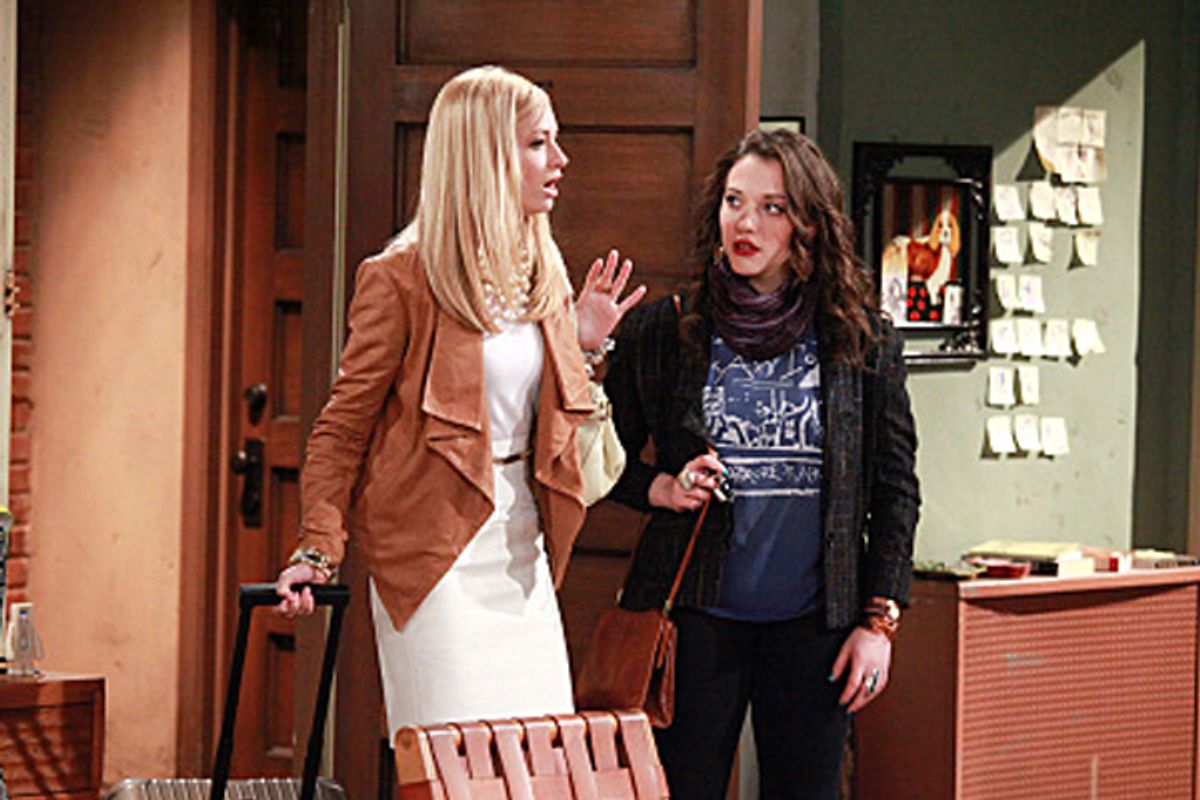
Beth Behrs and Kat Dennings in "2 Broke Girls" Long ago, vaginas were barely acknowledged in prime time. Mary Richards and Laverne and Shirley never mentioned theirs. Even Carrie Bradshaw only gave hers a few passing nods. And while “Grey’s Anatomy” turned “vajayjay” into a euphemism a few seasons ago, this year, there’s very little pussy-footing around. Vagina! Cue laugh track!
It’s a big year for the vagina, which has been asserting its presence as the go-to punchline for months now. It’s been lightheartedly hailed as the “center of civilization” (sorry, Williamsburg) in one Summer’s Eve douche campaign and turned into your sassy, vaguely racist BFF in another. Last month, Olivia Wilde one-upped Jennifer Love Hewitt’s now legendary explanation of vajazzling by describing her favorite “vagina tattoo” on “Conan.”
But now that the fall television season in full swing, it’s all ladybiz, all the time. On an upcoming episode of “Whitney,” its eponymous star Whitney Cummings ponders, “When did vaginas get so boring?” And in the opening moments of “Two Broke Girls,” waitress Max references “the sound of my vagina drying up” — a gag Bill Carter recently described in the ever-decorous New York Times as a “deleterious effect.” And “your vagina” turns up in zingers in “Free Agents” and “Suburgatory.” Coming next week: jokes about your mom’s vagina.
A portion of the vag effect can surely be laid directly at the feet of Whitney Cummings, who created “Whitney” and co-created “Two Broke Girls.” As Cummings told the Times last week, “If one day passes without me writing any more vagina jokes, my career is blown.” Cummings rightly notes that “our tolerance for what is edgy is changing” — when people can get unbleeped jokes all day on “Funny Or Die” or “College Humor,” why would audiences laugh at more delicately phrased jokes any more? But networks still have standards, just as joke writers still have marks to hit. “Muffin,” for example, might work in the family hour, but it doesn’t pack enough aggressive wallop. The C-word packs too much. And because it’s an anatomical term, vagina gets a pass that a pornier sounding turn of phrase would not. Enter vagina, laughing.
But why is the vagina having a moment now? A recent Associated Press story on “The vagina’s growing public profile” says it’s part of a “trend of women saying, ‘Hey, we’re not embarrassed to talk about this.’” And in his Times piece, Carter speculates optimistically that “The liberation of language could be read by some as barometer of how far women have come as creators of television content.” Really? Does all this “Power to the V” and chatting about pubic tattoos on late-night talk shows represent emancipation, linguistic or otherwise?
After all, the never-to-be-outdone penis has managed to assert itself this year as well. Matt LeBlanc’s allegedly formidable member is the unseen supporting star of Showtime’s “Episodes,” while Ashton Kutcher’s similarly Brobdingnagian rod has already more than announced itself on the revamped “Two and a Half Men.” We are still a long, long way from one-liners about the magnificent, near-frightening quality of any sitcom star’s wonder cooch. And “vagina” is yet to be used as a brassy, admiring synonym for moxie.
It doesn’t take long, when you’re thinking of a put-down or a punchline, to veer toward the genitals or their excretory and sexual functions. And why not? Douche commercials aside, our privates truly are the core of our humanity. They motivate and enthrall and sometimes disappoint and embarrass us, yet keep the species going. They’re beautiful and weird, and all it takes is one picture of Michele Bachmann eating a corn dog to prove that inside almost every adult is an 11-year-old boy.
For now, “vagina” is still the Voldemort of prime time, a word that has been unspoken for so long that it has a mystical, fearsome ability to shock. So simple. So plain. So powerful. But though it can provoke titters, “vagina” by itself isn’t uproariously funny. And if your prime-time sitcom can’t provide real jokes for its punchlines, chances are it won’t be long before your slot disappears altogether.
Mary Elizabeth Williams is a staff writer for Salon and the author of "Gimme Shelter: My Three Years Searching for the American Dream." Follow her on Twitter: @embeedub. More Mary Elizabeth Williams.
“Two and a Half Men’s” latest sexist dis
The co-creator of fart-joke staple "Two and a Half Men" is tired of all the punch lines about female anatomy on TV
Lee Aronsohn Lee Aronsohn is sorry he said he was tired of your vaginas. As you were, ladies.
On Monday, the co-creator of “Two and a Half Men” issued a now-standard Twitter mea culpa, explaining that “it was a stupid joke. I’m sorry.” His offense? Kvetching on Sunday to the Hollywood Reporter, “Enough, ladies. I get it. You have periods … We are approaching peak vagina on television, the point of labia saturation.” Labia saturation: no longer just a weird side effect from antidepressants.
Continue Reading Close
Mary Elizabeth Williams is a staff writer for Salon and the author of "Gimme Shelter: My Three Years Searching for the American Dream." Follow her on Twitter: @embeedub. More Mary Elizabeth Williams.
The great sitcom divide
Once you've grown used to adventurous shows like "30 Rock" and "Louie," the traditional sitcom feels like a relic VIDEO
30 Rock, Two Broke Girls, Parks and Rec, How I Met Your Mother On a recent episode of “2 Broke Girls,” the following writing somehow made it onto television:
(Waitress to dissatisfied customer)
Waitress: Would you like to see the menu again?
Customer: This is crap, I wanted Muenster.
Waitress: Well, I wanted to be running a Fortune 500 company instead of waiting on a toxic man-child like yourself. But we can’t always get what we want, so order something else, put it in your pie hole and get on with your damn life.
Continue Reading CloseThe retro sexism of “Whitney”
A new sitcom trots out the battle of the sexes -- circa "Three's Company." Who's ready for more cellulite jokes?
Comedian Whitney Cummings arrives at the 12th Annual Young Hollywood Awards in Los Angeles, Thursday, May 13, 2010. (AP Photo/Chris Pizzello) (Credit: Chris Pizzello) Ladies, don’t you just hate it when you’re ovulating? And guys are, like, not? Am I riiiiiiight?
It hasn’t even premiered yet, but Whitney Cummings’ aggressively promoted new sitcom may just be the most unself-awarely retro-sexist show on television. And in a season that’s giving us Playboy bunnies, sexy stewardesses and Charlie’s Freaking Angels, that’s quite an accomplishment.
As you likely already know from the deluge of magazine ads, billboards and canned laughter-heavy promos, “Whitney” is about a woman who’s happily unmarried to her scruffy yet adorable boyfriend. But lest you think this is some subversive takedown of biological clocks and enforced monogamy, the jokes about how a woman’s “silent treatment” isn’t really a punishment — probably not. Previews for “Whitney” include — I am not kidding — references to Cosmopolitan magazine, cupcakes, being “whipped,” and whether or not men are like cavemen. There are also references to cellulite, looking fat, her period, and what women “really mean” when they talk. As Best Week Ever exasperatedly points out, the show’s campaign might as well read, “Blah blah blah shopping. Blah blah blah PMS. Blah blah blah weight issues.”
Continue Reading Close
Mary Elizabeth Williams is a staff writer for Salon and the author of "Gimme Shelter: My Three Years Searching for the American Dream." Follow her on Twitter: @embeedub. More Mary Elizabeth Williams.
The Corner: All culture is devious propaganda
Liberals have been destroying the American family 30 minutes at a time, according to Ben Shapiro
William F. Buckley, and Jesse Tyler Ferguson and Eric Stonestreet from "Modern Family" How weird and sad life must be when viewed through the eyes of Ben Shapiro, pop-culture warrior-in-residence at the National Review. It is his job to pretend (or, good lord, actually believe) that everything that appears on your TV set — not just the news bits, but the cartoons and toothpaste commercials and laugh-tracked situation comedies — is part of a liberal plot to destroy the American family. Here is a fun pop culture listicle, “The Top Ten TV Dads,” done the National Review way: “It’s instructive because we can see the transformation of fatherhood on television reflecting the left-wing bias against traditional family roles.” Oh, can we?
Continue Reading Close
Alex Pareene writes about politics for Salon and is the author of "The Rude Guide to Mitt." Email him at apareene@salon.com and follow him on Twitter @pareene More Alex Pareene.
NBC picks up four new comedies, loses “Outsourced”
Laura Prepon is Chelsea Handler (kind of), Amanda Peet's in love with the help, and the return of Buffy's Giles
Laura Prepon, Hank Azaria, and Amanda Peet are the new faces of NBC comedy. It’s been a good week for “That 70′s Show” alumni. First Ashton Kutcher got himself the world’s sweetest gig taking over for Charlie Sheen on “Two and a Half Men,” and now Laura Prepon (Donna) has just snagged the lead in one of NBC’s four new comedies.
“Are You There, Vodka? It’s Me, Chelsea” has been adapted from Chelsea Handler’s memoir into a scripted sitcom starring Prepon as Handler. So was Elizabeth Banks not available, or is there just a rule against appearing on too many NBC sitcoms in one year? Because as much as I loved her as Donna, I’m not sure Prepon can pull off Chelsea’s wackiness.
Continue Reading CloseDrew Grant is a staff writer for Salon. Follow her on Twitter at @videodrew. More Drew Grant.
Page 1 of 4 in Sitcoms