Books
Books that deserve to be banned
Not that we take Banned Books Week lightly. But some classics are painful enough to ruin reading forever
(Credit: Salon) Book banning is a serious matter, and the American Library Association’s annual Banned Books Week is an important consciousness-raising exercise. True, a lot of the titles on the ALA’s list of targeted books have been “challenged” rather than actually banned, and — thanks to the ALA’s ability to mobilize the press and public opinion — most of those challenges end up being disregarded or overturned. Still, every year dozens of citizens, usually parents, try to get books removed from school curricula and libraries.
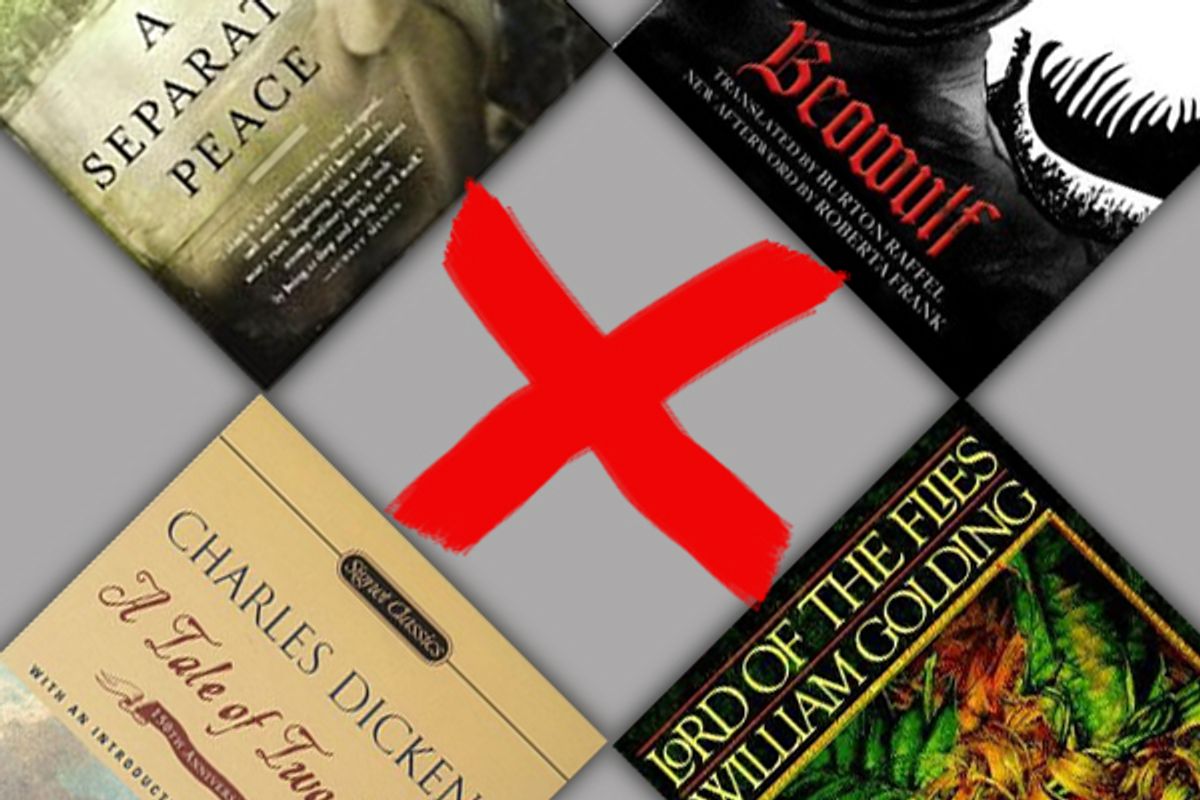
And so we ask: Where were these censors when we really needed them — that is, when our 10th-grade teachers assigned “Beowulf” or “The Pearl”? As deplorable as real-life book banning may be, there’s some required reading that those of us at Salon would love to see retired from the nation’s syllabuses simply because we were tortured by it as kids.
“What is the educative value of making nerdy kids (or anyone, I suppose) read ‘Lord of the Flies’?” asks film critic Andrew O’Hehir. “Is it pure sadism? To rub their faces in the gravity of their predicament, and the likely fact that they will sooner or later be sacrificed to a nonexistent God by their classmates? Now, I recognize the book’s literary value, no question, and the point that it’s an allegory about human society and not strictly about children or for children. But that’s not how you read it when you’re 11, for the love of sweet suffering Jesus. Really hated that experience.”
For my part, while I was a voracious independent reader of children’s fiction from the second grade on, “Lord of the Flies” — and another novel I was ordered to read at age 10, “Animal Farm” — convinced me that “grown-up” books were unrelentingly bleak and politically didactic; this kept me from venturing beyond the kids’ section of the library for a few years. (Also: with “Lord of the Flies,” I felt that the italicized allusions to “a stick sharpened at both ends” were so overwrought they must refer to atrocities even worse than putting someone’s head on a pike. This caused me to imagine things no 10-year-old should be imagining.)
Even the most omnivorous reader has at least one middle-grade anathema, an assigned book that was nothing but one long, brutal slog. Sometimes we’re simply too young for it; a man I know still shudders at the very mention of “A Tale of Two Cities” even though as an adult he came to love Dickens. Why make kids read a novel set during a historical period most will find difficult to grasp, especially as they wrestle with Victorian prose? I’m told “A Tale of Two Cities” gets put on curricula because it’s the shortest Dickens novel, but “Oliver Twist” is only a little longer and its mistreated-orphans premise seems vastly more child-friendly. Could it be that “Tale” has a message (“Revolutions are nasty!”) that adults find more congenial than the notions a kid might pick up from “Oliver Twist” (“Why not join a gang of pickpocketing urchins?”).
Then there are the books that seemed pretty good at the time, but when revisited later leave you doubting the wisdom and taste of our nation’s educators. Salon’s editor in chief, Kerry Lauerman, got choked up over John Knowles’ “A Separate Peace” as a high-school sophomore, but nowadays he’d prefer to see it jump from a high tree into a fast river. “I tried to read it again,” he writes, “and I instantly recognized the easy life lessons and broadly drawn characters of a reality show or Lifetime movie.”
But surely the most egregious tale of recklessly required reading comes from Life section editor Sarah Hepola, who at the age of 14 was assigned “Ivanhoe” by Sir Walter Scott, a novelist regarded as unreadable by most adults. “It was my freshman honors English class,” Sarah recalled, “and it was the first book we read that year. English had always been my favorite class, a refuge for a kid who felt out of place and loved words, and that pretty much put an end to all that.”
Readers, it’s your turn: What book did you have to read in elementary or middle school that you wouldn’t mind seeing vanish from the reading lists of children everywhere?
Further reading
The American Library Association’s official Banned Books Week 2011 site
A Google Map showing places in the U.S. where books were challenged between 2009 and 2011, indicating titles, reasons for the challenge and ultimate results
Laura Miller is a senior writer for Salon. She is the author of "The Magician's Book: A Skeptic's Adventures in Narnia" and has a Web site, magiciansbook.com. More Laura Miller.
Can you identify?
Science shows that the only way around some readers' prejudices is to trick them
(Credit: Shutterstock/Salon) The news of recent research documenting how readers identify with the main characters in stories has mostly been taken as confirmation of the value of literary role models. Lisa Libby, an assistant professor at Ohio State University and co-author of a study published in the Journal of Personality and Social Psychology, explained that subjects who read a short story in which the protagonist overcomes obstacles in order to vote were more likely to vote themselves several days later.
The suggestibility of readers isn’t news. Johann Wolfgang von Goethe’s novel of a sensitive young man destroyed by unrequited love, “The Sorrows of Young Werther,” inspired a rash of suicides by would-be Werthers in the late 1700s. Jack Kerouac has launched a thousand road trips. Still, this is part of science’s job: Running empirical tests on common knowledge — if for no other reason than because common knowledge (and common sense) is often wrong.
Continue Reading Close
Laura Miller is a senior writer for Salon. She is the author of "The Magician's Book: A Skeptic's Adventures in Narnia" and has a Web site, magiciansbook.com. More Laura Miller.
“The Aleppo Codex”: The bizarre history of a precious book
A reporter traces the shadowy fate of the definitive version of the Hebrew Bible
Matti Friedman An ancient and priceless book, a murky history of evasions and coverups, an underground of sinister and possibly violent dealers, a former spy who drops tantalizing hints and a wily 84-year-old millionaire who says stuff like, “The problem with this story is that it could damage your health”: Are these the ingredients for a cheesy, improbable historical thriller? Yet “The Aleppo Codex,” Matti Friedman’s account of his attempts to learn the history of one of the world’s most precious books, sports all of these assets, and it’s nonfiction. If reporting this story damaged Friedman’s health, it probably happened when he realized what he’d stumbled into and his reporter’s heart started beating in doubletime.
Continue Reading Close
Laura Miller is a senior writer for Salon. She is the author of "The Magician's Book: A Skeptic's Adventures in Narnia" and has a Web site, magiciansbook.com. More Laura Miller.
Augusten Burroughs: Conquer trauma by letting it go
Salon exclusive: The best-selling memoirist says past horrors haunt us because we think about them too much. Stop
Augusten Burroughs Many people continue to feel influenced and even controlled by the things that happened to them a long time ago. Sometimes, people harbor dark, traumatic memories from childhood. Or fragments of memories — incomplete scenes, uncomfortable feelings, perhaps even a sense of certainty that something specific and terrible happened to them, but little more than this.
Others experienced something traumatic in adulthood that continues to affect them day to day many years later. Maybe an assault has left a person afraid to leave their home or enter a particular neighborhood.
Continue Reading CloseAugusten Burroughs' many books include "Runnning With Scissors," "Dry," "Sellevision," "Magical Thinking" and "Possible Side Effects." His latest book is "This Is How." More Augusten Burroughs.
Why did we move to Paris?
Leaving New York seemed ideal. Until the crazy landlord, topless exams, the French flu, the lack of credit cards...
Rosecrans Baldwin Paris’s neighborhoods, the arrondissements, are organized like a twist. They spiral from the river like toilet water flushing in reverse and erupting out of the bowl — a corkscrew or what have you, a flattened pig’s tail, a whorling braid notched one to 20. But if you walk from one neighborhood to the next, there is little to suggest the numbers changing. So it was confusing. Anyway, if you began in the middle of the Seine and snaked around, we lived on the Right Bank in the top of the third arrondissement, called the haut Marais, the upper Marais, on Rue Béranger, a quiet little street curling down from Place de la République.
Continue Reading CloseRosecrans Baldwin is a founding editor of The Morning News. His first novel, "You Lost Me There," was named one of NPR's Best Books of 2010. His latest book is "Paris I Love You, But You're Bringing Me Down." More Rosecrans Baldwin.
Robert Caro’s bloated LBJ biography
Robert Caro's latest LBJ tome has everyone -- even Bill Clinton! -- hyping it. They've been had
“Even the President of the United States sometimes must have to stand naked.” When Bob Dylan wrote that line in 1964, the naked emperor was Lyndon Johnson, which makes that image perhaps the most disturbing in all of Dylan’s apocalyptic work.
By stripping down Lyndon Baines Johnson to his essence, Robert Caro has himself become an American legend. Since the publication of “The Path to Power” in 1982, Caro has transformed LBJ’s life into a cautionary tale of Shakespearean dimensions. In some wonky circles, the release of a new volume is heralded like the Summer of Love release of “Sgt. Pepper’s.” Can Caro possibly top his “Revolver”?”
Continue Reading ClosePage 1 of 984 in Books