
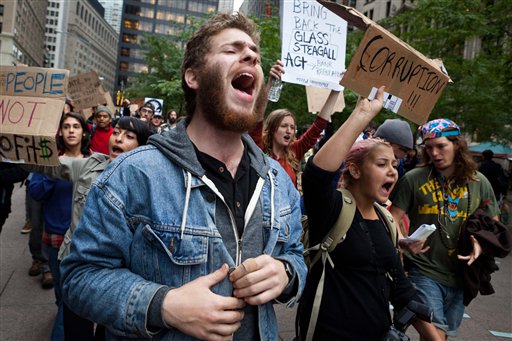

(updated below w/correction)
It’s unsurprising that establishment media outlets have been condescending, dismissive and scornful of the ongoing protests on Wall Street. Any entity that declares itself an adversary of prevailing institutional power is going to be viewed with hostility by establishment-serving institutions and their loyalists. That’s just the nature of protests that take place outside approved channels, an inevitable by-product of disruptive dissent: those who are most vested in safeguarding and legitimizing establishment prerogatives (which, by definition, includes establishment media outlets) are going to be hostile to those challenges. As the virtually universal disdain in these same circles for WikiLeaks (and, before that, for the Iraq War protests) demonstrated: the more effectively adversarial it is, the more establishment hostility it’s going to provoke.
Nor is it surprising that much of the most vocal criticisms of the Wall Street protests has come from some self-identified progressives, who one might think would be instinctively sympathetic to the substantive message of the protesters. In an excellent analysis entitled “Why Establishment Media & the Power Elite Loathe Occupy Wall Street,” Kevin Gosztola chronicles how many of the most scornful criticisms have come from Democratic partisans who — like the politicians to whom they devote their fealty — feign populist opposition to Wall Street for political gain.
Some of this anti-protest posturing is just the all-too-familiar New-Republic-ish eagerness to prove one’s own Seriousness by castigating anyone to the left of, say, Dianne Feinstein or John Kerry; for such individuals, multi-term, pro-Iraq-War Democratic Senator-plutocrats define the outermost left-wing limit of respectability. Also at play is the jingoistic notion that street protests are valid in Those Bad Countries but not in free, democratic America.
A siginificant aspect of this progressive disdain is grounded in the belief that the only valid form of political activism is support for Democratic Party candidates, and a corresponding desire to undermine anything that distracts from that goal. Indeed, the loyalists of both parties have an interest in marginalizing anything that might serve as a vehicle for activism outside of fealty to one of the two parties (Fox News‘ firing of Glenn Beck was almost certainly motivated by his frequent deviation from the GOP party-line orthodoxy which Fox exists to foster).
The very idea that one can effectively battle Wall Street’s corruption and control by working for the Democratic Party is absurd on its face: Wall Street’s favorite candidate in 2008 was Barack Obama, whose administration — led by a Wall Street White House Chief of Staff and Wall-Street-subservient Treasury Secretary and filled to the brim with Goldman Sachs officials — is now working hard to protect bankers from meaningful accountability (and though he’s behind Wall Street’s own Mitt Romney in the Wall Street cash sweepstakes this year, Obama is still doing well); one of Wall Street’s most faithful servants is Chuck Schumer, the money man of the Democratic Party; and the second-ranking Senate Democrat acknowledged — when Democrats controlled the Congress — that the owners of Congress are bankers. There are individuals who impressively rail against the crony capitalism and corporatism that sustains Wall Street’s power, but they’re no match for the party apparatus that remains fully owned and controlled by it.
But much of this progressive criticism consists of relatively (ostensibly) well-intentioned tactical and organizational critiques of the protests: there wasn’t a clear unified message; it lacked a coherent media strategy; the neo-hippie participants were too off-putting to Middle America; the resulting police brutality overwhelmed the message, etc. etc. That’s the high-minded form which most progressive scorn for the protests took: it’s just not professionally organized or effective.
Some of these critiques are ludicrous. Does anyone really not know what the basic message is of this protest: that Wall Street is oozing corruption and criminality and its unrestrained political power — in the form of crony capitalism and ownership of political institutions — is destroying financial security for everyone else? Beyond that, criticizing protesters for the prominence of police brutality stories is pure victim-blaming (and, independently, having police brutality highlighted is its own benefit).
Most importantly, very few protest movements enjoy perfect clarity about tactics or command widespread support when they begin; they’re designed to spark conversation, raise awareness, attract others to the cause, and build those structural planks as they grow and develop. Dismissing these incipient protests because they lack fully developed, sophisticated professionalization is akin to pronouncing a three-year-old child worthless because he can’t read Schopenhauer: those who are actually interested in helping it develop will work toward improving those deficiencies, not harp on them in order to belittle its worth.
That said, some of these organizational/tactical critiques are valid enough as far as they go; the protests could probably be more effective with some more imaginative, concerted and savvy organizational strategies. The problem is these criticisms don’t go very far — at all.
* * * * *
There’s a vast and growing apparatus of intimidation designed to deter and control citizen protests. The most that’s allowed is to assemble with the permission of state authorities and remain roped off in sequestered, out-of-the-way areas: the Orwellian-named free speech zones. Anything that is even remotely disruptive or threatening is going to be met with aggressive force: pepper spray, mass arrests by highly militarized urban police forces, and aggressive prosecutions. Recall the wild excesses of force in connection with the 2008 RNC Convention in Minneapolis (I reported on those firsthand); the overzealous prosecutions of civil disobedience activists like Aaron Swartz, environmentalist Tim DeChristopher, and Dan Choi; the war being waged on whistleblowers for the crime of exposing high-level wrongdoing; or the treatment of these Wall Street protesters.
Financial elites and their political servants are well aware that exploding wealth inequality, pervasive economic anxiety, and increasing hostility toward institutions of authority (and corresponding realization that voting fixes very little of this) are likely to bring London-style unrest — and worse — to American soil; it was just two weeks ago that New York Mayor Michael Bloomberg warned that the unemployment crisis could trigger “riots.” Even the complacent American citizenry — well-trained in learned impotence and acquiescence to (even reverence for) those most responsible for their plight — is going to reach a tipping point of unrest. There are numerous weapons of surveillance and coercion that have been developed over the last decade in anticipation of that unrest: most of it justified in the name of Terrorism, but all of it featuring decidedly dual-use domestic capability (illustrating what I mean is this chart showing how extensively the Patriot Act has been used in non-Terrorist cases, and how rarely it has been used for Terrorism).
In sum, there is a sprawling apparatus of federal and local militarized police forces and private corporate security designed to send this message: if you participate in protests or other forms of dissent outside of harmless approved channels, you’re going to be harmed in numerous ways. As Yves Smith put it this week:
I’m beginning to wonder whether the right to assemble is effectively dead in the US. No one who is a wage slave (which is the overwhelming majority of the population) can afford to have an arrest record, even a misdemeanor, in this age of short job tenures and rising use of background checks.
This is all designed to deter any meaningful challenges to the government and corporate institutions which are suffocating them, to bully those who consider such challenges into accepting its futility. And it works. In an excellent essay on the Wall Street protests, Dennis Perrin writes:
The dissident children were easily, roughly swept aside. Their hearts are in a good place. Their bodies a minor nuisance. They’ll stream back to prove their resolve. And they’ll get pepper sprayed and beaten down again. And again.
I admire these kids. They’re off their asses. Agitating. Arguing. Providing a living example. There’s passion and feeling in their dissent. They’re willing to be punished. It’s easy to mock them, but how many of you would take their place? . . . .
Yet I have doubts. The class war from above demoralizes as much as it incites. Countless people have surrendered. Faded from view. To demonstrate or occupy corporate turf doesn’t seem like a wise option. You’ll get beaten and arrested. For what? Making mortgage payments is tough enough.
Given the costs and risks one incurs from participating in protests like this — to say nothing of the widespread mockery one receives – it’s natural that most of the participants will be young and not yet desperate to cling to institutional stability. It’s also natural that this cohort won’t be well-versed (or even interested) in the high arts of media messaging and leadership structures. Democratic Party precinct captains, MBA students in management theory and corporate communications, and campaign media strategists aren’t the ones who will fuel protests like this; it takes a mindset of passionate dissent and a willingness to remove oneself from the safe confines of institutional respectability.
So, yes, the people willing to engage in protests like these at the start may lack (or reject the need for) media strategies, organizational hierarchies, and messaging theories. But they’re among the very few people trying to channel widespread anger into activism rather than resignation, and thus deserve support and encouragement — and help — from anyone claiming to be sympathetic to their underlying message. As Perrin put it:
This part of Michigan [where I live] was once militant. From organized labor to student agitation. Now there’s nothing. Shop after shop goes under. Strip malls abandoned. Legalized loan shark parlors spread. Dollar stores hang on. Parking lots riots of weeds. Roads in serious disrepair. Those with jobs feel lucky to be employed. Everyone else is on their own. A general resignation prevails. Life limps by.
Personally, I think there’s substantial value even in those protests that lack “exit goals” and “messaging strategies” and the rest of the platitudes from Power Point presentations by mid-level functionaries at corporate conferences. Some injustices simply need anger and dissent expressed for its own sake, to make clear that there are citizens who are aware of it and do not accept it.
In Vancouver yesterday, Dick Cheney was met by angry protests chanting “war criminal” at him while he tried to hawk his book, which prompted arrests and an ugly-for-Canada police battle that then became part of the story of his visit. Is that likely to result in Cheney’s arrest or sway huge numbers of people to change how they think? No. But it’s vastly preferable to allowing him to traipse around the world as though he’s a respectable figure unaccompanied by anger over his crimes — anger necessarily expressed outside of the institutions that have failed to check or punish (but rather have shielded and legitimized) those crimes. And the same is true of Wall Street’s rampant criminality.
But for those who believe that protests are only worthwhile if they translate into quantifiable impact: the lack of organizational sophistication or messaging efficacy on the part of the Wall Street protest is a reason to support it and get involved in it, not turn one’s nose up at it and join in the media demonization. That’s what one actually sympathetic to its messaging (rather than pretending to be in order more effectively to discredit it) would do. Anyone who looks at mostly young citizens marching in the street protesting the corruption of Wall Street and the harm it spawns, and decides that what is warranted is mockery and scorn rather than support, is either not seeing things clearly or is motivated by objectives other than the ones being presented.
UPDATE: In the first paragraph , I mistakenly linked to a post discussing a New York Times article by Colin Moynihan as an example of a “condescending” media report about the protest. There was nothing condescending or otherwise worthy of criticism in Moynihan’s article; I meant to reference this NYT article by Ginia Bellafante. My apologies to Moynihan, who rightly objected by email, for the mistake.
