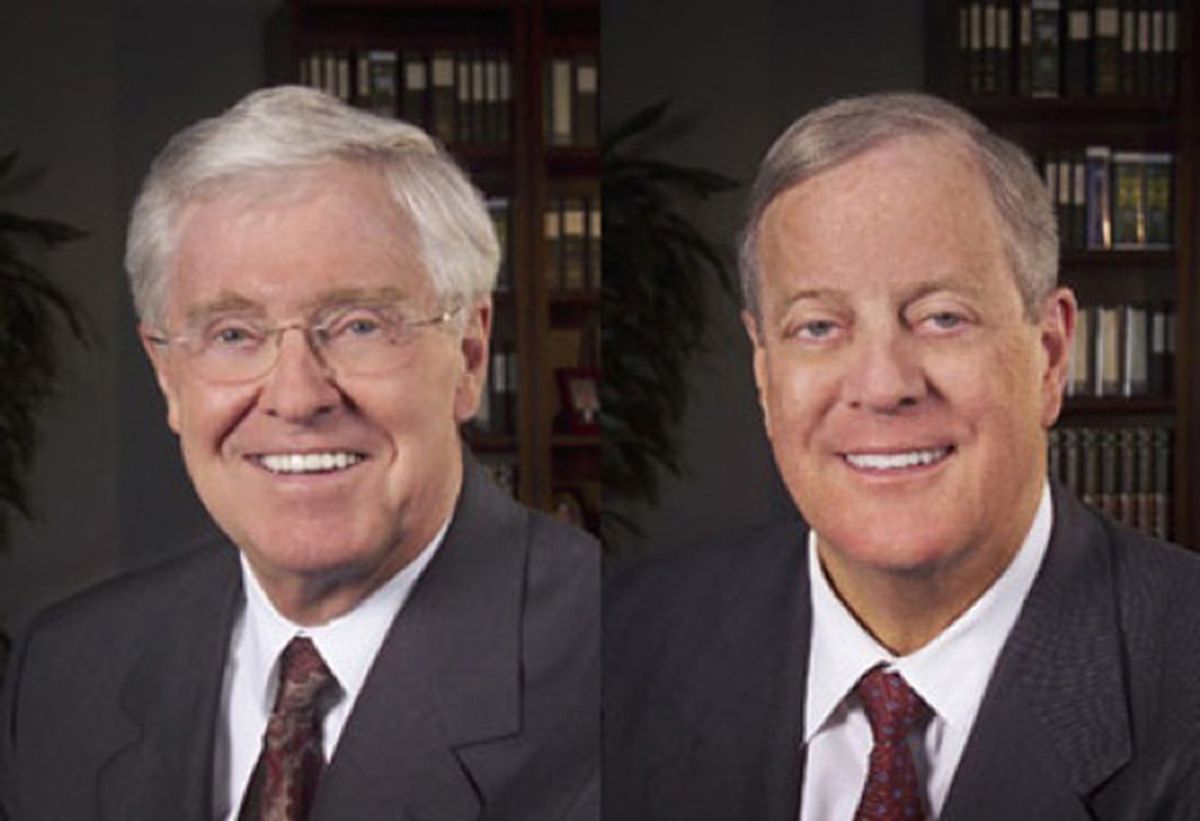
Koch Brothers

Koch brothers spooked by forthcoming story

Anonymous sources try to discredit Bloomberg article on Koch Industries before it's even published

The Koch brothers

Here’s a rule of thumb about public relations: When P.R. pros begin furiously spinning a story before it has even come out, there’s a pretty good chance the story is going to be damaging to the reputation of said P.R. pros’ bosses.

And that’s exactly what we’re seeing right now, as an anonymous person or persons in the orbit of the billionaire conservative donors Charles and David Koch try to discredit a forthcoming story in Bloomberg Markets magazine.

Based on the prebuttal items appearing this week in the Washington Examiner, the Daily Caller, and U.S. News and World Report, the Bloomberg story focuses on alleged malfeasance and/or fraud and/or bad behavior by the conglomerate Koch Industries.

One of those episodes apparently involves bribery by a Koch subsidiary in France, according to the piece by Washington Examiner editorial page editor Mark Tapscott. He reports that “Bloomberg reporters have been trolling among former Koch employees overseas in search of disaffected voices willing to talk,” but Tapscott suspects the story may be animated by bias against the Tea Party. And he notes that, “Koch USA officials say they were as surprised and angered as anybody else when they were first apprised of the bribery allegations, and moved as quickly as possible to get to the bottom of the situation and fix it.”

All three of the prebuttal stories cite an unnamed source who was interviewed for the Bloomberg story; it’s not clear if that same source spoke with all three publications. The Examiner describes the source as a former government official.

Another one of the issues addressed in the Bloomberg article will be the Kochs’ past business dealings with Iran, according to the Daily Caller’s Matt Lewis, who also argues that this is not “terribly newsworthy” and the Kochs are being singled out for their politics.

Meanwhile, Paul Bedard of U.S. News reports:

One of those interviewed by Bloomberg for the upcoming article said the firm received four pages of single-spaced questions, all dealing with old trade and environmental problems and issues the company says it has fixed. None were about the firm’s politics or the Koch brother’s support for conservative causes, though the firm believes that is the focus.

Clearly, the Kochs are nervous about what Bloomberg has coming. And as it turns out, they’ve used the prebuttal strategy before.

In April 2010 I got an unsolicited email from Koch Industries’ spokeswoman offering to “reiterate some important facts.” She said that Koch Industries and the Koch brothers had never funded the Tea Party, in case I was wondering. That, of course, was not true. And a few months later, Jane Mayer’s now famous expose on the Kochs and the Tea Party was published in the New Yorker.

Bloomberg Markets spokesman Drew Kerr told me he can’t comment on forthcoming stories, adding, “you should always check out Bloomberg Markets’ website and magazine because one never knows what may appear.”

Justin Elliott

Justin Elliott is a reporter for ProPublica. You can follow him on Twitter @ElliottJustin

The Kochs’ very bad week

From a damning documentary to a federal investigation, the arch-conservative brothers find themselves in hot water

Charles and David Koch
This article originally appeared on AlterNet.

Were there a way for a few billion clams to wipe a week off the calendar, one imagines that Charles and David Koch, the multibillionaire principals of Koch Industries, would like to see the final week of March 2012 vaporized, at least in the public mind. For the Kochs, it was a week of bad news: a new documentary about their political activity and corporate negligence was making a splash — on the same day a story broke announcing an FBI investigation of two Wisconsin groups tied to Americans for Prosperity, the political ground organization they founded and fund. (Full disclosure: AlterNet is a supporter of the documentary, “Koch Brothers Exposed,” and I appear in the film.)

AlterNetThings got even worse the next day, Friday, March 30, when the billionaire brothers learned that a federal court handed down a decision that may ultimately require certain nonprofit groups, such as Americans for Prosperity, to reveal their full donor list, and the New Yorker’s Jane Mayer, who wrote a devastating profile of the brothers last year, reported on the Kochs’ involvement in a barrage of anti-Obama ads sponsored by a tax-exempt nonprofit called the American Energy Alliance, which may also now be required to reveal its donor list.

On the very same day, another federal court struck down portions of Wisconsin’s controversial law that stripped collective bargaining rights from most of the state’s public employees – a law championed by Americans for Prosperity, and rammed through the state legislature a year ago by the AFP-supported Gov. Scott Walker. Here, we take a closer look at the Kochs’ very bad week.

1. An FBI Investigation

Just hours before the premiere showing of ”Koch Brothers Exposed” in Manhattan on Thursday, March 29, the Miwaukee Journal Sentinel’s Daniel Bice broke the news that the FBI was investigating possibly illegal activity by two groups led by Mark Block, former director of the AFP Wisconsin chapter, during his stint as campaign manager for former GOP presidential candidate Herman Cain. (The Hermanator famously referred to David Koch as his “brother from another mother” at an event hosted by the oil baron in Washington, D.C., last year.) Among documents Bice uncovered last year was a profit-and-loss statement for Prosperity USA, a nonprofit group headed by Block, which details travel costs for a visit last year with David Koch and Americans for Prosperity president Tim Phillips in Washington, DC.

While that’s not proof of wrongdoing, it is proof of David Koch’s link to Block, a shady character who has been prosecuted in the past for violating Wisconsin election law.

The Journal Sentinel reports: “FBI agents have been talking to donors and other individuals connected with Prosperity USA and Wisconsin Prosperity Network,” both non-profits founded by Block while he was at the helm of AFP-Wisconsin. (AlterNet has published several reports involving the Wisconsin Prosperity Network, here,  here and here.)

In correspondence with the Center For Public Integrity’s iWatch News last year, AFP spokesperson Levi Russell acknowledged that “there were financial dealings with Prosperity USA and/or the Wisconsin Prosperity Network.”

2. Revelation of Koch Involvement in Group Running Anti-Obama Ads

Already, March 29 was looking like a tough day for the Kochs when Politico’s Kenneth P. Vogel burst forth with an article revealing the involvement of the Kochs in an organization, the American Energy Alliance, that launched a multimillion-dollar ad campaign against President Barack Obama on Friday. The ads put forth the specious claim that the president’s policies are driving up gasoline prices.

According to Politico:

The group launching a $3.6 million ad campaign hitting President Barack Obama on gasoline prices has deep ties to the billionaire libertarian industrialists Charles and David Koch.

[...]

The groups are run by Tom Pyle, a former lobbyist for Koch Industries. Pyle regularly attends the mega-donor summits organized by the Koch brothers, including the 2012 winter summit in Indian Wells, Calif., where the Kochs raised more than $150 million to be directed to groups ahead of the general election.

[...]

The ads come after the Kochs’ primary political group, Americans for Prosperity, earlier this year launched a $6 million ad campaign calling out Obama over the now-defunct, government-subsidized maker of solar power components, Solyndra.

The following day, the New Yorker’s Jane Mayer followed up with a closer look at the American Energy Alliance:

So who is behind the advertising campaign to push the line that Obama is to blame? Bill Burton, senior strategist at the pro-Obama Super PAC Priorities USA believes that it comes from a familiar source. “The Koch brothers and other oil barons are using profits from high gas prices to fund false political attacks benefitting Governor Romney,” he says.

[American Energy Alliance Communications Director Benjamin] Cole retorts that there is “not a single penny of Koch money” paying for the two-week ad campaign. But he declined to confirm or deny reports, including one by Politico, that the Koch brothers, whose privately owned conglomerate, Koch Industries, is a major domestic-oil refiner, have steered funds to both the American Energy Alliance and the Institute for Energy Research. A spokesperson at Koch Industries did not respond to questions on the Kochs’ ties to the groups.

3. Federal Court Sets Stage for Revelation of Americans for Prosperity Donors

The Koch brothers are notoriously secretive about where they put their money when it comes to their influence on the political process. Their vehicles of choice are a particular sort of nonprofit organization – those that fall under either 501(c)(3) or 501(c)(4) of the Internal Revenue Service tax code. Under current Federal Election Commission regulations, organizations sponsoring so-called “issue” ads — even those with with the (c)(3) or (c)(4) designation — have not been required to reveal their donors. Americans for Prosperity, the Americans for Prosperity Foundation and the American Energy Alliance all fall under one of these designations. In her report on the anti-Obama ads discussed above, Mayer explains it on the New Yorker’s Web site:

Technically, the ads have been produced and aired by the Washington-based American Energy Alliance, a 501c-4 social-welfare organization under the Internal Revenue Service’s tax code, whose activities, under the law, have to be largely non-political. This group shares office space and personnel with a sister organization, the Institute for Energy Research, a 501c-3, whose tax status is typically reserved for charities. Its activities have to be strictly non-partisan and non-political.

Even though the American Energy Alliance and Americans for Prosperity are rather blatantly political in their activities, lax enforcement has allowed the groups to get away with their ads and political rallies while shielding their donors from disclosure.

A decision made on Friday by the U.S. District Court for the District of Columbia could change all that, laying before the eyes of the world the extent of the Koch brothers’ spending through such organizations.

As the Huffington Post’s Paul Blumenthal reported:

Friday’s court ruling could reverse a trend started by the FEC rules, and aggravated by the Supreme Court’s 2010 Citizens United decision, that led to an explosion in undisclosed contributions to electoral efforts. The percentage of independent spending that went undisclosed jumped from 1 percent in 2006 to 43.8 percent in 2010, according to the Center for Responsive Politics.

Advertisements falling under the rubric of “electioneering communications” include those run against President Barack Obama by the American Energy Alliance and Americans for Prosperity, both non-profits linked to the Koch brothers. All ads run by the U.S. Chamber of Commerce are classified as “electioneering communications.” The ruling would require for the first time that contributions to these groups, and many more, be disclosed.

The FEC, whose nondisclosure rules were challenged by Rep. Chris Van Holland, D-Md., could appeal the ruling if four of the six FEC commissioners vote to do so.

4. Recall This: A Legal Defeat for Koch-Funded Wisconsin Gov. Walker

Just as the date was being set for a recall election for Wisconsin Gov. Scott Walker, a federal court struck down portions of the anti-labor law that all but ended collective bargaining for the state’s public employees. When first introduced in the state legislature, the anti-union measure sparked an uprising in the Dairy State last year that led to an 18-day occupation of the state capitol building. Walker was elected in 2010 with a substantial assist from the Wisconsin chapter of Americans for Prosperity (then under the leadership of Mark Block, now a person of interest in the aforementioned FBI investigation). Judge William Conley took aim at several portions of the law: those that forbade the automatic deduction of union dues from public employes and demanded yearly union elections. Such provisions treated certain groups of public employees differently from others with similar jobs, apparently according to their loyalty to the governor.

From Amanda Terkel’s report on Huffington Post:

The court ruled that the state cannot prevent public sector unions from automatically deducting dues from workers’ paychecks and cannot require them to be recertified annually.

The law, known as Act 10, requires most public sector unions to hold annual votes on whether a majority of its members want to recertify the union. It also took away the rights of some unions to automatically collect dues from members’ paychecks.

The court kept most of the law in place, but it ruled that the state did not have the power to pick and choose which unions could deduct dues. Under Act 10, only “public safety unions” — those representing firefighters and police officers — could continue to take out payments automatically.

AlterNet’s Steven Rosenfeld explains the loyalty issues involved:

The ruling by U.S. District Court Judge William Conley, which struck down those sections of the law, held that the legislature had the right to deny union bargaining rights, so long as that policy was applied evenly across all state employee unions–not just the ones opposing the governor’s or his party’s policies. In Act 10, Walker generally exempted state police and public safety unions from the bargaining and dues-collecting restrictions.

“The Act’s treatment of the Capital Police, who endorsed the governor’s opponent, in comparison to its treatment of state vehicle inspectors, who endorsed the governor, best illustrates this suspect line-drawing,” Conley wrote, saying that targeting of some unions violated the Constitution’s equal protection clause.

5. “Koch Brothers Exposed” Debuts

If you’re trying to keep a secret — say, one about the amount of money you’re investing in organizations that put out disinformation in order to sway the political process in your favor, or maybe one about the cancer affecting nearly every family in a neighborhood downriver from your paper plant — a documentary raising questions about these things is never a good day. On Thursday, March 29, filmmaker Robert Greenwald unveiled a feature-length film, “Koch Brothers Exposed,” at a screening co-sponsored by AlterNet and Greenwald’s Brave New Foundation.

But given all the other fires that had popped up in Kochland — the court ruling against Scott Walker, the FBI investigation of Mark Block, the Politico report on the Kochs’ support of the American Energy Alliance, and the New Yorker’s exploration of the Alliance’s Koch links — you’d expect that public relations wizards for the Kochs and their proxies would be falling all over themselves issuing statements and doing spin-control on these developments. Instead, radio silence:

From Politico:

A spokesman for the Koch brothers did not immediately respond to requests for comment Thursday.

From the New Yorker:

A spokesperson at Koch Industries did not respond to questions on the Kochs’ ties to the groups.

The Kochs’ political operatives were hardly more responsive. From the Milwaukee Journal Sentinel, in its report on the FBI investigation that involves the Kochs’ Americans for Prosperity:

Block did not return texts, emails or calls asking for comment on Thursday.

From the Huffington Post, in its report on the court decision against parts of the Scott Walker anti-union law:

Walker’s office did not return a request for comment.

Instead, the PR professionals at Koch Industries focused on filmmaker Greenwald, posting an attack on him on their Web site, and complaining of “harassing phone calls” from Brave New Foundation staffers who were requesting comment on the documentary, and making a big deal of a bad joke made by one of the staffers after he thought he had hung up. When a behemoth corporation — in this case, the second-largest privately held corporation in America — uses its corporate Web site to attack an individual the way Koch Industries went after Greenwald on Friday, there’s usually a bit more to the story. In this case, it appears the public relations geniuses at Koch were hoping to deflect attention away from the Kochs’ very bad week.

Continue Reading Close

How billionaires destroy democracy

Wealthy Wall Streeters have rigged the economy and the government against the people. Here's how they did it

Kenneth Griffin, Philip Falcone, Jim Simons and John Paulson testify before a House Oversight and Government Reform Committee hearing on the regulation of hedge funds in 2008. (Credit: Reuters/Jonathan Ernst)

There are many words that could be used to describe Barack Obama, but one adjective decidedly doesn’t fit: Aggressive. So it was more than passing strange when a prominent member of Wall Street — Stephen Schwarzman, chairman of the private equity giant Blackstone Group — compared actions by President Obama to one of the most notoriously aggressive acts by one of history’s most aggressive villains. Speaking to the board of a nonprofit group, Schwarzman fiercely denounced initiatives by the Obama administration: “It’s war. It’s like when Hitler invaded Poland in 1939.”

In the arena of political commentary, few things are considered more clearly below-the-belt than comparing an opponent to Hitler. So there was a small stir in August 2010 when it was reported that Schwarzman — whom Time magazine had included on its 100 most influential people list only three years earlier — had likened Obama to the Nazi strongman. Schwarzman acknowledged making the remark and then apologized for it, while reaffirming the sentiment behind it. But what was striking about the Hitler comment — besides its sheer viciousness and absurdity — was what had provoked it. Schwarzman wasn’t complaining about undue military force, torture, or ethnic cleansing. He was likening the president to the most reviled man in history on the grounds that Obama was trying to close a tax loophole that allowed hedge fund and private equity managers (like Schwarzman) to pay tax at a rate that Warren Buffett famously noted was lower than that paid by their secretaries.

In an era marked by gluttony and hubris, Steve Schwarzman has still managed to stand out.

His 60th birthday party in Manhattan in 2007 was so lavish — with live performances by Rod Stewart and Martin Short — it became Wall Street legend. Then there’s Schwarzman’s 35-room Park Avenue residence, his sprawling estate in Saint-Tropez, a spectacular spread in Jamaica, and his massive Palm Beach estate, where the executive chef says it typically costs about $3,000 a weekend to feed just Schwarzman and his wife.

Schwarzman is a major figure in private equity, part of the surging field of “alternative asset” financial institutions that, along with hedge and real estate funds, appeared on the horizon two decades ago and now control trillions of dollars in assets. While hedge funds are well-known for contributing to the subprime mortgage crash, private equity funds are notorious for taking over established firms with borrowed money and essentially pillaging them. The bought-out companies are typically saddled with increased debt from the takeover and forced to make massive dividend and fee payouts to the private equity managers and their investors, while employees are shedded and union contracts gutted. The companies are usually chopped up into smaller pieces and sold soon afterwards at inflated prices, creating another windfall for the private equity managers. By 2007, the Blackstone Group had taken control of more than 112 companies worth nearly $200 billion. In 2011, Schwarzman ranked 169th on Forbes’ worldwide billionaire list, worth an estimated $5.9 billion.

Schwarzman may be rougher at the edges than most of the hedge fund and private equity crowd. But his outburst against Obama reminds us of the “war” he and others — by themselves or by proxies — have been engaged in to minimize their contribution to the public treasury. It’s an all-too-familiar tale of how effective the rich are at getting their way, even when the battle is being played out in a very public arena where a small group of billionaires advancing their own self-interest would seem a very tough sell.

- – - – - – - – - – - -

Victor Fleischer didn’t set out to be a 21st-century Robin Hood. His real aim was just to get tenure.

Fleischer joined the New York law firm Polk Davis in the late 1990s, working on the formations of private equity and venture capital funds. He was struck by the very low rates of tax paid by fund managers, even compared to the already low tax rates being paid by executives receiving corporate stock options. Fleischer wasn’t discovering something new; the rules had been in place since 1954. Nor was he outraged or even particularly interested in the question of tax fairness. At the time, he was simply interested in the impact that the tax rules governing so-called “carried interest” might have on the law firm’s clients.

The question stayed in Fleischer’s mind after he left Polk Davis in 2001 and became a law professor specializing in taxation. Hoping to get a paper published to improve his chances of securing tenure, Fleischer put together his thoughts on the taxation of private equity funds. Now that he was no longer constrained by working for people in the private equity field, he started to pay attention to what seemed to him to be a “quirk” in the law that distorted tax principles while undermining distributive justice.

He identified the fact that managers of private equity, venture capital and hedge funds were claiming a significant part of their incomes as capital gains (taxed at 15 percent), rather than treating them as regular income (taxed at 35 percent). That substantial difference in rates was magnified by the enormity of the incomes in question. A private equity manager receiving, say, $600 million as a capital gain would pay $90 million in tax. If the same income were treated as income from salary, it would be taxed at 35 percent (and also be subject to a 2.9 percent payroll tax), bringing the private equity manager’s tax bill to $227.4 million — almost $140 million more.

The ostensible purpose of the lower capital gains rate is to compensate investors for the risk they take in investing their capital. But private equity and fund managers aren’t investing their own capital. They’re investing other people’s capital. They’re simply money managers. By claiming capital gains treatment, they are passing off regular income as capital gains, simply to save themselves taxes.

The fund managers insist that their compensation is still very risky; while some deals may lead to huge profits, others prove disastrous. True. But risk is hardly confined to fund managers. And at lower income levels, the risks are far larger. Indeed, in the last 30 years, vast swaths of the economy could be designated as risky for those needing to earn a living. The sort of stable, lifelong jobs that were common a generation ago have been largely replaced by contract or part-time work, with little or no security. A layoff can mean the loss of the family home or health benefits, or even destitution — far more serious plights than anything likely to befall a hedge fund manager. (For that matter, no one ever seems to argue for special low tax rates for the real risk-takers among us — miners, oil-rig workers, acrobats, firemen, window washers working on tall buildings.)

The so-called “carried interest” loophole enjoyed by hedge fund and private equity managers raises the larger question of whether capital gains — even real ones — should ever be taxed at lower rates. On the face of things, the lower rate seems patently unfair. Why should someone earning income by investing their fortune be taxed at a substantially lower rate than those earning income from the sweat of their brows or from using skills they’ve spent years acquiring? The fairness argument has essentially been set aside, however, as business has relentlessly promoted the notion that such preferential treatment is necessary to coax those with capital to invest it. But do investors really need coaxing? Warren Buffett, one of the world’s savviest investors, doesn’t think so. “I have worked with investors for 60 years and I have yet to see anyone — not even when capital gains rates were 39.9 percent in 1976-77 — shy away from a sensible investment because of the tax rate on the potential gain,” Buffett argues.

Our business culture tends to portray investors as modern-day heroes who put their hard-earned capital into worthy high-risk ventures that lead to path-breaking discoveries that enrich the lives of all of us. Sadly, the vast majority of investments don’t fit into this category (and those that do qualify for additional tax incentives). Rather, as former mutual fund manager John C. Bogle notes, “most capital gains are made from gambling in the stock market.” So the ultimate function of the special low rate on capital gains is to save our wealthiest citizens billions of dollars a year on their winnings in the Wall Street casino.

- – - – - – - – - – - -

Fleischer’s paper found its way into the hands of congressional Democrats at a time when they were looking for fresh sources of revenue to pay for the expansion of the State Children’s Health Insurance Program and the Earned Income Tax Credit. The juxtaposition of high-flying hedge fund managers and children without health care seemed like a public relations nightmare for the Wall Street crowd.

Schwarzman himself helped put an unsavory face on the fund manager set with his plan to turn Blackstone into a publicly traded company in the spring of 2007. The plan would not only allow Schwarzman and other top Blackstone executives to continue to qualify for the low capital-gains rate as fund managers, but would also allow their new multi-billion-dollar publicly traded company to largely avoid paying corporate taxes. If Schwarzman won the approval of SEC regulators, he and Blackstone co-founder Peter Peterson would receive billions of dollars worth of stock, plus hundreds of millions in cash. And this would surely set a precedent, enticing other private equity funds, as well as investment banks — including giants like Goldman Sachs and Morgan Stanley — to reorganize themselves along similar lines, making the paying of corporate taxes almost optional for Wall Street institutions.

Schwarzman’s move had pushed the issue of sweetheart taxation for private equity kings from law school reviews to the front pages of newspapers. A bill to stop Schwarzman — dubbed the Blackstone bill — quickly appeared in Congress.

Momentum seemed to be building against the Blackstone deal and more broadly for a bill, sponsored by Democratic congressman Sander Levin that would shut down the fund manager loophole completely. But Wall Street quickly organized a counterattack. Some of the largest private equity firms formed the Private Equity Council, and, within six months, the Council had retained four top lobby firms to handle the case. Labor and public interest groups lobbied from the other side, presenting a letter to Congress signed by more than a hundred organizations across the country urging that the loophole be closed. But private equity had resources that were probably 1,000 times greater, according to Steve Wamhoff, legislative director of the Washington-based group Citizens for Tax Justice.

No argument seemed too extreme or silly to advance in defense of maintaining the loophole. Lobbyists insisted, for instance, that the tax break was crucial in the fight against cancer, pointing to the fact that the loophole also applied to those running venture capital funds, which sometimes invest in high-risk start-up firms — including those developing products to fight cancer. Private equity was trying to make the case that showering tax breaks on all fund managers, some of whom might be investing their funds in firms involved in fighting cancer, was an effective way to subsidize the fight against cancer — rather than simply increasing direct subsidies to cancer researchers or start-up firms.

In the end, the weakness of the case for maintaining the loophole didn’t matter. In three years of Congressional battles over the issue — with the Democrats mostly voting to shut down the loophole, and Republicans voting to keep it alive — the House passed a bill to shut it down three times. But Democrats finally abandoned attempts to overcome Republican obstacles in the Senate in June 2010. So, even with the Democrats holding the White House, the House and the Senate (including 60 seats for a while), “they were still incapable of closing the most indefensible loophole in existence,” notes Wamhoff.

- – - – - – - – - – - -

In the run-up to the debt-ceiling crisis in the summer of 2011, the most indefensible loophole in existence was once again in the spotlight. Figures from the Congressional Budget Office showed that closing the loophole could save $21 billion over 10 years. That wouldn’t eliminate the debt, of course, but given the scope of the debt problem, it seemed a lot of money to simply ignore. New York Times columnist Nicholas Kristof devoted a column to the tax break, awarding it the grand prize for the “Most Unconscionable Tax Loophole.” The president himself zeroed in on it again. “How can we ask a student to pay more for college before we ask hedge fund managers to stop paying taxes at a lower rate than their secretaries?” Obama said in an address to Congress in July.

But the Tea Party crowd now becoming power players in the Republican Party was as resistant to compromise as Obama was prone to it. They blamed the mounting deficit entirely on Obama (even though George W. Bush had added $5.07 trillion to the debt, primarily due to his tax cuts and military spending, while Obama had added just $1.44 trillion, mostly fighting the recession). Spotting an opportunity to use the deficit to achieve deep spending cuts, hard-line Republicans refused to raise the debt ceiling without a long-term strategy for debt reduction, which they insisted be entirely achieved through spending cuts. In the final deal, signed into law just hours before the deadline for a Latin American–style default, the hijackers appeared to win, with $917 billion in deficit-reduction measures all to come from spending cuts (and another $1.5 trillion to be worked out by a bipartisan committee). The radical Republicans had turned the fairly routine business of raising the debt ceiling — something Republicans had agreed to 87 times since World War II — into a bloodbath of spending cuts.

An observer could easily conclude that all this simply shows how resistant Americans have become to tax increases. But in fact it shows no such thing. In the years leading up to the debt-ceiling showdown, Americans have repeatedly told pollsters that they support higher taxes on the rich as a way to reduce the deficit. A Washington Post-ABC News poll reported in July 2011, as the crisis reached a crescendo, found that 72 percent supported raising taxes on those earning more than $250,000 a year.

What the debt-ceiling fiasco really showed was how a band of Republican extremists had effectively taken the U.S. political system hostage and were moving to enact the Right’s long-time fantasy of dismantling popular New Deal programs — particularly Social Security — which had been politically untouchable since the 1930s. Americans were told that these programs were simply no longer affordable — even though the country had grown considerably richer over the decades. In fact, what had changed was not the affordability of the programs but the intransigence of the nation’s elite to paying taxes.

So while programs helping students, the elderly, and the poor were to be picked over by deficit-cutting politicians with surgical precision, private equity and hedge fund mangers were to be spared any increase in taxes. They could get back to work pillaging companies and destabilizing financial markets with full peace of mind, knowing they’d continue to enjoy a tax rate lower than the mechanics who service their private jets.

Indeed, only a month after the debt-ceiling crisis, Stephen Schwarzman was back on the offensive, no longer just defending the special tax break that saved him millions of dollars a year, but now insisting on the need for broad tax reform — so that low-income people would pay more. Schwarzman’s concern was that many Americans manage to avoid paying income tax at all because their incomes are so low. His solution was a flat tax, so that everyone would pay some income tax. “If some people are left out and some people have special deals, it doesn’t feel like the kind of situation where everyone’s going to get on board,” Schwarzman told CNBC.” For Schwarzman, “special deals” aren’t loopholes for billionaires but exemptions for those with low incomes — mostly the elderly, people with children, and the poor — who’ve been dubbed “lucky duckies” by the Wall Street Journal for their apparent tax-free status.

Having rebuffed Obama’s invasion, the Wall Street crowd was now itching to launch a counter-invasion. No longer was the goal just to protect their own loopholes. They now sought to solve the deficit crisis, which they had greatly contributed to with their reckless financial speculation, by digging into the empty pockets of low-income Americans. It wasn’t that the rich weren’t paying enough tax; it was that others weren’t paying enough. It was time to go after the lucky duckies. A new rallying cry could be heard rumbling from the boardrooms of Wall Street: Make the Poor Pay!

- – - – - – - – - – - -

Barely a month after Barack Obama had been sworn in as the 44th U.S. president, riding a wave of immense popular support with his “Yes, we can” rallying cry echoing around the country and the world, a voice seemed to appear from nowhere saying, “No, actually you can’t.” Ostensibly, it came first from Rick Santelli, a relatively obscure investment manager-turned-commentator on CNBC, who denounced Obama’s plans to help struggling American homeowners as “promoting bad behavior.” In a wide-ranging rant from the floor of the Chicago Mercantile Exchange on February 19, 2009, Santelli said, “We’re thinking of having a Chicago Tea Party in July. All you capitalists that want to show up to Lake Michigan, I’m gonna start organizing.” Within hours, a protest movement had swung into action on the Internet, talk radio, and cable TV, and rallies were scheduled across the country for the following week.

The apparently spontaneous outburst of disaffected Americans was greatly helped along by an organized and sophisticated campaign ultimately funded by two of America’s richest men, Charles and David Koch.

In many ways, the emergence of the Tea Party as a potent force in American politics can be seen as the culmination of almost four decades of behind-the-scenes effort on the part of the billionaire brothers. The political views of the Koch brothers have always been on the extreme right, nurtured by their father, Fred Koch, a cofounder of the ultra-right-wing John Birch Society. Since inheriting his massive privately held oil fortune in the late 1960s, the brothers have been pouring untold millions of dollars into promoting libertarian causes. The probing of Ames and Levine, as well as a comprehensive, investigative piece by Jane Mayer in the New Yorker in August 2010, have shown that the brothers established a vast network of ultra-conservative political organizations, advocacy groups, publications, and think tanks. Included in this network is the high-profile Cato Institute, which has aggressively pushed for an end to Social Security, and the Mercatus Center, located at George Washington University, which has been a leading advocate of environmental deregulation and inaction on climate change.

The brothers have mostly stayed out of politics directly (apart from David Koch’s stint as the vice presidential candidate for the Libertarian Party in 1980, positioned to the right of Ronald Reagan). Perhaps the Kochs sensed how politically toxic a couple of billionaires could be to a movement whose central aim has been slashing taxes on the rich and dismantling programs, like Social Security, that keep millions of Americans out of poverty.

In fact, the Kochs were really just one — although a leading one — of the ultra-rich U.S. families that in the 1970s turned their attention and directed their wealth to the task of pushing American politics sharply to the right and putting in place policies that more clearly favored their own interests.

The business elite is and always has been the most powerful force in U.S. politics, by virtue of its dominant role in the economy. But what is striking — and perhaps inspiring to revisit — is the extent to which the power of business was somewhat curtailed in the 1930–1970 period, and the extent to which this allowed policies favoring other members of society to flourish.

But by the early 1970s, with postwar growth starting to stall, business had an opening. It also had a growing sense that it was losing ground to a broader anti-business movement that came out of the mass student protests over U.S. involvement in Vietnam. The movement’s ostensible leader, Ralph Nader, was attracting widespread support and sympathetic media coverage for this freewheeling campaign against “corporate power.” The threat felt by business leaders was captured well in an eight-page memorandum written in 1971 for the U.S. Chamber of Commerce by Lewis Powell, a prominent Virginia, attorney who served on a number of corporate boards (and later on the Supreme Court). The memo, expressed a feeling of being under siege. It amounted to a manifesto warning business that “the American economic system is under broad attack” and the assault was gaining influence “from the college campus, the pulpit, the media, the intellectual community . . . and from politicians.” Powell echoed Goldwater’s earlier condemnation of “scared-e-cat” businessmen, urging them to “stop suffering in impotent silence, and launch a counter-attack.”

Powell laid out a comprehensive plan that bears an uncanny resemblance to what actually happened. He argued that business largely owned, funded, or had influence over the key media, religious, and academic institutions in society, and should use its leverage to counter what he perceived as the liberal, anti-business bias of these institutions. He advocated explicit business intervention in the political sphere, where he said the American businessman had become “truly the forgotten man.” This had to be countered with concrete steps — expanding the “role of lobbyist for the business point of view” — in order to regain political clout with governments. It was time, wrote Powell, for business to learn that “political power is necessary; it must be used aggressively and with determination — without embarrassment and without reluctance which has been so characteristic of American business.”

Powell’s manifesto reverberated powerfully within business circles. Along with the Koch brothers, a number of America’s biggest corporate dynasties came forward to inject massive funds into the cause of pushing the country sharply to the right. The Olin family, owner of a giant chemical and munitions business, provided tens of millions of dollars to think tanks, organizations, and programs at major universities aimed at inculcating right-wing ideas and policy solutions. Huge financial support for libertarian and conservative causes (and later the attempt to impeach Bill Clinton) also came from Richard Mellon Scaife, heir to the massive Mellon banking, aluminum, and oil fortune. Joseph Coors, who had inherited the brewery fortune, described how he was “stirred up” by reading the Powell memo and wondered why businessmen were “ignoring a crisis.”

Freshly stirred by Powell’s call to arms, Coors became a key figure in establishing the Heritage Foundation, which was to become an influential promoter of radical pro-capitalist ideas as well as “the Judaeo-Christian moral order.” The foundation quickly attracted major corporate funding from Dow Chemical, General Motors, Pfizer Mobil, Chase, and the Manhattan Bank. Du Pont CEO Charles McCoy became one of the instigators of the Business Roundtable, an exclusive group of CEOs of leading U.S. companies, who planned to use their economic clout to gain access to top government and congressional leaders.

The war chest of funds from wealthy families and corporations provided the seed money for a huge new infrastructure of organizations, think tanks, publications, and “astro-turf” campaigns funded by the wealthy but designed to appear as grass-roots movements. With this massive effort to reshape the debate and politics of America, the wealthy elite was investing in a deliberate long-term strategy — exactly what Powell had called for — realizing that institutions shaped by liberal values wouldn’t change over night, but could be completely overhauled over time through determined push-back from business. The media, owned by business interests, quickly became a helpful collaborator, and the buzzwords of free-market ideology were soon dominating the airwaves. The rightward drift accelerated after media mogul Rupert Murdoch hired former Republican strategist Roger Ailes to launch Fox News in 1996 with an aggressive conservative message that pushed the media concept of balanced coverage ever farther to the right.

The impact on the Republican Party has been the most profound, with conservative money ensuring that moderates in the style of Dwight Eisenhower — or even George H. W. Bush — are increasingly blocked from winning their party’s nominations. The impact of conservative money on the Democratic Party has also been immense. With increasingly expensive political campaigns in the TV age, business gained a huge advantage with cash-hungry Democratic candidates, particularly after labor’s economic clout and financial contributions diminished. As labor faded, the well-financed voices of business grew louder and more persistent, aggressive, and ubiquitous. Democrats became the new scared-e-cats, retreating in lockstep as the conservative juggernaut advanced, putting up scant resistance as the goalposts were moved ever farther to the right. The Democrats largely abandoned support for important labor policies, allowing the minimum wage to languish, supporting trade deals that encouraged privatization and favored corporate interests, and even emerging as the leading proponents of financial deregulation in the 1990s. This brought in huge campaign support from the financial industry, realigning the party with Wall Street, particularly under the influence of powerful Democratic senators Charles Schumer and Joseph Lieberman.

- – - – - – - – - – - -

The campaign to roll back the postwar egalitarian advances, starting in the 1970s, gained momentum in the following decades as the rich got vastly richer and invested heavily in a sophisticated political infrastructure to advance their cause. Their political victories not only enriched themselves further but weakened other segments of society, creating economic insecurity for millions of Americans. That insecurity left ordinary Americans frightened, short of resources, and no longer inclined to trust and rely on unions, which seemed increasingly impotent in the face of rising business wealth.

The 2008 financial crash and its brutal aftermath has raised the possibility that the pendulum might swing back, once again diminishing the wealth and power of the elite. This hasn’t happened yet — although the Occupy Wall Street demonstrations in the fall of 2011 point to a building storm.

So far, however, the privileged elite have mostly managed to protect and even enhance their financial position, with the Wall Street crowd using its clout to win a massive $4.7 trillion bailout. The elite have also managed to derail attempts to raise their taxes. The very rich seem poised to dismantle programs that are vital to the well-being of millions of ordinary Americans and that for decades seemed politically untouchable.

Mark Hanna may well have identified a crude truth about American politics when he said “There are two things that are important in politics. The first is money and I can’t remember what the second is.” Perhaps the second thing, which the Republican strategist so casually forgot, is that it matters how widely money is distributed. We therefore offer up a corollary to Hanna’s rule: When money is distributed more equally in society, ordinary citizens speak with louder voices, making meaningful democracy possible.

Excerpted from “Billionaires’ Ball: Gluttony and Hubris in an Age of Epic Inequality” by Linda McQuaig and Neil Brooks. Copyright 2012. Excerpted with permission by Beacon Press.

Continue Reading Close

Linda McQuaig, the author of seven best sellers and winner of a National Newspaper Award, has been a national reporter for the Globe and Mail, a senior writer for Maclean's magazine, and a political columnist for the Toronto Star.

The author of three books, Neil Brooks is director of the graduate program in taxation at Osgoode Hall Law School in Toronto. He has participated in building projects relating to income tax in Lithuania (through the Harvard Institute for International Development), Vietnam (Swedish International Development Agency), Japan (Asian Development Bank), China (AUSAid) and Mongolia (AUSAid).

Exposing the Koch brothers

Filmmaker Robert Greenwald talks about the worst of the 1% and the importance of storytelling for progressives

Screenshot from the "Koch Brothers Exposed" trailer
This article originally appeared on AlterNet.

Robert Greenwald and his Brave New Foundation debuted their feature-length film “Koch Brothers Exposed” in New York on Thursday night. (The DVD is available here; see the two-minute trailer for the film on the last page of this article.) “Koch Brothers Exposed” weaves together a series of short films produced over the course of the last year or so as part of an online video campaign of the same name. As principals of Koch Industries, the second-largest privately held corporation in America and one of the nation’s top polluters, the Koch brothers have grown notorious for their funding of think tanks and astroturf organizations that aim to deregulate business and scale back government programs such as Social Security, Medicare and the new healthcare reform law.

AlterNet“Koch Brothers Exposed” zeroes in on several aspects of the Kochs’ impact by focusing on the people most affected by the brothers’ use of their billions to buy politicians and ignore regulators. In North Carolina, we meet high school students whose lives would have been gravely impacted had Koch-allied politicians succeeded in undoing the desegregation of the Wake County school system. In Arkansas, the filmmakers take viewers to a community that is riven with cancer, the likely result of toxic dumping by a Koch-owned paper plant. We meet voters in Missouri and Texas who find themselves disenfranchised by a voter-ID law pushed by an organization funded with Koch money.

Before becoming an activist filmmaker, Robert Greenwald enjoyed a long career in the world of commercial film and television, directing the feminist classic “The Burning Bed,” and earning a Peabody Award for “Sharing the Secret,” a 2000 made-for-TV movie about a teenager with an eating disorder. He also directed the cult classic “Steal This Movie,” about his late friend, Abbie Hoffman — which may speak to where his heart was all along. The advent of Fox News launched Greenwald into the role of an activist when his Brave New Films launched with “Outfoxed: Rupert Murdoch’s War on Journalism.” Since then Brave New Films and Brave New Foundation have produced a torrent of video shorts and films, including “Wal-Mart: The High Cost of Low Price,” “Rethinking Afghanistan” and “Iraq for Sale: The War Profiteers.”

AlterNet sat down with Greenwald to discuss the value of storytelling as an organizing tool — and to explore just what makes the Koch brothers “the 1 percent at its very worst.”

What drew your interest to the Koch brothers as a vehicle for a broader story? These guys are your poster boys, but they’re poster boys for something even larger than themselves.

What we always try to do with Brave New Foundation films is to connect the dots. I think it’s very important that people understand how whole systems work — and that it’s not a question of a rotten apple, be it Wal-Mart, or be it war profiteers, or be it the Koch brothers. In all these cases, they are representative of the fact that there are structural and systemic inequities in our society.

The Koch brothers, as you say today, are perfectly out of Central Casting [as typecasts for] rich, arrogant, conservative billionaires. But they’re not the only ones. What drew my attention to it was Jane Mayer’s brilliant piece in the New Yorker, and articles by Lee Fang and [AlterNet's] Addie Stan — and the realization that this was an opportunity to do what we do, which is build narratives. Now we can’t, and shouldn’t, do everything. There are certain issues that should absolutely remain in the hands of policy folks, or think tanks or position papers. But the Kochs are breathing, human representatives of the worst of the 1 percent — and it’s the way they use their money to advance their economic self-interest and their ideology. And that’s important.

It’s not just about having money; it’s the use of the money, the use of the power — it’s the use of the money and power to impress and take advantage of others. And it’s the fact that they are fighting tooth and nail to make sure that capitalism has absolutely no restraints on it. And capitalism without restraints is a very ugly beast.

You embarked on this initially as a series of shorter films. What led you to that approach? Each of these films dealt with very different aspects of the Koch brothers’ activities. When you set out to make these shorter films, did you have a longer film in mind?

When we started the “Koch Brothers Exposed” campaign, we were not thinking — or I was not thinking — of a longer film. It was similar to our work around Afghanistan, where we learned — you know, one of the things that’s exciting about working in digital media is how quickly everything changes.

One of the challenges, too.

Oh, my god! We could have a long session just on the changes on YouTube, which has been phenomenal in a short period of time. But we realized with the Afghanistan work — and there we did it because we really had no choice; we had no money and no funding at the beginning, so we were only able to do a couple of short pieces. But with each short piece, we found that we were building an online community, and so we used that same approach with the Koch brothers.

And so, one piece was around Social Security, one piece was around environment, one piece was around Wisconsin, one piece was around education — and what we were doing was we were reaching an audience with particular interests in that aspect of the Koch work. And, frankly, very strategically reaching out to audiences so they could see how the issue they care about most profoundly was being attacked by the Kochs. And then a couple of months into it, we realized that there was an opportunity for a full-length film here.

We fortunately were able to raise some money to allow us to take the short pieces — we went online, we asked people for help, we had a very strong response from thousands of our small donors and some wonderful larger donors and a foundation or two who said, We think this is important. We think it’s important because it’s talking about the structure, it’s talking about the way the system works, and it’s connecting the dots between these various issues: Social Security, resegregation, buying up politicians, buying up college professors. And, overall, it’s the money in politics frame. This is what you can achieve when you have money, when you have power, when you have access and you’re willing to use it for your own narrow self-interest.

By doing this film in these pieces that look at all different aspects of what these guys are up to because of their broad reach, do you inadvertently build a coalition? One piece of the film that is so moving is about an African-American community in Arkansas that is decimated by cancer because of the apparent dumping of toxic waste by a plant owned by Koch Industries. You have the environmental community galvanized by parts of your film. You have the voting rights community targeted by another part of the film.

Definitely. And as we realized the size and scope of what the Kochs were doing, it became very intentional. One of the problems in the progressive movement, all too often — and, you know, people have talked about this endlessly — is the separate silos, the single-issue folks who are both focused and funded to do a single issue. But how do you encourage and work so that the issue people come together and see the importance of the fact that the people who are attacking the environment are attacking Social Security, are attacking public education, are attacking and buying politicians, are attacking an African-American community, etc., etc.

[The Koch brothers] are a perfect example of the interlocking interests of the 1 percent, and how they are using, again, their money, their power, their access on a series of issues. And woe unto us if we do not see that and if we do not connect those dots, and if we do not bring all of those communities together. I’m actually thrilled that we have more than 40 groups working with us on this — from the NAACP to Greenpeace to DFA (Democracy for America) to a whole series of unions. And it’s been very exciting to see and be a part of building and growing that coalition.

Social media has been your primary means of distribution, particularly on the short films. “Koch Brothers Exposed” is being made available on DVD, but how else do you plan to distribute it?

There will be the 40-plus groups — and they’ve been critical to every undertaking we do. There will be progressive media, led by AlterNet, which have been, as on every single film, extraordinary partners. [Progressive] radio stations and televisions and the Huffington Post — there’s been all kinds of places where attention has been given to the specific campaigns [such as Rethinking Afghanistan and Wal-Mart]. Then there is the very, very active Facebook presence, and lots of work using Twitter, of course. And then in what’s going to be a major breakthrough, we’re going to be in somewhere between 50 and 60 million homes with streaming and video-on-demand (via cable and satellite networks). That doesn’t mean that all 60 million people are going to watch it, but it’s going to be an option.

Are there times when you find yourself surprised by who you’re actually reaching? For instance, in Addie’s research, she stumbled upon an opera blog that featured your video on the North Carolina school board takeover by Koch-sponsored advocates of resegregating the school system. The link there is that David Koch is a significant patron of the New York City opera, and this blogger was issuing a warning to other opera buffs about tainted Koch money.

One of the things that people often don’t understand about digital media online is that they’ll say, you know, you’re only reaching people who agree with you: You really should do an op-ed in the New York Times. And I kind of smile to myself and think, the only people who read an op-ed on a certain subject in the New York Times — and I love the New York Times — are a very self-selected group of people. But when you put narrative content on digital platforms the possibilities are limitless because — and the opera blog is a perfect example, because that’s gonna reach opera audiences. It’s not going to reach red, white or blue; it’s not going to be defined by Republican or Democrat; it’s going to be defined by opera.

And similarly, with some of the health folks that we are reaching with this because of the cancer in Arkansas. The fact that religious communities are spreading these around because they see a moral and religious issue around the Kochs. The fact that older people are spreading and using some of the Social Security stuff, which, again, we know cuts across Republican or Democrat. So that’s the beauty of the potential with the digital platforms. And video is a perfect way to do that — video passed on by friends, relatives, even co-workers, is among — and the advertising agencies have tested this — the most effective and impactful ways [to convey a story].

Because people don’t trust 30-second [television] spots. You can show me all the data in the world about how many homes [are reached by] the 30-second spot. But the impact is the real key, because regardless how many homes it’s in, how many silence it? How many are watching on TiVo and fast-forward through it? And how many, particularly 35 and under, just don’t trust TV ads? Versus something forwarded to you from an opera blog, or from a member of your church.

Returning to the Arkansas segment of “Koch Brothers Exposed” — the story of a small town that is riven with cancer, apparently because of toxic dumping by a Koch Industries Georgia Pacific factory. The rest of the film — in very different ways and in very different circumstances — mostly highlights the Kochs’ involvement in government or politics, whether it’s the attempt to resegregate the Wake County school system in North Carolina, or the voter ID laws passed by state legislatures across the country, or attempts to scale back Social Security.

Then we go to this community in Arkansas, where way too many people are dying of cancer, and it’s a very poignant story. The scenes in the cemetery are just gut-wrenching. What made you decide to use that story, and how did you decide where to place it in the film?

What I’ve tried to do in as many of the films as possible is to make the personal political, so that people understand it’s not them as individuals, and it’s not even their fault or a result of the alignment of the stars, but it’s the way the system works. Whether it’s the individuals in “Wal-Mart,” whether it’s the individuals in “Iraq for Sale,” it’s always important to find those people who exemplify what we’re talking about. Because otherwise the discussion is too abstract; it’s an abstract discussion about ideology and its consequences. But if you see people bleeding and hurting and paying a price, then it brings it home. So that’s the overview.

In this particular case, a couple of things that I read came together. One, that Koch [Industries] was one of the worst 10 polluters. Two, that David Koch was a cancer survivor himself. And, three, that [the Koch brothers] spend enormous amounts of money trying to fight regulations that would protect people from getting sick from their own factories and plants. So putting those three ideas together… [Brave New Foundation filmmakers] Jeff [Cole] and Natalie [Kottke] spent five months on this — a story, by the way, just as an aside, one would hope the corporate media would be undertaking, but they’re not, partly because they don’t have the resources, and partly because they don’t care about a poor, black community somewhere getting screwed over. So, because we had the support from the people we did … Natalie was able to put months into finding the community and the people, building a level of trust, going and visiting,and then getting their agreement and encouragement and support for us to be able to go forward.

Progressives and liberals — we know our facts. We like to think we can convince the world to see things our way through reason and facts. But you can’t convey the facts without storytelling and narrative, and despite the great number of artists and creative people who identify themselves as either liberal or progressive, the right often does a better job at creating a narrative — often a narrative with which facts do not comport. What do you have to say to AlterNet readers about the importance of storytelling and narrative?

This is a very important discussion; it’s very critical, because many wonderful, committed, passionate progressives really believe that if we can turn out one more white paper with 17 points about how to fix Problem X, the world and the axis would shift. And they truly believe that because they are in a distinct minority of people who function primarily with their rational brain. But there’s all kind of scientific evidence, psychological evidence, that that’s not primarily the way you reach people; it’s not the way you move people. It’s not the way a great majority of people make their decisions. And what we do at Brave New Films and Brave New Foundation always, and this comes from my commercial background in storytelling, is, you reach the heart first. And if you reach the heart first, then you can access the brain — and you can access change and movement. But if you start with the multifaceted position paper, it’s very hard to move people.

So narrative becomes important, because that’s the way that you touch people, that’s a way that you get them feeling something, and then you open up their brain so that you can change their position, so that you can encourage them to think differently.

We’re in the throes of a political season that is one of the angriest we’ve seen in a good, long while. Given that context, how would you like to see people use “Koch Brothers Exposed”?

Probably the most exciting thing of all in doing these films is that people find all kinds of ways of using them that we at the Brave New Foundation would never dream about. I mean, the most creative and inventive ways. People have shown them in bowling alleys, in church basements, on college campuses. I think the primary thing is that with the films, with the digital media, everybody can do something. Everybody can get a copy of the movie and do a screening. Or everybody can get a copy of the movie and donate it to the library. Or everybody can get a copy of the movie and give it to a church or a social group — or show it at any one of the many places today that have TV screens.

And that’s another reason that we do these films but do not focus on getting them into theaters, where the bar to entry is high — $9, $10, $11. No — put them in every possible place where people congregate, because where they congregate today, there’s almost always a TV screen. You know the ultimate goal is organize, organize — and then, organize.

Continue Reading Close

Union-buster joins Wisconsin recall fight

With a million-dollar ad buy, Rick Berman seeks to bolster Gov. Scott Walker

Rick Berman (Credit: CBS screen shot/Salon)

The Wisconsin recall ad wars have a new player: the Center for Union Facts, the well-heeled union-bashing outfit founded by food and beverage super-lobbyist Rick Berman.  A CUF source says the self-described “union watchdog” is spending “just over a million dollars” in Wisconsin, and “may do more in the coming weeks.”

Unlike the Koch-founded Americans for Prosperity’s pro-Walker campaign, the CUF’s ad buy makes no mention of Wisconsin or the union-busting “budget repair” that Gov. Scott Walker forced through last year.  Rather, it consists entirely of ads that CUF has already been running around the country.  You may have seen one on cable during GOP debates, or during the Super Bowl. But make no mistake, the ads are about keeping Walker in office.

As I’ve reported, CUF’s current campaign pushes the Employee Rights Act, a bill introduced in Congress by Republicans Orrin Hatch and Tim Scott that would ratchet our already conservative labor law much further to the right.  Though the ERA has no chance of passing this year, it offers a hook for CUF to push a string of misleading anti-union claims: that workers are trapped in unions without a chance to vote them out; that unions can spend members’ dues on politics without regard to their objections; that workers join unions because organizers threaten them.  In one of the ads airing in Wisconsin, “labor bosses” are symbolized by a student who grabs a card from a classmate and says, in a stereotypical “Italian gangster” voice, “You sure about this?”

The more Wisconsinites buy that view of unions, the more likely Walker is to turn back the efforts of the labor-backed coalition called We Are Wisconsin to recall him from office.

Whatever role Walker’s scandals, his opponent or his jobs record plays in the recall election, the result is certain to be seen as a referendum on his legislative union-busting.  CUF has pledged to spend $10 million on its national campaign.  It’s spending more than one-tenth of that amount on Wisconsinites, who make up less than one-fiftieth of the U.S. population.  “Wisconsin is one of our bigger buys at the moment,” says the CUF source, although he adds that “we’re planning on moving into more states soon.”

As I wrote last week, Walker and the AFP, backed by the billionaire Koch brothers, are both striking a no-doubt carefully chosen tone: celebrating the end of “abuses of collective bargaining” but avoiding the appearance of general anti-union animus.  CUF, whose founder last month popped up in Florida to advise a campaign to slash tipped workers’ minimum wages, is all about fanning anti-union flames.  A recent CUF ad compares being a member of a union to living under dictatorship in North Korea.

“Every day, more dirty out-of-state cash pops up in Wisconsin attempting to buy the recall election for Scott Walker,” says Kelly Steele, spokesperson for We Are Wisconsin.  “It is sadly no longer surprising to see the sleaziest of actors lining up to protect their interest in his extreme agenda.”

That these ads make no mention of Wisconsin may help Walker avoid any blame for their contents.  But it’s hard to imagine that CUF’s real goal is to promote a hopeless piece of legislation and not to influence what the Wall Street Journal’s Stephen Moore says “might be the most important nonpresidential election in a decade.”

Continue Reading Close

Josh Eidelson is a freelance journalist and a contributor at The American Prospect and In These Times. After receiving his MA in Political Science, he worked as a union organizer for five years.

You should care that the Kochs are seizing Cato

A libertarian think tank that does good work could become another well-funded arm of the Republican Party

The Koch brothers

Charles and David Koch, of the famous anti-Obama billionaire Koch brothers, are attempting a sort of hostile takeover of the Cato Institute, one of the most prominent and independent arms of the D.C.-based American libertarian movement. Charles Koch co-founded Cato in the 1970s, but, as Dave Weigel explains, he left the think tank in 1991. David has been a minority partner since then, but the Kochs have largely left Cato to fund its libertarian research while they focused on polluting and evil cackling and other Koch-ish activities.

The Kochs have sued for the right to buy the shares in Cato held by the widow of co-founder William Niskanen. Their aim is basically to make Cato into another arm of their explicitly partisan messaging machine, along with Americans for Prosperity. To that end, they have already attempted to install some ridiculous Republican Party hacks on Cato’s board of directors — hacks like John “Hind Rocket” Hinderacker, the attorney and “Powerline” blogger with no history of support for “liberty” to speak of. Current Cato people are upset. Some have preemptively resigned, even. (Well, announced an intention to resign upon the completion of the Koch takeover, anyway.)

There are a lot of bloggers and political media people who have worked for/interned at/been paid by Cato, which explains in part why so much has already been written about the battle, but you should wish for an independent Cato Institute even if — maybe especially if — you’re a socialist statist tool (like me). Cato is mostly antiwar, decidedly anti-drug war, and sponsors a lot of good work on civil liberties. That … is basically what the Kochs don’t like about them, because white papers on decriminalization don’t help Republicans get elected. As Jonah Goldberg complains in a post that otherwise resolutely refuses to come to a conclusion or have a point, Cato has an annoying habit of not always seeing itself as a natural member of the glorious Republican coalition. (Current Cato headline: “It’s Not Obama’s Fault That Crude Oil Prices Have Increased.” Oh, man, don’t tell Americans for Prosperity that!)

Not that Cato is all good — Cato did already purge the true “liberaltarians” back in 2010, ridding itself of some voices that sought to find more common ground between the left and the libertarian movement — but it’s more honest than AEI or the other industry-funded think tanks/glorified front groups operating in the same intellectual space.

One mildly amusing side effect of all this has been a bunch of pro-Cato libertarians continuing to mock liberals for imagining the Kochs to be powerful and nefarious while … bemoaning their insidious plot to destroy Cato from the inside.

Continue Reading Close
Alex Pareene

Alex Pareene writes about politics for Salon and is the author of "The Rude Guide to Mitt." Email him at apareene@salon.com and follow him on Twitter @pareene

Page 1 of 2 in Koch Brothers

www.salon.com/topic/koch_brothers/