Despite recent odes to "post-racial" sensibilities, persistent racial wage and unemployment gaps show that prejudice is alive and well in America. Nonetheless, that truism is often angrily denied or willfully ignored in our society, in part, because prejudice is so much more difficult to recognize on a day-to-day basis. As opposed to the Jim Crow era of white hoods and lynch mobs, 21st century American bigotry is now more often an unseen crime of the subtle and the reflexive -- and the crime scene tends to be the shadowy nuances of hiring decisions, performance evaluations and plausible deniability.
Thankfully, though, we now have baseball to help shine a light on the problem so that everyone can see it for what it really is.
Today, Major League Baseball games using QuesTec's computerized pitch-monitoring system are the most statistically quantifiable workplaces in America. Match up QuesTec's accumulated data with demographic information about who is pitching and who is calling balls and strikes, and you get the indisputable proof of how ethnicity does indeed play a part in discretionary decisions of those in power positions.
This is exactly what Southern Methodist University's researchers did when they examined more than 3.5 million pitches from 2004 to 2008. Their findings say as much about the enduring relationship between sports and bigotry as they do about the synaptic nature of racism in all of American society.
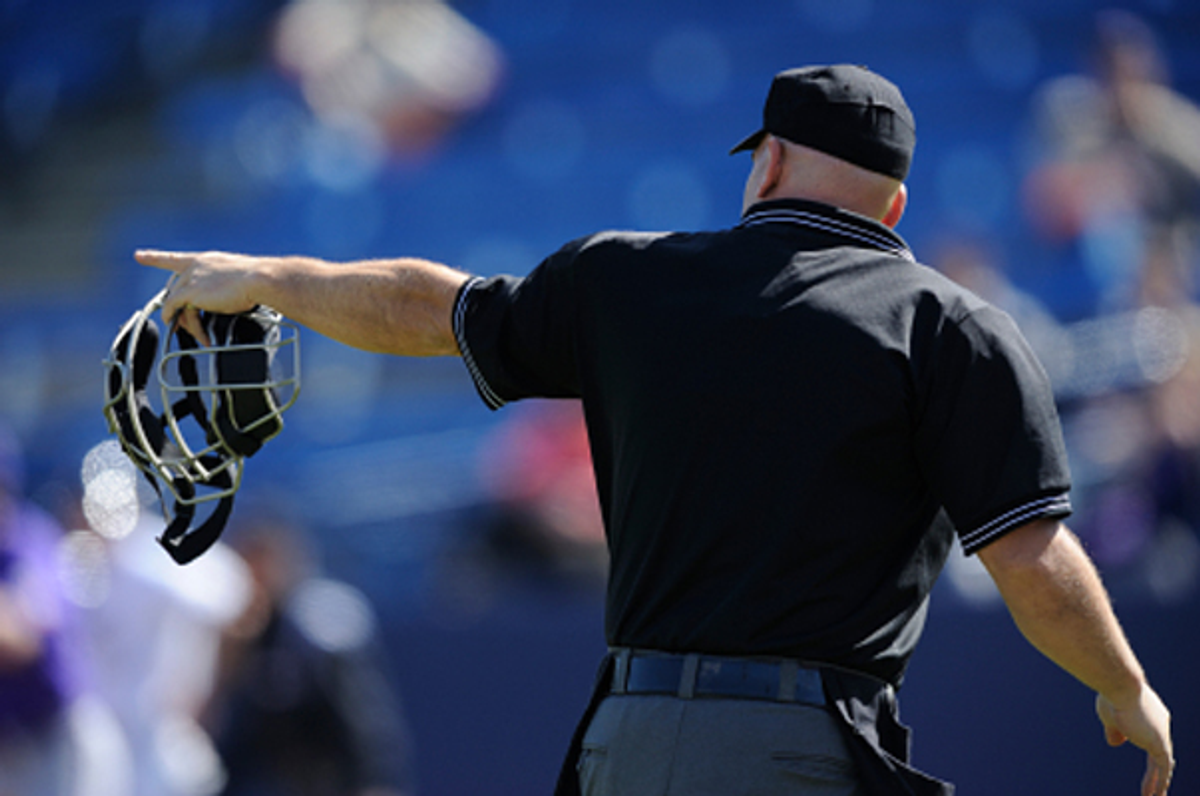
First and foremost, SMU found that home-plate umpires call disproportionately more strikes for pitchers in their same ethnic group. Because most home-plate umpires are white, this has been a big form of racial privilege for white pitchers, who researchers show are, on average, getting disproportionately more of the benefit of the doubt on close calls.
Second, SMU researchers found that "minority pitchers reacted to umpire bias by playing it safe with the pitches they threw in a way that actually harmed their performance and statistics." Basically, these hurlers adjusted to the white umpires' artificially narrower strike zone by throwing pitches down the heart of the plate, where they were easier for batters to hit.
Finally, and perhaps most important, the data suggest that racial bias is probably operating at a subconscious level, where the umpire doesn't even recognize it.
To document this, SMU compared the percentage of strikes called in QuesTec-equipped ballparks versus non-QuesTec parks. Researchers found that umpires' racial biases diminished when they knew they were being monitored by the computer.
Same thing for high-profile moments. During those important points in games when umpires knew fans were more carefully watching the calls, the racial bias all but vanished. Likewise, the same-race preference was less pronounced at high-attendance games, where umps knew there would be more crowd scrutiny.
Though gleaned from baseball, these findings transcend athletics by providing a larger lesson about conditioned behavior in an institutionally racist society.
Whether the workplace is a baseball diamond, a factory floor or an office, when authority figures realize they are being scrutinized, they are more cognizant of their own biases -- and more likely to try to stop them before they unduly influence their behavior. But in lower-profile interludes, when the workplace isn't scrutinized and decisions are happening on psychological autopilot, pre-programmed biases can take over.
Thus, the inherent problem of today's pervasive "post-racial" fallacy. By perpetuating the lie that racism doesn't exist, pretending that bigotry is not a workplace problem anymore, and resisting governmental efforts to halt such prejudice, we create the environment for our ugly subconscious to rule. In doing so, we consequently reduce the potential for much-needed self-correction.
Shares