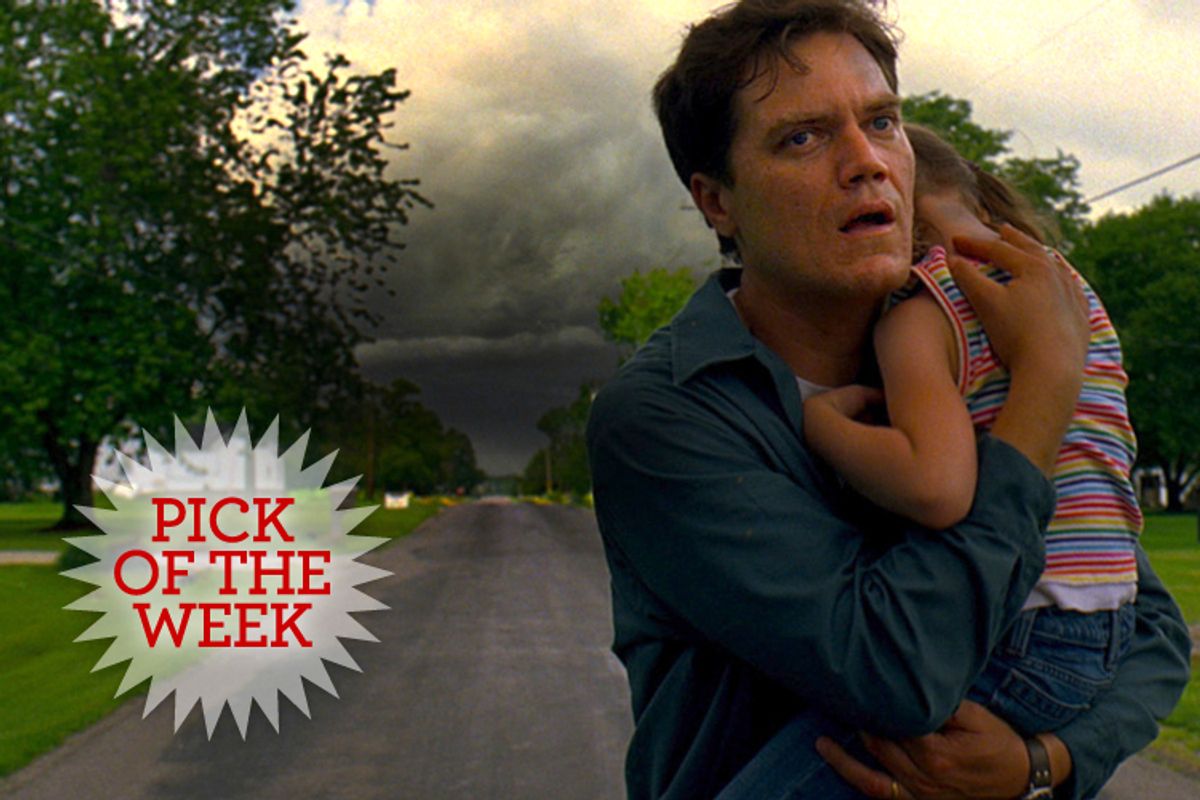
An intense psychological thriller that builds toward an explosive conclusion, indie writer-director Jeff Nichols' "Take Shelter" may be the most powerful American film I've seen this year. Having said that, I want to manage expectations a little bit. One can argue, and I will, that "Take Shelter" is a terrifically crafted little movie that bounces off current events and the nation's downbeat mood ingeniously, and that it variously suggests comparisons with the early work of Terrence Malick, Stanley Kubrick and the Coen brothers. Yeah, I think it's that good, but please note that I also said "little." This is a modestly scaled, character-based drama, shot quickly on a low budget in heartland locations. So don't go expecting big-screen spectacle, and don't complain to me about the limited production values or the imperfect CGI effects (although both are actually fine). I should add that I saw this movie while soaking wet, after walking through the residue of a recent tropical storm, and that given its obsessive depiction of extreme weather, that definitely heightened the firepower.
To some viewers -- maybe quite a few -- "Take Shelter" will look more like an above-average genre film, somewhat in the M. Night Shyamalan mode (before Shyamalan inflated into a Macy's Thanksgiving Parade balloon version of himself), with a bit more grit and realism. It's not an unfair comparison; "Take Shelter" revolves around Curtis (Michael Shannon), an ordinary Ohio husband and father, who begins having a series of apocalyptic, and increasingly terrifying, visions and nightmares. But Nichols, a 31-year-old Arkansas native who previously made the no-budget underground hit "Shotgun Stories" (also starring Shannon), is after something more complicated than the Scooby-Doo parlor trick of most Shyamalan-style films, where the spooky narrative events are eventually explained through a big "reveal." Curtis believes throughout the film that he's suffering a psychotic breakdown, and the possibility that there's some objective, external, parascientific explanation for his midnight terrors (and midday ones too) is kept locked away until the story requires it.
If there's a strong horror-movie undertow right under the surface of "Take Shelter," its main text is a recession-era marriage drama about a family struggling to cling to the lower edge of the middle class. Curtis has recently been promoted to a supervisor position at his construction firm, and his wife, Samantha (Jessica Chastain, of "The Help" and "The Tree of Life"), is increasingly anxious about how his wobbly personal behavior will affect their financial future. If Shannon's anguished, brooding performance as a man who's petrified by what he finds in his own head is very much the movie's centerpiece (and while Shannon gets a certain amount of stick for overacting, I think he's almost always good), Chastain provides its moral tether. Samantha is keenly aware that if Curtis loses his job, they lose their house, their deaf daughter (Tova Stewart) won't get cochlear implant surgery, and the family will slide into the chaos of poverty.
What makes this gripping and compact tale of marriage, faith, madness and possible apocalypse so unusual is the fact that it works so well on all levels. Nichols and cinematographer Adam Stone capture the undramatic Ohio landscape and wide Midwestern sky in almost lyrical compositions, and the rituals of Curtis and Samantha's days and nights are captured with no hint of anthropological condescension. Yet as Curtis' visions become more pronounced and more troubling -- they almost always begin with eerie and unexpected storms, involve unseen but dangerous intruders, and often end with someone he loves or trusts turning against him violently -- the sense that something shocking lies just below the film's everyday realism becomes almost unbearable. And with no more than a few deft allusions, Nichols makes the point that the pressure on Curtis and Samantha is coming from all directions, and is not purely psychological: Extreme weather and climate change, bad economic news, vanishing healthcare and the prospect of unemployment and bankruptcy are all very real threats for this family and millions of others. (Even the painfully inadequate mental-health services available to someone in Curtis' position play an agonizing role in the story.)
In an Oscar race that's likely to feature Brad Pitt, George Clooney and Ryan Gosling, an eccentric outsider like Shannon probably doesn't stand a chance. But I'd like to think this enormous, marvelously compassionate performance will put him in the running. Always a commanding physical presence, Shannon displays a gravity in this role, a gut-wrenching sense of inner turmoil, that I haven't quite seen before. Curtis is an intelligent but uneducated guy who's struggling to understand something no one can understand (the deepest mysteries of our own minds), and profoundly grieving for the loss of his own sense of self as a competent husband and father. He checks out books from the public library, tries to confide in his best friend (Shea Whigham), even goes to see a sympathetic counselor (a nice bit part for Lisa Gay Hamilton). When he borrows money to build out the underground storm shelter in his backyard, it's partly because he feels an irresistible compulsion to do so, even though he knows it's irrational. But he also does it because it's something he knows how to do; his relief at handling practical and logistical problems, rather than the murkier ones raised by faith and psychology, is tangible.
"Take Shelter" culminates with an escalating series of crises and explosions, the biggest of them when Curtis goes off, with all the pent-up fury of a volcano releasing magma, at a local fish fry full of whispering, gossiping neighbors. All I'll say is that Curtis and Samantha and their daughter will indeed wind up down in that storm shelter, but that even then the question of what Curtis' visions mean, or what's "really happening," is very much up in the air. When I talked to Jessica Chastain about the movie, she declined to offer any explanation for its breathtaking final scene, but she's right that the key to that ambiguous ending, and to the whole film, lies in the look that passes between the couple. It's that look that allows Nichols to end his terrifying tale of American apocalypse on a hopeful note: Whatever storm is coming, these two will face it together.
"Take Shelter" is now playing in New York and Los Angeles, with wider national release to follow.
Shares