New York

Lawyers seek docs on NYPD unit that eyed Muslims

Civil rights attorneys investigate the controversial surveillance program

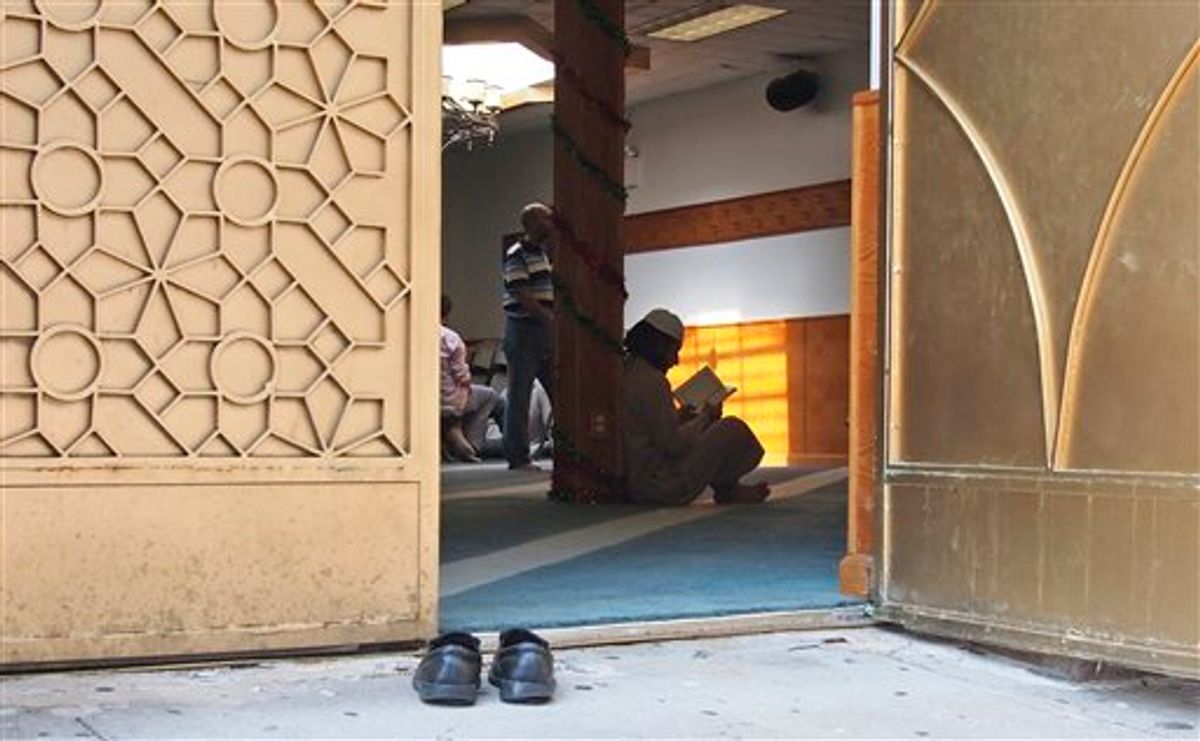
In this photo taken Sept. 2, 2011, worshippers are pictured inside the Al-Iman Mosque after midday prayers in the Astoria neighborhood of the Queens borough of New York. (Credit: AP Photo/Charles Dharapak)

Civil rights lawyers asked a federal judge Monday to force the New York Police Department to turn over documents about its secret efforts to spy on and infiltrate the Muslim community.

The request, filed in federal court in Manhattan, is based on reporting by The Associated Press, which revealed a clandestine police unit that monitored all aspects of daily life in Muslim neighborhoods. Documents showed that plainclothes officers were being dispatched to eavesdrop inside businesses. Restaurants that serve Muslims were identified and photographed. Hundreds of mosques were investigated. Dozens were infiltrated.

Police also maintained a list of 28 countries that, along with “American Black Muslim,” were labeled “ancestries of interest.”

“Based on this evidence, there is reason to believe that the NYPD retains records of surveillance of public places that are not limited to information pertaining to ‘potential unlawful activity or terrorism,’” lawyers told U.S. District Judge Charles Haight.

A spokesman for the New York Police Department didn’t immediately respond to a message seeking comment.

The documents were filed as part of a decades-old, class-action lawsuit against the NYPD for spying on war protesters and activists. Since 1985, a court order has limited how the department can monitor activities protected by the First Amendment. Police are not allowed to collect and store information about innocent people that is not related to criminal or terrorist activity.

“The (AP) articles, as well as NYPD documents that have been published in conjunction with them, strongly suggest that the NYPD retains such records as a matter of policy,” wrote lawyer Jethro M. Einstein, the lead lawyer in the case.

NYPD spokesman Paul Browne has said police only follow leads and do not trawl neighborhoods. Documents obtained by the AP, however, show a secret team known as the Demographics Unit was instructed to canvass neighborhoods looking for businesses catering to one ethnic group, Moroccans. The documents indicated plans to build databases for other ethnic groups showing where they eat, work, pray and shop.

Current and former officials said those databases made some working in the police department uncomfortable, including in-house lawyer Stuart Parker. Because of those concerns, they said, the Demographics Unit stored its information on a special computer not connected to the department’s normal intelligence database. Lawyers asked Haight to order police not to delete any of those materials.

Haight did not immediately rule on the request.

Mayor Bloomberg’s army

The mayor of New York and his police commissioner reveal just how comfortable they are with autocracy

Michael Bloomberg (Credit: AP/Richard Drew)

Billionaire New York City Mayor Michael Bloomberg has his own army! No, it’s not a private security firm, like Blackwater. It’s actually, according to the mayor, the New York City Police Department.

Bloomberg, again threatening vaguely to make that presidential run that the American people are decidedly not calling for, told MIT last night that he doesn’t even need to be president, because all of his autocratic desires are fulfilled by running America’s most populous city as his private fiefdom.

“I have my own army in the NYPD, which is the seventh biggest army in the world. I have my own State Department, much to Foggy Bottom’s annoyance. We have the United Nations in New York, and so we have an entree into the diplomatic world that Washington does not have,” Mayor Bloomberg said.

I’m not entirely sure what he means by having his own “State Department.” The city’s independent nonprofit tourism agency, maybe? But he didn’t mention that his army also comes with its own international (and questionably legal) intelligence-gathering apparatus, just like the CIA and FBI, except without any sort of oversight, congressional or otherwise.

Bloomberg, of course, is being a touch ironic, but he’s also not wrong. The NYPD has a 1,000-man army within its increasingly militarized ranks. It has tanks, combat rifles, anti-aircraft weaponry, non-lethal anti-terror sound cannons, and, supposedly, a submarine. And it’s all under the command of one guy, Ray Kelly, who answers solely to one other guy: Mike Bloomberg.

Bloomberg’s conception of the NYPD as “his army” explains a lot. Like why he thought it’d be OK to deploy them to Bermuda to help police his weekend home. (That plan was scuttled … once it leaked to the press.) Or why he thought it appropriate to use the NYPD to prevent demonstrators from … drumming on his block, one night.

If you want a sense of precisely how distanced from accountability NYPD commissioner Ray Kelly is, his response to being interrupted by a protester while addressing a Columbia class is illuminating. Faced with footage of police brutality, Kelly grinned and joked around.

A few minutes later, another student asked Kelly why most people who are arrested are incarcerated for “drug crimes.” Dinkins said he didn’t understand the question, and things got confrontational between the student, Kelly, and Dinkins pretty quickly. The student’s SIPA colleagues were not pleased—a few students and a TA asked if she was registered for the class. “No,” she said, “but I do have a question.”

Commissioner Kelly, still grinning, leaned over to another guest for today’s class, New York District Attorney Cy Vance, and loudly whispered, “Says something about the security of this school, doesn’t it?”

(Yes, that’s former Mayor David Dinkins, who himself once faced a revolt of entitled police officers chafing at the prospect of being held accountable for law-breaking and corruption.)

In case Kelly is unfamiliar with the easily available data regarding what his massive army actually does most days, the NYPD makes more arrests for possession of marijuana than for any other crime. Marijuana possession is used as a pretext to sweep up and arrest tens of thousands of black men every year. And the commissioner pretends he’s totally unaware of that fact, even as his department defends the practice as necessary for our safety.

Powerful (and popular) commissioner Kelly has basically escaped every NYPD scandal with his reputation unsullied. Mayor Bloomberg is generally treated by most of the local press as though the fact that he surely means well excuses all manner of illegal activities, lax oversight, and contempt for civil liberties and the law.

Harry Siegel, in a good recent piece on how the recent scandals of the NYPD are actually generating some negative ink for once, actually undersells the recent revelations:

The overly-aggressive response to the Wall Street “occupation”—which began with arresting dozens on the Brooklyn Bridge, proceeded to involve the pepper spraying of protesters, and concluded with a forced media blackout and the arrest of several reporters during the final, middle-of-the-night militarized “clean up” and Thursday’s “day of action”—may yet tip the scales toward a more normalized relationship between the city and the NYPD. It is the culmination of a scandal-ridden year. A partial list of the past year’s troubles includes the trial of two cops accused of rape; a leak-hindered internal affairs investigation into a ticket fixing conspiracy that some rank-and-file officers responded to by spitting on lawyers in the courthouse; a belated outcry over the frequently intrusive stop-and-frisk policy focused on poor and minority neighborhoods; revelations of the department’s secret intelligence program to collect information on Muslims; and the rough arrest of a black City Council member at a parade.

This leaves out, to name one major recent scandal, the 14-year NYPD veteran recently found guilty of planting drugs on an innocent subject. (It also leaves out a third cop credibly accused of rape.) (And the eight officers recently charged with smuggling guns — and cigarettes! — into the city.)

At the crooked narcotics detective’s trial, a retired cop claimed the practice of planting drugs to inflate arrest numbers was widespread, yet another unintended consequence of our data-driven mayor’s insistence on an NYPD that measures success by the number of people — predominantly young black people — subjected to the criminal justice system. The mayor has, in the past, dismissed serious criticisms of his “CompStat” system with ad hominem attacks on police unions.

In New York City, of course, each bad cop, or ring of bad cops, or unruly mob of bad cops is treated as an outlier. This is a press — especially the tabloid papers — that has long simply not cared that the NYPD routinely lies to journalists as a matter of departmental policy. It is widely known, for example, that arrest and ticket quotas exist, NYPD denials being approximately as worthless as a summons mistakenly issued to someone with Patrolmen’s Benevolent Association connections. Police statements on violent incidents are routinely contradicted by video evidence. Kelly feigns ignorance of his department’s methods of maximizing marijuana arrests.

But an army thinks differently than a simple civilian police force. They’re accountable only to their commanders, and not to the citizenry.

Continue Reading Close
Alex Pareene

Alex Pareene writes about politics for Salon and is the author of "The Rude Guide to Mitt." Email him at apareene@salon.com and follow him on Twitter @pareene

“Al-Qaida sympathizer” accused of NYC bomb plots

The 27-year-old suspect, Jose Pimental, is described as a "lone wolf," not part of a larger conspiracy

Mayor Michael Bloomberg speaks to the media at a City Hall press conference, Sunday, Nov. 20, 2011, in New York. (Credit: AP/Louis Lanzano)

NEW YORK (AP) — An “al-Qaida sympathizer” accused of plotting to bomb police and post offices in New York City as well as U.S. troops returning home remained in police custody after an arraignment on numerous terrorism-related charges.

Jose Pimentel of Manhattan was described by Mayor Michael Bloomberg at a Sunday news conference announcing Pimentel’s arrest as “a 27-year-old al-Qaida sympathizer” who was motivated by terrorist propaganda and resentment of U.S. troops in Afghanistan and Iraq. Police Commissioner Raymond Kelly said police had to move quickly to arrest Pimentel on Saturday because he was ready to carry out his plan.

“He was in fact putting this bomb together,” Kelly said. “He was drilling holes and it would have been not appropriate for us to let him walk out the door with that bomb.”

Ten years after 9/11, New York remains a prime terrorism target. Bloomberg said at least 14 terrorist plots, including the latest alleged scheme, have targeted the city since the Sept. 11 attacks. No attack has been successful, however. Pakistani immigrant Faisal Shahzad is serving a life sentence for trying to detonate a car bomb in Times Square in May 2010.

Kelly said Sunday that Pimentel was energized and motivated to carry out his plan by the Sept. 30 killing of al-Qaida’s U.S.-born cleric Anwar al-Awlaki.

“He decided to build the bomb August of this year, but clearly he jacked up his speed after the elimination of al-Awlaki,” Kelly said.

An unemployed U.S. citizen originally from the Dominican Republic, Pimentel was “plotting to bomb police patrol cars and also postal facilities as well as targeted members of our armed services returning from abroad,” Bloomberg said.

New York police had him under surveillance for at least a year and were working with a confidential informant; no injury to anyone or damage to property is alleged, Kelly said. In addition, authorities have no evidence that Pimentel was working with anyone else, the mayor said.

“He appears to be a total lone wolf,” the mayor said. “He was not part of a larger conspiracy emanating from abroad.”

At Pimentel’s arraignment, his lawyer Joseph Zablocki said his client’s behavior leading up to the arrest was not that of a conspirator trying to conceal some violent scheme. Zablocki said Pimentel was public about his activities and was not trying to hide anything.

“I don’t believe that this case is nearly as strong as the people believe,” Zablocki said. “He (Pimentel) has this very public online profile. … This is not the way you go about committing a terrorist attack.”

Pimentel, also known as Muhammad Yusuf, was denied bail and remained in custody. The bearded, bespectacled man wore a black T-shirt and black drawstring pants and smiled at times during the proceeding. His mother and brother attended the arraignment, Zablocki said.

Pimentel is accused of having an explosive device Saturday when he was arrested, one he planned to use against others and property to terrorize the public. The charges accuse him of conspiracy going back at least to October 2010, and include first-degree criminal possession of a weapon as a crime of terrorism, and soliciting support for a terrorist act.

Bloomberg said at the news conference that Pimentel represents the type of threat FBI Director Robert Mueller has warned about as U.S. forces erode the ability of terrorists to carry out large scale attacks.

“This is just another example of New York City because we are an iconic city … this is a city that people would want to take away our freedoms gravitate to and focus on,” Bloomberg said.

Kelly said a confidential informant had numerous conversations with Pimentel on Sept. 7 in which he expressed interest in building small bombs and targeting banks, government and police buildings.

Pimentel also posted on his website trueislam1.com and on blogs his support of al-Qaida and belief in jihad, and promoted an online magazine article that described in detail how to make a bomb, Kelly said.

Among his Internet postings, the commissioner said, was an article that states: “People have to understand that America and its allies are all legitimate targets in warfare.”

The New York Police Department’s Intelligence Division was involved in the arrest. Kelly said Pimentel spent most of his years in Manhattan and lived about five years in Schenectady. He said police in the Albany area tipped New York City police off to Pimentel’s activities.

Asked why federal authorities were not involved in the case, Manhattan District Attorney Cyrus R. Vance Jr. said there was communication with them but his office felt that given the timeline “it was appropriate to proceed under state charges.”

About 1,000 of the city’s roughly 35,000 officers are assigned each day to counterterrorism operations. The NYPD also sends officers overseas to report on how other cities deal with terrorism. Through federal grants and city funding, the NYPD has spent millions of dollars on technology to outfit the department with the latest tools — from portable radiation detectors to the network of hundreds of cameras that can track suspicious activity.

Alexis Smith, 22, who lives in an apartment in the same building as Pimentel, said she was shocked that he was a suspect in a terrorist plot. “He was always very courteous to us,” she said, adding that Pimentel helped her carry groceries and luggage into the building.

“It’s nice to know he was only working alone,” she said.

___

Associated Press writers Jennifer Peltz and Colleen Long and AP video journalist David R. Martin contributed to this report from New York. AP writer Samantha Gross also contributed to this report.

Continue Reading Close

Let's help the NYPD cut costs

If policing Occupy Wall Street is too expensive, why not save money by not illegally spying on Muslims?

Police escort Occupy Wall Street protesters marching in New York on Wednesday. (Credit: AP/Seth Wenig)

When the NYPD arrested hundreds of people participating in the Occupy Wall Street demonstration last weekend, in an echo of their illegal arrests during the 2004 Republican National Convention, the movement actually grew in size and scope, with thousands of people today participating and more to join later this week. The usual “sweep the hippies into jail because no one cares” strategy did not really work, this time. So here’s the next tactic, which I imagine you’ll be seeing in the Post (and probably the Daily News!) soon: The city will have to move against Occupy Wall Street because it’s too expensive to allow them to continue.

Queens City Councilman Peter Vallone tested this line today, claiming the protests were actually making New Yorkers more vulnerable to terrorism!

“This is costing a lot of money, at a time when we are being warned that we may face revenge attacks from al-Qaida because of our recent drone strike,” said Councilman Peter Vallone of Queens.

Vallone, chair of the Public Safety Committee, said he’ll be asking for an accounting at the end of it all.

“We’re going to spend hundreds of thousands, maybe even $1 million on this that we don’t have. Because of these protests, we might even wind up shutting down schools and firehouses because this is costing a lot of money.” Vallone said.

You monsters are going to shut down schools, by peacefully demonstrating while monitored by a small army of heavily armed police officers (not counting the undercover officers surely out “protesting” amongst you right now).

Vallone told Justin Elliott that the mayor should decide when to “limit” the protests (sweep everyone into jail, which will surely also be expensive) in order to save some cash, but I think the NYPD could probably find a bit of extra money if they shut down their vast, international and questionably legal intelligence-gathering and racial profiling-based spying network? You know, the one the AP has been reporting on brilliantly for a few weeks now?

I bet the NYPD would save a lot of money if it didn’t attempt to extensively track the movements of every Muslim person in the city, for one thing. Like the undercover officer assigned “to monitor a prominent Muslim leader even as he decried terrorism, cooperated with the police, dined with Mayor Michael Bloomberg and was the subject of a Pulitzer Prize-winning series by The New York Times about Muslims in America.”

The FBI had no interest in Sheikh Reda Shata, because he is a moderate man of peace, but the NYPD thought he was a very serious threat:

Police assigned an undercover officer and an informant to watch Shata personally, and two others were assigned to watch his mosque, according to the NYPD files. Mark Mershon, the FBI’s senior agent in New York in 2006, said he has no recollection of Shata ever being under FBI investigation.

You know what would be a good way to “radicalize” moderate American Muslims? To constantly spy on them, secretly record their every move, and suspect them without cause of aiding terrorists, all while lying to their faces about the NYPD not engaging in profiling, as Commissioner Ray Kelly did while addressing a mosque under NYPD surveillance last year.

So if Occupy Wall Street is costing the city too much money to police, I recommend they cut back a bit on expensive violations of our civil liberties.

Continue Reading Close
Alex Pareene

Alex Pareene writes about politics for Salon and is the author of "The Rude Guide to Mitt." Email him at apareene@salon.com and follow him on Twitter @pareene

Mayor Bloomberg, partner diagnose what's wrong with America: You

New York's elite ask that regular folk please be more respectful of their betters (and stop protesting them)

New York's First Couple(Credit: Reuters/Joshua Roberts)

The 90,000 New Yorkers who control 99% of the city’s wealth are completely segregated, geographically and intellectually, from everyone else in the city and the nation at large, so its no surprise that they tend to be tone-deaf and blind to the inequities and frustrations and resentments of Regular Folk, but billionaire Mayor Michael Bloomberg and his charming and powerful partner Diana Taylor are really out-doing themselves in terms of blinkered elite thickheadedness these days.

Let’s start with Mayor Michael Bloomberg, who is at the moment clearly struggling with his natural impulse to throw every protester in jail without charges for the crime in interrupting the business of the city’s truly important people. His impassioned plea to the people currently participating in the Occupy Wall Street protest: The banks are our friends!

“The protesters are protesting against people who make $40-50,000 a year and are struggling to make ends meet. That’s the bottom line,” Bloomberg said, presumably meaning service workers on Wall Street, adding that “we all” share blame for taking on too much risk, not just the financial industry.

“And people in this day and age need support for their employers. If the banks don’t go out and make loans we will not come out of our economic problems, we will not have jobs so anything we can do that’s responsible to help the banks do that is what we need.”

Wonkette’s Kirsten Boyd Johnson correctly notes that every single word the mayor says here is utterly nonsensical, unless you are, say, a billionaire mogul with deep ties to the financial industry.

Everyone else knows that the banks exist to make huge amounts of money by screwing everyone over, but banks are generally run by human beings (with the exception of Goldman Sachs, a Lizard Person From Outer Space operation), and those human beings have largely convinced themselves that they are very good and productive members of society. Hence, this sort of talk.

Which working-class people making $50,000 a year are the protesters protesting against, exactly? I’m not sure. The people who clean the offices of the financial firms that are actually being protested, maybe? The people who sell them fancy coffees? (This is just a slightly confused version of the old hostage argument against attacking the pillars of the vast, corrupt financial industry — if you hurt the banks they’ll hurt everyone else in America in retaliation.)

Still, Mayor Mike is to be commended for his political acumen. Desperate, terrified fealty to “employers” is a great, inspiring message. That should be his independent presidential campaign slogan. “SUPPORT YOUR BETTERS, OR ELSE.”

Diana Taylor, the mayor’s partner (in a personal/romantic sense, not in terms of business), gives an interview to Elizabeth Spiers, the editor of the New York Observer, boy real estate magnate Jared Kushner’s newspaper of record for New York’s media and real estate elite. Taylor manages to be less astoundingly dense as the mayor, but she still illuminates the mindset of the Gotham’s ruling class.

They hate democracy, or at least they hate the decisions made by voters (and who among us doesn’t, much of the time), but she is positive that everyone would see the light and support people like her (or her, specifically) if only those damned left-wing nuts and right-wing nuts who control the political parties hadn’t rigged the whole system.

Here’s the classic “I WOULDA WON IF I WANTED TO!” cry of the elite centrist who declines to messy themselves with an actual run for office, after flirting with the idea:

Last year, Senate Republicans approached Ms. Taylor about the possibility of running against incumbent Senator Kirsten Gillibrand, and for a while she considered it. “The Senate Republicans basically asked me to run and I thought about it, talked to a lot of people,” she said. “But then when I really thought about it, what attracted me to the idea was the race because I knew I could win that race. It was the thought of actually having to go and do that job, that was really not all that appealing.”

I bet Taylor would’ve been just as successful as her handpicked ridiculous Congressional challenger to Rep. Carolyn Maloney, the hilarious Reshma Saujani.

Taylor explicitly defines herself in the traditional “centrist” way: socially liberal (she is pro-choice!) and “fiscally conservative” (she is pro-corporatist!). Contrary to popular belief, this is basically the opposite of how “most Americans” — especially genuine swing voters — actually feel. (To drastically oversimplify, your generic “swing voter” is uncomfortable with changing social mores and thinks the government should soak the rich to pay for regular folks’ schools and healthcare, basically.)

Of course, Taylor identifies as a Republican, but her platform is basically the same as that of the “moderate” wing of the Democratic party, which Barack Obama mostly belongs to, despite occasional liberal rhetorical flights. But it is those liberal rhetorical flights that Taylor deplores about him, because she doesn’t think he’s polite enough to her class:

She was even less sanguine about Obama. “I think that he’s a very intelligent man,” she said carefully. “And he has a lot to learn.”

Her voice took on a sharper edge. “For somebody’s who’s going to come in and be the great unifier—you know, that hopey-changey stuff—it hasn’t worked very well. The country is more divided now than it’s ever been. And he doesn’t appreciate other people and what they do. “

He doesn’t… “appreciate other people.” If only he knew how much the world’s top 1% had done for him!

Having given this some thought, she had a three-pronged list of his biggest mistakes. “There are probably more,” she said, but here were three. He wasn’t supporting business, Ms. Taylor said. “He should be a champion for this country and he’s not. Because that’s where the jobs are going to come from. They’re not going to come from government; they’re going to come from the private sector.” The second: Obamacare. He basically told Congress, ‘you know what? I want a health care bill, do something.”

“The last time I checked, the president was supposed to sit down and figure out what he wanted and then get Congress to go along with it. And we got a mess. And exactly the same thing with financial regulation and regulatory reform.” This was number three. “And we have a mess.”

This boilerplate center-right political analysis is self-evidently stupid to anyone who’s been paying attention to the legislative process over the last, say, 20 years (it is the “magic president” school of analysis) but it is always useful to understand how our betters think about the world. In Diana Taylor’s mind, the unemployment crisis is a result of… Barack Obama being insufficiently respectful of business, or somehow not “championing” business. The jobs will come from the private sector, once… Obama thanks them, profusely, for their goodness.

Next: Barack Obama mistakenly allowed Congress to craft legislation, a clear violation of the Constitution, which holds that Congress should sign or veto bills sent to it by the president. That’s what the Constitution says, right? I seem to have misplaced by pocket copy.

“The last time I checked, the president was supposed to sit down and figure out what he wanted and then get Congress to go along with it.” What a wonderful line! The last time you checked what, Ms. Taylor? Your email? “Doonesbury”? The Thursday Styles section?

Taylor goes on to decry “uncertainty,” claiming Dodd-Frank is somehow stopping banks from lending money to people who need money, and throws in this exasperated cry to the heavens:

“And this whole business of the FHFA suing all the banks around Fannie and Freddie; it’s crazy!” Inasmuch as Mr. Taylor would ever be inclined to pound her fist on a table to make a point, she seemed on the verge of it. “I’ve never—I mean, it just makes no sense at all to me!”

They’re suing the banks because the banks committed mass fraud, basically? It’s pretty easy to understand! (And don’t worry, they’ll let your bank friends off easy, probably.)

But Taylor doesn’t blame the banks for what the banks did. No, she places the blame where her class knows it belongs: On All of Us.

“I think it’s a problem with Congress. I think it’s a problem with the ratings agencies. I think it’s a problem with the banks. I think it’s a problem with the population at large. Everybody’s going like this” she threw her hands up in the air. “And at the end of the day, everybody’s responsible in some way or another.”

Everybody! Did you know that you, citizen, are responsible for the financial disaster and the ensuing mass unemployment crisis? You should probably call up Diana Taylor and apologize personally. You are making her so upset!

Continue Reading Close
Alex Pareene

Alex Pareene writes about politics for Salon and is the author of "The Rude Guide to Mitt." Email him at apareene@salon.com and follow him on Twitter @pareene

“Margaret”: The great NYC post-9/11 movie that crashed and burned

Kenneth Lonergan's long-delayed follow-up to "You Can Count on Me" is a fascinating, half-brilliant disaster

Anna Paquin in "Margaret"

Kenneth Lonergan’s film “Margaret” took so long to make that two of its producers died before it was finished. I’m not trying to be witty, just reporting the facts: In the opening credits, Anthony Minghella is listed as a producer of “Margaret” and Sydney Pollack as an executive producer. Both of those eminent filmmakers have been dead for more than three years. When a high school student complains, early in the film, that she doesn’t think much of the current president, you’re tempted to wonder whom she’s thinking about. Jimmy Carter? Ike? William Howard Taft?

No, OK, that really was a cheap joke. “Margaret” is most definitely a time capsule from George W. Bush’s America, and a promiscuous and overcrowded one at that, which is both what makes it fascinating and what makes it almost guaranteed to attract no audience. It’s got not one but two tear-jerker excerpts from live opera, shot on the state of the Metropolitan Opera House; a running in-joke about the New York theater world; small supporting roles for Matt Damon and Mark Ruffalo and Matthew Broderick and Jean Reno and Kieran Culkin and Rosemarie DeWitt; literary exegesis about Shakespeare and Gerard Manley Hopkins; heated high-school debates about American foreign policy and the Arab world; and wonderful parts for the underappreciated actresses J. Smith-Cameron (Lonergan’s wife) and Jeannie Berlin (Elaine May’s daughter). Oh, and have I mentioned that none of the people in the movie is named Margaret?

Lonergan is a prominent New York playwright who moved to the big screen in 2000 with the wry, sharp-witted indie comedy “You Can Count on Me,” which won numerous awards and was nominated for two Oscars (Laura Linney as best actress, and Lonergan for his screenplay). It seemed like the beginning of a moviemaking career that held unlimited promise, and I guess Lonergan felt that way too, since “Margaret” is a work of enormous ambition, a clear effort to make the great post-9/11 New York City movie about death and love and guilt and repentance and family and other big ungainly things. It was a foolish thing to try to do, especially for a guy with such limited film experience, but if it had been completed and released several years ago, the whole experience would feel a lot less like watching Sisyphus chained to the deck of the Titanic. In some ways, the fact that this movie became an unmitigated disaster says a lot more about America after 9/11 than Lonergan intended.

Lonergan shot the film, which stars Anna Paquin as a distressingly neurotic and self-involved Manhattan teenager who believes she may have caused a fatal bus accident, in 2005, and Fox Searchlight intended to release it the following year. Exactly what has been going on for the last six years remains murky, although a lengthy Los Angeles Times article from 2009 explains that Lonergan was never able to arrive at a final version of the film that he liked, despite help from several veteran Hollywood editors, including Anne McCabe, Thelma Schoonmaker and Dylan Tichenor. (McCabe’s name alone appears on the film being released this week.) Lonergan, Fox Searchlight and principal financier Gary Gilbert wound up in court, trading breach-of-contract suits back and forth and insulting each other in the press. Rumors suggest that Matthew Broderick personally loaned Lonergan money to finish the movie, and that Martin Scorsese (who described one editing-room version of “Margaret” as a masterpiece — in 2006!) became involved after the legal fracas subsided, although his name is nowhere in the credits.

Given all that backstage drama, I’m genuinely grateful that some critics are adopting “Margaret” as a cause célèbre; see Keith Uhlich’s Time Out New York review for one fine example. People should love this movie — it’s like the ugly but brilliant orphan abandoned behind the staircase in some sub-Dickensian 19th-century novel. Unfortunately, those people will not include me, or not entirely. Rarely has a film with such a great cast and so many moments of terrific writing and such high dramatic goals (and overdone but beautiful cinematography, from Ryszard Lenczewski) been so messy and disorganized and fundamentally bad. And by “rarely” I believe I mean “never. ” Watching “Margaret” is rather like going to a friend’s house for dinner to discover that they’ve apparently had a breakdown, and bought all sorts of delicious ingredients with no recipe in mind: Ice cream followed by lentil soup followed by sashimi followed by uncooked root vegetables, with half-kneaded bread dough dumped in your lap and Pinot Noir poured over your head.

This movie’s central problem can be stated simply: Paquin’s character, Lisa Cohen, is not only one of the most irritating people in the history of cinema, she belongs to a constitutionally irritating class of person — the overprivileged New York private-school teenager — about whom no more movies need to be made, by anyone, ever. (I live in New York and don’t want to know anything about those people. Perhaps, though, they are more tolerable viewed from afar.) Then there’s the fact that the dreadful bus accident — which Lisa inadvertently helps cause by flirting with the driver (Ruffalo) — happens almost as soon as you’re in your seat, and is lingered over in gruesome, even devastating detail. Lisa kneels on the street, cradling a mutilated and dying woman (Allison Janney) in her arms, and then lies about what happened and goes home covered with blood.

It’s not like I don’t see where Lonergan is trying to go with this episode of horror and death and guilt and shame, or the way he’s trying to connect, on a symbolic or psychological level, with recent American experience. But the film lurches from one episode to the next in haphazard, drunken fashion: Lisa’s crusade to punish Ruffalo’s character for something that was largely her fault in the first place is bracketed by her troubled relationship with her mom (Smith-Cameron, as the only halfway sympathetic character in the whole damn thing), her deflowering by a stoner classmate (Culkin), her seduction of a math teacher (Damon, looking “Bourne Identity”-slender) and innumerable other baffling characters and episodes that are meant to build to something prodigious and inexpressible but cannot quite get there. That said, if I told you that I wasn’t intermittently dazzled and moved I’d be lying, and the final scene between Paquin and Smith-Cameron left me in tears. Listen: If you have a chance to see “Margaret” on the big screen where you live, don’t pass it up. It’s likely to go down in movie history as a great woulda-shoulda, a film that at some point people will defend furiously, and if you’re more tolerant of its glaring, glass-in-the-eyeballs flaws than I am, you’re probably a better person.

“Margaret” opens Sept. 30 in New York and Los Angeles, with more cities to follow (or not). 

Continue Reading Close

Page 1 of 36 in New York

www.salon.com/topic/new_york/