Quick Hits

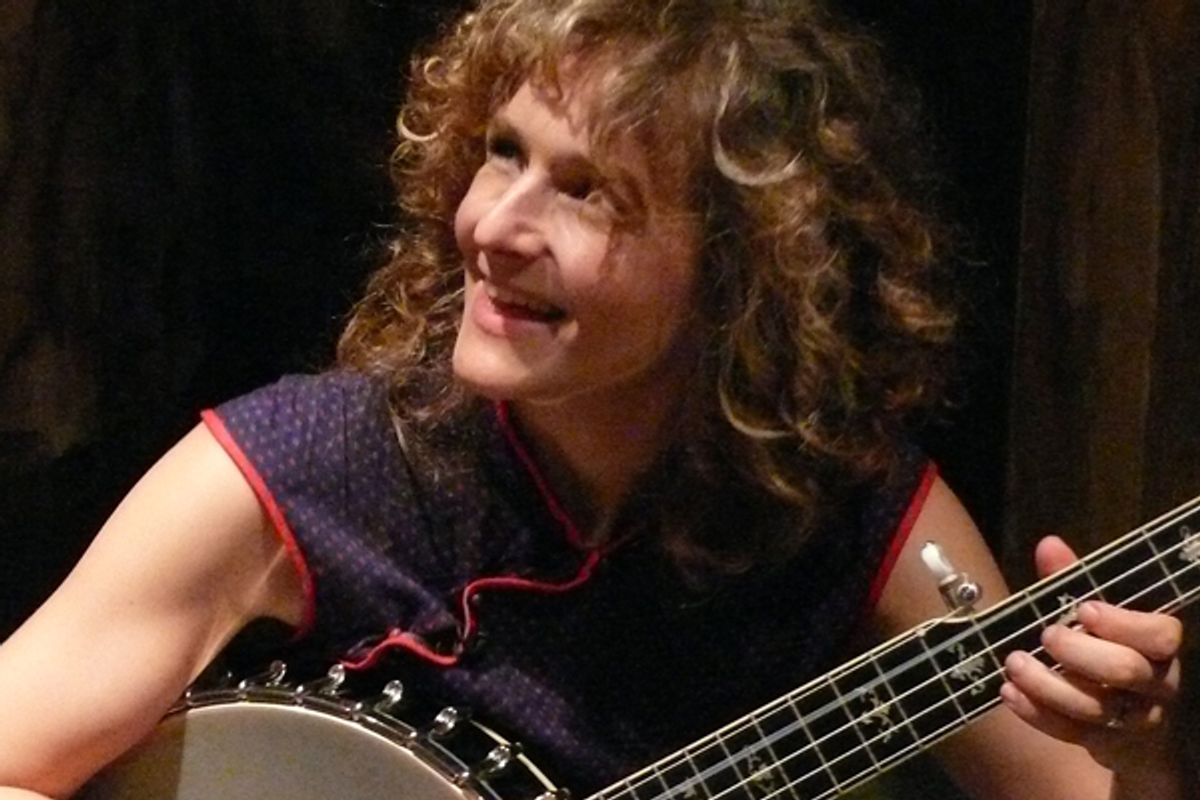
Quick hits: Abigail Washburn performs live

Meet a sensational young banjo player with a debt to Appalachia, an obsession with China and a charming live style VIDEO

  • more
    • All Share Services

Quick hits: Abigail Washburn performs live Abigail Washburn

Abigail Washburn is a blond, blue-eyed banjo player from the Midwest who is obsessed with China, speaks Mandarin and sings in Chinese when she feels like it. That is, when she’s not performing her very contemporary versions of traditional Appalachian-style folk songs, threatening in one to use her shotgun on a lover who has betrayed her. (She ends that song with a wicked smile.)

In this edition of “Quick Hits,” Sound Tracks reporter Arun Rath talks with Washburn about how she fell in love with China and how listening to Doc Watson made her fall for bluegrass music. And she performs three songs exclusively for “Quick Hits,” including “City of Refuge,” the title track from her new album.

Watch the full episode. See more Sound Tracks.

“City of Refuge” is the title track from Abigail Washburn’s latest solo album. Abby sings of taking off to a place where “everyone is made new,” and many of her songs speak to this need to keep moving, running, reinventing oneself.

Watch the full episode. See more Sound Tracks.

With Abby, what would never work on paper has a way of coming out natural and swinging, this song being a perfect example. There’s simply no one else on the planet who could pull this off. Piao means “floating,” and Abby sings in Mandarin, “This morning I woke up to no big plans, no great ambitions, just floating, floating, floating … ” It’s hard to explain the mix of influences in this song — just watch and enjoy.

Watch the full episode. See more Sound Tracks.

Never, ever, cross Abigail Washburn. Consider this video your warning. She’s playing a Gold Tone cello banjo for this selection, which has a sound that’s deep and resonant — and in this context, a little ominous. The central riff has a nasty, bluesy edge, but sounds like it could also come straight out of a Chinese folk tune.

Watch the full episode. See more Sound Tracks.

As if our debt to China weren’t big enough, it turns out we also owe the Asian giant for inspiring Abigail Washburn, a true American original, to become a musician. It’s a roundabout story. But you’ll get the drift of it in her interview with Sound Tracks reporter Arun Rath, plus a sampling of her songs.

Her original plan was to pursue a law degree in China — did we mention she’s really smart? – but her discovery of the banjo and bluegrass music changed all that. She still gets to China regularly, doing earthquake relief concerts and embarking on a musical tour of the old Silk Road. As she says, “I really believe in the power of music.”

Quick Hits: Rock icon Levon Helm plays live

The legendary Band drummer recounts stories from his long career and rambles through two classics VIDEO

  • more
    • All Share Services

Quick Hits: Rock icon Levon Helm plays live

Rock legend Levon Helm — the drummer and a lead singer for the Band — is batting 1.000 at the Grammys. Last month, when his “Ramble at the Ryman” won best Americana album, he made it three in a row — three nominations, three wins — following Grammy Awards for his two previous albums, “Dirt Farmer” (2007) and “Electric Dirt” (2009). Not bad for a 71-year-old survivor of throat cancer, who had once lost his voice completely.

These days, a happy-to-be-alive Levon Helm presides over what he calls “midnight rambles” — concerts in his Woodstock, N.Y., barn, where he’s surrounded by musical friends and family, including his daughter, singer Amy Helm. His voice may be raspy, but his energetic drumming and high-beam smile can warm the coldest winter night. Following rousing versions of “The Weight” and “Ophelia,” Helm invites Marco Werman into his house for after-midnight conversation.

Watch Quick Hits: An Interview with Levon Helm on PBS. See more from Sound Tracks.

Like Johnny Cash or Willie Nelson, there is something fundamentally authentic about Levon Helm. His music always felt real and if you ever read his autobiography, “This Wheel’s on Fire,” you know he doesn’t flinch from describing his long, rambunctious ride.

To anyone who grew up with Levon Helm and the Band, it’s a shock to see him these days, a reminder of our own mortality. He’s gaunt, almost spectral, and his voice is sometimes a whispery rasp. As Levon explains, these midnight rambles — which have become a tremendous success featuring a who’s who of guest stars – began as “rent parties” organized by his manager Barbara O’Brien to pay the mortgage on his farm and cover his medical bills. Weed and whiskey were replaced by cancer treatments.

But Levon Helm is a survivor. A man who beat the odds. He’s a true gentleman. And he can still drum like a demon for two hours straight.

What’s important to Levon now is keeping his American roots music alive, and passing it on. Lots of new groups seem to be tuning in – from the Decemberists to Mumford & Sons and the Carolina Chocolate Drops.

We’re tempted to describe Levon as a lion in winter, but as you’ll see in this interview with Marco Werman, he’s more like a Cheshire cat with that incredible smile and a wry perspective on his life. Don’t miss his rendition of a Turkish Army Band toward the end of this conversation.

Our Quick Hits team was directed by John MacGibbon with Andy Bowley as director of photography.

Watch Quick Hits: Levon Helm Performs “The Weight” on PBS. See more from Sound Tracks.

I pulled into Nazareth was feelin’ about half past dead
Just need to find a place where I can lay my head

It’s one of the most famous opening lines to any rock song of the past 50 years, and it was sung originally by drummer Levon Helm in a clear, strong tenor voice with an unmistakable Arkansas twang. Since it’s release in 1968, “The Weight” has become an essential part of the American songbook.

This version — filmed for Quick Hits at a Feb. 4, 2012, midnight ramble concert in Levon’s Woodstock, N.Y., barn is “The Weight” at its most communal. A song in which everyone shares the burden and the joy.

Levon’s spirit hovers over the whole song but he turns over the opening vocals to Woody Platt, a smooth, handsome country singer from North Carolina, whose group, the Steep Canyon Rangers, shares the stage with the Levon Helm Band. Larry Campbell, a Jackson Browne look-alike who leads Levon’s outfit, joins in, followed by Brian Mitchell singing about “crazy Chester” (Rick Danko’s role in the original). Teresa Williams (Campbell’s wife) and Amy Helm (Levon’s daughter) deliver some heartfelt harmonies.

Look closely and you’ll spot Donald Fagen of Steely Dan on piano.

Written by Robbie Robertson, “The Weight” is a masterpiece of biblical allusions, enigmatic lines and iconic characters. But the heart of the song has always been Levon Helm, who emerged from the Southern cotton fields to play with Bob Dylan and become the only American in a group that reintroduced America to its musical roots.

Watch Quick Hits: Levon Helm Performs “Ophelia” on PBS. See more from Sound Tracks.

“Back porch music” is how Levon Helm describes what he and his band perform in their midnight rambles. It’s the music of the traveling tent shows he used to hear as a kid in Arkansas. Communal music, everybody joining in. A little country. Some rockabilly. A touch of gospel. A tinge of blues. Add the guitars, drums and horns that power rock ‘n’ roll, and it’s the Levon Helm Band in action.

“Ophelia” is the perfect kind of song for this: old timey and fired up — with plenty of humor and some clever lyrics:

Ashes of laughter
The ghost is clear
Why do the best things always disappear?
Like Ophelia
Please darken my door.

That’s Jim Weider on guitar, followed by Larry Campbell, the leader of the band. Clark Gayton does the trombone honors, and we get to hear Amy Helm (who has her own band, Ollabelle). Levon brings us home with his distinctive drumming, ending in a flourish and a smile of pure satisfaction.

Continue Reading Close

Quick Hits: Yuja Wang plays live

This elegant young virtuoso pianist (and not-so-secret Rihanna fan) is on track for a dazzling career VIDEO

  • more
    • All Share Services

Quick Hits: Yuja Wang plays live (Credit: Sound Tracks)

At the age of 24, Chinese-born Yuja Wang is one of the most exciting concert pianists in the world. Onstage, she cuts an elegant, sometimes provocative figure. Backstage, she’s more like a teenager, noshing snacks and listening to Rihanna on her earphones. But there’s no doubt that Ms. Wang, now a resident of New York, has captivated audiences and critics, from Beijing to Berlin. Her “virtuosity is stunning,” says the New York Times. “An artist of dazzling genius,” raves the San Francisco Chronicle. She’s earned praise for her almost “superhuman keyboard technique,” as well as her sensitivity and fearlessness.

We caught up with the international sensation in Los Angeles, where she performed Prokofiev at the Disney Concert Hall. Afterward, in a Steinway showroom, Wang played for us and spoke with SOUND TRACKS reporter Alexis Bloom about her life as a musical nomad.

Watch Quick Hits: Yuja Wang’s Polka by Strauss on PBS. See more from Sound Tracks.

Written in 1858 after a trip to Russia, Johann Strauss’ “Tritsch Tratsch Polka” is a jaunty, high-spirited affair and Yuja Wang obviously delights in playing it. Watch her smile at the end. If you’d like to see her perform live, Yuja Wang will be playing this April at Avery Fisher Hall with the New York Philharmonic and in Atlanta with the symphony there. In June she returns to San Francisco, where conductor Michael Tilson Thomas has been one of her strongest supporters.

Watch Quick Hits: Yuja Wang Plays Gluck and Liszt on PBS. See more from Sound Tracks.

We knew she was an incredible talent, but watching up close as Yuja Wang performs is another matter. She plays so lightning fast it seems as if we’ve sped up the video. Her technique is dazzling and precise, but it’s equaled by her passion and sensitivity.

In this video, recorded at the Steinway showroom in West Hollywood, Yuja is playing bits of three different pieces by Gluck, Liszt and Scriabin. It’s wonderful to watch her change pace and mood and see the concentration and deep feeling in her expression. At the end, it’ almost as if she emerges from an intense dream, smiling, and telling us, “This piano’s nice.”

Watch Quick Hits: Interview with Pianist Yuja Wang on PBS. See more from Sound Tracks.

Born in Beijing in 1987, Yuja Wang began playing the piano at the age of 6. From a music conservatory in China to the Curtis Institute in Philadelphia, she never stopped, and now she roams the world, playing a demanding schedule of concerts across Europe, Asia and North America. She’s recorded three critically acclaimed albums for Deutsche Grammophon, her most recent is a Grammy nominee. “I’ve been doing this my whole life,” she tells SOUND TRACKS reporter Alexis Bloom. “I can’t really remember anything before the piano.”

So, Yuja Wang is already a veteran, a self-assured and immensely accomplished virtuoso. But she’s also a young woman who travels the world, mostly alone, living in hotels and backstage dressing rooms. Is she ever lonely? “Not really,” she tells us. She’s “more alive” on the road, especially in concerts, plus “I have my BlackBerry, laptop and kindle. I’m all set.”

As you’ll see in her interview, Yuja is a warm, engaging personality with a quick laugh and a candid comment. She can be shy one moment, outspoken the next. When she’s warming up to play Rachmaninoff or Prokofiev, she likes to hear the raw wildness of Rihanna. And she’s made something of a reputation for herself in the classical world as a fashionista, not afraid to wear eye-catching outfits, including that orange dress that set off a wave of commentary last year when she appeared at the Hollywood Bowl. “I’m just being myself,” she says.

As the New York Times critic wrote after Yuja’s Carnegie Hall debut last October, “If you’ve got it, flaunt it. What matters is that Ms. Wang has got it as a pianist.”

Continue Reading Close

Quick Hits: Jazz trumpeter Tom Harrell

For this remarkable musician, even severe paranoid schizophrenia has not stood in the way of success VIDEO

  • more
    • All Share Services

Quick Hits: Jazz trumpeter Tom Harrell Tom Harrell. (Credit: Sound Tracks)

Tom Harrell is without question one of the most important jazz trumpet players now working. In 40 years of playing and composing cutting-edge jazz, he’s worked with everyone from Dizzy Gillespie to Carlos Santana.

And he does all this while managing an illness that would ordinarily prove debilitating: paranoid schizophrenia. Harrell’s condition is impossible to miss: he has a difficult time with social interactions, and is uncomfortable in public. But all of that melts away when he puts the horn to his lips.

SOUND TRACKS visits New York’s historic Village Vanguard for an exclusive look at Harrell’s latest adventurous project: his own arrangements of the works of Ravel and Debussy performed by his Chamber Ensemble. And after the show, Tom sits down for a rare, intimate conversation about his creative process.

Watch Tom Harrell Performs “Passepied” (Debussy) on PBS. See more from Sound Tracks.

The Passepied from Debussy’s Suite Bergamasque is probably one of the composer’s most recognizable tunes — but you might not recognize it here.  It’s been slowed down quite a bit and reharmonized — and right before this violin solo, it’s just shifted out of a Brazilian bossa-flavored blues. Violinist Meg Okura can play just about any style of music imaginable and has worked with artists from David Bowie to Ziggy Marley.  She told SOUND TRACKS that Tom’s music is incredibly challenging, and a total blast to play.

Watch Tom Harrell Performs “Sainte” (Ravel) on PBS. See more from Sound Tracks.

“Sainte,” Ravel’s first published composition, was originally written for a vocalist. Tom Harrell says he hears French composer Eric Satie in this piece, and tries to bring out Satie’s “saintly” quality in the music. But after starting out in a prayerful mood, this saint isn’t above getting a little funky.

For his Chamber Ensemble, Tom Harrell has augmented his core quintet of the past 10 years — Wayne Escofferey on saxophones, Danny Grissett on piano, Ugonna Okegwo on bass and Jonathan Blake on drums — with Dan Block (flute), Meg Okura (violin), Rubin Kodheli (cello) and Rale Micic (guitar). Tom switches off between trumpet and flugelhorn.

Our special thanks to the legendary Village Vanguard in New York for allowing us to film this performance.

Watch Tom Harrell Performs “Beau Soir” (Debussy) on PBS. See more from Sound Tracks.

It might seem strange that a composer as original as Tom Harrell would throw himself into the melodies of dead French impressionists, but he’s done far more than write “jazz” arrangements of Claude Debussy and Maurice Ravel.  While staying true to the melodic roots of the music, he’s effectively recomposed these pieces.

All of the musicians in Tom’s Chamber Ensemble — not just his core working group, but the “hired guns” brought in for these arrangements — clearly revere Tom. They love playing this music, even though — well, probably because — the jazz/classical fusion requires outsize talent and technical skill. We noticed that many of the performers set down their own personal digital recorders on their stands or at their feet to keep their own record of that night’s gig.

Watch Interview with Tom Harrell on PBS. See more from Sound Tracks.

You will notice right away that Tom Harrell doesn’t look directly at SOUND TRACKS interviewer Arun Rath or the camera. Tom Harrell suffers from severe paranoid schizophrenia. Ordinary social interactions can be extremely difficult for him, so you can only imagine what a formal interview with lights, cameras, microphones and crew might feel like. We are grateful that he agreed to talk with us.

Tom’s diagnosis came in his early 20s. Before that, it was clear that he was intellectually gifted and a musical prodigy. As a teenager, he was already jamming with local professional groups.

You can use any superlative you like to describe Tom’s playing; he’s one of those rare figures who has actually extended the vocabulary of the jazz trumpet. Since hitting the scene in the early ‘70s, Tom has also established himself as one of jazz’s most important composers.

When he first sat down for SOUND TRACKS, Tom was clearly uncomfortable, but as we began to talk in detail about the music he had just played at the Village Vanguard, his responses became less halting. In the end we spoke for over an hour and a half — keep in mind this was well after 1:30 in the morning, following his second set that night — and his answers grew expansive and detailed, following unexpected connections much like one of his solos. You’ll notice how Tom gradually begins to look up more and more, even cracking jokes by the end.

Continue Reading Close

Quick hits: Milos Karadaglic plays live

28-year-old rising star Milos Karadaglic -- inspired by Andres Segovia -- is classical guitar's new face VIDEO

  • more
    • All Share Services

Quick hits: Milos Karadaglic plays live

At the age of 28, guitarist Milos Karadaglic is a rising star in the classical music world — “Young Artist of the Year,” according to the Gramophone Awards in London. Milos is an advocate for his instrument, wanting the guitar to regain its profile in the classical world. He wouldn’t mind wooing some rock audiences, too, and why not? He’s darkly handsome, charismatic, and his fingernails are as sharp as daggers.

Fresh from his Carnegie Hall debut, Milos talks with “Quick Hits” host Marco Werman about being inspired by the legendary Andres Segovia while growing up in Montenegro in the ’90s during the Balkan wars. He also performs four beautiful pieces, at the nearby Klavierhaus recital hall and on a bench in Central Park.

Watch Milos Karadaglic perform Recuerdos on PBS. See more from SOUND TRACKS.

Perhaps our favorite piece that Milos performed for us at Klavierhaus on “piano row” right around the corner from Carnegie Hall is “Recuerdos de la Alhambra” by Francisco Tarrega. It’s so very Spanish, sad, melodious, and it displays Milos’ incredibly fast and intricate finger work. As he says, his fingers just begin to fly.

Watch Milos Karadaglic perform “Prelude #1″ on PBS. See more from SOUND TRACKS.

“Prelude #1” is probably the hardest to play of all the pieces Milos performed for “Quick Hits,” requiring the most concentration. At the end, he sighs “phew” and smiles in apparent relief. For fans of classical guitar, this is the show-off piece from a young man who says the guitar is his best friend.

Watch Milos Karadaglic perform “Oriental” on PBS. See more from SOUND TRACKS.

“Oriental” by Enrique Granados is the final track on Milos Karadaglic’s debut album on Deutsche Grammophon, “Mediterraneo,” a musical tour of his interior and geographical world.

When Milos was a novice guitarist, he hoped the instrument would win him girlfriends. It was when his father played a record for him of the beloved Andres Segovia that he realized he wanted to play that kind of music for lots of people. “In my ears, and in my whole body, something happened,” Milos remembers. Today, he doesn’t try to make it happen. He’s not in control when he plays. As in, he doesn’t think about it. “When I play,” says Milos, “I just play.”

Watch Interview with Milos Karadaglic on PBS. See more from SOUND TRACKS.

Watch this interview and you’ll see that Milos Karadaglic already has the composure, the confidence and the easy charm of a movie star, which may horrify classical music purists. But all you have to do is listen to him play to realize he’s more than a poster boy for the classical guitar. He’s smart, self-deprecating, funny and a sensitive, gifted musician. His fingers are fast, and his intonation is perfect.

As Milos tells “Quick Hits” reporter Marco Werman, his discovery of his musical gift coincided with the wars in the Balkans in the 1990s. Those conflicts didn’t engulf his native Montenegro as much as other parts of the region. But he still came to see music as a sanctuary and as a universal language, with the power to soothe, to excite and to unite.

Watch Thursday in the Park with Milos on PBS. See more from SOUND TRACKS.

We coaxed Milos out of the recital hall to wander around in the sunlight and play for us on a park bench. The result is a short, dreamy piece, “Granada” by Isaac Albeniz, that our video producer/editor, John MacGibbon, turns into an ode to New York and Central Park.

Continue Reading Close

French songwriter Piers Faccini performs live

Best known in the U.S. for a "Grey's Anatomy" song, Faccini is a truly international voice VIDEO

  • more
    • All Share Services

French songwriter Piers Faccini performs live (Credit: Mirissa Neff for "Quick Hits")

Mississippi and Mali. The Delta blues and the mesmerizing music of West Africa. Those are the sounds and spirits that struck Piers Faccini to the core, shaping his expressive, intimate songs. But with his Anglo-Italian heritage, you can also hear English folk songs and old Naples rhythms in his music, as well as lyrical debts to Sufi poetry.

We first met Piers when he wrote theme music for the pilot episode of our upcoming PBS series, “Sound Tracks.” We’d heard his dark warning, “A Storm Is Going to Come,” on “Grey’s Anatomy” and we knew he’d toured with Ben Harper and Amadou and Mariam. For “Quick Hits,” he agreed to perform three songs and to talk about his new album, “My Wilderness.”

Watch Piers Faccini Performs “No Reply” on PBS. See more from Sound Tracks.

“No Reply” is the opening cut on Pier Faccini’s new album, “My Wilderness,” which he recorded at his home in southern France. It’s a soulful, haunting song. The despair is existential. The singer calls out to the darkness, seeking answers, and “in the silence I heard my reply and no one will ever know why.” The sense of being lost and alone is leavened by a beautiful melody and the rhythms of southern Italy provided by percussionist Simone Prattico.

Watch Piers Faccini Performs “A New Morning” on PBS. See more from Sound Tracks.

Accompanied only by some jostling bells, Piers Faccini stands alone in a garden and delivers a kind of ancient chant, part spiritual, part stripped-down work song. It promises a new morning, a new life, but in a world where “all our words will soon be broken.” Like a monk chanting amid incense in an old European monastery, Faccini invokes biblical images of “seven days, seven nights, seven years, seven lives.” His singing at the end seems to echo a Muslim call to prayer.

Watch Piers Faccini Performs “Two Grains of Sand” on PBS. See more from Sound Tracks.

“Two Grains of Sand” is the title track from Piers Faccini’s previous album released in 2009. As you’ll see in this acoustic guitar solo performance, it’s a sad, intimate, philosophical song with an oblique story of jealousy and violence. There’s “a murder buried under autumn leaves” and a plaintive cry: “How can we turn to violence and burn/ Forget all we’ve learned/ to darkness return.” But as with many of Faccini’s songs, the dark lyric is wrapped in a graceful melody, this time with traces of the Beatles at their most wistful.

Watch Interview with Piers Faccini on PBS. See more from Sound Tracks.

On tour in San Francisco, Piers Faccini settles into an old Victorian home and talks to “Sound Tracks” reporter Mirissa Neff about his Roma gypsy great-grandmother, his early infatuation with the Smiths, and the profound influence that the Delta blues and West African music have had on his songwriting and musical style. He pays special homage to bluesman Skip James, whose songs were rediscovered by ’60s rockers like Cream, and to the great, mournful singer from Mali, Boubacar Traoré.

Faccini also talks about his feeling of never quite fitting in, his penchant for melancholy music (“It makes me happy!”), and his song “Tribe,” which has an epic sweep, with mighty powers collapsing, people fleeing across deserts, and a kind of bluesy, gospel chorus pleading for release: “How long?”

Continue Reading Close

Page 1 of 3 in Quick Hits