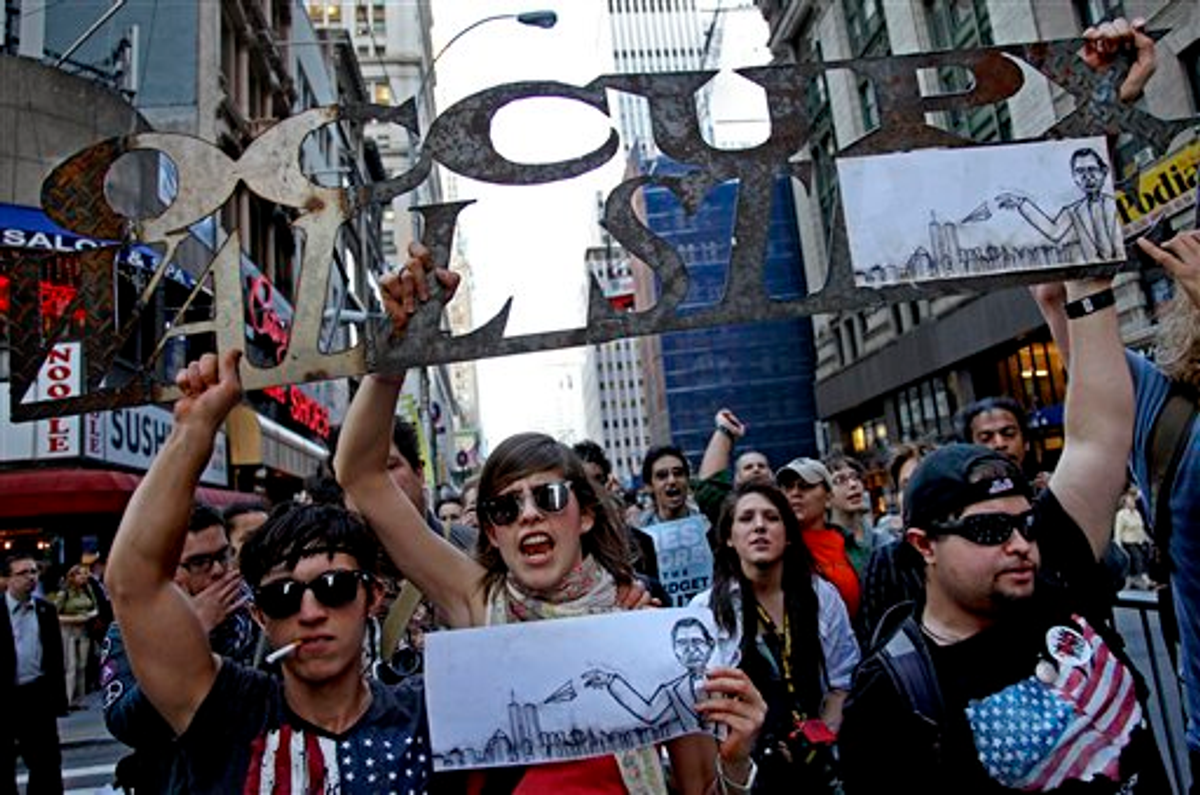
Will the Wall Street Occupiers morph into a movement that has as much impact on the Democratic Party as the Tea Party has had on the GOP? Maybe. But there are reasons for doubting it.
Tea Partiers have been a mixed blessing for the GOP establishment – a source of new ground troops and energy but also a pain in the assets with regard to attracting independent voters. As Rick Perry and Mitt Romney square off, that pain will become more evident.
So far the Wall Street Occupiers have helped the Democratic Party. Their inchoate demand that the rich pay their fair share is tailor-made for the Democrats’ new plan for a 5.6 percent tax on millionaires, as well as the President’s push to end the Bush tax cut for people with incomes over $250,000 and to limit deductions at the top.
And the Occupiers give the President a potential campaign theme. “These days, a lot of folks who are doing the right thing aren’t rewarded and a lot of folks who aren’t doing the right thing are rewarded,” he said at his news conference this week, predicting that the frustration fueling the Occupiers will “express itself politically in 2012 and beyond until people feel like once again we’re getting back to some old-fashioned American values.”
But if Occupy Wall Street coalesces into something like a real movement, the Democratic Party may have more difficulty digesting it than the GOP has had with the Tea Party.
After all, a big share of both parties’ campaign funds comes from the Street and corporate board rooms. The Street and corporate America also have hordes of public-relations flacks and armies of lobbyists to do their bidding – not to mention the unfathomably deep pockets of the Koch Brothers and Dick Armey’s and Karl Rove’s SuperPACs. Even if the Occupiers have access to some union money, it’s hardly a match.
Yet the real difficulty lies deeper. A little history is helpful here.
In the early decades of the twentieth century, the Democratic Party had no trouble embracing economic populism. It charged the large industrial concentrations of the era – the trusts – with stifling the economy and poisoning democracy. In the 1912 campaign Woodrow Wilson promised to wage “a crusade against powers that have governed us … that have limited our development … that have determined our lives … that have set us in a straightjacket to so as they please.” The struggle to break up the trusts would be, in Wilson’s words, nothing less than a “second struggle for emancipation.”
Wilson lived up to his words – signing into law the Clayton Antitrust Act (which not only strengthened antitrust laws but also exempted unions from their reach), establishing the Federal Trade Commission (to root out “unfair acts and practices in commerce”), and creating the first national income tax.
Years later Franklin D. Roosevelt attacked corporate and financial power by giving workers the right to unionize, the 40-hour workweek, unemployment insurance, and Social Security. FDR also instituted a high marginal income tax on the wealthy.
Not surprisingly, Wall Street and big business went on the attack. In the 1936 campaign, Roosevelt warned against the “economic royalists” who had impressed the whole of society into service. “The hours men and women worked, the wages they received, the conditions of their labor … these had passed beyond the control of the people, and were imposed by this new industrial dictatorship,” he warned. What was at stake, Roosevelt thundered, was nothing less than the “survival of democracy.” He told the American people that big business and finance were determined to unseat him. “Never before, in all our history, have these forces been so united against one candidate as they stand today. They are unanimous in their hate for me, and I welcome their hatred!”
By the 1960s, though, the Democratic Party had given up on populism. Gone from presidential campaigns were tales of greedy businessmen and unscrupulous financiers. This was partly because the economy had changed profoundly. Postwar prosperity grew the middle class and reduced the gap between rich and poor. By the mid-1950s, a third of all private-sector employees were unionized, and blue-collar workers got generous wage and benefit increases.
By then Keynesianism had become a widely-accepted antidote to economic downturns – substituting the management of aggregate demand for class antagonism. Even Richard Nixon purportedly claimed “we’re all Keynesians now.” Who needed economic populism when fiscal and monetary policy could even out the business cycle, and the rewards of growth were so widely distributed?
But there was another reason for the Democrats’ increasing unease with populism. The Vietnam War spawned an anti-establishment and anti-authoritarian New Left that distrusted government as much if not more than it distrusted Wall Street and big business. Richard Nixon’s electoral victory in 1968 was accompanied by a deep rift between liberal Democrats and the New Left, which continued for decades.
Enter Ronald Reagan, master storyteller, who jumped into the populist breach. If Reagan didn’t invent right-wing populism in America he at least gave it full-throated voice. “Government is the problem, not the solution,” he intoned, over and over again. In Reagan’s view, Washington insiders and arrogant bureaucrats stifled the economy and hobbled individual achievement.
The Democratic Party never regained its populist footing. To be sure, Bill Clinton won the presidency in 1992 promising to “fight for the forgotten middle class” against the forces of “greed,” but Clinton inherited such a huge budget deficit from Reagan and George H.W. Bush that he couldn’t put up much of a fight. And after losing his bid for universal health care, Clinton himself announced that the “era of big government” was over – and he proved it by ending welfare.
Democrats have not been the ones to engage in class warfare. That was the distinct product of right-wing Republican populism. Anybody recall the Republican ad in the 2004 presidential election describing Democrats as a “tax-hiking, government spending, latte-drinking, sushi-eating, Volvo-driving, New York Times-reading, body-piercing, Hollywood-loving, left-wing freak Show?”
Republicans repeatedly attacked John Kerry as a “Massachusetts liberal” who was part of the “Chardonnay-and-brie set.” George W. Bush mocked Kerry for finding a “new nuance” each day on Iraq – drawing out the word “nuance” to emphasize Kerry’s French cultural elitism. “In Texas, we don’t do nuance,” he said, to laughter and applause. House Republican leader Tom DeLay opened his campaign speeches by saying “Good morning or, as John Kerry would say, Bonjour.”
The Tea Party has been quick to pick up the same class theme. At the Conservative Political Action Conference of 2010, Minnesota Governor Tom Pawlenty attacked “the elites” who believe Tea Partiers are “not as sophisticated because a lot of them didn’t go to Ivy League Schools” and “don’t hang out at … Chablis-drinking, Brie-eating parties in San Francisco.” After his son Rand Paul was elected for Kentucky’s Senate seat that May, Congressman Ron Paul explained that voters want to “get rid of the power people who run the show, the people who think they’re above everyone else.”
Which brings us to the present day. Barack Obama is many things but he is as far from left-wing populism as any Democratic president in modern history. True, he once had the temerity to berate “fat cats” on Wall Street, but that remark was the exception – and subsequently caused him endless problems on the Street.
To the contrary, Obama has been extraordinarily solicitous of Wall Street and big business – making Timothy Geithner Treasury Secretary and de facto ambassador from the Street; seeing to it that Bush’s Fed appointee, Ben Bernanke, got another term; and appointing GE Chair Jeffrey Immelt to head his jobs council.
Most tellingly, it was President Obama’s unwillingness to place conditions on the bailout of Wall Street – not demanding, for example, that the banks reorganize the mortgages of distressed homeowners, and that they accept the resurrection of the Glass-Steagall Act, as conditions for getting hundreds of billions of taxpayer dollars – that contributed to the new populist insurrection.
The Wall Street bailout fueled the Tea Party (at the Utah Republican convention that ousted incumbent Republican Senator Robert Bennett in 2010, the mob repeatedly shouted “TARP! TARP! TARP!”), and it surely fuels some of the current fulminations of Occupy Wall Street.
This is not to say that the Occupiers can have no impact on the Democrats. Nothing good happens in Washington – regardless of how good our president or representatives may be – unless good people join together outside Washington to make it happen. Pressure from the left is critically important.
But the modern Democratic Party is not likely to embrace left-wing populism the way the GOP has embraced – or, more accurately, been forced to embrace – right-wing populism. Just follow the money, and remember history.
Shares