Movies
Will Scorsese’s “Hugo” redeem the 3-D fiasco?
The master director's gorgeous holiday film -- shown as a work in progress -- looks like a classic-in-waiting
(Credit: Jaap Buitendijk/GK Films) I have seen the future of 3-D moviemaking, and it belongs to Martin Scorsese, of all people. If you were bewildered by the news that Scorsese was apparently blundering into Steven Spielberg’s territory and making a 3-D family spectacle for the holidays, wonder no longer. Indeed, I am tempted to guess that Scorsese’s “Hugo,” which screened as a work in progress on Monday night at the New York Film Festival, is the best movie that anyone will make in the current 3-D wave, which shows distinct signs of ebbing.
“Hugo” definitely isn’t finished. The print Scorsese introduced on Monday before a packed house in Lincoln Center’s Avery Fisher Hall included some crude, temporary digital effects footage in a couple of scenes, one of them a crucial action sequence near the climax of the film. A working version of Howard Shore’s score was played on the soundtrack, without full orchestration or instrumentation. The movie hadn’t been color-corrected, and lacked a full credit sequence.
Members of the press were asked not to review the film before seeing the final cut, which may of course also differ in other ways. (If I had to guess, I would say that Scorsese might decide to cut a few minutes of running time.) That’s only fair, although I can promise you that all of us who saw “Hugo” last night are virtually bursting with private analyses and questions and debating points. It looks to be a movie with tremendous box-office and awards-season potential, and also a deeply personal film that’s artistically uneven. It will also present an intriguing marketing challenge. A jocular debate broke out on Twitter last night over the burning question of whether Johnny Depp (a co-producer) plays a cameo role as legendary jazz guitarist Django Reinhardt. I won’t even answer that question completely — no, sort of — and the rest of those discussions will have to wait until next month.
I don’t think Scorsese or Paramount Pictures will object to the following teaser: Based on what I’ve seen so far, “Hugo” is an absolutely magical film, one that creates a fantastical, storybook vision of Paris, circa 1930, and moves around in it with fluid cinematic ease. Scorsese does not use 3-D as a stunt or a value-added effect, but as a storytelling tool, a method of infusing his tale with humor, humanity and often breathtaking depth. If you already know Brian Selznick’s Caldecott Medal children’s book
Given Scorsese’s superlative command of the technical aspects of cinema, and his career-long commitment to movies as full-on sensual spectacles (although always, or almost always, built around human characters and stories), it shouldn’t really surprise us that he saw potential in 3-D that other filmmakers failed to grasp. Up until now, almost the only post-”Avatar” film made in 3-D that displayed any verve or imagination whatsoever was the summer 2010 animated hit “Despicable Me,” which at least was good fun. (I enjoyed “Cars 2″ quite a bit more than most critics, but you really didn’t miss much of the production design — and saved several bucks — if you watched it in 2-D projection.) Too much of the time, we’re dealing with post-production 3-D conversion, which either looks like absolute crap (“The Last Airbender”) or added nothing but a mild headache to the viewing experience (the two-part “Harry Potter” conclusion).
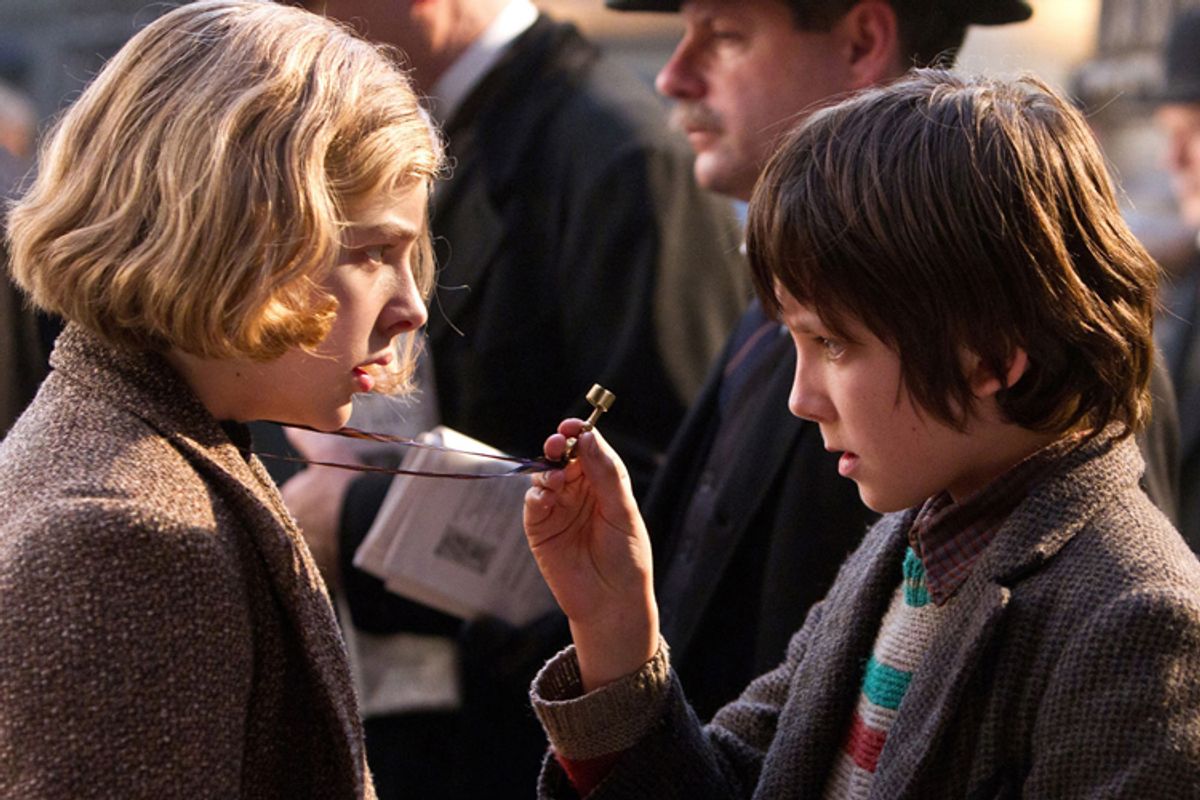
This is a movie that goes inside the machinery of a clock high above a Parisian train station, where the eponymous orphan (English youngster Asa Butterfield) makes his home, and also, so to speak, inside its own dream-factory machinery. Butterfield and Chloë Grace Moretz, as a better-off orphan who takes pity on Hugo, are the evident protagonists of this Dickensian-gone-Gallic fable. But the film’s real star may be Ben Kingsley, playing an obscure toymaker named Georges who literally holds the story’s secrets, as well as the prehistory of the craft and art to which Scorsese has devoted his life.
There are other delights too numerous to mention, including supporting roles for Emily Mortimer, Jude Law, Richard Griffiths and Christopher Lee, along with Sacha Baron Cohen — and his character’s Doberman pinscher — used as the movie’s most memorable 3-D effects. Scorsese has aimed for nothing less here than a memorable holiday classic, an exciting melodrama that will play very differently for child and adult viewers and will reward repeat viewings for many years to come. Has he gotten there? We’ll soon see.
Blockbuster fatigue? A summer alt-movie guide
Summer movies beyond Batman, from male strippers to a Depression neo-noir to Matthew McConaughey's big comeback
From top: stills from "Beasts of the Southern Wild," "Take This Waltz" and "Lawless" It may feel to you as if the summer moviegoing season has only just begun and many months of popcorn-munching delight lie ahead. That’s both true and not true. There’s a degree of pseudo-Calvinist predestination about the whole thing this year that’s unusual even by the standards of Hollywood, where conventional wisdom and guesswork-in-advance count for actual knowledge.
I mean, nobody knows for sure how much money the 1980s big-hair musical “Rock of Ages” will gross or whether “The Dark Knight Rises” will beat out “The Avengers” as the top box-office hit of the year. (My answers: Not enough to be a huge hit, and no.) But pretty much any idiot with a computer — me, for instance — can look at the calendar and figure out what the biggest hits of the summer will be. As I just mentioned, the summer’s No. 1 movie, in all probability, has already been released. (I’ll save the trollery about how it wasn’t really all that great for some other time.) After we get through “Prometheus” and “Abraham Lincoln: Vampire Hunter” in June, followed by “The Amazing Spider-Man” and “The Dark Knight Rises” in July, well, that’s pretty much it. I exaggerate, but only a little — these days, blockbuster season commences in early May and is over by the end of July, with August reserved as usual for offbeat genre movies, the fourth chapters of trilogies, and the continuing careers of Sylvester Stallone and Jackie Chan. (In other words, the good stuff.)
Continue Reading CloseThe kids are all wrong
Nightmare children populate the dark, dreary and near-perfect "The Bad Seed" and "We Need to Talk About Kevin"
The best movies act as a kind of amber, trapping the life of their times. Sometimes, you get jewels, other times you get, well, amber.
It was hard to read anything about “We Need to Talk About Kevin” without some reference to its distinguished antecedents in the “there’s something about that boy, June” school of demon child cinema. “The Omen,” “Rosemary’s Baby” and “Problem Child” all got their time on deck, but one film in particular gets mentioned, for it invented this entire genre. And that film is Mervyn LeRoy’s 1956 epic “The Bad Seed.” This is one of those movies embedded in our consciousness that perhaps should stay embedded and not actually be pried loose.
Continue Reading ClosePick of the week: Haunting, gorgeous “Oslo, August 31st”
Pick of the week: "Oslo, August 31st" is a wrenching voyage of discovery in Norway's suddenly trendy capital
“Oslo, August 31st” is, as the title suggests, an evocation of one day in the Norwegian capital, as experienced by a troubled young man who’s facing the end of summer and the end of his youth. It’s a marvelously constructed personal journey, both wrenching and bittersweet, whose emotional ripple effects stay with you for days and weeks afterward. While much of international art cinema can seem overly talky or conceptually alien to American viewers, this second feature film from Norwegian director Joachim Trier is a dynamic, even breathtaking visual experience without much dialogue or any philosophical heavy lifting, following the bony, handsome, exceedingly vulnerable Anders (Anders Danielsen Lie) through coffee shops, nightclubs and bodies of water, en route to an ambiguous final destination.
Continue Reading Close“Moonrise Kingdom”: Wes Anderson’s mid-’60s love story
Bruce Willis and Ed Norton are at their best in the rapturous summer fantasy "Moonrise Kingdom"
Tilda Swinton, Bruce Willis and Edward Norton in "Moonrise Kingdom" All the details of Wes Anderson’s rapturous and hilarious mid-1960s New England summer romance “Moonrise Kingdom,” taken one at a time, are plausible. Indeed they are more than plausible; they’re perfect, from the fitted uniforms and yellow canvas tents of the troop of “Khaki Scouts” headed by cigarette-smoking Edward Norton to the achingly picturesque island home where the brood of children belonging to Bill Murray and Frances McDormand sit around listening to the Leonard Bernstein recording of “A Young Person’s Guide to the Orchestra.” (I’m not going to bother questioning whether that record existed in 1965; some production intern probably spent half a day tracking down its history.)
Continue Reading CloseMovie assailant punches a kid, becomes a folk hero
A 10-year-old gets punched in the face for being too noisy at "Titanic" -- and the Internet applauds the beating
(Credit: iStockphoto/IBushuev) It’s a general rule of thumb that a grown man doesn’t get a lot of support for knocking out a 10-year-old child’s teeth. But Yong Hyun Kim has won himself a few fans lately for doing just that.
Back on April 11, the 21-year-old Washington state man settled in with his girlfriend to enjoy “Titanic” in 3D — right in front of a boy known only in police documents as KJJ. What ensued led to a night in jail and a charge of second-degree assault.
Continue Reading Close
Mary Elizabeth Williams is a staff writer for Salon and the author of "Gimme Shelter: My Three Years Searching for the American Dream." Follow her on Twitter: @embeedub. More Mary Elizabeth Williams.
Page 1 of 708 in Movies