Opening Shot

Rick Perry is quickly becoming an afterthought

It didn't even feel like he was trying on Tuesday night. Does he want the right to fall in love with Herman Cain?

  • more
    • All Share Services

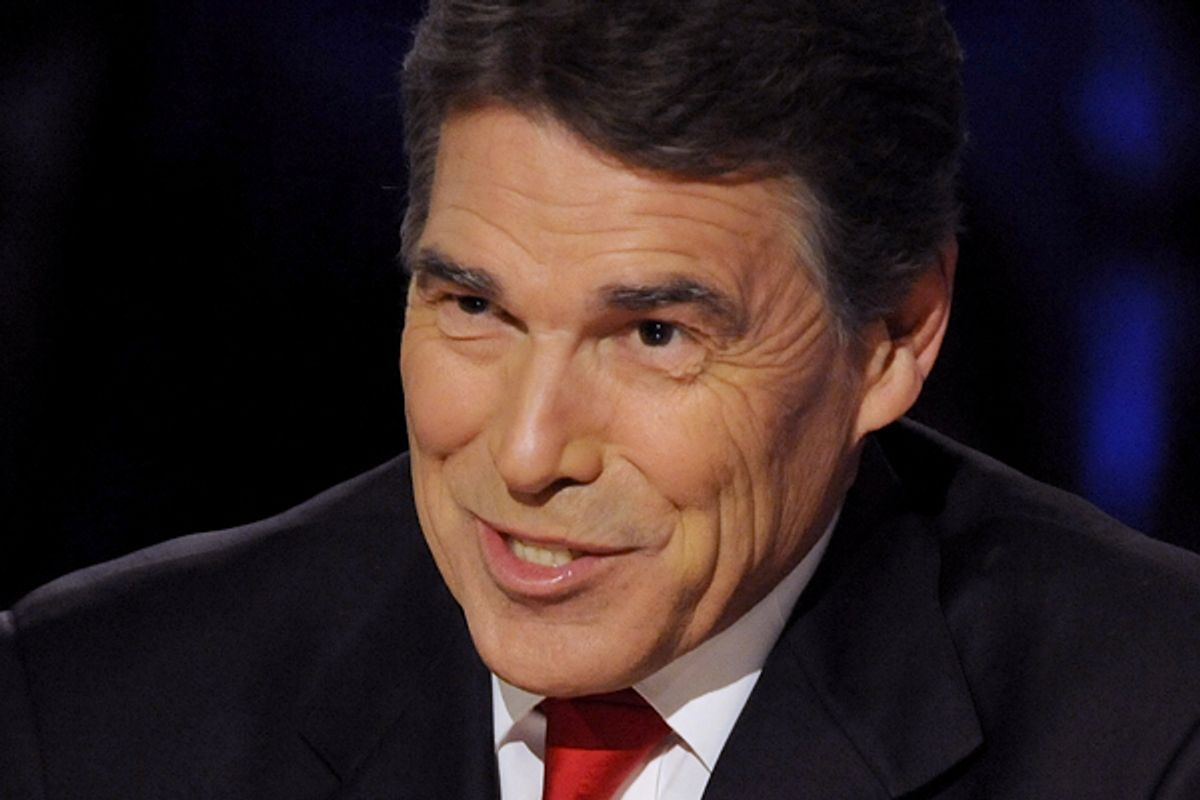
Rick Perry is quickly becoming an afterthoughtRepublican presidential candidate Texas Gov. Rick Perry speaks at a presidential debate at Dartmouth College in Hanover, N.H., Tuesday, Oct. 11, 2011. (Credit: AP/Melina Mara)

It was a new, more difficult challenge that Rick Perry faced in Hanover, N.H., Tuesday night: Find a way to stand out. And he failed.

Until recently, attracting attention was hardly a concern for the Texas governor. He burst into the GOP race in mid-August with all the eyes in the political world on him – and with conservatives poised to flock to his camp, if he could prove he was the skilled, electable candidate they badly wanted him to be.

Perry responded by doing virtually everything in his power to show that he wasn’t ready for the national spotlight, talking his way into trouble on the campaign trail, antagonizing conservatives who questioned his record on immigration, and turning in three increasingly ghastly debate performances that culminated in his painful attempt to confront Mitt Romney in the last debate, on Sept. 22.

Measured against that last outing, Perry’s showing in Hanover wasn’t actually that bad. The problem, though, is that the standard Perry needs to meet in debates changed over the last three weeks. “Not bad” might have cut it before, when conservatives were all looking to him to deliver them from the inevitability of Romney, but three weeks of deteriorating poll numbers and scathing reviews from Republican opinion-leaders have taken their toll.

By the time Tuesday’s debate rolled around, Perry had plummeted to third place in national polls, overtaken not just by Romney but by Herman Cain too, and his standing in Iowa and New Hampshire had plunged to even lower depths. The organizers in Hanover took note of this and swapped the seating around, putting Cain center stage next to Romney and moving Perry toward the periphery with the rest of the also-rans.

Hence the more complicated challenge for Perry. This time around, the action wasn’t going to automatically come to him. He would be handed fewer opportunities to speak, forced into a secondary slot in the question rotation, and subject to less attention from his rivals. This is the treatment that candidates who are polling at 4 percent in New Hampshire and 9 percent in Iowa receive. It would be up to Perry to make the most of the moments he was given and to force the moderators – and his opponents – to pay him more attention.

Subtracting for commercials (and a ridiculous “halftime show” with former Bush aide Matthew Dowd), the debate ran about 90 minutes, and for almost all of that time it didn’t even feel like Perry was there. Especially in the first hour, the gaps between his opportunities to speak were endless, with Perry more often showing up on the screen in the background while one of his opponents was talking. And when he was actually called on, he did nothing to help himself, issuing dull, vague responses that seemed designed mainly to run out the clock.

Perry’s handling of the first question posed to him, about what he would do as president to break through Washington’s gridlock and improve the economy, was typical of his night. He simply noted that he’d issue a plan later in the week – he’s scheduled to give a speech on the economy on Friday – and made some generic comments about domestic energy sources. Moderator Charlie Rose observed that Romney long ago offered a 59-point economic plan and challenged Perry to be more specific. Perry simply noted that Romney has been running for president for several years, “and I’ve only been at this for about eight weeks.”

The lack of preparation, to say nothing of Perry’s limited agility, was staggering. The sole topic for the debate was the economy, and Perry was surely aware of how high the stakes were for his candidacy. And yet all he could say was that he’d soon have a plan?

Meanwhile, Romney spent the night confidently and energetically plowing through his familiar denunciations of Barack Obama, promoting himself as a savvy businessman come to rescue America from the Great Recession. And Cain, with similar confidence and energy, returned over and over to his “999” tax plan, eliciting frequent cheers from the crowd. In fact, at one point Rose even played a clip of Cain talking up his trademark plan and asked the other candidates to respond. The best Perry could muster was that “what we need to be focused on in this country today is not whether or not we’re going to have this policy or that policy.” He never seemed so small and insignificant.

The best news for Perry is that this was probably the least-watched GOP debate yet, airing on Bloomberg television (and a broadcast station in New Hampshire). But the GOP’s opinion-shaping class surely tuned in, and Perry gave them no reason to declare his candidacy reborn – even as Romney gave them further reason to call him the front-runner, and Cain gave them plenty of reason for them to say he’s for real.

It’s true that Perry still has a ton of money and that in the volatile environment of the current GOP race he could still reverse his fortunes with a strong performance in the next debate (which will be next week). It’s also true that Cain has essentially no campaign organization, has barely paid attention to the early primary and caucus states, is living almost entirely off media attention and buzz right now, and has yet to face a concerted assault on the 999 plan from his rivals (it’s coming, though). Given the GOP base’s resistance to him, it’s hard to imagine Romney just walking off with this race by default; someone’s going to emerge and give him a run, and it still could be Perry.

But it doesn’t have to be, and Tuesday night provided the best reason yet to doubt that it will be. Perry just doesn’t seem capable of performing well in these settings. He’s now shared the stage with his opponents four times, and each time he’s walked away with his stature reduced. In the three previous debates, he delivered performances that were simply unworthy of a front-runner. At least on Tuesday, he delivered one more on par with his poll numbers.

Steve Kornacki

Steve Kornacki writes about politics for Salon. Reach him by email at SKornacki@salon.com and follow him on Twitter @SteveKornacki

Obama’s elusive lead

Voters overwhelmingly agree Romney favors the rich and big banks. So why hasn't the president opened up a lead?

  • more
    • All Share Services

Obama's elusive leadPresident Obama(Credit: AP)

One of the goals of Barack Obama’s campaign is for voters to see Mitt Romney as an out-of-touch rich guy who’s far more attuned to the concerns of corporate executives, bankers and the affluent than middle- and working-class Americans.

The good news for the Obama team is that they’re well on their way to achieving this goal. Further data from an ABC News/Washington Post poll released this morning finds that voters by a 65 to 24 percent margin believe Romney would do more to advance the interests of wealthy Americans. Romney also wins by a big spread on the question of who would do more for financial institutions, 56 to 32 percent. At the same time, Obama enjoys a healthy 9-point advantage, 51 to 42 percent, on who will do more to help the middle class.

The problem for Obama: This isn’t translating into much of an overall lead. In the ABC/WaPo poll, he’s clinging to a 3-point edge, 49 to 46 percent, while the Real Clear Politics average of all polls puts his lead at just under 2 points. There are a lot of voters, in other words, who see Romney pretty much as the Obama campaign wants them to see him but who are still willing to support him anyway.

This speaks to the challenge of running for reelection against a backdrop of pervasive economic anxiety. It gives swing voters a strong incentive to vote the incumbent out, and tends to lower the bar in terms of what they’re willing to accept in a challenger candidate. The ABC/WaPo numbers offer a glimpse of this phenomenon at work.

When it comes to making the race competitive, the key for Romney seems to be a specific type of voter: white, middle-/working-class, and economically struggling. The poll finds that these voters agree with the idea that Romney will better serve the interests of the rich and financial institutions, but that they also see him as better for the middle class. According to the Post’s write-up:

Among white voters trying to stay in the middle class, Romney is considered the better candidate for that group by a 20-point margin; Obama is preferred by better than 3 to 1 among middle-class nonwhite voters, regardless of their sense of security.

This dovetails with earlier polling that showed Obama’s support from non-college-educated white voters – which was never that strong to begin with – plunging to new lows, particularly with men. Several theories have been proposed to explain this, including the idea that it reflects the culture-based attacks and insinuations that have been a staple of the right’s opposition to Obama. There may be something to that, but according to ABC/WaPo nearly three-quarters of whites who say they’re struggling lack college degrees, so they’re sympathy to Romney might simply reflect their own economic anxiety, and their instinct to punish whoever’s running the country for it.

That’s precisely the instinct that Romney’s message is designed to stoke. His economic pitch is in many ways contradictory and incoherent, but that’s intentional. Romney isn’t trying to sell Americans on some detailed, comprehensive plan to rebuild the economy. His goal is to offer broad, pleasant-sounding policy prescriptions while playing up dire statistics and anecdotes about the economy and the deficit. When you really boil it down, as I’ve written before, the Romney message is simply this: If you’re feeling anxious about the economy, don’t ask questions – just vote out the guy in charge. The ABC/WaPo numbers are an indicator of the potential effectiveness of that strategy.

Continue Reading Close
Steve Kornacki

Steve Kornacki writes about politics for Salon. Reach him by email at SKornacki@salon.com and follow him on Twitter @SteveKornacki

The Warren meltdown that isn’t

Despite weeks of controversy over her Native American ancestry, she’s still tied with Scott Brown

  • more
    • All Share Services

The Warren meltdown that isn’tIn this May 2, 2012 file photo, Democrat candidate for the U.S. Senate Elizabeth Warren responds to questions from reporters on her Native American heritage during a news conference at Liberty Bay Credit Union headquarters, in Braintree, Mass.(Credit: AP Photo/Steven Senne, File)

Reports of Elizabeth Warren’s demise have been greatly exaggerated. A new Suffolk University poll puts the consumer advocate in a virtual tie with Massachusetts Sen. Scott Brown, who holds a statistically insignificant 48 to 47 percent lead.

This comes after weeks of intense controversy over whether Warren had advanced her academic career by claiming Native American ancestry based on being 1/32 Cherokee. As the story dragged on, members of her own party groaned at her handling of it, critics charged that she was being evasive, and the press speculated whether Democrats were about to endure a repeat of the Martha Coakley debacle.

The Cherokee story, according to the survey, has definitely dented the public’s consciousness; 72 percent of voters say they’re aware of it. But by a 49 to 28 percent margin, they also say that Warren is telling the truth about it, and by a 45 to 41 percent margin they say she didn’t benefit professionally from listing herself as Native American back in the 1990s.

“I’m not saying there was no damage from the Native American thing, but if you zoom out to see what the net effect was, it was minimal,” David Paleologos, who conducted the poll, told the Boston Globe. “It’s considered a nonstory.”

There are hints of the story taking a toll on Warren’s image. Her unfavorable score is up 5 points from the last Suffolk poll in February, from 28 to 33 percent, while her favorable score sits at 43. Brown, by contrast, has a more robust 56 to 28 percent favorable rating. In that February poll, Brown enjoyed a 9-point lead over Warren, 49 to 40 percent, but that result was dismissed by both sides as an outlier – not that it’s stopping Democrats now from crowing that Warren is surging.

Really, though, the poll just shows that the race is back to being the nail-biter everyone’s long assumed it would be. If the outcome was based strictly on personal popularity, Brown would win easily. But the Republican label is a profound liability in Massachusetts, especially for candidates for federal office. This is why the Suffolk poll also finds Brown failing to break 50 percent against Maria DeFranco, Warren’s little-known Democratic primary opponent. (In a head-to-head race with Warren, DeFranco trails 71 to 6 percent.)

Warren’s challenge isn’t to become better-liked than Brown; it’s to make herself likable and acceptable enough for voters who are fond of and identify with Brown but don’t want to send a Republican vote to the Senate. On this front, there are some encouraging signs for her in the poll. She beats Brown 49 to 36 percent on the question of who will better represent middle-class families and 40-37 percent on who is more honest. And she’s not far behind him (47-42) on who’s more independent – a trait Brown has tried to make his calling card.

Continue Reading Close
Steve Kornacki

Steve Kornacki writes about politics for Salon. Reach him by email at SKornacki@salon.com and follow him on Twitter @SteveKornacki

Where Obama has no hope

Humiliating primary results in Kentucky and Arkansas prove that, in some states, Obama-phobia still reigns

  • more
    • All Share Services

Where Obama has no hopePresident Obama(Credit: AP)

There’s a large swath of rural America, extending from somewhere in Oklahoma up into West Virginia, where Barack Obama never had a chance, and it really showed last night.

A majority of Kentucky’s 120 counties voted against Obama in the state’s Democratic presidential primary, opting instead for “uncommitted.” Big margins in Louisville and Lexington saved the president from the supreme embarrassment of actually losing the state, not that his overall 57.9 to 42.1 percent victory is anything to write home about.

In Arkansas, the other state to hold its primary yesterday, the results were only slightly less humbling to Obama, who defeated an actual human-being candidate — a Tennessee lawyer named John Wolfe — by a 58.4 to 41.6 percent spread, with more than a third of the state’s 75 counties siding with the challenger. Wolfe, if anyone asked him, was running against Obama from the left, on a progressive economic message. But to the average Arkansas voter, his name might just as well have been “not Obama”; he had no money, no campaign organization, and no name recognition, and he received scant media coverage.

Whether this qualifies as Obama’s most humbling primary night of 2012 is open to debate. Just two weeks ago, a federal inmate who somehow maneuvered his way onto the West Virginia ballot racked up nearly 41 percent against the president in that state’s primary and carried 10 counties. Back in March, Obama was held to 57 percent in Oklahoma, losing 15 counties to anti-abortion zealot Randall Terry and another gadfly candidate. Terry actually qualified for delegates in that contest, prompting national Democrats to invoke their “LaRouche rule” and deem him unqualified to actually receive delegates.

There were also problems for the president in pockets of Louisiana, where Wolfe cleared the 15 percent delegate eligibility threshold in several congressional districts. Democrats are refusing to actually allocate any delegates to him, though, on the grounds that he failed to file a comprehensive delegate selection plan – a rationale that is also being invoked in Arkansas. Wolfe is vowing to overturn the rulings in court.

In terms of deciding the Democratic nomination, obviously, none of this really matters. Obama has won most states by the massive margins that incumbent presidents typically rack up against fringe challengers and “uncommitted,” and he long ago surpassed the magic number of delegates needed for re-nomination. In most of America, this year’s Democratic primaries have been just as uneventful and unremarkable as they were in 1996, the last time a Democratic incumbent sought reelection.

But then there’s that sea of resistance in Appalachia and states like Arkansas and Oklahoma. A case can be made that Obama’s energy policies contributed to his West Virginia headache, but otherwise there’s no sense trying to pin this on anything he’s actually done as president because the resistance was just as apparent when he ran four years ago.

Back then, Obama was crushed by Hillary Clinton in West Virginia by 41 points – even though it was clear by primary day that he was on his way to being the nominee. In Kentucky, Clinton’s margin was 35 points. In Arkansas (where she served as first lady for more than a decade), it was 44. And in Oklahoma, it was 25. The same largely poor, rural and white areas that gave Clinton her best numbers in 2008 are now doing the same for John Wolfe, “uncommitted” and Randall Terry. The problem was just as apparent for Obama in the fall of 2008, when he improved on John Kerry’s 2004 performance in just about every corner of the country except the Oklahoma-to-West-Virginia swath.

Chalking this up only to race may be an oversimplification, although there was exit poll data in 2008 that indicated it was an explicit factor for a sizable chunk of voters. Perhaps Obama’s race is one of several markers (along with his name, his background, the never-ending Muslim rumors, and his status as the “liberal” candidate in 2008) that low-income white rural voters use to associate him with a national Democratic Party that they believe has been overrun by affluent liberals, feminists, minorities, secularists and gays – people and groups whose interests are being serviced at the expense of their own.

The good news for Obama is that this probably doesn’t say much about what will happen in November. The damage is limited to states he was already expecting to lose to Mitt Romney. Not that this will stop Republicans from playing up Kentucky and Arkansas as the latest proof of Obama’s shattered popularity. But that’s just spin. He could have a 60 percent approval rating, and he’d still be getting embarrassed in these states.

Continue Reading Close
Steve Kornacki

Steve Kornacki writes about politics for Salon. Reach him by email at SKornacki@salon.com and follow him on Twitter @SteveKornacki

Booker’s maddeningly slippery interview

The Newark mayor did a lot of talking on “The Rachel Maddow Show,” but he didn’t really say anything

  • more
    • All Share Services

Booker’s maddeningly slippery interview

Cory Booker did an awful lot of talking last night, but he didn’t really say anything.

After refusing requests all day, the Newark mayor agreed late in the day to a live interview on Rachel Maddow’s MSNBC show. By this point, Republicans had launched an online petition urging their supporters to “stand with Cory” against the Obama campaign’s “attacks on the free market.”

“It wasn’t until the GOP went across that line that I said, ‘Forget it. I’ve heard all I can stand and I can’t stand no more,’” Booker told Maddow when the interview started.

If you only watched Booker’s 12-minute performance last night, you’d probably be tempted to believe his claim of near-total innocence and even victimhood in an episode that overtook the presidential campaign Monday. This only makes sense; Booker can talk with the best of them. But in all of his earnest pleadings and verbose answers, he never actually confronted what landed him in hot water in the first place.

On Sunday’s “Meet the Press,” Booker seemed to call the Obama campaign’s attacks on Mitt Romney’s private equity record “nauseating” and to liken them to efforts by some on the right to make Jeremiah Wright an issue in the race. On Maddow’s show, he played off the “nauseating” line as a reference to super PAC-era negative campaigning in general and copped only to some sloppy phrasing.

“Obviously, I did things in the ‘Meet the Press’ interview, as I told you, that did not land the points that I was trying to make,” Booker said. “And in some ways, frustratingly, I think I conflated the attacks that the Republicans were making with Jeremiah Wright with some of the attacks on the left. And those can’t even be equated.”

And as he did in a hastily produced video on Sunday night, Booker insisted that Romney’s Bain Capital past is fair game, and that he’s happy to “echo” Obama’s efforts to highlight it. Other than that, though, Booker mainly talked around the private equity issue. He invoked marriage equality several times, the war on women, universal healthcare and college tuition affordability, and bragged that “I’ve been standing with Barack Obama since before most people were standing with Barack Obama.” He also excoriated Republicans for not focusing on issues affecting cities like his and moralized at length about the corrosiveness of attack ads.

This was damage control at its slipperiest. The reality is that Booker did more than just clumsily register his objections to the negative tone of politics on “Meet the Press.” He specifically stood up for Romney’s private equity firm and its record:

“I have to just say from a very personal level, I’m not about to sit here and indict private equity. To me, it’s just we’re getting to a ridiculous point in America. Especially that I know I live in a state where pension funds, unions and other people invest in companies like Bain Capital. If you look at the totality of Bain Capital’s record, they’ve done a lot to support businesses, to grow businesses.”

He had no interest in grappling with this in his Maddow interview, though, so he filibustered.

What’s happening here really isn’t that complicated. Booker, like many Democrats (especially in the New York/New Jersey area), spent years cultivating Wall Street and the investor class. He was better at it than most, building an enviable network of elite financial supporters by leveraging personal ties (from his Stanford/Yale/Oxford days) and convincing them that he shared their basic worldview.

In the Clinton-era, this was a standard part of the Democratic playbook, but in post-meltdown America, intimate ties to Wall Street can be poisonous inside the party. Booker, who likes to portray himself as a third way/new politics figure, clearly didn’t appreciate this before Sunday. And now, with Democratic activists turning on him, he’s scrambling to put out the fire – without completely contradicting himself or permanently alienating the Wall Street base that will still be crucial to his statewide political aspirations.

The result was his 12-minute display of charismatic evasion last night.

* * *

After Booker’s interview last night, I was on MSNBC’s “The Last Word” to talk about it:

Visit msnbc.com for breaking news, world news, and news about the economy

Continue Reading Close
Steve Kornacki

Steve Kornacki writes about politics for Salon. Reach him by email at SKornacki@salon.com and follow him on Twitter @SteveKornacki

Booker, in retreat

His attempt to downplay his “nauseating” comment doesn’t pass the sniff test

  • more
    • All Share Services

Booker, in retreat

It didn’t take long for Cory Booker to get the message. Just hours after undermining the Obama campaign’s main line of attack against Mitt Romney, the Newark mayor released a video late Sunday afternoon in an effort to repair some of the damage.

Booker had seemed to pronounce the Obama effort to highlight unflattering aspects of Romney’s private equity background “nauseating,” but in the video, he suggested he was making a broader statement about negative campaigning.

“I used the word ‘nauseating’ on ‘Meet the Press’ because that’s really how I feel when I see people in my city struggling with real issues and still feeling the challenges of this economy, and still looking for hope and opportunity and real specific plans,” Booker said. “I get very upset when I see such a level of dialogue and calls to our lowest common denominator.”

But he insisted that he sees Bain as a legitimate topic for Obama to raise: “Let me be clear. Mitt Romney has made his business record a centerpiece of his campaign. He’s talked about himself as a job creator. And therefore it is reasonable — and in fact I encourage it — for the Obama campaign to examine that record and discuss it. I have no problem with that.”

Booker’s new line is a bit hard to swallow, though, because his “Meet the Press” comments clearly went beyond simply decrying the tone of the campaign. At one point, he offered a pointed defense of Romney’s Bain past, saying:  “I’m not about to sit here and indict private equity. If you look at the totality of Bain Capital’s record, it — they’ve done a lot to support businesses, to grow businesses. And this to me — I’m very uncomfortable.”

An RNC spokesman told Politico that “it’s clear this video was orchestrated by the Obama campaign,” which certainly sounds plausible. Shortly after Booker posted his clarification, an Obama campaign press secretary tweeted out a link to a condensed version of it featuring only Booker’s statement about Bain being fair game.

As I noted yesterday, Booker has throughout his political career cultivated and maintained close ties to Wall Street and affluent, investor class donors – people who, in many cases, believe the administration has declared war on their world and see the Bain attacks as an extension of that effort. Booker’s statewide political aspirations are no secret in New Jersey, and the presumption is that he’s eyeing a Senate run in 2014 (others have mentioned him for governor next year, but that’s less likely for a number of reasons).

Booker’s actions on Sunday are best understood in that context. In sticking up for private equity, he was tending to a financial base that’s been there for him before and that he’ll need in the future. Running ads in the New York and Philadelphia markets is an expensive proposition, so Booker will need a ton of cash for a statewide run. And in rushing to clarify (but not exactly retract) what he said, Booker was trying to contain the damage with a Democratic Party base that likes Obama and has no problem with his attacks on Bain.

In a way, the episode is simply a high-profile illustration of the very real tension that exists, especially in the New York area, between elite Democratic donors and rank-and-file voters. Booker is hardly the only tri-state region Democrat who’s cultivated Wall Street, but in 2012 not many are as open about it as he is.

Continue Reading Close
Steve Kornacki

Steve Kornacki writes about politics for Salon. Reach him by email at SKornacki@salon.com and follow him on Twitter @SteveKornacki

Page 1 of 27 in Opening Shot