
Occupy Wall Street
Obama White House parrots “99 percent” line
Occupy Wall Street's most powerful slogan crosses the lips of an administration spokesman
(Credit: AP/Salon) This is what co-optation looks like?
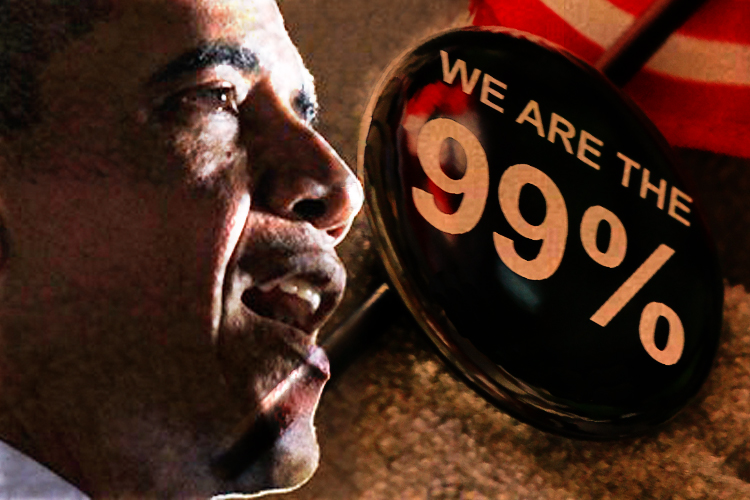
It appears that the White House is adopting what is probably the most powerful slogan of Occupy Wall Street: “We are the 99%.”
That reference to the growing gap in income and wealth between the super-rich and the rest of us was invoked by a top administration spokesman during a press briefing Sunday about President Obama’s bus trip to Virginia and North Carolina. Politico reports:
[Principal Deputy Press Secretary Josh] Earnest told scribes to stay tuned, adding that it was possible Obama would talk about the movement specifically but that he would acknowledge the “frustrations” of middle and working-class people who feel the rich haven’t paid their fair share – or been penalized for the excesses that led to the financial crisis.
The president, he said, will make sure “the interests of the 99 percent of Americans are well-represented on the tour,” the first reference I can find in which an Obama staffer specifically repeated the mantra.
Here’s Press Secretary Jay Carney being quizzed on the same issue during a press gaggle aboard Air Force One this morning:
Q How explicitly do you expect the President to embrace or echo some of the rhetoric of the Occupy Wall Street protest? We heard Josh yesterday actually use the phrase, “the 99 percent of Americans.” Might we expect to see the President move in that direction?
MR. CARNEY: Well, I want you to listen carefully to what the President does say, so I won’t preview his remarks in any detail. But I think we have expressed, and the President has expressed, an understanding of the frustration that the demonstrations manifest and represent. There is a link between two things: One, the frustrations that regular folks — middle-class Americans feel about the state of the economy, the need for growth to improve, and certainly the need for job creation to improve. And there is a related frustration that a lot of Americans feel about the idea that Wall Street in the past played by different rules than Main Street*, and now we have a situation where — and yet was, for good reasons, was assisted by the federal government to prevent the financial sector from collapsing.
Following on that, there is frustration now I believe with the efforts by some to roll back the protections the President fought so hard to put into place through the Wall Street reform act that was passed and signed into law. It is — I don’t have to imply or insinuate that it is the objective of the Republicans, including contenders for president, to roll back those reforms because they say so themselves. And it’s just inconceivable to us that an economic plan for the future would contain within it the elimination of reforms that would prevent the kind of financial protector collapse that we saw that created the greatest recession since the Great Depression. Just doesn’t make sense to us. Doesn’t make sense to the President.
I don’t think anyone at Occupy Wall Street is satisfied by the anemic “Wall Street reform act” that Carney invokes here.
But we seem to be seeing an emerging White House strategy to adopt the language of Occupy without actually proposing any policy changes. Top Obama aide David Plouffe previewed this very strategy to the Washington Post a few days ago.
Gleen Greenwald has written at length about why this is going to be an awkward fit, to say the least.
Justin Elliott is a reporter for ProPublica. You can follow him on Twitter @ElliottJustin More Justin Elliott.
Dissent, à la Québécoise
The student strike in Quebec has generalized, and solidarity is spreading in the U.S.
Demonstrators in Montreal on Tuesday. (Credit: Reuters/Christinne Muschi) For the past eight months, when chants of “Anti-Capitalista!” have echoed through New York streets, they’ve tended to emanate from crowds with a penchant for black clothing. But on Tuesday night, when once again a march of around 300 snaked through the streets around Washington Square Park, the color scheme was different: red flags, red banners, red clothes, red masks and little red felt square pins adorned the marchers — a mixture of long-term Occupy participants, students and others taking the streets and donning some red in solidarity with the Quebec student strike.
Continue Reading CloseNatasha Lennard covers the Occupy movement for Salon. A British-born, Brooklyn-based journalist, she has been covering Occupy Wall Street since before the first sleeping bag was unrolled in Zuccotti Park. One of the first journalists arrested at an Occupy action, she has managed to enrage Andrew Breitbart, Rush Limbaugh and Glenn Beck. You can follow her on Twitter (@natashalennard), and email her any Occupy updates/videos/ideas to natasha.lennard@gmail.com More Natasha Lennard.
Protest music’s odd conservative turn
A 100-track, four-CD Occupy collection assembles generations of icons. So why does it sound shapeless and safe?
“In this hour of the ever-changing season, may our tears not douse the fire in our hearts.”
That’s a guy named Michael Pless singing “Something’s Got to Give.” Even without hearing the song, you can surely imagine the essential elements: Plaintive acoustic strumming, an earnest vocal, and an air of polite outrage to match the stilted syntax and hoary platitudes. Welcome to “Occupy This Album,” the collection of protest-minded songs released by Occupy Wall Street. Sprawling across four CDs and a slew of bonus digital tracks, this behemoth set includes 100 (why not 99?) new and previously released tracks from artists representing a range of generations, genres, backgrounds, settings, and styles. Folkies join hands with rappers; ominous post-rock marches alongside peppy radio pop. There’s spoken-word poetry, tribal percussion, earnest singer-songwriter fare. Even a bit of jazz.
Continue Reading CloseFirst NATO protest targets Obama
A small rally kicks off a week of protests in Chicago and makes clear the president is a target in his city
Rahm Emanuel and President Obama (Credit: Reuters/John Gress) In the first week of November 2008, tens of thousands of people gathered in Chicago to watch dewy-eyed as Barack Obama won the presidential election, believing, as the then-president-elect said in his victory speech, that “this time must be different.” This week, the Windy City is welcoming large crowds again — but as was made clear by a small protest action Monday — the president is not the sweetheart of these Chicago masses, which are assembling for a week of actions and protests surrounding the NATO summit.
Continue Reading CloseNatasha Lennard covers the Occupy movement for Salon. A British-born, Brooklyn-based journalist, she has been covering Occupy Wall Street since before the first sleeping bag was unrolled in Zuccotti Park. One of the first journalists arrested at an Occupy action, she has managed to enrage Andrew Breitbart, Rush Limbaugh and Glenn Beck. You can follow her on Twitter (@natashalennard), and email her any Occupy updates/videos/ideas to natasha.lennard@gmail.com More Natasha Lennard.
Occupy: A Tea Party for the left?
The Mississippi Freedom Democratic Party didn't succeed by electing candidates. Occupy doesn't need to either
An Occupy Wall Street demonstrator chants during a march to celebrate the protest's sixth month, Saturday, March 17, 2012, in New York. (AP Photo/John Minchillo) (Credit: AP) As long as there has been a thing called Occupy Wall Street, there have been people who’ve suggested it should become the left’s version of the Tea Party. Josh Harkinson’s piece is a notable contribution to the conversation because it comes after eight months of in-depth reporting on the movement. Harkinson, like Jennifer Granholm, suggests that Occupy should recruit and run candidates, so the left has champions in Congress and can credibly threaten less ideologically aligned Democrats. According to this logic, it doesn’t matter if Occupy does this itself or essentially outsources the job to our progressive allies — the point is to find ways to elect more good Democrats.
Continue Reading Close“Occupy Cop” under attack
Retired Philadelphia Police Capt. Ray Lewis could lose his life insurance for wearing his uniform to a protest
Ray Lewis (Credit: AP/Joseph Kaczmarek) On Occupy Wall Street’s Nov. 17 Day of Action, the NYPD arrested nearly 250 protesters. Ray Lewis, however, stuck out: the retired Philadelphia Police captain was dressed in uniform. He was holding a sign that on one side encouraged people to watch the Charles Ferguson financial crisis documentary “Inside Job.” On the other: “NYPD Don’t Be Wall Street Mercenaries.”
Continue Reading CloseDaniel Denvir is a staff writer at Philadelphia City Paper and a contributing writer for Salon. You can follow him at Twitter @DanielDenvir. More Daniel Denvir.
Page 1 of 67 in Occupy Wall Street
