
Abortion

The next front in the abortion wars: Birth control

Mississippi debates a "Personhood" initiative that could ban the pill -- but ultimately aims at Roe v. Wade

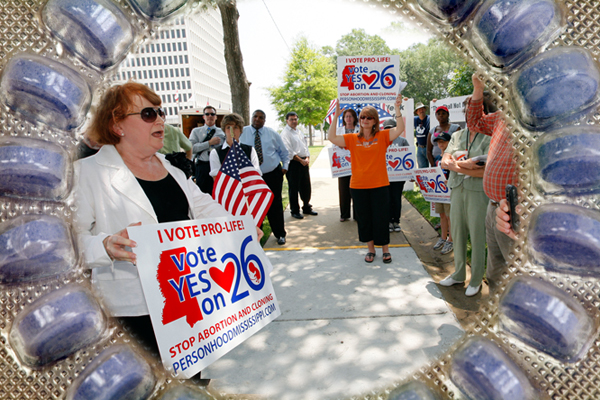
At a June 6, 2011, rally, Dr. Beverly McMillan, president of Pro-Life Mississippi, left, thanks the people gathered in Jackson, Miss., for their support on the state's proposed "personhood" amendment. (Credit: iStockphoto/meltonmedia/AP/Rogelio V. Solis)

Dr. Freda Bush has a warm, motherly smile. In her office just outside Jackson, Miss., she smiles as she hands me a brochure that calls abortion the genocide of African-Americans, and again, sweetly, as she explains why an abortion ban should not include exceptions for rape or incest victims. The smile turns into a chuckle as she recounts what the daughter of one rape victim told her: “My momma says I’m a blessing. Now, she still don’t care for the guy who raped her! But she’s glad she let me live.”

Bush is smiling, too, in the video she made to support as restrictive an abortion ban as any state has voted on, Initiative 26, or the Personhood Amendment, which faces Mississippi voters on Nov. 8. “It doesn’t matter whether you’re rich or poor, black or white, or even if your father was a rapist!” she trills. But Initiative 26, which would change the definition of “person” in the Mississippi state Constitution to “include every human being from the moment of fertilization, cloning or the equivalent thereof,” is more than just an absolute ban on abortion and a barely veiled shot at Roe v. Wade — although it is both. By its own logic, the initiative would almost certainly ban common forms of birth control like the IUD and the morning-after pill, call into question the legality of the common birth-control pill, and even open the door to investigating women who have suffered miscarriages.

Personhood amendments were once considered too radical for the mainstream pro-life movement, but in the most conservative state in the country, with an energized, church-mobilized grass roots, Mississippi could well be the first state to pass one. Initiative 26 even has the state’s top Democrats behind it.

And in Bush, it even has a respectable medical face. Last month, Bush led a press conference of fellow gynecologists to try to refute the “scare tactics” of the opposition, which includes even the solidly conservative Mississippi State Medical Association. (The group feared 26 would “place in jeopardy a physician who tries to save a woman’s life.”) In one of several “Yes on 26″ videos in which she stars, Bush says unequivocally, “Amendment 26 will not ban contraception.”

But when we spoke, Bush was far less sure. And if her smiling face carries the day, the debate over even basic access to birth control could be heading to similar votes in every state legislature, and extremists have their dream case to take to a Supreme Court where the Roe majority teeters precariously.

- – - – - – - – - -

That’s partly because the Personhood movement hopes to do nothing less than reclassify everyday, routine birth control as abortion. The medical definition of pregnancy is when a fertilized egg successfully implants in the uterine wall. If this initiative passes, and fertilized eggs on their own have full legal rights, anything that could potentially block that implantation – something a woman’s body does naturally all the time – could be considered murder. Scientists say hormonal birth-control pills and the morning-after pill work primarily by preventing fertilization in the first place, but the outside possibility, never documented, that an egg could be fertilized anyway and blocked is enough for some pro-lifers.

Indeed, at least one pro-Personhood doctor in Mississippi, Beverly McMillan, refused to prescribe the pill before retiring last year, writing, “I painfully agree that birth control pills do in fact cause abortions.” Bush does prescribe the pill, but says, “There’s good science on both sides … I think there’s more science to support conception not occurring.” Given that the Personhood Amendment is so vague, I asked her, what would stop the alleged “good science” on one side from prevailing and banning even the pill?

Bush paused. “I could say that is not the intent,” she said. “I don’t have an answer for that particular [case], how it would be settled, but I do know this is simple.” Which part is simple? “The amendment is simple,” she said. “You can play the ‘what if’ game, but if you keep it simple, this is a person who deserves life.” What about the IUD, which she refuses to prescribe for moral reasons, and which McMillan told me the Personhood Amendment would ban? “I’m not the authority on what would and would not be banned.” No – Bush simply plays one on TV. And if her amendment passes, only condoms, diaphragms and natural family planning — the rhythm method – would be guaranteed in Mississippi.

Bush also says in the commercial that the amendment wouldn’t “criminalize mothers and investigate them when they have miscarriages.” And yet if the willful destruction of an embryo is a murder, then that makes a miscarried woman’s body a potential crime scene or child welfare investigation. What about women whose miscarriages were suspected to be deliberate or due to their own negligence? One Personhood opponent, Michelle Johansen, told me she wondered whether she could have been investigated for miscarrying a wanted, five-week pregnancy, because she rode a roller coaster. (Her doctor ultimately told her they were unrelated.)

The boilerplate Personhood response, echoed by both McMillan and Bush, is that no woman was prosecuted for miscarriage before Roe v. Wade, so why start now? Of course, there was no Personhood amendment at the time, nor much knowledge of embryonic development.  And in countries with absolute abortion bans, like El Salvador, women are regularly investigated and jailed when found to have induced miscarriages.

Pressed, Bush said, “Look at the numbers of women who were injuring themselves [pre-Roe] in an attempt to have an abortion. It was not 53 million,” the estimated number of abortions since Roe v. Wade.

“I don’t have all the answers,” she said, “but those questions that are there do not justify allowing nine out of 10 of the abortions that are being done that are not for the hard cases,” she said.

But a Colorado-based Personhood activist, Ed Hanks, is more than willing to publicly take things to their logical conclusion. He wrote on the Personhood Mississippi Facebook page that after abortion is banned, “the penalties have to be the same [for a women as well as doctors], as they would have to intentionally commit a known felony in order to kill their child. Society isn’t comfortable with this yet because abortion has been ‘normalized’ — as the Personhood message penetrates, then society will understand why women need to be punished just as surely as they understand why there can be no exceptions for rape/incest.”

- – - – - – - – - -

Personhood represents an unapologetic and arguably more ideologically consistent form of the anti-choice movement. It aims squarely for Roe v. Wade by seizing on language from former Supreme Court Justice Harry Blackmun – the author of the Roe decision — during the hearings that the case would “collapse” if “this suggestion of personhood is established … for the fetus.”

Similar ballot measures have failed twice in Colorado, where an evangelical pastor and a Catholic lawyer started the Personhood movement, but Mississippi is no Colorado. It’s the most conservative state in the nation. Planned Parenthood (which doesn’t even provide abortions in its one clinic here) and the ACLU are dirty words. Where there were once seven abortion clinics in the state, the one remaining flies in a doctor from out of state. As for supporting life, Mississippi’s infant mortality rate is the worst of any state in the nation. It also has one of the highest rates of teen pregnancy nationwide, alongside a child welfare system that remains dangerously broken.)

Even so, if Initiative 26 passes, it would embolden similar efforts in Ohio, South Dakota, Florida and other states, currently trying to get a Personhood amendment on the ballot in 2012. And though there have been no reliable public polls, insiders on both sides believe it is headed for approval. “This thing will pass if people don’t understand what it really means,” says Oxford-based attorney and Initiative 26 opponent Forrest Jenkins. The Personhood movement “can either convince people that birth control is abortion or they can convince people that it’s not really true and we’re just being silly.” (Indeed, when I asked one college student who described himself as pro-life about the birth-control implications, he said, “I thought that was just gossip.”)  Unfortunately for opponents, talking about sweeping and nuanced implications takes a lot more words than “stop killing babies.”

Mindful of anti-abortion sentiment in the state, even the local pro-choice opposition has taken to referring to all these implications – like banning birth-control pills — as “unintended consequences” of the initiative. But as my conversations in Mississippi with pro-Initiative 26 doctors made clear, for many Personhood supporters, these effects are anything but unintended. They’re part of the plan.

- – - – - – - – - -

I had barely arrived in Mississippi when I was declared a “wolf in sheep’s clothing” by the grass-roots wing of the movement. Les Riley, the self-described “tractor salesman with 10 kids and no money” who got Personhood on the ballot, stopped responding to my messages, so I’d posted interview requests on the Personhood Mississippi Facebook page, disclosing that I was pro-choice but committed to giving them a fair hearing.

“This is just a reminder of some of the ‘Neutral and Fair’ mainstream media that are trying to lure us into debate, argument, and confrontation,” Wiley S. Pinkerton wrote on the same page, not long after. “They are coming to this site hoping to catch us without the full armor of God.”

Of course, even if I’d wanted to, the chances of catching any of them without “the armor of God” seemed remote. The Personhood movement in Mississippi is openly theocratic. Riley has written that “for years, the pro-life movement and the religious right has allowed the charge [of being “religiously motivated”] to make them run for cover. I think we should embrace it.” Riley, in fact, had already enthusiastically embraced Christian secessionist and neo-Confederate groups as part of his coalition. (The national media play his personal history received by the time of my visit this month might explain some of the hostility to the press.)

Last summer, a more mainstream face, Brad Prewitt – a lobbyist and former high-level staffer for U.S. Sen. Thad Cochran – took over the campaign at the request of the American Family Association, which, like Prewitt, is based in Tupelo. (Riley continues to actively campaign, though he isn’t listed on the official Yes on 26 site. Prewitt promised an interview several times, but never came through.) Prewitt, too, publicly described the conceptual origin of Personhood being “the Bible, Genesis,” and declared, “Mississippi is still a God-fearing state.”

At several public forums organized by the secretary of state to discuss ballot initiatives, resident Scott Murray’s statement was typical: “I know there is an issue with pregnancies, unmarried pregnancies, but I tell you the greatest prevention is God, and we’ve got to return to God.” So was Stephen Hannabass’ assertion that “we’ve got to repent. We’ve got to come before God and beg for mercy for our state and for our country.”

There are women in the Personhood movement too, of course. In Tupelo, two of them thanked the men who were “created to be protectors” and who “are to speak out for the women and children.” Another, who said she wished the law had protected her from her own choice to have an abortion at 18, took a more practical tack: “Yes, it’s going to cost us money, but you know what? Have we thought about the cost it’s already costing the state from the ladies who are hurting themselves and the babies and the hurts?”

- – - – - – - – - -

But is there mercy for women facing life-threatening pregnancies – specifically ectopic pregnancies, which are never viable and can seriously threaten a woman’s life? In countries with absolute abortion bans and in many Catholic hospitals, doctors often have to wait to operate until fetal death or until there is a rupture, increasing the risks to the mother and baby.

As for cases where a woman has to choose between pursuing treatment for a life-threatening illness and her pregnancy, McMillan said, “I like to think about them as a graph. You have health going up and down, you have time nine months going this way. Here’s the mother’s health going down, down, down over those nine months of pregnancy. Here’s the baby’s chance of survival going up, up, up over that nine months. What I pray to recognize is that when those two lines intersect. That’s not the time for an abortion but for a planned early delivery.” I pointed out that, say, cancer tended to involve far less predictability than she described. “It’s a medical wisdom thing. You try your best,” the doctor replied.

The Yes on 26 site speaks of “saving both lives” as if it’s an unequivocal setup in which doctors can just pick both. “You can’t write a law that takes into account all of the amazing range within pregnancies,” responds Randall Hines, a Jackson doctor who opposes the initiative. “That’s why physicians have to counsel patients given the best evidence that they have.”

Prewitt has also frequently proclaimed that in-vitro fertilization, which gave him his two sons, won’t be banned under the measure. But Hines, one of only three doctors who do IVF in the state, told me, “It’s conceivable that with this same amendment, some IVF practices would be illegal,” adding, “I’ve heard a variety of opinions and they all sound bad.”

This, too, is seen as simple by the Personhood crowd, whose understanding of the actual science is, well, simplistic. Alex Strahan, who described himself as Personhood’s Southern field director (he’s not currently listed on the site), said at the Tupelo hearing, “If you harvest 10 eggs and you implant three and you throw away the other seven, you’re aborting seven children. You’re aborting seven humans. You’re killing seven humans. So do it the right way and don’t kill children.”

The best chance of an in-vitro pregnancy involves a winnowing process, starting with harvesting eggs and ideally ending in a fertilized egg implanting, and embryos are usually frozen in the process. Using all of the fertilized eggs at once could result in a dangerous multiple pregnancy, or if fewer are used, a very low chance of success. Some Personhood people even want to do away with freezing embryos, because roughly half of the embryos don’t survive it. Hines says of these strategies, “We would lower the overall pregnancy rate and we would often fail.” He says several patients have called frantically asking what to do about their frozen embryos. “These people who say that they’re all about the sanctity of life are creating great anxiety for women who are already desperate to have children,” Hines says. Personhood advocates, including Prewitt, have also suggested couples give leftover embryos, if there are any, up for “adoption” by another family.

- – - – - – - – - -

So how did something so radical get on the ballot in a state where such initiatives are rare? Prewitt has admitted that he didn’t even sign the initial petition to get Personhood on the ballot, which was filed in February. That’s not particularly surprising; until Riley got close to, then exceeded, the 90,000 needed signatures, his cause was considered marginal and dangerous by many mainstream pro-lifers.

Personhood hadn’t just failed in Colorado; it had also helped elect a pro-choice Democrat to the Senate, according to that state’s Republican Party chair. (Michael Bennet had run ads saying opponent and Personhood supporter Ken Buck wanted to ban birth control, and by the time Buck backed off it was too late; Bennet won by dint of independent women.) Florida’s Catholic bishops opposed it as strategically unsound. (Mississippi’s Catholic brass followed.)  And it was just plain weird – there was its Coloradan leader (who also declined comment), darkly warning of a future of human-animal and human-robot hybrids unless Personhood amendments were broadly accepted.

It was the American Family Association endorsement that put media muscle behind the movement in Mississippi, with email blasts, radio PSAs and interviews, promotions on its own website, and combined with the grass-roots energy, the state’s anti-choice groups took notice. Suddenly, people who had previously focused on incremental change – parental consent laws, waiting periods, ultrasound laws – were ecstatically heralding an end of the “murders.” Mike Huckabee keynoted a fundraiser and even presumed GOP front-runner Mitt Romney to endorse the concept on his show. (It’s unclear if Romney knew what he was getting into.)

The state’s tiny pro-choice contingent was stunned by Personhood’s success. It didn’t help that a legal challenge mounted, and eventually lost, by the ACLU and Planned Parenthood delayed the official opposition. The Personhood coalition had been busy organizing – getting churches on board, showing up at every gun show, county fair and flea market telling people it would save babies — for months. But the opposition coalition, known as Mississippi for Healthy Families, waited until a state Supreme Court decision a month ago kept the initiative on the ballot. Before that, says Stan Flint, the managing partner of Southern Strategies who’s advising them, “People wouldn’t pull out a checkbook.”

They could expect no help from local Democrats. The party’s current candidate for governor, Johnny Dupree, who would be the first black statewide official since Reconstruction, supports Personhood. (Republican candidate Phil Bryant embraced Personhood early on, and co-chairs Yes on 26.) Only one of Mississippi’s legislators, Deborah Dawkins, has come out against the measure, telling the Huffington Post that her fellow Democrats “are at a different place in their life, they’ve got to have a job.”

Just how much Personhood has succeeded in moving the goalposts was clear at a recent gubernatorial debate. Dupree said he had concerns about rape and incest victims and the impact on birth control. “But I’m answering the question and voting on the question based on what was asked in the initiative,” he said. “That initiative says, ‘Where do you believe life begins?’ I believe life begins at conception.”

Cristen Hemmins, an anti-26 activist and survivor of a brutal carjacking, rape and shooting, told me she’d gotten a call from Dupree after repeatedly contacting his office. Dupree reiterated that he opposes abortion but thought there should be some provisions for rape and incest victims. Moreover, he said, his daughter had had an ectopic pregnancy and eventually had a child through IVF, both situations potentially impacted by Personhood.

“I said, ‘I don’t understand, if you’re for all these things … why are you voting yes?’” Hemmins recalled. “[Dupree] said, ‘I’m starting to see that there are issues … I’ve said I’m going to vote yes and it’s too late to go back on it now. It’d destroy me politically.’”

I tried to confirm those quotes with Dupree; he did not return calls to his cellphone.

But Democratic candidates aren’t the only ones who are scared. As one anti-Personhood woman angrily put it in a community forum in Cleveland, Miss., I attended last week, “They are counting on us being so afraid of being ostracized in our communities.”

Personhood advocates say all these ambiguities can be hashed out later by the Legislature – quite the small government line, leaving some room for the opposition to use conservative rhetoric.

“We feel it’s the greatest invasion of government into private family matters in the nation’s history,” says Flint. “We’re in a half a billion dollar budget hole. We don’t need ludicrous lawsuits about dangerously extreme constitutional amendments.” Anti-26 phone bankers have cited the possibility of higher taxes to pay for all of those lawsuits, criminal enforcements and presumed new additions to the Medicaid rolls.

Internal polling showed the initiative had overwhelming support among the state’s voters – until they heard the opposition messaging. “It’s the largest movement on numbers I’ve seen, in terms of the undecideds. It reverses the position,” says Flint. A straightforward abortion ban, he said, would have been tougher to beat. “They’ve given us all the ammunition we need to defeat it.”

Personhood could represent the most audaciously successful reframing of the national abortion debate yet – in which pro-choicers have to fight over whether forms of birth control are abortion, as opposed to ensuring a woman’s right and access to reproductive choice. But even in Mississippi, allowing the fringe to drive the antiabortion movement could represent the point where it overplays its hand.

If it’s the latter, the best hope for defeating Personhood in Mississippi lies in the hands of people like the stammering middle-aged man I saw rise at the same community forum. The room was full of indignant pro-choicers, but he described himself as a minister opposed to abortion. “I’m disturbed by this initiative,” he volunteered. “In the name of something that pro-life people like myself think is good – stopping abortions – we’ve designed this thing that is horrible, or has the potential to be horrible.

“I do have a concern about the broadness of this and the way that it says things,” he went on. “And I tell you, it’s almost like it’s not true. It’s like they come in — I don’t like people coming through back doors. And I think I’m more honest than that as a preacher. I hope I am.”

Irin Carmon

Irin Carmon is a staff writer for Salon. Follow her on Twitter at @irincarmon or email her at icarmon@salon.com.

Abortions made public

States want more data on abortion patients. Zealots want their hands on it. Shame is the new anti-choice strategy

(Credit: Cannaregio via Shutterstock/Salon/Benjamin Wheelock)

It was an “anonymous informant,” Operation Rescue claimed last week, after someone slipped them the April records of 86 women who were treated at Central Family Medical. The clinic’s lawyer was blunter. “It certainly appears to me that a crime was committed,” Cheryl Pilate told the Kansas City Star. Though the clinic (which performs abortions) had already reported a break-in to a locked dumpster, Pilate said it wouldn’t have contained patient records, which are shredded. The “informant” must have gotten the documents – containing names, addresses and details of procedures – another way.

“Our concern is for the privacy of these women and for their health and safety, for which Central Family Planning has shown very little regard,” said Operation Rescue’s Troy Newman – while posting photographs of the documents, partially redacted in black marker, online.

Antiabortion activists want to create the impression that one way or another, a woman’s decision to have an abortion will be discovered and exposed. The Central Family Medical incident is only the latest skirmish in a decades-long effort to undermine the privacy of abortion patients and harass doctors. In the early ’90s, for example, at least one group of clinic protesters printed on their signs the names of women seeking abortions that day, alongside “don’t kill your baby.” Such actions, while failing to make abortion illegal, have nevertheless managed to cloak it in a stigma that belies the fact that one in three women will have an abortion before the age of 45. Now, activists are seeking new ways to shame women who seek abortions, from requiring them to hand over personal information to actually hacking into their medical records.

Kansas has been ground zero for this: Last year, the Kansas Board for Discipline of Attorneys recommended that former Attorney General Phill Kline, a hero to Operation Rescue, have his legal license suspended indefinitely for mishandling the records from murdered abortion provider George Tiller’s clinic. (The Kansas Supreme Court will make the final call.) But the zeal to keep, and sometimes steal, abortion records casts a wide net.

In Texas, the state Department of Health is trying to implement a failed legislative measure that would require abortion clinics to report far more information about their patients to the state. In Florida, voters will weigh in on a ballot measure that would exempt abortion from the privacy clause in the state constitution, with the short-term aim being to strip minors of a right to privacy that would preclude parental consent. The U.K. recently jailed a hacker who stole and intended to publish the records of 10,000 women who visited the country’s largest abortion provider.

“It promotes the idea that abortion – or your privacy, if you have any – is not safe,” says Katie Stack, a graduate student and activist who spoke out about her abortion on an MTV special, “No Easy Decision.” That put her in close contact with the “online ministry” – the name antiabortion activists have given their efforts to reach women considering abortions through the Internet.

This has been the unstated goal of many activists in the antiabortion movement — and, sometimes, the stated one. “This might sound a little strange,” said antiabortion activist Lila Rose at the Value Voters Summit in 2009, but “if I could insist, as long as they are legal in our nation, abortions would be done in the public square, until we were so sick and tired of seeing them that we would do away with the injustice altogether … maybe then we might hear angels singing when we ponder the glory of conception.”

Rose won’t get her wish any time soon, but antiabortion activists are trying to use the Internet to have a similar effect. Rose was recently on a panel at the International Pro-Life Youth Conference about social media and pro-life activism, where topics included targeting women who are seeking information about abortion online, whether through Yahoo Answers or YouTube commenters – including figuring out where they live and recommending a crisis pregnancy center nearby.

“Privacy is very important to women who have abortions,” says Kate Cockrill, program director of the Social and Emotional Aspects of Abortion project, at the University of California, San Francisco. She points out that abortion is traditionally underreported even in confidential surveys, “which is a good indication that women don’t want to be associated with abortion experience in the eyes of someone who’s gathering data, even if it’s anonymous.”

Cockrill recently conducted a survey, as yet unpublished, that seeks to measure the impact of social stigma on women who’ve had abortions. It asked 641 women who had had abortions about 61 items, including questions about the fear people would gossip about you, judge you or hurt you, or the fear that you would lose an important relationship.

So far, she’s found that the women who experienced the most stigma were worried about being judged more than they were about being hurt or harmed, that they feared loss of social status and the ruining of their public identity, that they felt isolated and guilty, and that they feared community condemnation.

But as with other abortion restrictions, which create extra burdens in the supposed service of changing women’s minds, it’s not clear that anyone’s mind is being changed.

“Lots of women who feel a lot of stigma about abortions have abortion anyway,” Cockrill says. “If it’s not doing what antiabortion people want it to do, which is reducing the number of abortions, is it doing something on the other end, [after the fact]?”

Cockrill and her team are going to be using their scale in a study next year to look at the relationship between stigma and poor coping after abortion. Given that antiabortion activists have added to their obsessions the alleged harm abortion causes to women, there’s reason to believe that this is a self-fulfilling prophecy.

Women who have abortions, Cockrill says, “have a huge range of political views.” In fact, in her survey, only 62 percent of the women identified as pro-choice. (Seven percent identified as prolife, and 18 percent described their position as “mixed or neither.”)

“A lot of women don’t experience their abortions as a political act,” Cockrill says, partly an extension of the fact that they don’t see it as constitutive of their identity.

Whether it’s political rhetoric or individual ambivalence, these women are highly sensitive about whom they tell they had abortions. Sixty-four percent of the women in the study said they’d “withheld information about my abortion to someone I’m close to,” and 45 percent said they’d “lied to someone I’m close to about my abortion.”

They may not see it as political, but that silence functions as a vicious circle that antiabortion activists happily seize upon and promote. Cockrill says, “Some people say, ‘We need to have more people come out about their abortions.’ But it’s impossible to get more women to talk about their abortions if they don’t feel supported. And it needs to be on women’s own terms.”

Continue Reading Close
Irin Carmon

Irin Carmon is a staff writer for Salon. Follow her on Twitter at @irincarmon or email her at icarmon@salon.com.

Texas’ abortion enforcer

Fifth Circuit Court Judge Jerry Smith makes sure that the state's antiabortion legislation gets upheld

Jerry Smith

Here is what the state of Texas considers “irreparable harm”: Continuing to provide Planned Parenthood with federal funds for the Texas Women’s Health program, which it has done for several years. Here is what it does not find harmful: immediately denying healthcare access to tens of thousands of women who have been going to Planned Parenthood affiliates for basic health services that aren’t abortions.

On Monday, a U.S. District Court judge didn’t buy the state’s legislation defunding Planned Parenthood, putting a temporary stay on the enforcement of the law. But within a day, there was another judge who found the argument persuasive: Fifth Circuit Judge Jerry Smith, last seen obnoxiously demanding that a female Justice Department lawyer ”submit a three-page, single-spaced letter by noon Thursday addressing whether the Executive Branch believes courts have such power.” (Kevin Drum memorably compared it to “a middle school teacher handing out punishment to a student because of something her father said at a city council meeting the night before,” and you wouldn’t have to look hard to find the sexist condescension.)

The District Court judge had written 24 pages on the constitutional merits, focusing on Planned Parenthood’s First Amendment rights of association. Smith issued two sentences two hours after the state’s petition, undoing that, and apparently buying the state of Texas’ argument that Planned Parenthood’s alleged “abortion promoting” mission justified discriminating against a qualified provider of healthcare.  (The clinics receiving WHP funding don’t even provide abortions, but other Planned Parenthood clinics do.)

In an election year, these posturings take on new meaning; by today, Planned Parenthood was proclaiming in a news release, “What would Mitt Romney’s America look like for women’s health care?  We need look no further than Texas,” and highlighting the policy similarities of Romney and Perry on women’s health. Romney, of course, has pledged to defund Planned Parenthood, which during the primaries became a consensus Republican issue. The last federal attempt to do so, last year’s Pence Amendment, nearly shut down the entire government, though Obama held the line — as he pointed out in a recent campaign video supporting the organization.

The presidential policies matter, but as we can see from Texas, the judiciary, prompted by state legislatures that are coming off a wave of abortion restrictions, is currently wielding the most power when it comes to women’s everyday lives, and the 5th Circuit in particular has been unrepentantly hostile to reproductive rights. When they failed with Pence, right-to-lifers turned to the states, primed by the 2010 election of even more anti-choice legislators and governors. In Texas, the conservative 5th Circuit has become a brick wall, previously allowing enforcement of the most extreme ultrasound law in the country, one that requires a woman to listen to the results.

Smith is a Reagan appointee, as is his fellow 5th Circuit conservative gadfly Edith Jones, who wrote the opinion in the ultrasound case, though if they’re feeling particularly emboldened lately, you can’t really blame them. After all, the Obama administration has shown little interest in prioritizing the judiciary, even after Bush’s ambitious effort to fill federal appellate courts with movement conservatives. A January Brookings Institution report showed that Obama has nominated fewer federal trial judges than his predecessors, even as a wave of judges retires. (Unprecedented Senate intransigence is a major factor in confirmations, but doesn’t explain the nominations.)  And Dahlia Lithwick has argued that “Obama, like Bill Clinton before him, has selected lower court judges more notable for their racial and gender diversity than their hard-left judicial orientation.”

All of this is to say that as long as states like Texas keep passing laws that punish women and stretch the boundaries of constitutional interpretation, to put it mildly, the buck is likelier than ever to stop at a judge like Jerry Smith.

Continue Reading Close
Irin Carmon

Irin Carmon is a staff writer for Salon. Follow her on Twitter at @irincarmon or email her at icarmon@salon.com.

The myth of the “morning-after abortion pill”

There's a reason why people mistake emergency contraception and abortion: The right intentionally confuses the two

(Credit: Shutterstock/Salon/Benjamin Wheelock)

It started around February, when Republicans were still eager to talk about contraception. The Obama administration, or so Mitt Romney charged in Colorado, was forcing religious institutions to provide “morning-after pills –in other words abortive pills — and the like, at no cost.”

It was, of course, a lie. Romney was conflating two different pills: emergency contraception, known as the morning-after pill, which prevents a pregnancy; and chemical abortion, or mifepristone, which ends a pregnancy of up to seven weeks’ gestation and isn’t covered under the new guidelines. Since both pills were marketed in the U.S. around the same time, even some pro-choicers have gotten confused. But Colorado happens to be the epicenter of people confusing them on purpose. It’s the birthplace of the Personhood movement and home to Focus on the Family, both of which have strategically called emergency contraception “abortion” on the scientifically unproven basis that they could block a fertilized egg from implanting.

There are a host of ironies here. Obama has earned the renewed support of reproductive-rights advocates by requiring health insurers to cover contraception, but the Center for Reproductive Rights is still taking him to court – with oral hearings being held this week before a New York federal court -– for overruling the FDA’s recommendation to lift the prescription requirement on emergency contraception for women under 17. That litigation has been winding its way through the system for over a decade, throughout the Bush-era politicization of the FDA, eventually resulting in a federal judge concluding that “the FDA repeatedly and unreasonably delayed issuing a decision on [the emergency contraception pill] Plan B for suspect reasons.” The FDA was ordered to explain why Plan B shouldn’t be available over the counter for girls 13 and up. When the Obama administration overruled the FDA’s recommendation to make it over the counter, U.S. District Judge Edward Korman suggested the Center for Reproductive Rights reopen its case.

“It seems to me that what we’re going through is a rerun of what happened before,” Korman remarked, referring to politics trumping the recommendations of medical professionals.

The Obama administration’s unspoken but unmistakable fear was of an election-cycle attack line that Michele Bachmann would use anyway: That teenage girls would be able to get Plan B from “the grocery store aisles next to bubble gum and next to M&Ms.” That was, in fact, an echo of the language President Obama himself used to invoke a highly unsupported bogeyman: that “a 10-year-old or 11-year-old going to a drugstore would be able to, alongside bubble gum or batteries, … buy a medication that potentially if not used properly can have an adverse effect.”

But there is another twist, so far mostly overlooked: Emergency contraception won’t be covered by insurance for everyone, since it’s available over-the-counter for those who can show I.D. proving that they’re 17 or older. They’ll still have to fork over around $50 a pop. But as long as girls 16 and younger need a prescription for the morning-after pill and they have insurance, it will be fully covered — effectively free. The same goes for women older than 17 who decide to jump through the hoops of getting a prescription, either for over-the-counter Plan B or the prescription-only generic and Ella versions.

As much as pro-choice advocates want to lift the barriers that make emergency contraception hard to get — because it’s more effective the faster you use it — one of those barriers, the prescription requirement, also mitigates another, the high cost. Said Adam Sonfield, a senior public policy associate at the Guttmacher Institute, of this catch-22, “It presents a tradeoff between cost and access.”

– – — – — – — – — – — – — – — – — – — – — – — – –

Part of the reason people get confused about emergency contraception and abortion is because lots of people are confused about the basic biology of pregnancy: specifically, that it doesn’t necessarily happen instantaneously and that sperm can live in the body for several days, during which time a woman can ovulate and an egg can potentially be fertilized and implant. Regular use of hormonal contraception prevents ovulation and the chance for fertilization; emergency contraception essentially works the same way except that it’s taken after sex, by which point ovulation may have already happened. But according to recent studies, there is no evidence that taking emergency contraception after ovulation and fertilization will stop the egg from implanting.

But the misinformation and misunderstanding have created a contradictory public health picture when it comes to emergency contraception. In some ways, it’s become more accessible. In 2010, the U.S. approved a longer-acting French variant of Plan B, known as Ella, and there are scattered experiments in convenient delivery, from a birth-control vending machine at Shippensburg University in Pennsylvania to a new bike messenger service in London, both of which caused minor news sensations. The annual “Back Up Your Birth Control” campaign has been promoting the line “EC=BC,” emphasizing that emergency contraception is birth control, not abortion — just in case that is a barrier for women who are considering taking it. And the Center for Reproductive Rights’ petition did manage to lower the age restriction from 18 to 17.

But there are more disturbing suggestions that misinformation is triumphing. A recent Boston Medical Center study found that many pharmacists were still often misinformed about the age requirement and were even more likely to wrongly refuse emergency contraception to 17-year-olds in low-income neighborhoods, where the rate of unintended pregnancy is higher. In Honduras, the Supreme Court upheld the criminalization of emergency contraception, which means women who use it could be jailed. Personhood initiatives, which oppose the morning-after pill, have so far failed in Colorado, Mississippi and Oklahoma, but they’ve introduced false doubts by providing even more opportunities for pundits and candidates to say “the morning-after abortion pill.”

It’s a problem that dates back decades: When, throughout the ’90s, the U.S. considered approving a French chemical abortion pill known as RU-486, it was widely called the “morning-after abortion pill,” including, often, in the New York Times. The distinction wasn’t pressed by the pro-choice community itself.  “At the time, the prevailing medical wisdom was that there is a continuum rather than a bright line between EC and mifepristone,” said Gloria Feldt, who was president of Planned Parenthood at the time, with the benefit providing more options for women who did not wish to be pregnant. “It was also assumed that a formulation of mifepristone would eventually be made for use as a true ‘morning-after’ pill.” The widespread belief, she recalled, was that a chemical abortion pill would “solve all the abortion debate problems and guarantee privacy.”

Another problem was that although doctors and non-professionals had been giving women high dosages of regular birth control pills for decades as a form of emergency contraception, the science of exactly how emergency contraception worked remained unclear. The medical definition of pregnancy remains “implantation of a fertilized egg,” but let’s say you believe, as the Catholic Church does, that fertilization itself creates a human life. Anti-choice advocates obsess over what would happen if a woman who took emergency contraception did happen to ovulate anyway and an egg potentially was fertilized, which is enough reason for some of them to call postcoital contraception “abortion.” They have claimed that hormonal contraception makes the lining of the endometrium inhospitable to a fertilized egg, constituting “murder.” Even the official packaging for Plan B, the single-step version of emergency contraception, suggests that “in addition” to blocking ovulation and fertilization, “it may inhibit implantation (by altering the endometrium).”

Except that we now know it doesn’t, even if you walk down the path of remote maybes, which requires you to believe that a zygote, which may not implant for unknowable reasons, has the same rights as a living woman who doesn’t want to be pregnant. As Princeton’s Kelly Cleland pointed out recently, “The science has evolved considerably in the last 13 years. Newer evidence, published since the Plan B label was approved, provides compelling evidence that levonorgestrel EC (LNG EC) works before ovulation, but not after.” The International Consortium for Emergency Contraception and the International Federation of Gynecology & Obstetrics also note that two new studies have shown conclusively that if a woman has ovulated and an egg has been fertilized, it’s too late for emergency contraception to work. They recommended that the language on the product labeling be changed.

Of course, scientific evidence has rarely had much place in this debate. In the meantime, even the most non-ideological news sources keep making the mistake alongside the ideologues. Last week, a furor erupted after the Associated Press reported that “Women seeking to take emergency contraception like the so-called ‘morning after’ pill would have to do so in the presence of a doctor under a bill before the Alabama legislature.” That is, until Erin Gloria Ryan from Jezebel read the actual bill and saw that it was, in fact, a law meant to limit chemical abortion, not emergency contraception. (A spokesperson for the AP said a correction was being prepared). “The confusion over this issue is probably one of the reasons emergency contraception hasn’t had as positive an impact as hoped when it comes to lowering the abortion rate,” wrote Amanda Marcotte at RH Reality Check. “If women think it is some kind of abortion-ish thing, they probably think taking it is a big deal, instead of thinking of it more like taking the pill, since it’s basically the same thing.”

But talk about moved goalposts. If ’90s-era advocates had hoped that the ability to end a pregnancy in the safety of your home with RU-486 — the actual abortion pill, not the morning-after one — would defuse the abortion debate, their more recent counterparts hoped to take it to the next technological level by providing “tele-med” abortions. They would involve doctors seeing a woman over webcam with a nurse practitioner physically present, helping women in remote areas with ever-dwindling options for safe abortions to access them. But four states have already passed requirements meant to undercut these options by forcing a doctor’s presence, and the bill the Associated Press misreported was aiming to add Alabama to the list. All in all, there have been fewer gamechangers, and more cases of one step forward, two steps back.

Continue Reading Close
Irin Carmon

Irin Carmon is a staff writer for Salon. Follow her on Twitter at @irincarmon or email her at icarmon@salon.com.

Tuning out bad abortion laws

One woman's idea on how to counteract invasive ultrasound and sonogram rules: Hand out iPods at Planned Parenthood

(Credit: Kostia via Shutterstock)

“I don’t know how you make anybody watch. You just have to close your eyes,” Pennsylvania Gov. Tom Corbett notoriously said of a now-shelved forced-ultrasound law in his state. Now one enterprising pro-choicer online has offered another option: Drowning it out with music.

Although it’s the transvaginal ultrasound laws that get all the attention, the true cutting edge of abortion restrictions is currently in place only in Texas, which not only mandates ultrasounds before abortion but also compels the woman to listen to a description of the sonogram and to a fetal heartbeat. (An attempt to get the law struck down on First Amendment grounds  — both the woman’s and the doctor’s right not to be forced by the state to submit to ideological speech — has so far failed, and the law is currently being enforced.)

Although there is technically an exception for cases of medical emergency, the regulations are still little-understood, as seen in a widely read account in the Texas Observer by Carolyn Jones, who had a second-trimester termination of a wanted pregnancy because of a genetic defect after that law took effect. One paragraph of that story in particular struck Denise Paolucci, 35. The doctor is quoted as saying, “I’m so sorry that I have to do this, but if I don’t, I can lose my license,” and then there’s this passage: “Before he could even start to describe our baby, I began to sob until I could barely breathe. Somewhere, a nurse cranked up the volume on a radio, allowing the inane pronouncements of a DJ to dull the doctor’s voice. Still, despite the noise, I heard him.”

Paolucci had an idea. She’d just been offered an iPod at the dentist’s office to drown out the drill – why not have the same for women having abortions? She decided to solicit donations to buy iPods for all of the Planned Parenthoods in Texas that provide abortions so that women who don’t want to hear the state-sponsored script can have another option.

“Here is something that is utterly miserable for her to have had to go through, and now the state is putting all of these micro-aggressions piling on top of that,” Paolucci told Salon.

She contacted several Planned Parenthood branches to check that they would be up for her plan, and heard back from a few of them. Last night, she posted about the idea on her blog at Dreamwidth, the site she co-owns and helps run. “It took about nine hours, overnight, to reach the goal,” initially set at $1,060, she says. If there’s more interest, she’s looking for help in finding independent abortion providers in Texas who’d be up for it, and has encouraged her readers to donate directly to Planned Parenthood or to the National Network of Abortion Funds.

Paolucci sees the drive as a way to channel anger into something specific and attainable. “We can’t fix the big ones. I can’t go down to Texas and overturn this law, but I can donate and I have and I will,” she says. Of the current legislative climate, she adds, “Women always think that, OK, we’ve won this time, we can relax. I think this last year of the legislative agenda has proven pretty much beyond all doubt that no, we can’t relax.”

Continue Reading Close
Irin Carmon

Irin Carmon is a staff writer for Salon. Follow her on Twitter at @irincarmon or email her at icarmon@salon.com.

Abortion options fade in South

Have antiabortion activists finally found a way to drive two women's clinics out of Mississippi and Alabama?

(Credit: iStockphoto/sjlocke)

The New Woman All Women abortion clinic in Birmingham, Ala., survived a 1998 bombing, though Eric Rudolph’s terrorist attack took the life of a security guard and seriously injured a nurse. In Mississippi, Jackson Women’s Health is the last abortion clinic standing in the entire state. But both clinics, which share an owner, will likely soon close their doors – not by dint of violence, but by legislation, regulations and enforcement explicitly designed to shut them down.

Last week, Diane Derzis, who owns both clinics and several others, signed a consent order by the Alabama State Board of Health relinquishing New Woman All Women’s license to perform abortions by May 18. Any entity that might take on the license “must agree that it or he/she will not employ Diane Derzis” or another unnamed employee. Antiabortion activists celebrated, calling the clinic a “very dark and deadly place,” though the vast majority of the violations cited in the Board of Health’s report concerned record keeping and legibility of reports.

And any day now, Mississippi Gov. Phil Bryant is expected to sign into law a bill that would require abortion providers to have admitting privileges at a local hospital. Derzis told the press that would likely shut down the Jackson clinic. Only one of the three doctors who perform abortions at her clinic has such privileges, and hospitals commonly refuse to admit abortion providers. That was the goal: As Bryant said of the legislation, “As governor, I will continue to work to make Mississippi abortion-free.” Derzis vowed to challenge the law in court.

Derzis is no shrinking violet. She once jokingly said that her fellow clinic workers think “I’m such a hard bitch.” She was said to carry a Beretta to work (not unreasonable given two doctors she’d worked with have been murdered), and earned the nickname the “abortion queen.” But she didn’t respond to Salon’s repeated requests for comment on the pending closures, and an employee at the Birmingham clinic said Wednesday that Derzis wasn’t speaking to the media.

Of all the innovative abortion restrictions passed from state to state, so-called TRAP laws – targeted regulation of abortion providers, which impose expensive and often unenforceable restrictions that other outpatient facilities aren’t subject to – may be the most insidious and the most effective. They often involve arcane building specifications and licensing requirements that, to the layperson, can sound either eminently sensible or too dry and boring to rally around. And by fighting them, providers risk falling into the anti-choice narrative that they are back-alley butchers who resist law enforcement, despite the fact that fewer than 0.5 percent of abortions involve complications that require hospitalization.

“We’ve seen these regulations become more and more onerous,” says Elizabeth Nash, state issues manager at the Guttmacher Institute. “Ten years ago, what you would think of as a clinic regulation law pales in comparison to what you see now. Not only are they affecting those clinics currently open, they are strong disincentive for those who would want to open a clinic.”

A 2008 Guttmacher Institute study found that a third of all women of reproductive age lived in the 87 percent of counties nationwide without an abortion provider. And the number of providers has declined: Between 2005 and 2008, Alabama went from 13 providers to eight. As Nash pointed out, the numbers have likely declined since then. In 2008, Mississippi had two abortion clinics; it currently has one – and soon may have none. If Jackson Women’s Health closes, it would likely mean women traveling to neighboring states, when possible, to seek abortions, which tends to result in later and more expensive abortions. (In Birmingham, Planned Parenthood still provides abortions.)

Derzis has been on the front lines of the abortion war since the 1970s, as a clinic administrator and owner, and as a litigant. In 1987, she accompanied the first teenager to the state of Alabama’s first hearing seeking permission to have an abortion without parental consent. In Marlene Gerber Fried’s book “From Abortion to Reproductive Freedom: Transforming a Movement,” Derzis is described as a “tough, chain-smoking rail of a woman with dark blond hair and long red fingernails,” who on every anniversary of Roe v. Wade gives all of her patients “red roses and notes that tell them they are part of a critical, historical movement to protect a woman’s right to choose.” She briefly quit as director of Birmingham’s first abortion clinic, Summit, saying she had tired of the hostility. “I don’t see any end in sight. We used to be able to laugh and talk on the picket lines.” That was in 1996, but she was soon drawn back in when the owner of New Woman All Women volunteered to sell her his practice. And she oversaw the reopening of the clinic after the first fatal bombing of an abortion clinic in the United States. When Dr. George Tiller was murdered by an antiabortion terrorist, Derzis told CNN, “The only way they see to take care of this is to kill us. This is just the first of what I foresee as many more.”

Last fall, when the proposed “Personhood” ballot initiative threatened to shut the Mississippi clinic, Derzis allied herself with the opposition group that had “Hell No” in its name, while Planned Parenthood and the ACLU opted for the more diplomatic “Mississippians for Healthy Families.” A YouTube video from a Hell No on 26 and 27 (a voter ID initiative that, unlike Personhood, passed) rally shows Derzis describing the proposed constitutional amendment to give fertilized eggs full rights as “a law engineered by do-goodin’ politicians, born agains, outsiders — I’m gon’ tell you what they are, they’re evil people. Those are people who care more about the fertilized egg than the vessel containing it. That’s how they look at us … we are uteruses with legs.”

New Woman All Women’s most recent troubles started when Derzis called 911 on Jan. 21 because two women had accidentally been given 10 times the intended dosage of the drug Vasopressin. The protesters outside – whom Derzis had repeatedly battled in court – said they photographed the women getting into the ambulance and filed a complaint with the Department of Public Health. According to the subsequent report, “the registered nurse that made the medication error has had disciplinary action taken against her by the clinic. Medical records and interviews with clinical staff at the clinic did not indicate the patients were in immediate danger.” But the subsequent investigation produced a 76-page report, which mostly details violations of documentation — such as failing to have clear job descriptions for various employees and adequate orientation procedures — and legibility of records. Other findings were more serious, such as a chart being signed off by a nurse who wasn’t present in the clinic on that day and failure to document the monitoring of a patient who was given Pitocin. All added up to the surrender of the clinic’s license, rather than go through protracted negotiations.

In the meantime, women in Mississippi and Alabama are slated to have fewer safe options to end a pregnancy than they have in decades. Leola Reis, an external affairs officer for Planned Parenthood of the Southeast, which includes Alabama and Mississippi, points out that the initial lifting of state abortion bans in Roe v. Wade focused on the public health risk illegal abortions posed to women. “Do we want to go back to those times?” she said. “I don’t believe we do.”

Continue Reading Close
Irin Carmon

Irin Carmon is a staff writer for Salon. Follow her on Twitter at @irincarmon or email her at icarmon@salon.com.

Page 1 of 127 in Abortion

www.salon.com/topic/abortion/