Thursday, Oct 27, 2011 6:00 PM UTC
In a few islands of prosperity, Americans are flourishing. This is where -- and why SLIDE SHOW
By Daniel Denvir and John Paul DeWitt
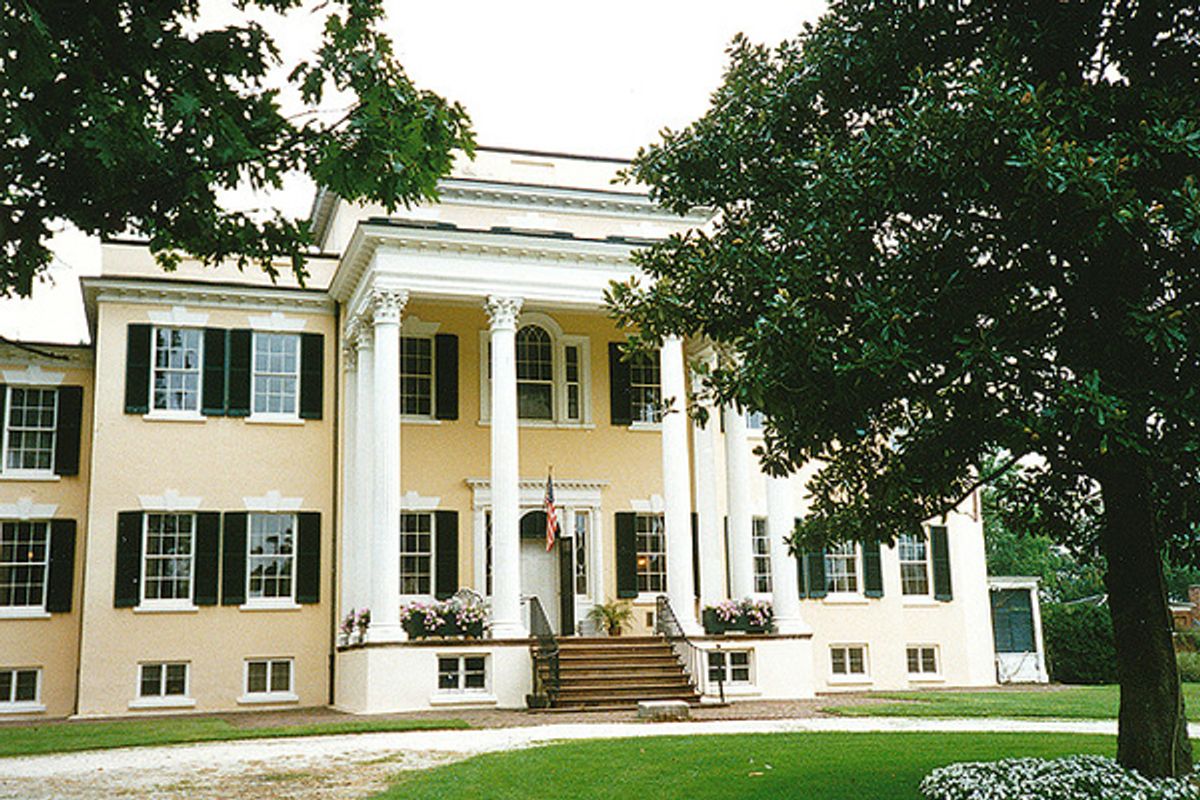
A Loudon County home (Credit: lcm1863 / CC BY 3.0)View the slide show
Census Bureau data released today shows how five of America’s wealthiest counties have gotten wealthier while most of the rest of the country endures foreclosures, joblessness and recession.
As the Occupy Wall Street movement has zeroed in on the wealthiest 1 percent of Americans who dominate politics, the geography of American wealth and poverty displays a slightly more complicated picture. Some of the country’s richest counties are flourishing as bastions of the upper middle class or just plain rich — but not necessarily of the super rich. These are already well-to-do areas where median income has grown since the recession began in 2007. In this sample, only one, Rockland County, N.Y., is partially fueled by Wall Street money.
The others, selected for geographic and economic diversity, embody the contradictions of a country that often rejects government rhetorically while embracing it practically.
In Loudoun County, Va., many are benefiting from ever more privatized government and military spending by the federal government.
In Wyoming, Gillette County makes much of its money from the extraction of low-sulfur coal made commercially profitable by the Clean Air Act.
Fayette County, Ga., and Rockwall County, Texas, are wellsprings of the Tea Party movement. Though the government funded the mortgages in their suburbs and paid for the highways that connect them, many residents in these areas persist in believing that their success has little to do with government.
In so many ways, we all pay for America’s few economic bright spots.
View the slide show
Tuesday, May 29, 2012 5:00 PM UTC
Mark Ulriksen, best known for his New Yorker covers, paints family dogs, politicians and the San Francisco Giants SLIDE SHOW
By Anna Hiatt
(Credit: Mark Ulriksen)View Mark Ulriksen's Artist Showcase
Welcome to Salon Studio's first installment of the Art Room, a new weekly feature highlighting artists and their work.
Looking at Mark Ulriksen’s boldly colored paintings, it’s hard to see where his style ends and the New Yorker’s begins. Since 1993, his work has graced the magazine’s cover more than 30 times, and he’s working on his next one now. His most recent cover, for the May 28, 2012, issue, depicts crowds of college graduates in their caps and gowns stranded on ice floes.
In between creating covers for the New Yorker, Ulriksen freelances illustrations to other top magazines, including Mother Jones, and paints family and dog portraits. “With New Yorker covers, you’re kind of responding to the zeitgeist. You’re trying to be timely and funny. With dog portraits you don’t have to be funny,” Ulriksen said.
Ulriksen jokes that he didn’t become a good illustrator until the early ’90s. He spent years commissioning work for San Francisco Focus magazine. In 1993, magazines began responding to his work, and in one week, Rolling Stone, GQ and Esquire called to buy artwork. He switched soon after to making art as a full-time freelancer.
In 2006, shortly after Vice President Dick Cheney’s hunting accident, Ulriksen parodied the “Brokeback Mountain” movie poster, casting President George W. Bush and Cheney as the lover cowboys. Ulriksen’s piece was named the year’s top magazine news cover by the Magazine Publishers of America.
In between doing commissions and filing editorial illustrations, Ulriksen makes time for personal pieces. After the San Francisco Giants won the 2010 World Series, he spent a month, painting 10 hours a day, to complete a 4-by-5-foot image of the starting lineup of the new championship team. He’s sent prints of the painting to members of the team, including Tim Lincecum and Brian Wilson, to share with them his piece honoring their championship season. A print of the Giants painting hangs on the wall of a lower Manhattan bar called Finnerty’s. But he has yet to sell the actual painting, which hangs in his house. His art is in the permanent collections of the Smithsonian and the Library of Congress. Ulriksen lives in San Francisco’s Cole Valley with his wife, two daughters and the family’s chocolate Labrador, Henry.
View Mark Ulriksen's Artist Showcase
Continue Reading
Close
Tuesday, May 29, 2012 1:00 AM UTC
Slide show: Everyone's favorite light-bondage bestseller illustrated by inexplicable stock photography SLIDE SHOW
By Salon Staff
View the slide show
This week, for roughly the millionth time, E.L. James’ romance-bondage trilogy “50 Shades” nabs the No. 1, 2 and 3 spots on the New York Times bestseller lists. We don’t get it either. Every page of that book, which famously began as “Twilight” fan fiction, elicits a sigh of confusion and weird secondary embarrassment. The question is: Who would read this? (The answer is: Apparently everyone.) It’s the same baffled, helpless feeling we get when we sort through stock photos on a daily basis. Stock photos – which have been the subject of recent outstanding Internet satire – are used by this site, and many others, to illustrate our flood of content. Many are plain and simple, but a good portion are flat-out mind-blowing. Why did anyone think that photo was a good idea? It only made sense to join these forces. And so, we present to you passages from the most head-scratching bestseller of our time, illustrated with the assistance of inexplicable stock photography.
View the slide show
Monday, May 14, 2012 12:00 AM UTC
From "Tiffany's" to "Khan," we look at Hollywood's illustrious tradition of casting white actors in non-white roles SLIDE SHOW
By Aasif Mandvi
View the slide show
The extraordinary box office success of "The Hunger Games" has launched a heated discussion of Hollywood's peculiar habit of casting white actors in nonwhite roles. Why does this happen? We decided to turn to a very important studio chief for answers -- channeled here by comedian (and "Daily Show" correspondent) Aasif Mandvi.
All I have to say is that whitewashing has been going on since as long as Hollywood has existed — it’s a tradition — and rather than non-white people complaining about it, they should embrace it. It will make going to the movies so much easier and more fun. But there are just a few things you need to understand.
First, stop watching movies as ethnic people and start watching them as white people. There’s nothing that white people like more than seeing other white people in movies and on television. When you go to the movies with your ethnic “judgment” eyes, you miss my point. Watch as a white person, and suddenly your outrage turns to understanding and laughter.
Take a minute to walk to your limousine in my Gucci shoes, and you’ll realize that I’m just trying to make people smile. Mickey Rooney with buckteeth and a crazy accent in “Breakfast at Tiffany’s”? It’s so much funnier than finding a real Chinese actor just talking like himself. Then you’d have to get a screenwriter to actually write genuinely funny lines for that character. You get so much more comedy bang with buckteeth and a funny accent. I mean, it made me laugh. Many people, including myself, were also convinced that Charlton Heston truly was a Mexican/Native American/Egyptian/Ape who talked to God. And I think I convinced a lot of Asians that Genghis Khan really did look like John Wayne back in the ’60s. “Short Circuit” was one of my biggest hit movies and I was completely convinced that Fisher Stevens was Indian. Who knew he was a Jewish guy from New York? That accent was spot on!
My point is, I’m not the bad guy. I’m just the rich guy. When you look at it through my studio executive lens, you understand how important it is that both white people and non-white people believe that Indians, Asians, Mexicans and Arabs are truly just white people in brown makeup. I don’t like thinking that way. I just don’t have the luxury not to. I’m a businessman. White people spend more money on shit than anyone else. (Except on fast food, which is mostly blacks and Mexicans … at least that’s what I have heard. I’m a vegan.) So hey, non-Caucasians, stop buying tacos and start buying Cadillacs.
White people are also cheaper to light than dark-skinned people, and just so you know, you the moviegoer end up paying for that extra cost. Sometimes it’s just too unbelievable to cast an ethnic actor. I turned away a lovely Indian actress once who auditioned for the role of a hobbit. I mean there are no Indian hobbits. Audiences would never believe that.
Now, look: I am trying to do the right thing. America has changed and Hollywood should attempt to portray a truer depiction of the ethnic diversity that makes up this country. The fact that many television shows now hire a certain percentage of non-white actors is a step in the right direction, right? I am even prepared to make a deal with you ethnic people out there. Every time you let me cast a non-Caucasian character with a Caucasian actor, I will give you two or three non-white actors in smaller supporting roles. Why not lead roles? Because I’m trying to make a living here. I have spent a lot of time and money throughout history convincing everyone that white is normal. I have even convinced non-white people that white is better, prettier, smarter, stronger, and that only white people can truly be the heroes. Everyone has bought into it, and now you want me to just abandon all my hard work? OK, I will make an exception for some of you non-whites: If you are a hot Latina, you can be the lead. Why? Because white guys want to fuck Jennifer Lopez.
Here are a few more key elements to remember when watching a movie the way white people have been programmed to react. Laugh at the funny accents, because they are funny. Ignore the source material; I’m making movies, I don’t give a shit about staying true to your comic books. And … hold on! Why the fuck is Idris Elba playing a Norse God!?
To view a slide show of Hollywood’s egregious moments in white-washing, click on the link below — and share your own most memorable moments in the comments. (Slide show by Max Rivlin-Nadler)
View the slide show
Continue Reading
Close
Wednesday, Mar 7, 2012 4:59 AM UTC
A blog uses the Google maps function to scope out cute guys. Is it fun, art -- or a creepy invasion of privacy? SLIDE SHOW
By Lucy McKeon
View the slide show
Most people use Google Street View for practical purposes, whether to look at the façade of a building and discover how an old neighborhood has changed or to check out the looks of an one not yet visited. But a new blog has found a novel use for the Google application: checking out guys. For the last five months, Dudes From Views has been collecting images of men culled from Google Street View, with some concise commentary: “Smooth Ukranian”; “Triceps and biceps on Christopher Street.”
But beyond just being a novel, tongue-in-cheek use of technology, “Dudes From Views” raises interesting questions about the subtle ground between what one might call voyeurism — secretly taking pictures of attractive, half-naked people and posting them in a public space — and public information. To get more insight into this Big Brother-meets-peepshow hybrid, Salon corresponded with the blog’s creator, Brad, over email, about his method, issues of privacy and the Google gaze. Click above for a slide show of images from the site.
How did you come up with the idea for Dudes From Views?
I live in NYC and use Google Maps and Street View a lot in general. I’ve seen sites like 9-Eyes that find serious photography from Street View and have wanted to do my own spin. One time I went to Google’s site promoting Street View at famous landmarks around the world and saw they had photos from beaches, so I thought finding guys in Street View (and other similar sites) would be a fun and novel take on blogs that just post pictures of hot guys.
How do you find your photos? It seems awfully labor intensive — I’m legitimately curious.
I think of public places where people are likely to be without their shirts, like beaches, gyms entrances, running trails, and then I find those places in cities that have Street View (or similar services). Sometimes it’s frustrating because the photos will be taken early in the morning when there’s few people around, or during colder seasons when people are more bundled up. That strategy works better for Google if they’re trying to get pictures of buildings, but not for me. And sometimes it can take a while to find a picture I can use (people need to be pretty close to the camera).
The site raises some interesting questions about privacy — there have been controversies about Google Earth taking pictures of naked people, like recently the woman in Florida.
It’s an interesting problem. My feelings are that Google only drives their cars through public places and they’re capturing what everyone else out in public can already see. Their cars are clearly marked and have a giant camera on top, and I often see people waving at them. If you’re doing something embarrassing, you’re already exposing yourself to whoever can see you if you don’t do it behind closed doors. Google just needs to make sure they have an easy way for people to notify them, and for them to react quickly, when someone has an issue with the photos. Other sites, like Daum in Korea, sometimes blur out entire bodies, but then Yandex in Russia doesn’t blur anything out at all.
As far as my site goes, I’m using photos that these sites have already allowed, and I wouldn’t want to post anything embarrassing.
In modern photography criticism, it’s become almost common wisdom to associate power and violence with the photographer (and camera’s) position. Do you think this idea translates when thinking about the cameras of Google Earth and Street View?
I’m not sure. There is a sense of “Big Brother” with what Google’s doing, especially with the scale that they’re doing it in, but that applies to all their products in general. The Street View photos are fairly automated, and Google’s limited in the places their cars can travel (either physically or by jurisdictions in the cities or countries they want to map). Other than that, I don’t think the power lies with Google’s cameras at all, just the few people like me who are crazy enough to try to curate them in the arduous way that we can.
What would your reaction be to someone making the equivalent about women — something like Chicks From Views? Have you seen the groupings of Street View pictures of alleged prostitutes?
There’s definitely a double-standard. I honestly don’t think a Chicks From Views would last very long. It’s a lot more acceptable amongst gay men to (discreetly) ogle at other men, even if they have a boyfriend, than it is for a man to stare at women. And it brings up a lot of issues with misogyny, objectification, etc. Prostitution is an even more sensitive subject, and I wouldn’t want to post pictures of that (or people doing anything else illegal) even if it were pictures of men. The point of my site is to do the equivalent of elbowing your friend to look at the hot guy that just walked by.
View the slide show
Continue Reading
Close
Saturday, Nov 12, 2011 1:30 AM UTC
Slide show: From Altman to Spielberg, here's a list celebrating Hollywood's most versatile composer SLIDE SHOW
By Matt Zoller Seitz
View the slide show
A couple of weeks ago, my young son asked me if I had “any more DVDs of John Williams movies.” It took me a second to register what he meant by this. He thought that the prolific Hollywood composer was actually the director of some of his favorite movies, a list that at this point consists entirely of the fantasy, science fiction and adventure films that thrilled me and his older sister as kids and kids-at-heart: “E.T.,” “Jaws” and “Close Encounters,” the “Jurassic Park” and “Harry Potter” and “Star Wars” and Indiana Jones pictures, and many others. I started to explain that Williams was not actually a filmmaker. But then the truth of his assumption hit me: In a sense, Williams is the unnamed co-author of a good many of the films he’s scored. His galloping, wondrous tone promises a particular type of entertainment, and is so recognizable that we can’t think of certain blockbusters without hearing their themes in our heads.
But as even some adult moviegoers sometimes have to stop and remind themselves, there is more to Williams’ career than iconic theme music for tales of mayhem and magic. He’s been the go-to composer for a particular type of blockbuster ever since his second collaboration with Spielberg, 1975′s “Jaws”; their long collaboration will be analyzed on Turner Classic Movies next week in an episode of “AFI Master Class.”
But the 79-year-old multiple Oscar-winner’s work predates the career of Spielberg, George Lucas and almost everyone else he’s worked with. His career spans an array of eras, genres and modes. He started out as a jazz pianist and session musician and has often worked brilliantly in that vein. He’s done superb scores for horror films, mysteries, romances and grim historical epics. He even did fanfare for the 1984 Olympic games and the long-running theme to “The NBC Nightly News With Tom Brokaw.” He’s as versatile as any character actor and as durable as any great movie star. His résumé is so lengthy — 140 titles and counting! — that the following list of 10 favorites could easily be swapped out for a totally different list. And knowing you, my dear reader, you’ll do precisely that in the Letters section.
View the slide show
Continue Reading
Close
Page
1
of
52
in
Slide Shows