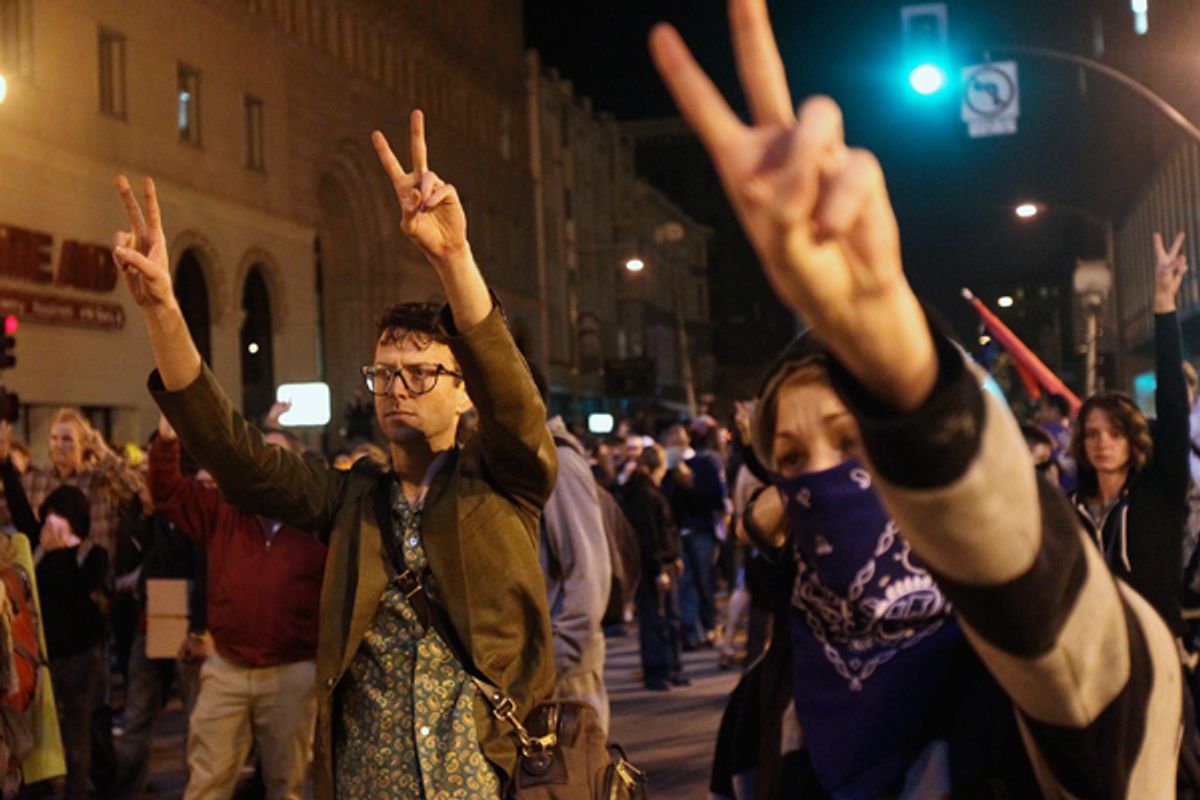

Occupy Wall Street has already achieved a stunning victory -- a victory that is easy to overlook, but impossible to overstate. In just one month, the protesters have shifted the national dialogue from a relentless focus on the deficit to a discussion of the real issues facing Main Street: the lack of jobs -- and especially jobs with decent benefits -- spiraling inequality, cash-strapped American families' debt loads, and the pernicious influence of money in politics that led us to this point.
 To borrow the loosely defined terms that define the Occupy movement, these ordinary citizens have shifted the conversation away from what the “1 percent” -- the corporate right and its dedicated media, network of think tanks and PR shops -- want to talk about and, notably, paid good money to get us to talk about.
Peter G. Peterson, a Wall Street mogul and Nixon administration Cabinet member, has reportedly dedicated a billion dollars of his fortune to the effort since the 1980s. How successful have he and his fellow travelers been? In 2009, the Washington Post came under fire for running an article – in its news section, not its opinion pages – written by Peterson's Fiscal Times, which the watchdog group Fairness and Accuracy in Reporting described as “a propaganda outlet … [formed] to promote cuts in Social Security and other entitlement programs.” (It was Peterson Foundation employees, among those from other outside groups, who staffed Obama's “bipartisan deficit commission.”)
As I noted back in May, a study done by the National Journal that month quantified what the Washington Post's Greg Sargent described as a “deficit feedback loop,” in which “the relentless bipartisan focus on the deficit convinces voters to be worried about it, which in turn leads lawmakers to spend still more time talking about it and less time talking about the economy.”
According to the Journal, “major U.S. newspapers have increasingly shifted their attention away from coverage of unemployment in recent months while greatly intensifying their focus on the deficit.”
The analysis -- based on a measure of how often the words "unemployment" and "deficit" appear in major publications -- portrays a dramatically shifting landscape of coverage over the past two years, as the debate over how to fix the federal deficit has risen to prominence and the question of how to handle still-high unemployment has faded from the media's consciousness.
Consider the impact that relentless focus on the deficit – and declining coverage of the jobs crisis and housing meltdown -- had on public opinion until very recently:

Now fast-forward five months, and we see an entirely different media landscape. According to the Pew Research Center's Project for Excellence in Journalism, the economy dominated last week's news, grabbing 24 percent of the mainstream media's “news hole.” Occupy Wall Street accounted for 10 percent of the news hole, up from 7 percent the week before, and 2 percent the week before that. (The death of Libyan leader Moammar Ghaddafi drew more attention to foreign policy issues this week, but the economy continued to be a dominant topic.)
Last week, Zaid Jilani of Think Progress offered some data that tell the tale of a dramatically shifting media landscape. He noted that “at the beginning of August, when Washington, DC was debating the debt ceiling crisis, the national debt dominated the airwaves.”
While it was appropriate for the media then to be covering the deficit due to the debt ceiling debate at the time, there was a stunning lack of coverage of the jobs crisis. A ThinkProgress review of the media coverage of the last week of July found that the word “debt” was mentioned more than 7,000 times on MSNBC, CNN, and Fox News, and “unemployed” was only mentioned 75 times.

But, writes Jilani, a recent “review of the same three networks between Oct. 10 and Oct. 16 finds that the word 'debt' only netted 398 mentions, while 'occupy' grabbed 1,278, Wall Street netted 2,378, and jobs got 2,738.”

This sea-change can't be attributed only to the Occupy movement – it also correlates with the White House's “pivot” toward jobs and the economy – but there is no doubt that Occupy Wall Street has played a major role in bringing attention to the plight of working America. Even House Majority Leader Eric Cantor, R-Va., acknowledged the occupiers' grievances when his office announced that he would be giving an address “about income disparity and how Republicans believe the government could help fix it.” One would be naïve to believe Cantor would ever support such measures, but it nonetheless marked a dramatic departure from the GOP's usual class-war stance. (Cantor later canceled the speech when he learned he would be greeted by protesters.)
The real-world impact of this shift is difficult to predict, but the problems on which our mainstream discourse focuses are the ones most likely to be addressed.
Shares