Iraq war
What “withdrawal” means for an empire
As troops pull out of Iraq, Obama plans more combat forces elsewhere in the Middle East
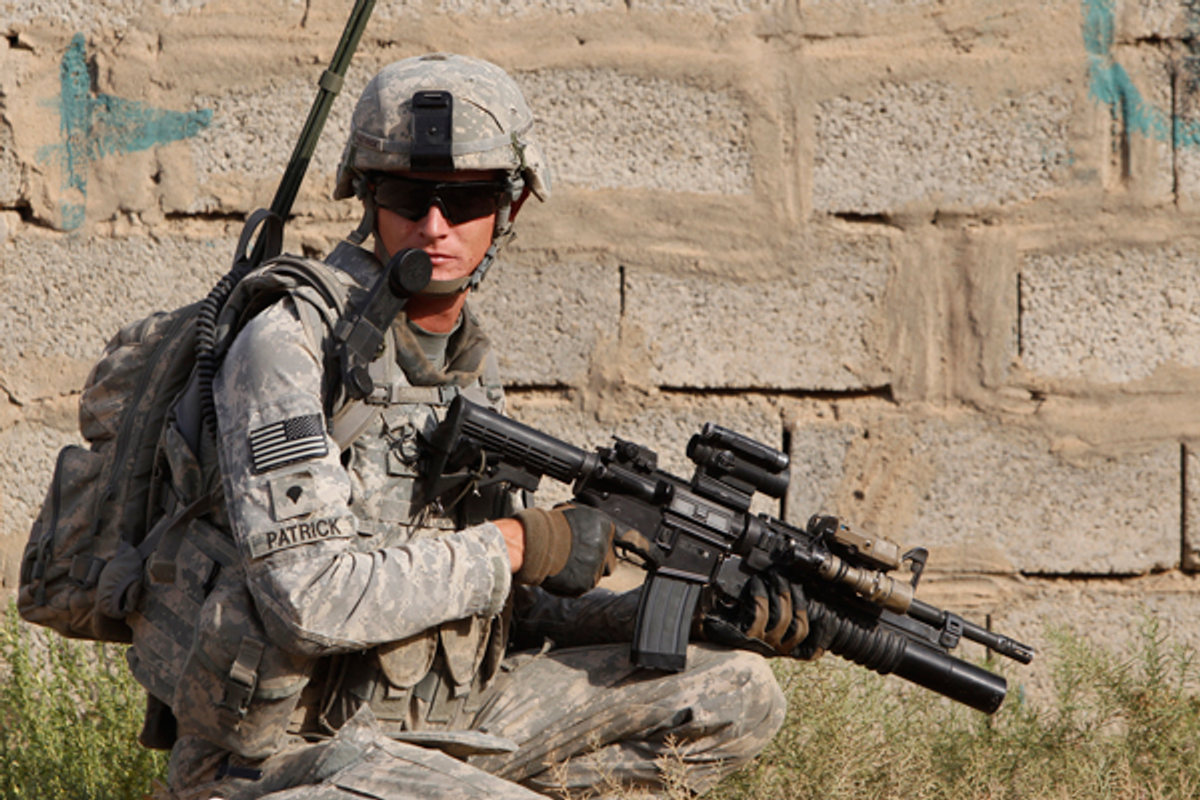
A U.S. soldier takes up a position during a patrol in the city of Kirkuk (Credit: Reuters/Saad Shalash) Last week here at Salon, we had a good back and forth about whether America is an empire, and why even pondering that question is so taboo. Quite serendipitously, our debate came just before this big report in the New York Times over the weekend:
The Obama administration plans to bolster the American military presence in the Persian Gulf after it withdraws the remaining troops from Iraq this year, according to officials and diplomats. That repositioning could include new combat forces in Kuwait…
In addition to negotiations over maintaining a ground combat presence in Kuwait, the United States is considering sending more naval warships through international waters in the region.
Indefinite military occupations of resource-rich regions is one of the hallmarks of empire — indeed, if we saw another country do that, we would almost certainly refer to it as an unacceptable imperial move. Of course, the justification of the Obama administration’s announcement doesn’t hew to the standard lexicon of imperialism; it applies our modern newspeak in an attempt to promote the fallacy that the United States acts only out of selfless benevolence.
There’s lots of talk, for instance, about regional “stability” — a buzzword designed to downplay democratic ideals and rationalize America’s continued support of the brutal dictatorships that serve as our client governments. We’re also hearing the old War on Terror tropes about how we must stay in the Middle East indefinitely and not show weakness by supposedly cutting and running. We’re not an empire, these voices insist. It’s just that “the complete withdrawal of our forces… is likely to be viewed as a strategic victory by our enemies!” as 12 Republicans write in a absurd new letter.
Only in the words of Secretary of State Hillary Clinton do we see this paternalistic imperial ideology, with all its inherent contradictions, laid bare:
“We will have a robust continuing presence throughout the region, which is proof of our ongoing commitment to Iraq and to the future of that region, which holds such promise and should be freed from outside interference to continue on a pathway to democracy,” Secretary of State Hillary Rodham Clinton said in Tajikistan after the president’s announcement.
Yes, according to Clinton, we must have a “robust continuing presence throughout the region” — read: a massive military force propping up undemocratic regimes — in order to make sure the region is “freed from outside interference to continue on a pathway to democracy.”
Reminiscent of oxymoronic burn-the-village-down-to-save-it declarations of yore, Clinton’s statement — which goes completely unexamined and unquestioned by the Times — shows how imperial agitprop in 2011 works.
Rather than brazenly promoting the greatness of the empire, American government officials appeal to their citizenry’s sense of morality and kind-heartedness. They do this because they know most Americans don’t want to see themselves as contributing — even indirectly — to imperial oppression and avarice around the globe. Hence, empire is presented as a project of noblesse oblige, “democracy” and “nation building” — a project that lets citizens feel good about themselves, even as their government props up brutal regimes, squelches democracy and rules a foreign region with threats of invasion and retaliation.
There’s a simple lesson here: Just because a nation’s foreign policy rhetoric doesn’t sound like imperialism doesn’t mean it’s not an empire.
David Sirota is a best-selling author of the new book "Back to Our Future: How the 1980s Explain the World We Live In Now." He hosts the morning show on AM760 in Colorado. E-mail him at ds@davidsirota.com, follow him on Twitter @davidsirota or visit his website at www.davidsirota.com. More David Sirota.
America’s real Hunger Games
Young people are already being sacrificed at the whims of the 1%. Just look at Iraq and Afghanistan
U.S. Army soldiers respond after a suicide attack on the US..-led provincial reconstruction team (PRT) compound in the Behsood district of Jalalabad, east of Kabul Afghanistan, on Sunday, April 15, 15 2012. (Credit: AP Phot/Rahmat Gul) When I was growing up, I ate books for breakfast, lunch and dinner, and since I was constantly running out of reading material, I read everyone else’s — which for a girl with older brothers meant science fiction. The books were supposed to be about the future, but they always turned out to be very much about this very moment.
Some of them — Robert Heinlein’s “Stranger in a Strange Land” — were comically of their time: that novel’s vision of the good life seemed to owe an awful lot to the Playboy Mansion in its prime, only with telepathy and being nice added in. Frank Herbert’s “Dune” had similarly sixties social mores, but its vision of an intergalactic world of disciplined desert jihadis and a great game for the substance that made all long-distance transit possible is even more relevant now. Think: drug cartels meet the oil industry in the deep desert.
Continue Reading CloseRebecca Solnit grew up in California public libraries and is thrilled to be revisiting them all over the state as part of the Cal Humanities California Reads project, which is now featuring five books, including her A Paradise Built in Hell: The Extraordinary Communities That Arise in Disaster. More Rebecca Solnit.
Neocons’ new lie
You thought they were gone, but now they're popping up to claim that Iraq inspired the Arab Spring
Dick Cheney, left, and Elliott Abrams (Credit: AP/Pablo Martinez Monsivais) The rulebook for conservative punditry is straightforward. Push for a policy. When it turns into a disaster, defend it. When the defense becomes untenable, ignore it. Finally, when something unrelated but positive occurs, take credit for it.
The newest conservative myth is that the upheavals in the Middle East — called the Arab Spring but occurring too in non-Arab countries like Iran — are a result of the Iraq War. The “freedom” that George W. Bush brought to Iraq had a domino effect on other countries in the region, the argument goes. Neocon Robert Kagan told Salon recently that “there were repeated free elections in Iraq and that undoubtedly had some effect on how neighboring people views their government.” Said Kagan: “I think Egyptians said. ‘If the Iraqis can have elections, why can’t we have elections?’”
Continue Reading CloseJordan Michael Smith writes about U.S. foreign policy for Salon. He has written for the New York Times, Boston Globe and Washington Post. More Jordan Michael Smith.
“War crime” delusions
A WikiLeaks video of an Iraq war massacre raises questions about international laws governing armed conflict
Still of Namir Noor-Eldeen, a 22-year-old war photographer, from WikiLeaks' Collateral Murder video Anyone who would like to witness a vivid example of modern warfare that adheres to the laws of war — that corpus of regulations developed painstakingly over centuries by jurists, humanitarians, and soldiers, a body of rules that is now an essential, institutionalized part of the U.S. armed forces and indeed all modern militaries — should simply click here and watch the video.
Wait a minute: that’s the WikiLeaks “Collateral Murder” video! The gunsight view of an Apache helicopter opening fire from half a mile high on a crowd of Iraqis — a few armed men, but mostly unarmed civilians, including a couple of Reuters employees — as they unsuspectingly walked the streets of a Baghdad suburb one July day in 2007.
Continue Reading CloseChase Madar, is a lawyer in New York, a contributor to the London Review of Books and Le Monde diplomatique and the author of a new book, The Passion of Bradley Manning (OR Books). More Chase Madar.
Our real Iraq losses
We left their nation in turmoil and our own country entangled in an endless "national security" nightmare
A man, left, inspects his destroyed vehicle at the scene of a car bomb attack in Ramadi, 70 miles (115 kilometers) west of Baghdad, Iraq, Tuesday, March 20, 2012. Officials say attacks across Iraq have killed and wounded scores of people in a spate of violence that was dreaded in the days before Baghdad hosts the Arab world's top leaders. (AP Photo) (Credit: AP) People ask the question in various ways, sometimes hesitantly, often via a long digression, but my answer is always the same: no regrets.
In some 24 years of government service, I experienced my share of dissonance when it came to what was said in public and what the government did behind the public’s back. In most cases, the gap was filled with scared little men and women, and what was left unsaid just hid the mistakes and flaws of those anonymous functionaries.
What I saw while serving the State Department at a forward operating base in Iraq was, however, different. There, the space between what we were doing (the eye-watering waste and mismanagement), and what we were saying (the endless claims of success and progress), was filled with numb soldiers and devastated Iraqis, not scaredy-cat bureaucrats.
Continue Reading ClosePeter Van Buren spent a year in Iraq as a State Department Foreign Service Officer serving as Team Leader for two Provincial Reconstruction Teams (PRTs). Now in Washington, he writes about Iraq and the Middle East at his blog, We Meant Well. His book, We Meant Well: How I Helped Lose the Battle for the Hearts and Minds of the Iraqi People (The American Empire Project, Metropolitan Books), will be published this September. More Peter Van Buren.
He was our eyes
The tragic death of Anthony Shadid has made the world a little darker
The late Anthony Shadid I was stunned and saddened to learn of the death of Anthony Shadid, the great New York Times reporter who covered the Middle East. Shadid was quite simply the best mainstream reporter working the most important foreign beat in the world. From his superb coverage of Iraq to his groundbreaking reporting on the Arab Spring, he set the journalistic standard. Shadid’s profound knowledge of the Arab world, his even-handedness, his historical sophistication, and above all his empathy for the ordinary people he wrote about, made him indispensable.
Continue Reading CloseGary Kamiya is a Salon contributing writer. More Gary Kamiya.
Page 1 of 299 in Iraq war