Movies

Pick of the week: “A Very Harold & Kumar 3D Christmas”

Pick of the week: Yuletide comes early for the beloved stoner comedy duo. Plus: Neil Patrick Harris' dark secret!

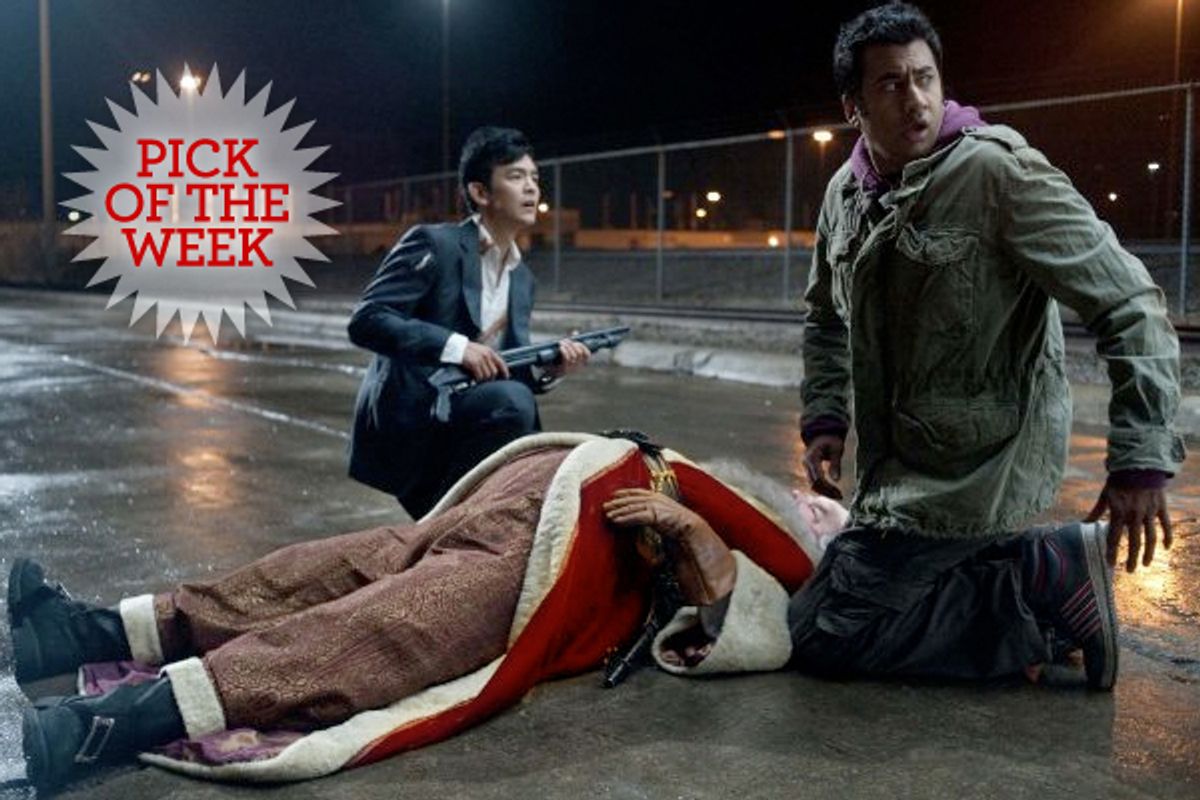
John Cho and Kal Penn in "A Very Harold and Kumar 3D Christmas"

Is the first week of November, before we’ve finished eating the Halloween candy, too early for a Christmas movie? Ordinarily my answer would be abso-freakin’-lutely, but when the movie in question is a disgusting, anarchic celebration of drug abuse and random violence, complete with free-floating ethnic stereotypes, an evil Claymation snowman, a self-explanatory hit Yuletide toy called the Wafflebot, the most preposterous self-mocking Neil Patrick Harris performance in the long history of such things and a pilfered scene from “Madea’s Family Reunion” — well, it’s never too early for that, is it?

Early in “A Very Harold & Kumar 3D Christmas,” Harold Lee (John Cho), who has grown up into a yupped-out, suit-wearing financial whiz with a house in the ‘burbs, asks a servile underling, “Hasn’t the whole 3-D thing kind of jumped the shark?” (Said underling has promised to find Harold a 3-D HDTV that will be so awesome “it makes ‘Avatar’ look Avatarded!”) So it has, and never has a shark been so thoroughly and ingeniously jumped as in the third installment of the stoner-bromance comedy franchise built around Cho and co-star Kal Penn, which is full of imaginative, outrageous and egregiously insulting 3-D gags. I saw this movie at a critics’ screening in the Warner Bros. building in midtown Manhattan in the middle of the afternoon, and the normally stonefaced crowd succumbed to widespread braying, snorting and guffawing. You could almost smell the fifth-generation unsexed Congolese skunkweed. (I said almost.)

Time often passes more slowly in movieland than in the real world, but in Harold and Kumar’s universe the opposite appears to be true. Numerous years have passed since our Asian-American dynamic duo escaped from Guantánamo Bay (without eating the fabled cock-meat sandwich) and got baked with George W. Bush, in a scene that made me feel some genuine human sympathy for President No. 43. And you know what happens as boyhood friends grow up: They drift apart, and sometimes it might just take the magic of Christmas — Santa Claus, and Jesus Christ, and Ukrainian mobsters and Neil Patrick Harris and lots and lots of narcotics — to make them understand what’s really important in this world.

Harold makes a lot of money and feels only slightly bad about the Occupy-type protesters outside his Manhattan office building, and lives in a Christmas-bedecked New Jersey domicile that’s about to be invaded by his intense Latino father-in-law (Danny Trejo) bearing a 12-foot Fraser fir he grew himself. Harold has given up the ganja and pretty much lost touch with his old pal Kumar Patel (Penn), who still lives in their old apartment with no job, no girlfriend and a beard approaching Grizzly Adams dimensions. His thoroughly reprehensible new best friend, Adrian (Amir Blumenfeld) tries to get him to come to some party full of allegedly deflowerable teenage virgins, but Kumar isn’t interested. “No, I gotta stay here and smoke this weed. Otherwise I won’t get high.”

But never fear: This is indeed a Christmas movie, and when a mysterious package arrives addressed to Harold, Kumar knows he must deliver it in person. As for the package … well, I’m spoiling nothing by telling you it contains a ginormous doobie, but what it really contains is a message of holiday love that will bring together the best-loved East Asian-meets-South Asian comedy duo of the 21st century. Also, it will burn down Harold’s father-in-law’s beloved Christmas tree and send Harold and Kumar out into the streets on Christmas Eve to negotiate with faux-ghetto tree salesmen (one of them the rapper RZA), introduce a baby to marijuana, cocaine and untold other illicit substances, interrupt a party of naked lesbian nuns and encounter a genuine, if distressingly gory, Christmas miracle.

“Harold & Kumar” creators Jon Hurwitz and Hayden Schlossberg have once again written the screenplay but have handed the director’s chair over to newcomer Todd Strauss-Schulson, and it’s absolutely the right choice. (Yeah, I’m pretty sure those guys are all Jewish, but hell — nobody’s ever crafted Christmas entertainment like the people of the Torah.) They directed “Harold & Kumar Escape From Guantánamo Bay” themselves, and while that movie’s plenty funny, it lacks either the classic teen-oriented pacing of the original 2004 “Harold & Kumar Go to White Castle” or the outrageous Busby Berkeley production values of this one. I shouldn’t tell you too much more about the giddy excess of “A Very Harold & Kumar 3D Christmas” — and for once, you really should pay the extra few bucks for those glasses — but it’s pretty much one ridiculous set-piece after another, and you absolutely don’t need to be wasted to enjoy them. (I’m not saying that wouldn’t be awesome.)

I’ve already mentioned the Claymation bad-trip sequence featuring a vengeful snowman, but that may not even be as funny as the sentimental montage sequence explaining Danny Trejo’s impoverished childhood, or Kumar’s pornographic fantasy involving the near-total demolition of the Catholic Church. And then there’s Neil Patrick Harris, a consummate entertainer of our time, who somehow manages to be completely authentic and blissfully fake at the same time. Ah, NPH, how do I love thee? Let me count the ways. Harold and Kumar encounter Neil again as the star of a Radio City-style holiday pageant, and then venture backstage with Neil and his boyfriend to hear him explain how he cheated death in “Guantánamo Bay.” I’ll merely hint that if you were suspicious that the whole gay thing (“homo-crap,” in Neil’s words) might be an elaborate front, you’re on the right track. After dispensing some sage advice and disgusting vulgarity, Neil assures our heroes that he’ll see them “in the fourth one.” We can only hope.

“Battleship”: Dumbest military spectacle ever?

Aliens invade a Navy recruitment video and turn back the gender-politics clock in this moronic blockbuster

A still from "Battleship"

One of the great marketing constants of contemporary Hollywood is the idea of appealing to the 11-year-old boy within every moviegoer (whatever gender that person may manifest on the surface). Almost every American movie released during the summer season has that squirmy pre-adolescent id in view, and about two-thirds of the movies made the rest of the year. But what about a movie as baffling and incoherent and flat-out stupid as “Battleship” — an alien-invasion adventure by way of a Hasbro game, or maybe the other way round — a movie that would make your inner 11-year-old stomp out of the theater in disgust?

It’s undoubtedly gilding the lily to claim that “Battleship” is the dumbest movie I’ve ever seen — for all that I front as someone who only likes Turkish films where people stare at the landscape without talking, I’ve seen a lot of dumb movies — but it’s definitely up there. Over and above its extraordinary, mind-melting level of stupidity, “Battleship” (which is directed by actor-turned-filmmaker Peter Berg, of “Hancock” and “Friday Night Lights,” and written by action-flick brothers Erich and Jon Hoeber) is also extremely weird. Its shameless and nonsensical combination of ingredients finally won me over, after a fashion, when I realized that its gung-ho Navy-recruitment propaganda and retrograde gender politics shouldn’t be taken any more seriously than the ZZ Top, AC/DC and Billy Squier songs on the soundtrack. The only point of the whole exercise is to make small boys whoop and holler.

You know that bar over on the roughneck side of town, the one where all the jingoistic, pro-military, America-hell-yeah movies go to quaff some brewskis and swap tales about kickin’ Communist hiney? Yeah, that one. Well, when “Battleship” shows up there and starts breaking beer glasses on its head, “Top Gun” and “Red Dawn” and “The Green Berets” get to feel all grown-up and complicated and full of girly-man sensitivity. That’s how stupid it is. Come to think of it, that’s the same Oahu tavern where we first meet our handsome but headstrong hero, Alex Hopper (Taylor Kitsch, last seen fleeing the ruins of “John Carter”), who’s enjoying a birthday beverage and stern lecture, both provided by his uptight Navy officer brother, Stone (Alexander Skarsgård). Let me back up and repeat that key piece of information: Skarsgård’s character is named Stone Hopper, and I promise that if you remind me of that in three years, I’ll still think it’s hilarious.

That bar on that evening is also where Alex first claps eyes on Sam (Brooklyn Decker), a leggy, cheerleader-ish blonde who’s come into this testosterone-rich dive bar unaccompanied, only to be denied a microwave burrito. Alex gets her that burrito, and wins her heart, at the end of a painful slapstick sequence that involves the total destruction of a convenience store and him being repeatedly Tased by local law enforcement. Funny! Shortly after that, we get to see Sam wearing short-shorts and a tank top, smooching with Alex on the beach — and that’s the one and only moment of faint implied sexuality anywhere in “Battleship.” Decker’s Sam might as well be encased in a glass vitrine; for the rest of the movie she’s seen only in chaste white dresses or tomboyish outdoor clothes. She’s less a Megan Fox-style sex object than a small boy’s vague and non-threatening idea of a sexy lady, and in her remaining scenes with Alex she spends her time urging him — I’m not kidding about this! — to ask her father for her hand.

Alex doesn’t get around to doing that right away, because after the seemingly endless throat-clearing of these early scenes, stuff finally starts happening and the action movie gets here at last. See, Alex has been dragged into the Navy by his big brother Stone Hopper and somehow gotten an officer’s commission, and Sam’s dad (Liam Neeson, doing his growly Amurkin act) is some big-shot admiral who hates him, and then some huge alien vessels from outer space show up, because of a beacon sent out there by geek scientists (thanks, nerds!), destroy Hong Kong and land in the Pacific right in the middle of RIMPAC, which sounds vaguely pornographic but is actually a massive naval exercise involving fleets from many nations. The alien ships are immense gleaming CGI monstrosities wielding impressive firepower — as usual, far beyond our comprehension, etc. — but they’re also kind of the McMansions of the alien-invader world, meaning that they look great for the first few minutes and then you start wondering what the point is, and how well anybody thought any of this through before they started building.

There appear to be no clear rules governing the behavior of the marauding aliens, which is to say that the only rule is this: Despite their overwhelming military superiority, the invaders must have weaknesses that will eventually allow the United States Navy to boo-ya all over their asses. So the aliens never fire on anyone who doesn’t pose a direct threat (except when they do), even though their apparent purpose is world conquest. They come from a planet that, as we are repeatedly told, is very similar to Earth, yet they have reptilian eyeballs and cannot tolerate direct sunlight. Their ships can apparently fly — or, at least, they flew here across millions of miles of space — yet they navigate through the ocean with a frog-hopping motion not unlike metallic whales doing the butterfly stroke. In fairness, all the big machines and humanoid monsters and things that go boom are awesomely rendered; Berg has definitely spent his reported $200 million budget on stuff you can see. It’s just all so profoundly stupid.

Thanks to whatever marketing logic dictates that these kinds of summer movies have to last more than two hours, Berg and the screenwriters pack in all kinds of Navy protocol, ludicrous subplots and irrelevant comic business, among the explosions. R&B star Rihanna is here, in a nothing role as a tough-as-nails petty officer, and Tadanobu Asano, a major Japanese star whose presence may pay off in East Asia, plays a kind of guest-star captain who figures out how to track the radar-cloaked alien ships using a low-tech grid that somewhat resembles — yes! — the traditional layout of the Battleship game. I bet there were high-fives all around in the writing room when they figured that one out. (Let me observe here that playing the Hasbro version is lame; Battleship can and should be played with graph paper.)

I’m not even getting into the bizarre “Space Cowboys” twist toward the end, in which a mothballed World War II-era battleship, and its crew of geriatric docents, is dragged into the fray in a last-ditch effort to save the world. I mean, I know what the title of the movie is, but it’s somehow especially funny that they got all worried about the fact that the real-life Navy doesn’t use battleships anymore. (“Man, we can’t let down the people like this! They want a freakin’ battleship, and they’re gonna get one!”) Plus, did you know that museum ships built 70 years ago are kept all fueled up and ready to go, with stacks of live missile shells piled up behind the Grab-a-Smurf machine? Me neither! But please forgive me; I’m just bitter. Unlike Taylor Kitsch’s endlessly enthusiastic character, I never did get around to asking my wife’s dad for her hand in marriage. And when you get right down to it, isn’t that kind of a charming custom? Why in the world did we let that one get away?

Continue Reading Close

Sacha Baron Cohen’s dark political farce

The "Borat" creator's nutty Arab "Dictator" moves to Brooklyn, falls in love -- and schools the West in democracy

Sacha Baron Cohen in "The Dictator"

What exactly is Sacha Baron Cohen up to? This question, stupid as it may appear on the surface, has intrigued me ever since “Da Ali G Show” began airing in the United States. It’s a stupid question because Baron Cohen is a comedian; as “edgy” or “controversial” as his topics and material may sometimes be, his job is to make people laugh. But most comedians don’t try to get laughs by interviewing Pat Buchanan or Boutros Boutros-Ghali (“Boutros Boutros Boutros-Ghali,” as Ali G introduced him) under false pretenses, or by leading a group of unsuspecting Arizona nightclubbers in a rousing chorus of “Throw the Jew Down the Well.”

It’s an ancient truism of comedy that what makes us most uncomfortable and shocks us the most is also where the deepest veins of humor reside, and throughout his career Baron Cohen has specialized in prodding those sore spots, sometimes with an evident political point of view, and sometimes totally not. In a throwaway moment early in Baron Cohen’s new movie, “The Dictator” (directed by Baron Cohen’s frequent collaborator Larry Charles, who was also at the helm for “Borat” and “Brüno”), we see the bearded North African tyrant Admiral General Aladeen, portrayed of course by Baron Cohen, playing a first-person-shooter video game called “Munich Olympics.” You’re groaning already, right? Here’s how it works: You knock on the door marked “Israeli Olympic Team.” When a cute little Smurf-like creature in a yarmulke and side-curls answers the door — “Shalom!” — a pop-up widget announces “Shoot the Jew!” and you waste him. It continues from there: “Oy vey!” “Mazeltov!” “Meshugenah!” cry the cheerfully dying figures.

This is funny precisely because it’s not funny, and if that sounds too mystical or dialectical for you, let’s remember that we’re talking about a guy who has cited World War II-era historian Ian Kershaw, who was one of his professors at Cambridge, as a major influence. “I know it’s not very funny being a comedian talking about the Holocaust,” Baron Cohen once told Rolling Stone interviewer Neil Strauss, while making it clear that in exposing the casual cruelty and docile conformity of the ordinary people with whom he interacted he was doing exactly that. You can argue there’s a personal agenda at work here, since Baron Cohen grew up in a prominent British Jewish family and is the grandson of a Holocaust survivor (in his words, the last Jewish girl trained as a ballerina in Nazi Germany). But I see something more than that, a dark and even misanthropic moral and intellectual vision that conceals, somewhere way deep down, the smothered hope for a better world.

We laugh at the “Munich Olympics” video game (if, indeed, we do laugh) because we’re appalled and we see some truth in it. We’re appalled that Baron Cohen and his co-writers were malicious enough to come up with it, we’re appalled with ourselves for so readily accepting it as humor, and we’re appalled by the incontrovertible fact that some people — in places like Aladeen’s fictional homeland, the Republic of Wadiya, but also in Britain and the U.S. and anywhere else you care to mention — would take smirking delight in such a game if it existed. (Which, for all I know, it may.)

“The Dictator” is a much more normal kind of movie than “Borat” or “Brüno,” perhaps because Baron Cohen is now too famous — and has been threatened too many times with lawsuits and/or beatdowns — to pull off his in-character performance provocations. (Frankly, hadn’t the shtick worn out by the time of the very mixed “Brüno” anyway?) Despite some cleverly snipped bits of real news footage from the Libyan crisis, “The Dictator” is a scripted entertainment from start to finish, with Baron Cohen playing both the vainglorious and idiotic Wadiyan autocrat and also the even dumber rural goatherd selected to serve as his assassination-thwarting double. On a trip to New York to address the United Nations, the real Aladeen gets separated from his entourage, thanks to an incompetent CIA blowhard played by John C. Reilly. Shorn of his beard and of his access to voluptuous hookers and anti-Semitic video games, the erstwhile dictator is forced to work in a feminist food collective in Brooklyn, where he falls hard for Anna Faris, as its unshaven-armpit, pixie-cut sporting, ultra-p.c. manager. (Aladeen repeatedly remarks that she has the physique of a preteen boy — and specifically of Harry Potter — but it’s not clear whether that’s a bad thing.)

Although the character of Aladeen seems awfully predictable by Baron Cohen standards, the movie itself veers from one hilarious, absurd and patently offensive setup to the next, mercilessly mocking the stupidity and paranoia of Americans, the venality of celebrities — there’s a joke about Katy Perry’s purported relations with Aladeen that I can’t even euphemize successfully — the Chinese lust for world domination and the cultural vapidity and backwardness of the Arab world. There are moments of unabated vulgar silliness, as when a rich woman gazing out the window of a Manhattan luxury hotel gets an unexpected faceful of wobbly Aladeen dong. And there are even moments when Baron Cohen’s portrayal of the benighted dictator — who is perhaps more ignorant and miseducated than innately evil — borders on sweetness, if you can really use that word to describe a film that involves jokes about rape, torture, abortion and fellatio performed with a geriatric drug dealer’s severed head.

But let’s revert to my original WTF question about Baron Cohen by way of this film’s obvious relationship to Charlie Chaplin’s 1940 “The Great Dictator,” which is also about a demented world leader with genocidal fantasies and the ordinary citizen (in Chaplin’s film, a Jewish barber) who becomes his accidental replacement. On one level, of course, the comparison is ridiculous. Chaplin’s film is a masterpiece, or something close to it — prescient, daring and almost unbearably tragic, an optimistic and sentimental plea for reason in a world teetering on the edge of the abyss. Remember that when that film was released, the U.S. and Germany were not yet at war and the worst atrocities of the Holocaust had not yet happened, although the film seems to see them coming.

I can’t resist feeling that “The Dictator” (whose screenplay is credited to Alec Berg, David Mandel and Jeff Schaffer, along with Baron Cohen) restages Chaplin’s great farce in a darker and more vulgar register, to reflect a world that has been fundamentally poisoned, not just by Hitler’s crimes but by decades of subsequent mendacity and hypocrisy. I shouldn’t spoil Aladeen’s climactic speech, in which he praises the many virtues of dictatorship (which the Western world has so foolishly left behind), except to say that it’s a brilliant, sardonic response to the paean to progress and democracy delivered by Chaplin’s barber in the guise of the dictator Hynkel — and that its targets are you and me, not the known tyrants and despots of the Arab world. “We are coming into a new world, a kindlier world, where men will rise above their hate, their greed and brutality,” Chaplin’s character tells the world. There are good reasons to suspect that Baron Cohen, who spent his teen years active in the Zionist-socialist youth organization Habonim Dror (which advocates peace between Israel and its neighbors), is a lefty somewhere deep down. But the new world without hate, greed and brutality — nuh-uh, he’s heard that one before.

Continue Reading Close

American influx at Cannes

American filmmakers dominate this year's line-up at France's annual glitzy celebration of cinema

Workers sets up a giant 65th Cannes Film Festival official poster featuring Marilyn Monroe on the Cannes Festival Palace, Monday, May 14, 2012. The Cannes Film Festival will start on Wednesday, May 16.(AP Photo/Lionel Cironneau)(Credit: AP)

CANNES, France (AP) — Despite the mood in Europe, don’t expect any austerity at the Cannes Film Festival, the annual Cote d’Azur extravaganza where glamour is wrapped in world cinema fervor and gauzy Mediterranean sunshine.

Except for the Oscars, it’s the flashiest red carpet in the world, a ruby staircase flanked by tuxedoed photographers — and a world away from financial turmoil.

Yet Cannes, the 65th edition of which starts Wednesday, fetes its directors as much as it does its stars. This year, there are plenty of both: esteemed international filmmakers like Abbas Kiarostami and Michael Haneke to big-name talent like Brad Pitt and Nicole Kidman.

Among the 22 films in competition, there’s a particularly large American contingent, starting with the opening night film, Wes Anderson’s “Moonrise Kingdom.” The movie about adolescent love on the run brings a few new actors (Bruce Willis, Edward Norton) into Anderson’s carefully orchestrated world.

Later, there’s David Cronenberg’s Don DeLillo adaptation “Cosmopolis,” starring Robert Pattinson, and Walter Salles’ (“The Motorcycle Diaries”) anticipated adaptation of Jack Kerouac’s beloved “On the Road.” That film, produced by Francis Ford Coppola, stars Sam Riley and Garrett Hedlund, but has attracted more attention for its supporting roles, including Pattinson’s “Twilight” co-star Kristen Stewart as Dean Moriarty’s girlfriend.

There’s also John Hillcoat’s “Lawless,” a Prohibition-era bootlegging tale starring Shia LaBeouf and Tom Hardy, and Andrew Dominick’s “Killing Them Softly,” a crime film starring Pitt as a Mob enforcer. The unusually large U.S. group is rounded out by Jeff Nichols’ “Mud,” with Matthew McConaughey and Reese Witherspoon, and Lee Daniels’ “Precious” follow up, “The Paperboy,” a death row drama starring McConaughey, Zac Efron and Kidman.

“The Americans are coming!” heralds Daniels, whose “Precious” screened in Cannes’ Un Certain Regard section.

That echoes the same sentiment of Cannes’ artistic director Thierry Fremaux, who declared America cinema “back in full force” when announcing the lineup.

For Daniels, the festival is a comfortable place to premiere his latest.

“We get so caught up, as Americans, in a specific type of film experience that we forget that this is a small fraction of what cinema is about,” he says. “It’s OK to be odd. I remember when I was doing ‘Precious,’ everybody looking at me and scratching their heads like, ‘What are you doing, really?’ I remember feeling that I was odd, and I don’t feel odd at Cannes.”

Terrence Malick’s “Tree of Life” last won the festival’s top prize, the Palme d’Or, the first American film to do so since Michael Moore’s “Fahrenheit 9/11″ in 2004. Although the French silent film ode “The Artist” was bested by “Tree of Life” at Cannes, it went on to win best picture at the Academy Awards.

“The Artist” had been picked up for U.S. distribution ahead of Cannes by Harvey Weinstein, whose Weinstein Co. will release “Lawless” and “Killing Them Softly” this fall. He’s frequently used Cannes as a place to both acquire and launch films.

“Cannes is a worldwide arena,” says Weinstein. “It’s just a great opportunity to launch something. The worldwide press is there and it commands worldwide attention. You get such a difference of opinion, and when it comes together as a consensus, you can really launch a movie like we did ‘The Artist’ last year.”

Several films in competition will be looking for distribution, and some have already found it. “On the Road” was last week acquired by IFC Films and Sundance Selects with plans for a release late this year. In deals signed in hotel rooms and aboard yachts, many other films in various stages of production will be bought and sold. After a robust market in 2011, Weinstein — “a buyer and a seller” this year, he says — describes this year’s market as “maybe stronger.”

Other films will seek to benefit from the global convergence of media, like the upcoming DreamWorks animation blockbuster “Madagascar 3: Europe’s Most Wanted,” which will screen out of competition, and “The Dictator,” for which Sacha Baron Cohen is expected to make an in-character promotional appearance on the waterfront Wednesday. The festival will also host a fundraiser for several Haiti charities, including Sean Penn’s.

Whereas Penn and Pitt are familiar favorites at Cannes, this year’s festival includes a new crop of young actors seeking more adventurous work, including LaBeouf, Efron and Pattinson.

“When you fantasize about how the world views you as an actor, you’re like, ‘I want to be recognized at Cannes,’” says Pattinson, who has drawn high compliments from his director, Cronenberg, for his performance in “Cosmopolis.”

Pattinson has previously been to Cannes to promote the “Twilight” film “New Moon” in 2009, but he’s clearly thrilled to be a part of the main slate.

“Hopefully, people don’t hate it,” he says, alluding to Cannes’ famously vocal audiences.

Newcomers, though, are outnumbered by veterans this year. More than two-thirds of the directors with films in competition have previously had films at the festival.

There are no women directors in competition this year, after four last year — an outcome that the feminist group La Barbe has condemned in an online petition.

Haneke, the Austrian director who won the Palme d’Or for “The White Ribbon” in 2009, returns with “Amour,” about an octogenarian couple. The British filmmaker Ken Loach, winner of the Palme in 2006 for “The Wind That Shakes the Barley,” is back with “The Angels’ Share” — atypically for Loach, a comedy. The Iranian master Kiarostami, whose “Taste of Cherry” won the Palme in 1997, has the Tokyo drama “Like Someone in Love.”

That also leaves international heavyweights Jacques Audiard (“Rust and Bone”), Cristian Mungiu (“Beyond the Hills”), Matteo Garrone (“Reality”), Hong Sang-soo (“In Another Country,” Carlos Reygadas (“Post Tenebras Lux”) and the 89-year-old Alain Resnais (“You Haven’t Seen Anything Yet”).

Several of the American films are international collaborations, helmed by filmmakers from Brazil (Salles), New Zealand (Dominik) and Australia (Hillcoat).

At Cannes, the context is always macro: all the world, all of cinema.

“It’s great to have an American genre film in that kind of arena, where what you’re coming to do is just share storytelling and the love of filmmaking as opposed to national boundaries,” says Hillcoat. “That’s what’s really exciting about Cannes.”

Continue Reading Close

Whitewashing, a history

From "Tiffany's" to "Khan," we look at Hollywood's illustrious tradition of casting white actors in non-white roles SLIDE SHOW

View the slide show

The extraordinary box office success of "The Hunger Games" has launched a heated discussion of Hollywood's peculiar habit of casting white actors in nonwhite roles. Why does this happen? We decided to turn to a very important studio chief for answers -- channeled here by comedian (and "Daily Show" correspondent) Aasif Mandvi.

All I have to say is that whitewashing has been going on since as long as Hollywood has existed — it’s a tradition — and rather than non-white people complaining about it, they should embrace it. It will make going to the movies so much easier and more fun. But there are just a few things you need to understand.

First, stop watching movies as ethnic people and start watching them as white people. There’s nothing that white people like more than seeing other white people in movies and on television. When you go to the movies with your ethnic “judgment” eyes, you miss my point. Watch as a white person, and suddenly your outrage turns to understanding and laughter.

Take a minute to walk to your limousine in my Gucci shoes, and you’ll realize that I’m just trying to make people smile. Mickey Rooney with buckteeth and a crazy accent in “Breakfast at Tiffany’s”? It’s so much funnier than finding a real Chinese actor just talking like himself. Then you’d have to get a screenwriter to actually write genuinely funny lines for that character. You get so much more comedy bang with buckteeth and a funny accent. I mean, it made me laugh. Many people, including myself, were also convinced that Charlton Heston truly was a Mexican/Native American/Egyptian/Ape who talked to God. And I think I convinced a lot of Asians that Genghis Khan really did look like John Wayne back in the ’60s. “Short Circuit” was one of my biggest hit movies and I was completely convinced that Fisher Stevens was Indian. Who knew he was a Jewish guy from New York? That accent was spot on!

My point is, I’m not the bad guy. I’m just the rich guy. When you look at it through my studio executive lens, you understand how important it is that both white people and non-white people believe that Indians, Asians, Mexicans and Arabs are truly just white people in brown makeup. I don’t like thinking that way. I just don’t have the luxury not to. I’m a businessman. White people spend more money on shit than anyone else. (Except on fast food, which is mostly blacks and Mexicans … at least that’s what I have heard. I’m a vegan.) So hey, non-Caucasians, stop buying tacos and start buying Cadillacs.

White people are also cheaper to light than dark-skinned people, and just so you know, you the moviegoer end up paying for that extra cost. Sometimes it’s just too unbelievable to cast an ethnic actor. I turned away a lovely Indian actress once who auditioned for the role of a hobbit. I mean there are no Indian hobbits. Audiences would never believe that.

Now, look: I am trying to do the right thing. America has changed and Hollywood should attempt to portray a truer depiction of the ethnic diversity that makes up this country. The fact that many television shows now hire a certain percentage of non-white actors is a step in the right direction, right? I am even prepared to make a deal with you ethnic people out there. Every time you let me cast a non-Caucasian character with a Caucasian actor, I will give you two or three non-white actors in smaller supporting roles. Why not lead roles? Because I’m trying to make a living here. I have spent a lot of time and money throughout history convincing everyone that white is normal. I have even convinced non-white people that white is better, prettier, smarter, stronger, and that only white people can truly be the heroes. Everyone has bought into it, and now you want me to just abandon all my hard work? OK, I will make an exception for some of you non-whites: If you are a hot Latina, you can be the lead. Why? Because white guys want to fuck Jennifer Lopez.

Here are a few more key elements to remember when watching a movie the way white people have been programmed to react. Laugh at the funny accents, because they are funny. Ignore the source material; I’m making movies, I don’t give a shit about staying true to your comic books. And … hold on! Why the fuck is Idris Elba playing a Norse God!?

To view a slide show of Hollywood’s egregious moments in white-washing, click on the link below — and share your own most memorable moments in the comments. (Slide show by Max Rivlin-Nadler)

View the slide show

Continue Reading Close

Aasif Mandvi is an actor and writer who appears as a correspondent on "The Daily Show with Jon Stewart." He also co wrote and stars in the film "Today's Special" and will be appearing this summer in the films "Premium Rush" and "Ruby Sparks."

New Yorker profile? No, thanks

It's an honor to be the subject of a long, flattering, well-written New Yorker piece. It is also the kiss of death

(Credit: AP/Salon)

Last year, The New Yorker ran a long, flattering profile of the director Andrew Stanton, the Pixar veteran who was engaged at the time in reshoots for the troubled “John Carter.” The article, by Tad Friend, noted some of the studio’s concerns about the initial cut of the film, which was Stanton’s debut in live action, but for the most part, its tone was highly positive, portraying Stanton as nothing less than Pixar’s resident storyteller: “Among all the top talent here,” an executive is quoted as saying, “Andrew is the one with a genius for story structure.”

Six months later, “John Carter” became one of the costliest flops in Hollywood history, and while the film may have its redeeming qualities, story structure isn’t among them. Read in retrospect, the Stanton profile now seems laden with irony, and it isn’t alone: A striking number of recent New Yorker features on movie directors and actors have been followed by embarrassing setbacks for the artists in question, usually involving the very projects that the articles are extolling.

In other words, whenever a New Yorker profile shows a director hard at work in the editing room, the studio should start to worry. Since the beginning of 2010, the magazine has published eight features on artists best known for their work in film. Two are profiles of Clint Eastwood and Jane Fonda that are basically career retrospectives. Of the remaining six, five of their subjects — Steve Carell, Guillermo del Toro, Anna Faris, John Lasseter and Andrew Stanton  — experienced significant professional reversals soon after the articles appeared. And while I’ll discuss the one exception in a moment, such a dire track record might well give pause to Armando Iannucci, the British director of “In the Loop,” who was profiled by the magazine in March.

To put it mildly, there’s something of a New Yorker feature curse going around Hollywood these days. It doesn’t always hold true — Dana Goodyear’s profile of James Cameron certainly didn’t hurt “Avatar” — but when it does, the results can be startling, especially when you set the articles alongside the films they so effusively describe. Tad Friend’s profile of Steve Carell, for instance, portrays its subject as “a brilliant piece of software, a 2.0 fix for the problem of unfunny comedy,” whose approach to collaboration is nothing less than “a painstaking set of procedures aimed at maximum creativity.” The result? “Dinner for Schmucks,” a critical and commercial nonevent that few would hold up as a model of “the golden age of improvisation.”

Other profiles read even more strangely in hindsight. Last May, the film “Bridesmaids” had everyone talking about the role of women in modern comedy, a topic that Friend addressed in a lengthy feature published the month before. “What’s at stake is not merely a tenable marketplace for ‘hard’ female comedies,” he writes, “but a fresh vantage on romance and, perhaps, a fresh way of seeing men and women.” Unfortunately, he isn’t talking about “Bridesmaids,” but about Anna Faris in “What’s Your Number?,” which came out in September and promptly sank like a stone.

I don’t mean to pick on Tad Friend, a fine and perceptive writer, because he certainly isn’t alone. I first noticed the phenomenon in an article on Tony Gilroy by D.T. Max, who glowingly describes the creative process behind the underwhelming “Duplicity.” More recently, Guillermo del Toro had the curse hit him twice, first during the writing of a profile by features editor Daniel Zalewski, which coincided with del Toro’s departure from “The Hobbit,” and shortly after the piece appeared, when Universal passed on “At the Mountains of Madness.” These articles are invariably graceful, smart,and insightful — and their subjects are all talented. Yet there’s no shaking the sense that such a feature rarely bodes well for the future.

Sports fans have talked for decades about a Sports Illustrated jinx, in which a player’s cover appearance seems to lead to a string of unusual bad luck. The reason for the jinx, if it exists, isn’t hard to understand: Athletes generally make the cover after an exceptional performance, which is right when they often regress to the mean. The New Yorker doesn’t put stars on the cover, but its features are valuable real estate, so it tends to favor subjects with a big success already behind them. There’s room in the magazine for emerging artists, but it’s in the Brooklyn of the back pages, not the Manhattan of the features section, which prefers seemingly sure things. Much as in Hollywood itself, you can’t get fired for going with last year’s star.

In finance, this is called performance chasing. It means investing in today’s interview subject based on yesterday’s hit movie, which, as an outlier, is often followed by a slump. This is how we get a look behind the scenes of “Duplicity,” not “Michael Clayton,” and it sometimes results in reportage that has a troubling tendency to ignore obvious warning signs. Anthony Lane’s feature on John Lasseter and “Cars 2,” for instance, is written in his characteristically prickly style, but for all his evident cynicism, he never raises a crucial point that many other observers had noted at the time, which was that Pixar was making a sequel to one of its weakest films. In the end, Lane’s skepticism is only skin deep, and it’s ultimately sacrificed to the needs of the narrative, in which the critic is grudgingly won over by the studio’s charms.

Occasionally, of course, the feature section does devote space to an emerging talent, as Rebecca Mead did last year with the director Lena Dunham, before the release of “Tiny Furniture.” (Iannucci can take some comfort from Dunham’s example: Their shows “Veep” and “Girls” were both renewed last week by HBO, one of the few forces around that can reliably beat the curse.) In this article, the exception mentioned above, several elements combine to push it into feature territory — social media, the New York art scene, “the cinema of unexamined privilege” — and the result is a rare instance of a profile catching an artist on the way up. Dunham jumps the queue because her story feeds into fashionable issues, a fact she lightly mocks: “There’s always an article coming out, saying ‘The new thing is funny women.’”

And this gets close to the heart of the problem. Many feature articles — including this one — strive to tie a bow on the story, to tether themselves to some larger theme, a tendency visibly pronounced at the New Yorker, thanks both to its reputation and to the relatively small number of movie features it publishes. At four or so profiles per year, an article can’t just be about Steve Carell or Tony Gilroy or Anna Faris: To justify the use of such premium space, it has to be about the future of comedy, or adult drama, or funny women, which leads to grand claims that can ultimately seem peculiar when we finally see “Dinner for Schmucks.”

“Nobody knows anything,” the writer William Goldman famously said of Hollywood, and if that’s true of filmmakers, it’s doubly true of the journalists who try to draw conclusions about so unpredictable an industry. If journalism is the first draft of history, it’s no surprise that the draft occasionally contains 10 finely reported pages on “What’s Your Number?” But that shouldn’t stop reporters from trying. We desperately need thoughtful articles that go deeper than the average star profile, like Ian Parker’s New Yorker feature from a few years back on George Clooney, which remains one of my favorite pieces ever published in the magazine. It came out the same month, naturally, as “Leatherheads.”

Continue Reading Close

Page 1 of 707 in Movies