Interviews
Michael Stipe: Why R.E.M. called it a day
In a Salon exclusive, the R.E.M. singer explains the iconic band's ending and reflects on a near-peerless legacy
By David DaleyTopics: Interviews, Music
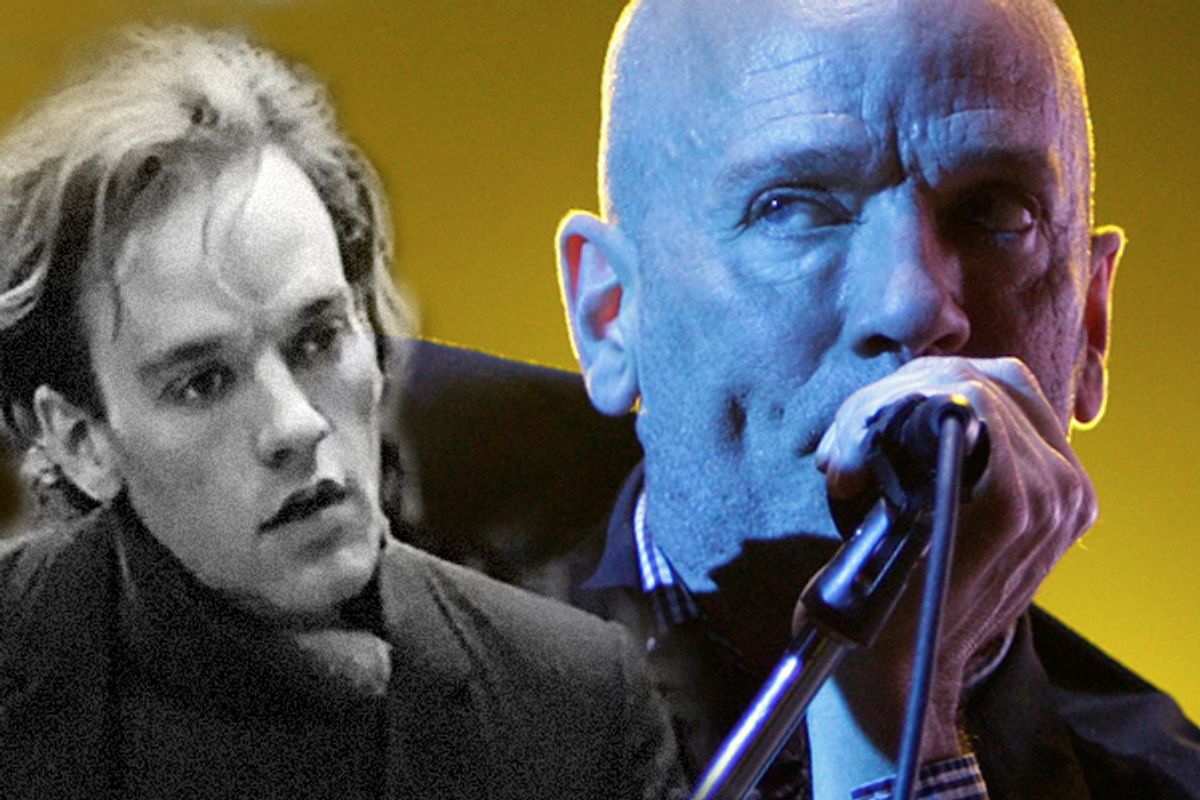
Michael Stipe in the '80s, and today (Credit: oldTOtaper/AP) The easy way to start this story would be it’s the end of R.E.M. as we know it, and Michael Stipe feels fine.
Except that’s not exactly true. Read between the lines of our half-hour conversation with Stipe on Friday — the first interviews he’s given in America since R.E.M. announced its disbanding in September — and it appears that the decision was as much his as anyone else’s. That he’d perhaps wearied of the touring grind, or no longer felt he could give it the same passion, and didn’t think it was fair to keep bandmates Peter Buck and Mike Mills waiting. That if it’s not the end of the world as we know it, as the song continues, it’s time Stipe had some time alone.
But Stipe looks pained, too. R.E.M. was a creative project of 31 years, a life’s work, and walking away, even by choice, is clearly terrifically bittersweet. When he talks about never playing these songs with his friends again, Stipe goes quiet and almost chokes up. The band’s final single, “We All Go Back to Where We Belong,” included on a 40-song retrospective out Tuesday, ends with the plaintive line “is this really what you want,” as an orchestra swells. Stipe’s answer seems to be “yes, but…”
It’s a response as emotional as the one many fans felt upon hearing the news. For those of us who came of age in the 1980s, the arty kids, the misfits, someone in an R.E.M. shirt was usually an immediate fast friend. Through allusive lyrics and cool album covers, they turned fans on to writers and artists and bands they might not have otherwise discovered. Over 31 years, they did the impossible — without compromising, and at the height of Reagan’s plastic, backwards ’80s, R.E.M. bent the mainstream to the margins and moved the entire culture toward them. The number of bands who can claim that is small, indeed. They brought the Replacements and 10,000 Maniacs and Wilco and Radiohead on the road; Stipe mentored Kurt Cobain and Thom Yorke and Chris Martin as the next generation dealt with the challenges of unexpected, massive fame.
Oh, and they released at least a dozen start-to-finish classics. (Today I’ve got “Fables of the Reconstruction” first, followed closely by “New Adventures in Hi-Fi,” “Murmur,” “Life’s Rich Pageant” and “Automatic for the People.” And “Reckoning,” where to put “Reckoning”…) If R.E.M. isn’t the greatest American rock band of all time, they’re undeniably near the very top, depending how you rank Springsteen and the E Street Band, the Beach Boys and the Byrds. (We can argue all this in the comments.)
Stipe is a fascinating conversationalist. He creates a charming and disarming intimacy, makes direct contact with those steely blue eyes when interested in a question, but drifts to looking at a spot behind you when bored. He speaks rapidly, but edits himself as he goes — sometimes striking an answer that he has worded inartfully, then doubling back over the response word for word until he fixes the clumsy or unfortunate phrase. But he also knows exactly what he’s offering to the public and what he’s keeping for himself — if he ever decides to write a memoir, it will be every bit as good as “Just Kids,” the early autobiography of his idol and mentor, Patti Smith.
We met last week in a corner office at Warner Bros. in midtown Manhattan, a room Stipe had a feeling once belonged to a big executive since departed — an empty office symbolizing all the change and tumult in the music industry. “I don’t understand why this happened the way it happened,” Stipe said. “The world we live in could have been a very different world had a number of people at the top of several industries figured out this tidal wave was coming and said let’s ride it — let’s not bury our heads in the sand. Music, film, newspapers, all publishing, now television. It didn’t have to happen this way.”
As we entered the room, Stipe rolled his eyes and said, “Everyone’s asking about 1982.” That seemed to signal better answers would come to unusual questions, so we started with the breakup news and worked chronologically backward, getting almost all the way to 1982, before circling back to the present.
R.E.M.’s split came as a surprise to fans in September, but it sounds like the band came to this decision as much as three years ago. How did you keep it a secret, through the 2008 tour and through promoting “Collapse Into Now” this spring?
To be completely frank, we were talking about it during the 2008 tour, but we didn’t know for sure. It was one of our options. It was an option that was made available to us … by ourselves. (laughs) The decision came about quite organically, like most things in R.E.M. There were always times when we had to really push something to make it work – “Monster” would be an example, and of course after Bill left.
By the end of the 2008 tour, we all kind of knew that these were most likely going to be our last shows. It was already, for us, bittersweet and weird and hard. The idea of doing some kind of victory lap or final farewell tour just felt — and still feels — like it would have been completely mercenary and exploitative and impossible.
Do you think? I imagine a lot of fans would have genuinely appreciated the opportunity to see the band play live again. That seemed to be one of the regrets after the announcement was made.
I could not perform “Everybody Hurts” for the last time in London with 30,000 people in the room or 80,000 people on the field knowing full well it was the last time we were going to do it. I just couldn’t. I would collapse. It would be impossible – I wouldn’t be able to hit the notes. We all knew that would be a really hard thing to do. It’s just not very R.E.M. I hate to quote “The Simpsons” quoting us (laughs), but it would not be a very R.E.M. way to do that kind of thing. So we decided to do it our way. I’m really proud of the way that we did it.
Nobody has ever asked how did you keep it a secret, so that’s a bit of an exclusive. It wasn’t easy. We had different ideas of how and when to make the announcement. The horror was if somebody Twittered or leaked it.
I’ll draw a parallel and then I’ll excuse myself for it, because it’s conflating the end of a band and a creative force with someone’s death, but I got a text message “RIP Amy Winehouse” from a friend that was sad that she had died. He didn’t know that I had met her, that I knew her producer… That’s my tiny connection to this woman, but I didn’t need to find out through a text message that she had died. I’m really very OK with this world, with parts of it, and then parts of it I’m really not.
If you seemed fairly certain that the 2008 tour would be the last one, then you also knew while making “Collapse Into Now” that it would be the last record.
Well, we can all Monday morning quarterback the theme on that record and what’s running through it. There was one reviewer who said “there’s something missing in this record that I can’t put my finger on,” and it was about themes. I think he was saying that consciously or unconsciously, R.E.M. records always have a theme – fire and water, sex for “Monster,” they’re obvious – but this time the theme wasn’t immediately identifiable to him. I always think I’m incredibly obvious and I’m not. (laughs) For me, it was the biggest, the most obvious farewell album thematically.
Looking at it now, you’re waving goodbye on the cover.
I’m waving goodbye, yes. But we’re on the cover! R.E.M.’s never been on the cover of an album. On “Around the Sun,” that’s a single image that’s repeated three times. That’s not the band. The song “All the Best.”
The coda on “Blue,” which takes it back to “Discoverer,” full circle with the first song on the album…
Yes, which is referencing “Fables of the Reconstruction.” It’s that cyclical thing that the end is the beginning, the beginning is the end. “Discoverer” is also the song that is somewhat autobiographic about me and New York as a 19-year-old. And it closes with Patti Smith, which is where it all fucking began. Now that we can Monday morning quarterback it, yes, hopefully it’s a very beautiful farewell, that record.
R.E.M. has always been very deliberate about what you do and what you don’t do.
Mostly about what we don’t do.
Well, this is a band that stood up to record labels about producers before you even had an album, a band that had a distinct visual identity from the beginning, a band with the instinct to split all the songwriting credits equally.
You could call it the Peter Buck school of how not to fuck up and fuck over your closest friends.
And lots of bands learned from that model over the last three decades. But most bands, like most athletes, stick around too long. Was that R.E.M.’s final lesson: Let us show you how to bow out gracefully?
No one’s ever done it before, as far as we know. It’s not a lesson, necessarily. I do have my professorial side, and I think you know that. I shy away from it because I hear myself talking and I’m just like, “You’re a fucking blowhard, shut up.” And I hope you print that because someone needs to hear that coming from me. As much as I’m crazily sentimental – and I pull away from that as much as I can, but my part in what we did is that inherent contradiction that is such a part of humanity. I think consciously or unconsciously, people hear and feel that in my voice and in the lyric. I think I know what this is about, but it doesn’t matter what he’s thinking because I can make it my own. That’s all there and that works. And then there’s the inherent contradiction within the band and within each of us and what we want. It all made for a pretty amazing package, I think, for a long fucking time. And we did go out on our own terms. That means the world to us.
What will you miss about it? Performing those songs live?
The tours were always amazing. When we were on stage, whatever problems we were having behind the scenes disappeared. We never took them on stage, and so as a live act, we forever gave it everything we had.
The second I was 40, which was 11 years ago, I thought to myself, “Look, I can’t.” I’m really tired, but I will do a tour because the guys want to do it and we need it – it’s good camaraderie. I can’t let myself give just a portion – I have to give everything I have for every song or I’m just that sad guy that’s in his 40s and holding onto some teenage dream. We didn’t move through the last decade with that feeling at all. I gave everything I had.
The idea of not ever being able to do that again is really sad for me. It’s actually painful to think about. And when I see things like Coldplay at the Natural History Museum last night – they played five songs at an amazing institution in New York, people paid a lot of money for those tickets, it’s a great thing they did. But there’s a tinge in my heart. I’m singing along kind of quietly to my favorite songs, and oh, it hurts.
So why put a period and exclamation point on it? Why not reserve the right to do another album or tour if you change your minds?
For closure. I think we needed it. I don’t like that term. Closure is always about something bad, like death or divorce, and this isn’t a bad thing. But I felt like it wasn’t fair to each of us to let what had been side projects remain side projects while everyone’s saying, “So, when’s the next R.E.M. tour?” That wouldn’t be fair to Peter right now, out with John Wesley Harding. People need to know this is it. Enjoy it. Be in the moment, be there for that. For each of us moving forward from this, letting it whimper away didn’t feel right. We needed it to be a finite thing.
You’ve spent the last few months working on a career retrospective, “Part Lies, Part Heart, Part Truth, Part Garbage.” It’s not the band’s first collection, following “Eponymous, “In Time” and “And I Feel Fine,” but those tended to separate the IRS and the Warner Brothers years, while this covers everything from 1982 to 2011.
These songs are such a part of my DNA now. To try and talk about them is hard. Journalists keep asking about certain songs. I have the same story I told in 1987 if you want to hear that one. That’s my story about that song and that’s my memory of it. I have 25 years of touring and writing other songs and records between that memory, and I’m sorry that I can’t pull up anything different.
How did you go about selecting 40 songs from 31 years? Did you leave off some you would like to have included?
We picked the singles and then we picked a number of songs that I wouldn’t have put on there. We were trying to make it sound like a well-rounded introduction to what we were for someone who maybe only knew us from the elevator, dare I say it, or the supermarket. We were background. We were wallpaper to 14-year-olds if their parents weren’t big music fans or if they liked us when they were in college. To a 14-, 16-, 18-, 21-year-old, I’m the bald guy and we’re the guys who do “Losing My Religion” and “Everybody Hurts.”
I wanted kind of the same experience I had when I bought “Changes One” by David Bowie. I had already discovered CBGBs and the whole punk rock scene. I was in. I was fucking in at 15. Bowie releases “Changes One” and I only knew him as this guy who had influenced other people. I knew “All the Young Dudes,” but that was Mott the Hoople. Looking back, “Changes One” was this monumental record. It provided me with a snapshot of who he was and why he was so significant to all these other people – why Talking Heads or Television would care about this British guy who dressed funny.
You mentioned people who maybe liked the band in school – was it difficult, over the years, as fans drop out? As albums sell fewer copies?
No. I recognize and understand. I’m going to get myself really in trouble here, but parenting is one of the most selfish acts on earth. You’re a different person. It’s incredibly selfish. Anyway, all these other things come in and the thing that music means to you as a young person changes dramatically and that’s that. And that’s before Wii and before Xbox and before DVDs and before home theater and before texting and SMS and all the other distractions that we now have literally in the palm of our hand.
So it doesn’t surprise me that music has taken that wallpaper position. There are people who I think have – I’m going to get myself in trouble again – the thing that I think is hardest for me as a public figure is people not realizing the degree to which music and art is a reflection of yourself, not me. And when you turn the light on and people see that reflection, sometimes it’s actually shocking to them.
After the band’s announcement, there were a lot of people online who ranked the band’s catalog from top to bottom, and the three albums after Bill Berry left – “Up,” “Reveal” and “Around the Sun” – were derided near the bottom. Is that fair? Do you think those albums will be, or should be, reconsidered?
I don’t think it’s mine to say. I will say that we got a free pass from a lot of people who really believed in us and really wanted us to pull through. I’m honored that people were that believing in our abilities. It was a very difficult time for each of us — (clears throat) — and the result of that is a body of songs that I think are quite beautiful, and then some not-great choices in terms of production and in terms of our abilities or inabilities as human beings and as great friends to communicate. So the key ingredient that was missing was the kind of communication that you need to say Actually, that’s too long, or that’s too slow or that’s a bad lyric or you’re too mopey here or this needs more backbone, or whatever it was.
A lot of those songs really worked live, though. Are there earlier versions of those albums which might emerge, maybe less fussy, in the six-CD box set version?
Probably. I think the live version of “The Great Beyond” is far superior to the recorded version. But the recorded version was as big a hit outside the United States as “Losing My Religion,” which I don’t think people know. It was a massive hit for us, as was “Imitation of Life.” But I thought the live versions of those songs were better simply because they were faster. I don’t know why we always pulled back like that.
When I’ve interviewed Peter and Mike over the years, they’ve talked about how when Bill left, it shifted the working dynamic – that Peter and Bill tended to be the guys who wanted to show up and get it done.
Bill’s nickname was I Go Now. He always wanted to be somewhere else. He couldn’t wait for the end of a song, both in the studio and live. He’s the guy who was always speeding to the finish line. That was a great tool for us and we lost that – so our first thing out of the box as a three-piece, “Up,” is a record that’s two songs too long with songs that are over five minutes long. We needed a great editor and we weren’t in the head space – we weren’t able to even look each other in the eye to be able to make that happen. “Up” is kind of a mess, but it’s a glorious mess.
And the glorious messes are often my favorite albums in a band’s catalog.
Exactly. What you get is this beautiful, fucked-up mess. I find that interesting as a fan of the band, and I am a fan. I find that interesting as a music lover. “Around the Sun” took a real beating, and this meme went out that that was our worst record ever and it was misery. It grew and grew and grew until that was basically what people said — and that’s how it’s gone down in history. And it’s actually not that bad of a record.
At the very beginning, you mentioned that “Monster” was a difficult album to make. Over the years, people have talked about “Fables” being hard, and of course the records after Bill, but not about “Monster.” What did you mean by that? That was also around the time you first started talking publicly about your sexuality.
I tried to give people what they wanted, and of course the blowback from the gay community was pretty intense because I don’t identify as gay and I never have. So finally the 21st century provides me and the 14-year-olds with this idea of queerness – which actually, if Anita Bryant and Jesse Helms in 1976 had not brought us screeching into the Reagan/Bush years and then AIDS, we might be a little more advanced in our thinking about the fluidity of sexuality. So I started talking about my sexuality in terms people were none too happy with, and that’s fine.
But “Monster” was difficult because people were dying around us. I’m talking about really close friends dying unexpectedly, terribly. There’s River (Phoenix) and Kurt (Cobain), but I can think of another four people off the bat who died in that year. It was hard for us on a personal level.
What I was referring to earlier was us trying to make a rock record when it wasn’t really what we wanted to do. We just wanted to tour, and we couldn’t tour behind “Out of Time” or “Automatic for the People.” It was all beautifully orchestrated slow songs and that doesn’t really fly at a festival in Belgium in front of 45,000 people who have been there for three days and are drunk and tired and muddy. You can’t do that.
So we were trying to write these rock songs, What we wound up with was… with the influence of Peter’s moving to Seattle and Kurt and Courtney being his next-door neighbor, and grunge happened – what a sad, weird term that is because it is so diminishing to the music that actually came out of it, I think, there’s a lot of great stuff. But in classic R.E.M. style, we were yet again out of time. We were doing something that was either a little too before or a little too behind what was actually happening. We created this weird record that’s so oddball. The real rock record, of course, was the next one. “New Adventures in Hi-Fi” is in my top-two records we’ve made.
And the other one?
“Collapse Into Now.”
Favorite song?
“Supernatural Superserious.” I took my abilities as a fiction writer and pushed them as far as I could with that song and I’m really proud of it. It does that beautiful thing at the end where the vocals go faster and the drums come in and accentuate that.
What else is in the vaults? In the liner notes, Peter talks about pulling “Bad Day” from a file of 40 or 50 songs that weren’t quite finished or done. Is there a chance more songs see the light?
I don’t know. I was never that guy. So those guys were releasing 25th anniversary packages and there’s stuff on there … I would rather throw myself off a cliff or be boiled in lead than listen to “Life’s Rich Pageant” demos – [and here Stipe groan sings unintelligible syllables as if he is in pain] — my doing this horrible moaning over a song that then became a beautiful song. Peter and Mike love that stuff. Who am I? If I’m still embarrassed by something that I did in 1986 that turned into a beautiful song, I need to go back to therapy. Which actually I’ve never been to. I might need to start now that the band’s over!
So all of us who spent hours with “Murmur” or “Chronic Town,” rewinding the tape and pushing the needle back on the record, trying to figure out the words – were we just wasting our time?
No, it’s not a waste of time. You figured out your own words, and it was more about you than me. I was figuring out how to be a lyric writer and it took me about an album and a half to figure it out.
Fear – and not being afraid – have been a staple of your lyrics from the beginning.
Fear is a big thing. It goes all the way back to “9-9.”
“Conversation fear.” But also all the way through “Imitation of Life” and “The Outsiders” and “Discoverer.” That theme has stayed constant, while you’ve seemingly become so much more comfortable as a public figure.
Did you watch “Colbert” last night? They had to stop and say “Michael, sing louder.” I’m like, Sorry, trying to the background guy. I’m still that guy. My boyfriend has to hail taxis or argue with people over tiny day-to-day things. I’m still that guy, but as a public figure I had to really step it up. And as an evolving person — I think evolving, I hope – I had to get over my teenage insecurities and fucking face it. So I’m still that guy, but I’m not as much of a coward as I thought I was, as it turns out. My father would be the first person to say “I don’t know how you do that. I don’t know how you ever could stand in front of those people and sing. The courage it takes to do that.” You’re a fucking helicopter pilot! I can’t even look at a helicopter without breaking into a cold sweat, much less fly one in combat. So I guess I do have courage. I guess I’m not as afraid as I thought I was.
So what happens next? Sculpture? Photography? Music?
I have no idea.
David Daley is the senior culture editor of Salon. More David Daley.
Wes Anderson on “Moonrise Kingdom”: I’m trying to make something unfamiliar
Salon exclusive: Wes Anderson defends his distinctive visual look and remembers the intensity of childhood emotions
By Andrew O'HehirTopics: Interviews, Movies, Our Picks
Wes Anderson in Cannes on May 16. (Credit: AP/Joel Ryan) All narrative filmmakers, pretty much by definition, create artificial simulations of the world. Most of these simulations obey certain accepted conventions most of the time, which allow us to view them as “realistic” (mainstream comedies and dramas) or exaggerated in a familiar fashion (action movies and thrillers). The problem with Wes Anderson — if you think there is a problem with Wes Anderson — is that his movies appear to call attention to their own artificiality in an unusual way, and do not pretend to be naturalistic. This quality has made Anderson one of the most divisive figures among contemporary American directors, which is odd when you consider that his principal instrument is genial, rueful family comedy, not espresso-depresso or ultraviolent art cinema.
As I wrote last week in reviewing “Moonrise Kingdom,” Anderson’s new fairytale romance set on a remote New England island in 1965 (that is, in a Wes Anderson version of 1965), I’m pretty much on board with his whole trip. Furthermore, I think that those who accuse Anderson of precious or pretentious postmodern poseur-ness are missing the fundamental sincerity that lies beneath his view of movies and the world. “Moonrise Kingdom” may be the loveliest of Anderson’s films, and is undeniably art-directed to the moon, but it captures both the sweet intensity of early adolescent love and the rueful complexity of adult emotion. While newcomers Jared Gilman and Kara Hayward are enjoyable as the preteen lovers, the movie’s real heroes are Bruce Willis as the heartbroken island cop and Edward Norton as a lonely scoutmaster, who both give their finest performances in years. (Bill Murray and Frances McDormand are also terrific in smaller parts as a crumbling married couple.)
I recently caught Wes Anderson on the phone from his Los Angeles office, just after his return from Cannes, where “Moonrise Kingdom” opened this year’s festival. We established, first of all, an odd point of connection: A family friend and Brooklyn neighbor of mine, the author, activist and sociology professor Alex Vitale, is Anderson’s cousin. (I only bring that up because Alex played a role in our discussion of Sam, the rebel Boy Scout — sorry, “Khaki Scout” — in “Moonrise Kingdom.”)
Wes, congratulations on the opening-night slot at Cannes. How did that go?
I think it went over pretty well, but you know, I’m probably not the best judge of it. It was a very good experience for me. I had a lot of fun.
Tell me what came first with “Moonrise Kingdom”: The place and the period, or the characters?
I think the first thing was just the emotion of what it’s like to fall in love at that age, and how it’s completely overwhelming and powerful.
What was it about that particular period, the mid-’60s, that spoke to you? I mean, you weren’t actually alive then.
You know, I think it was the feeling of being the end of — at least when I look back on it, it looks like a more innocent time in the culture. When these kids in the story are 18, there’s going to be such a radically different climate. I thought of it as the end of this Norman Rockwell time in our country, sort of.
Yeah, it feels like that. There was this period of optimism in American life, and that was pretty much the tail end of it.
Yeah, I think so. Again, I don’t know how much of this is what we project as we look backward, but at least that’s what it symbolizes for me.
I know you actually grew up in Texas, and you weren’t even born until 1969. Do you have any family connections to that part of the world, the islands and coast of New England? Did you spend summers there or anything?
No, not really. It really has nothing to do with me. But I have spent quite a bit of time on a New England island over the last 15 or 20 years, visiting friends. One of the inspirations for the movie is one particular island where I’ve gone that’s a place with no cars. It’s only accessible by boat, there’s no shops. There’s only one farm on the island, and it really has its own whole set of traditions. The way this place has been for a long, long time is very well preserved, in fact, and when you go to this place it’s like stepping back in time. It has a very particular sort of atmosphere, and that was something I wanted to conjure up a bit.
Right. It’s like the people in the movie aren’t just cut off from us because of 40 years of history. They’re also geographically cut off.
Yes, I think they may be a bit further out to sea than you might think automatically. They’re also very isolated characters, each one of them. So maybe that all ties together.
I have to ask you this: Were you ever a Boy Scout?
Uh, I tried it. I did not succeed. But, you know, I definitely wanted to be! I did not achieve any rank.
So Sam, the rebel outcast Scout in the movie, isn’t personal to you. He almost feels like he might be.
I actually think he might be like Alex. [See above.] I can definitely see Alex rebelling against his Scout troop and walking out in protest. And that’s probably where I would have ended up too.
I don’t even know if I want to come out on this issue, but I wasn’t just a Boy Scout. I was an Eagle Scout! And I have to say, for somebody who wasn’t really a part of that world, you captured its terrors and delights wonderfully. Some of those summer camp scenes made me break out in a cold sweat.
I have to say: The idea of somebody being an Eagle Scout — I’m still impressed by that. One of my closest friends in high school had a mohawk and listened to the Cramps and the Dead Kennedys, but at the same time was secretly continuing his Scouting. It was not something that any of us were ever in on, but when he graduated from high school, at the same time he was becoming an Eagle Scout. And it was interesting, in a way it was something I kind of recognized. He was a very independent thinker, and he didn’t let the preconceptions about Scouting, or the aura of Scouting, which can be taken as quite square — he didn’t really let that deter him. Although I will say he kept it a bit compartmentalized.
You have no idea how strongly I identify with that, actually. Not to get sidetracked, but a good friend from my Scout troop, who came out as gay, is the guy whose discrimination case against the Scouts went all the way to the Supreme Court in the ’90s, when they decided it was OK for the Scouts to kick him out.
Wow! Really? And they upheld it? On what basis can that be legally upheld?
Well, it’s a private organization. Within certain limits, they can kick out whoever they want for any reason.
OK. That’s the reason!
Now let’s talk about Benjamin Britten! I thought using his music was such a weird and wonderful choice, and I wondered how you got there.
Well, first of all, my older brother and I were in a production of a Benjamin Britten opera or play, “Noye’s Fludde.”
The one we see in the movie. Where Sam and Suzy, the young lovers, first meet.
Yeah. So that was the first Britten, the thing that I had in mind. And then came “The Young Person’s Guide to the Orchestra,” which is a recording conducted and produced by Leonard Bernstein, with a 1960s child’s voice reciting this narration — which I guess is written by Bernstein. It felt very period, and also this music is very powerful to me. I’m a great fan of Britten. During a period of a year when I was trying to write the film, a big part of what I was doing was not actually writing the film, but just getting the sound of it figured out.
Well, you definitely inspired me. I’m going to track down that recording and play it for my kids. I have no idea if it’ll still work.
I bet it will. It’s very interesting, that whole piece, and we only used some of it in the movie. I think kids will still respond to it. Britten wrote quite a bit of music specifically for children, and also Leonard Bernstein was so interested in sharing classical music with children. I think there’s still room for that, although I guess kids might have to be coaxed into it these days.
Some people have expressed the view that the characters and emotions in “Moonrise Kingdom” are childlike, or that it’s basically a movie for children, and I have to say I totally disagree. I think you’re always addressing the conflict between childhood emotions and adult emotions, but this movie strikes me as being more about the grownups.
I think there are parallel relationships going on in this movie, and the children are the only ones who have any real clarity about what they want. They have the limitation of not thinking very many steps ahead, but they certainly know what they want their next steps to me, and I think the adults don’t even really have that. There’s a simplicity to knowing with some certainty what you’re trying to accomplish.
Right. Very often the experience of adulthood involves losing that emotional clarity.
It’s the thing that happens when you’ve seen it go wrong.
You create such specific looks for your films, and I guess I’ve always thought of that as part of the process of characterization. The design, the interiors and the exteriors kind of fuel who the people are. Is that close?
That is usually what I’m trying for. My kind of movie — the kind I’ve always been interested in making — are ones where part of it is that we’re inventing a setting where I hope the audience has never been before. Part of the experience of the movie is going into this world, and the characters are a part of the world. They’re a part of what is making that world. When I start a movie, I am very interested, from the script forward, in creating this universe where the story can take place and these characters can interact, but I very rarely think of myself as designing anything. I sort of think of it as all one thing together. It’s just fleshing it out and trying to bring it to life and figuring out the details of artwork and behavior that can create this experience.
All filmmakers do a version of that, I think. But we don’t notice it as much with the ones who depict the world more naturalistically. Your way of doing it calls our attention to the fact that the world you’re creating is an illusion.
Yes. Well, I can’t say that I am conscious of making an effort to call attention to what I’m doing, but I’m definitely making a point of trying to make something that’s unfamiliar. To make the visual part of it a surprise, and contribute to it being something new. I guess I want to emphasize that I’m very conscious of wanting to make this world, but I don’t particularly want people to think about me making it. I just want to make something that they’re experiencing.
“Moonrise Kingdom” is already playing in Los Angeles and New York. It opens this week in Boston, Chicago, Dallas, San Francisco and Washington; June 8 in Atlanta, Denver, Minneapolis, Philadelphia, Phoenix, Portland, Ore., St. Louis, San Diego, San Jose, Calif., Seattle, and Austin, Texas, with more cities to follow.
Maggie Gyllenhaal on sexual liberation
The beloved indie star tells Salon about her "vibrator movie" and why she loves playing transgressive women
By Andrew O'HehirTopics: Feminism, Interviews, Movies, Sex
Maggie Gyllenhaal (Credit: Reuters/Mark Blinch) When I met Maggie Gyllenhaal about six weeks ago, she was enormously and gloriously pregnant, stretching out on a sofa with her shoes off and feet up in a Manhattan office building. (Since that time, Gyllenhaal and husband Peter Sarsgaard have welcomed their second daughter, Gloria Ray, to the world.) We were there to talk about “Hysteria,” the charming, lightweight feminist farce from director Tanya Wexler that explores a key event in the history of female sexuality: the invention of the vibrator by Mortimer Granville, a Victorian doctor who was seeking to cure the mysterious “female malady” that lends the movie its title.
While I wouldn’t assume there’s a vast amount of historical and social accuracy to “Hysteria,” it’s a lot of fun, and could definitely provide a viable moviegoing alternative for adult women eager to move on from “Iron Man” and “Captain America.” Gyllenhaal’s character, the crusading feminist and social worker Charlotte Dalrymple, who becomes the comic and romantic foil to Hugh Dancy’s stuffy, stammering Granville, might be described as a supporting character who takes over the movie. Charlotte effectively becomes the modern viewer’s window into the world of “Hysteria,” insisting as a matter of course that women indeed enjoy sexual pleasure (but are often plagued with partners who don’t know how to deliver it) and espousing then-outrageous views about women’s right to vote, go to college, work outside the home and so on.
Although still best known for her roles in independent films like the 2002 spanking-liberation manifesto “Secretary,” Spike Jonze’s “Adaptation” and the underappreciated “Sherrybaby” (not to mention her early role opposite real-life brother Jake Gyllenhaal in “Donnie Darko”), Gyllenhaal has also appeared in several major Hollywood productions, including “The Dark Knight,” “Crazy Heart” and the forthcoming “Won’t Back Down,” in which she stars with Viola Davis as parents trying to rescue a failing public school. Her prodigious on-screen charm is matched by a reputation as one of the most genuine and easygoing people in the movie business, and although I’d never met her before, this was one of the most relaxed interviews I’ve ever conducted.
We began our conversation, in fact, by talking about the Park Slope Food Coop, the legendary Brooklyn collective grocery store where we are both members. Unlike some celebrity members I could name, Gyllenhaal and Sarsgaard perform their assigned Coop work shifts personally. (She works in the basement, wearing a kerchief and packing nuts, teas, spices and cheeses, although like any other new mom she now has a one-year work exemption.) Is the Coop’s produce both better and cheaper than the pretty but nosebleed-expensive stuff for sale at Manhattan’s outdoor markets, we asked each other rhetorically? It is. Then we moved on to “Hysteria.”
So it seems like this must have been a fun character to play. You get to be the totally uninhibited character in a movie where everybody else has the 19th century hanging over them. You’re the liberated woman at a time when there almost weren’t any.
Right. Sometimes, a movie is set up where you’re meant to be winning, you know what I mean? I’ve certainly played a lot of characters who were really flawed and did horrible things, and where the challenge is to ask the audience if they can be compassionate enough to still have empathy for you. That’s really important to me, and I think that’s a really interesting thing to do with film — play a character who’s really flawed and ask the audience to practice being compassionate. Or who does things that are really outrageous that the audience might have judgments about, and make them question where their judgments come from.
This is completely different. This is like, you walk in and the movie doesn’t work if Charlotte isn’t winning. But the one thing I really did think — I mean, the script was so great, and so much of the tone of the movie was in place. I didn’t think it needed to be shifted almost at all. But one thing that I think comes from me is that I didn’t care at all about her being historically accurate. About her not having the 19th century over her, like you said. I think the movie is served better if she seems wild even now, if she seems so full of life that she could come from any time. Or any planet!
Because what she’s talking about in the movie — the actual politics — is very simple. The movie doesn’t have room for a complicated discussion of socialism. She says, “Socialism is a lot of people working together.” Well, you know, I mean — there’s a lot more to say about it! (Laughter.) Or, you know, women should have the right to vote, women should be able to go to college. We’re good with that here! So because her politics are so simple, and because the things that were so outrageous that she was saying do not sound outrageous now, she needs to be more outrageous in her spirit. So, yeah, it was fun to be able to just go, “You guys are constricted and constrained by all these things, and I just don’t feel them!”
I have to say the question of historical accuracy, or lack thereof, really never bothered me. It’s not that kind of movie.
Yeah. I think you’re on the wrong track if that’s what you’re worried about!
But one thing the writers really got right — or maybe this is your theatrical background and English-lit education at work — is that Charlotte feels like the heroine of a George Bernard Shaw play that Shaw never got around to writing.
Right! Right! She fits into a history of great wild women, you know? Even, like, ’40s women, screwball women, who you love even though they’re pissing you off. So, yeah, I agree with that. I liked that about it. I thought it would be fun!
You know, I probably can’t push this analysis of your career too far, but you do have a pattern of playing transgressive women, women who are defying social norms. Do you see it that way?
Well, I guess I think — and this might not be true either — but if you think about who might be interesting to watch, is it interesting to watch someone who’s absolutely following the norm and the pattern you’re used to watching? Sometimes people write those characters and they’re much more secondary characters meant to give you some exposition or whatever. Usually, the interesting character in a movie is either making a big change or transgressing somehow — making you think about how you live. So, yes, that is what appeals to me, but I also think it appeals to many people.
But no, I think maybe you’re right. When I think about Chekhov’s “Three Sisters,” for example — did you happen to see the production that we did last year?
No. I really, really wanted to. I love that play.
Well, so, of the three sisters, the transgressive one is Masha, and that’s who I played. But of course Olga is such an interesting character, and she’s not really transgressing at all. And in the movie I did after this, which is called “Won’t Back Down,” I’m also fighting against everything. It’s coming out in September, I think. I’m so pregnant! I’m all like, “It’s coming out sometime! I’ll talk to people about it!” Then there’s my character in “Crazy Heart” — she’s transgressive too, in a way. In her heart.
And of course everybody’s going to bring up “Secretary,” which, although it’s quite a different movie from “Hysteria,” is also about liberating female sexuality.
Well, yeah. That’s why people think about me that way. It’s always about what your first big movie is, that anybody knows about. And that movie is about transgression. I mean, that movie is overtly about what it means to transgress, and how it feels, and how you can live as a transgressor. But maybe it’s true: I am interested in people who are thinking — although the girl in “Crazy Heart” definitely isn’t thinking, or she wouldn’t do a lot of the things she does! I don’t know, you probably can’t tie them all together.
No, I wasn’t arguing that they all fit into that template. I’m always curious about the effect of having appeared in a really big movie. Do people see you on the street now and recognize you just because of “The Dark Knight”?
Some people do, yeah. It’s funny, because I’ve moved back and forth a lot. Even last year, I made “Hysteria” and then I made “Won’t Back Down,” which is a studio movie. There’s such a different feeling in terms of schedule, in terms of time, in terms of subject matter. I used to find it much easier to work on little movies: the pace and the way of working was just better for me. But I think I’m starting to change. I think I work the same way now on a smaller movie as I did on “Won’t Back Down.” It depends on the style of the movie. It’s harder when you’re in and out, like on “Dark Knight” or “World Trade Center.” I find that difficult. You’re not going to work and working for two months, going into the tunnel and just getting in your body who you are.
How has moving into your 30s changed your career? Don’t get me wrong, you’re still young! I was actually thinking it might have opened up some different possibilities.
Yeah, I actually feel like getting older has opened up a spectrum of roles to me. When I was younger, a lot of the roles that were coming to me were like, especially from a more Hollywood standpoint, the wacky girl. (Laughter.) Now I feel really drawn to playing grown-up women. I’m 34, and maybe it’s the way people age now or whatever, but I still feel like some roles I play are not grown-up women and some roles are. In “Won’t Back Down” she’s a child. In “Hysteria” she’s a woman, and in “Crazy Heart” she’s kind of half and half. You know, I have one foot in and one foot out. But thank God I’m done with, like, the wacky 25-year-old girl! That never worked that well for me. Plus, it’s so interesting to see a crop of really talented new actresses who are in a different generation.
Tell me who you especially like.
I love Rooney Mara. I was absolutely blown away by her performance in “Girl With the Dragon Tattoo.” Absolutely blown away. And to be honest, when you’re an actress, you go in and say, “All right — show me what you can do!” And every turn of that performance was excellent, and not just excellent in the way that some young actors are, where they’re just working on instinct and they have no craft. That was a crafted, excellent, beautiful performance. So to root for someone younger, that’s new for me. (Laughter.) You know, I’m sort of not in that young group anymore! I’m in another group now, but I like seeing talented young women come along. It’s exciting! What are they like? What I loved about Rooney Mara in that movie was that she wasn’t asking for anyone to love her. That’s hard to do!
“Hysteria” opens this week in New York and Los Angeles, with wider national release to follow.
Bobcat Goldthwait: Let’s kill all the mean people!
Comedian turned filmmaker Bobcat Goldthwait talks about his outrageous, ultraviolent satire "God Bless America"
By Andrew O'HehirTopics: Editor's Picks, Interviews, Movies, Our Picks
Bobcat Goldthwait (Credit: AP/Matt Sayles) Bobcat Goldthwait is something like the id underbelly of Michael Moore, with every pretense of journalistic objectivity and reasonableness stripped away. While Moore has a background as a reporter and editor, Goldthwait has always been an entertainer, who began doing stand-up comedy as a teenager in the late 1970s. Both guys present as rumpled, middle-aged heartland Americans with blue-collar roots — Goldthwait is from Syracuse, N.Y., where his dad was a sheet-metal worker — who are angry about the debasement of political life and public dialogue in their beloved country.
But I feel pretty confident that even Moore would not make a movie about a laid-off worker who hits the road with a runaway teenage girl and goes on a killing spree aimed at right-wing talk-show hosts, obnoxious reality-TV subjects and people who talk on the phone in movie theaters. “God Bless America” is Goldthwait’s fourth film as a writer-director — I’m going clear back to “Shakes the Clown” in 1991, often described as the “‘Citizen Kane’ of alcoholic-clown movies” — and it’s definitely his most coherent and most consistently hilarious, perhaps because its canvas is so large and the world it depicts so insane. It plays a little like “Network” mixed with Mike Judge’s “Idiocracy” mixed with “Natural Born Killers,” and in the very first scene its main character, the depressed, divorced and soon-to-be unemployed Frank (Joel Murray), does something completely unforgivable.
That first scene turns out to be a dream sequence, thankfully, but it’s not like the stuff Frank will actually do in the waking world “God Bless America” is so much better. After losing his job and getting some really bad medical news, Frank decides to seek violent retribution against the evil, stupidity and cruelty he sees streaming out of the TV every day. (He could, after all, just turn it off instead; I think that’s part of Goldthwait’s point.) While hunting down an ultra-spoiled Southern teenager and her stupid-rich parents — the subjects of an especially insulting reality show — he meets Roxy (the wonderful Tara Lynne Barr), a precocious high-school girl who says she’s fleeing an abusive home life and whose appetite for destruction beggars his own. Roxy’s delighted to waste vapid cheerleaders and reactionary creeps, but wants to up the ante: People who high-five! People who say things are “punk rock”! Adult women who call their breasts “girls”! Diablo Cody (described herein as “the only stripper with too much self-esteem”)!
Yeah, OK, that’s all pretty funny. But what about 50-year-old guys who go on cross-country road trips with cute underage girls, without asking themselves too many hard questions? Somewhat less funny, right? On one level, “God Bless America” is grossly inflated, over-the-top satire, but on another, it possesses its own kind of moral subtlety. Goldthwait doesn’t so much want us to root for Frank and Roxy without question, or to excuse actions that can’t be excused. Rather, he wants us to acknowledge that the idiotic and insulting state of public discourse in our country has made us all a little crazy. And this critique isn’t coming from some avant-garde outsider or media-studies professor, by the way. Goldthwait is a lifelong showbiz professional, who spent four years as the principal director of his friend Jimmy Kimmel’s late-night talk show.
I met Goldthwait last week in his Manhattan hotel room, where he was joined by Joel Murray, who plays ultra-violent anti-cruelty crusader Frank in “God Bless America.” You may know Murray from his recurring role as Freddy Rumsen on “Mad Men,” or before that for extended runs in “Still Standing” and “Dharma & Greg.”
So — another work of subtle and delicate social satire from the mind of Bobcat Goldthwait.
Bobcat Goldthwait: Well, in these not very subtle times, this is what’s called for.
You’re just about the right age to have seen “Network,” growing up, and I couldn’t help thinking there’s a lot of that movie in here.
Oh, I actually went back and watched it when I was writing the movie. You know, this movie’s influences are like “Bonnie and Clyde” and “Network,” a movie I love. I went back to movies where obviously comparisons were going to be drawn and watched those too. You know, like “Falling Down.” Which, by the way, is a terrible movie.
Yes, absolutely terrible.
Some people absolutely love it. I’m like, I don’t know. I could never get into the movie. When Michael Douglas finally kills somebody, they make the guy a closet Nazi. So you don’t have to feel bad, you know — Michael Douglas’ character isn’t a bad guy. And he really just wants to get home. It’s also a very racist movie.
I mean, I didn’t want this to be a vigilante movie where everybody that Frank kills — not only do they talk in the movie theater, but they also happen to be Nazis or they kill a puppy in the parking lot. Because it isn’t OK to shoot people that text in the movie theater! I was just trying to make it clear to people that text in the movie theater that there’s a lot of people that really don’t like them. It’s funny with some of the comments I’ve gotten: “Oh so — what? I’m not supposed to be using my phone in the movie theater?” I can’t even comprehend that someone might be upset by that.
Here’s one scene I found upsetting and challenging. When Frank kills the sleazy contractor dude who has challenged him about his relationship with the girl, I think that gets at something very essential in the movie. Because that guy hasn’t actually done anything except make a disturbing comment. It’s like he’s spoken a dangerous version of the truth, and Frank doesn’t want to hear it.
Joel Murray: It’s a moment in the film where I realize I brought this girl along for the ride and that was a complete lie. I was doing a thing in the movie about the pain in my head — when it was relieved by killing, suddenly the pain would go away. In that scene, I’m slamming that steering wheel in that Camaro as hard as I can, and the pain in my head was really bad. Because suddenly everything was wrong, and I had to kill someone right about then.
B.G.: To me, what’s happened is that guy represents Frank. You know, Frank is flawed because he’s a human being. He has these really strict ideas about how people should live and then he can’t live up to them. He’s not killing that guy because that guy’s a scumbag. He’s killing that guy because he represents a side of himself he did not expect to encounter. He’s been fooling himself: Yeah, I could go home more often, I could have a life to go home to.
J.M.: Yeah, maybe we really can move to France and get some goats! It’s pretty nice dancing with you and touching you and … [growls]
It’s like for the whole movie Frank has been aware of the danger of being around this teenage girl, and trying to reassure himself that he’s not that kind of guy.
B.G.: That he’s not a creep. You know, for the first two-thirds of the movie the girl just supplies Joel’s character with this family he doesn’t have. And then the wheels fall off.
Bobcat, there’s a lot of material in this movie that feels somewhat like your comedy routines, so I’m tempted to see a lot of it as the author speaking through the characters. Is that misleading?
You know, it’s funny, and I haven’t said this in any other interview or anything. But I’ve seen reviews where they say, “It’s clearly Bobcat saying this and that.” But I’m like — well, Bobcat has access to a medium where he gets to say everything he wants and rant for an hour on Showtime. So it’s a character. Clearly I agree with about 90 percent of the things Frank says, but it’s not a showcase for me. I wanted to make a movie that explores our appetite for distractions. Like I said, I do agree with almost everything Frank says, outside of killing people. But I didn’t feel like as a human being I was being ignored and I needed to make a movie because I was pissed off no one was listening to me.
Well, one of the things Frank is pissed off about — or you’re pissed off about, I guess — is the cruelty and sadism we see in popular media, reality shows and talk TV. Frank talks about how that’s a symptom of a dying empire. But do you think that cruelty is specific to the media, or is it a larger social phenomenon?
It’s our appetite for the cruelty. I didn’t want to make a movie that blamed the media because I thought that was really lazy. Both the right and the left blame the media constantly. It’s either bashing Fox News or bashing the “lamestream media.” As soon as I see a post or comment where someone uses the word “Hollyweird” or “elitist” I go, oh, your opinions are already formed for you. You don’t make your own ideas. I’m not interested in what you have to say. But I didn’t want to make a movie that blamed the media because that’s too easy. I didn’t want to kill the messenger. I think the media takes a beating. You know those guys who are trying to give you the truth? We hate them. [Laughter.]
I’m talking about the public’s willingness to be spoon-fed their opinion and not even discuss the different sides. Just: This is my team, I root for this news. This is what I think. I’m jumping off the cliff. I like this radio personality because they’ll make all my decisions for me and I don’t have to. I’m going to sit around for hours talking about Charlie Sheen instead of my own life.
This isn’t in your movie, but I’ve been working in the media for 25 years, and while watching this I couldn’t help thinking about all the tools we have now and the changes they have wrought. It used to be that TV had the Nielsen ratings and the newspapers had circulation numbers. You did marketing surveys or whatever, but that was about it. These days we can tell precisely what people are watching or reading at any given moment. If I publish an article on our site, I can find out, in real time, exactly how many people are looking at it.
So later on, editorial policies — wow, I didn’t even think about that — will be dictated by that.
Sure. Back when I worked at an old-school alternative newspaper, we could decide to run an article about some avant-garde dance performance that nobody else was interested in, just because we thought it was cool and because it was the sort of thing we were supposed to cover.
And you were forcing people to expose themselves to it. My wife is younger than myself — she’s not Roxie’s age, she’s actually age-appropriate. Which is, whatever, new. [Laughter.] But, you know, newspapers seem weird to her: “Why would you hold those dirty things?” Well, because before I rush to the entertainment section, I have: Oh, what are we doing in Syria? On the Web you just click to your site and just keep clicking, like a mouse who has something that stimulates his pleasure zone. I think it’s very cocainey.
Well, that depiction of the workplace in your movie, where people only talk about what they saw last night on TV or what they just heard on the drive-time radio shows. It’s obviously exaggerated for effect, but there might be a kernel of truth there. And it’s very much like mice responding to stimulus.
My exposure to that world is when I go to comedy clubs and do the morning shows and I’m up against this talking that’s all about non-information. Now, I don’t think everything should be the heavies, but very little of it is about our own selves. I’d be more interested if someone tells me something about themselves, versus posting something about their political opinions or whatever. It’s like, I’m about to say that I’m an atheist who owns a gun and is a vegetarian — is he still going to like me? Instead I go: They’re going to take our guns away!
I wanted to talk about the violence in the movie. There’s a fair amount of it! Let’s just say that. And one of the things about contemporary society is that there’s all this cruel and angry discourse you’re talking about, and there’s a national fixation on crime and violence, yet we’re living in a time of relatively low violence. The three of us can all remember the ’70s, when crime rates were double or triple what they are today.
B.G.: Yeah, maybe people are getting it out? I think it’s like, most people don’t even know or feel that, because we’re just constantly told how violent the world is.
J.M.: And how you can’t even let your kids walk to the corner. “What are you thinking?” And it’s less dangerous than it was in the ’70s.
B.G.: We must be comfortable in fear. It must be rewarding for some reason that we want to live in it so much. What I’m learning is that there are a lot of extreme right-wing websites that are really going after me. But what I realize now is that it really doesn’t matter. It’s so funny how little it affects my life in any way at all. They’re saying I’m the worst thing ever.
Because of your movie?
Yeah. I guess I’m really naive about how much anti-Semitism there is. When I ego-surf the comments under the trailer there’s so much stuff about what a dirty kike I am. And I’m not Jewish.
I was gonna say: Wikipedia definitely conveys the fact that you were raised Catholic. They’re just making the incorrect assumption because your name has “Gold” in it?
Yeah. I’m willing to become a Jew, but it’s just really funny.
J.M.: Right when the trailer first came out they were calling us dirty Jew bastards. My first name is Joel, OK, that’s Hebrew. But Murray is 100 percent Irish. I got a sister that’s a nun. I went to Catholic school growing up. Do some research before you start, you know, posting this stuff!
B.G.: You know what’s also funny is that this really isn’t the world I live in, this movie. This is just a theme I wanted to explore. I’m actually fairly happy. I was the one up on the bar last night at Blazing Saddles, dancing with a couple of hot young dudes. They were aping my moves! Aping the moves of a 50-year-old.
J.M.: He’s a shrinking violet.
B.G.: I was like, look, man, carpe diem. How many times am I going to have that kind of access? Can I get on the bar?
There are some truly delicious rants in this movie, both from Frank and Roxy. I love the rhythm of those, because you’ll start out with something almost everybody hates, like texting in the movie theater or whatever, and then it becomes completely absurd. Let’s kill everybody who high-fives! Let’s kill everybody who says “punk rock”! Which spoke to my personal animus, by the way.
J.M.: Right. I try to call her on it when she says we should kill NASCAR fans. What?
Yeah. That’s, like, 40 percent of the United States population.
B.G.: I think the “punk rock” thing is about doing a lot of radio. I’ll be on what they call an alternative rock station and this guy is giving me attitude and I want to say, “Dude, I opened for Nirvana and actually roadied for the Ramones when they were in central New York, the original Ramones. Don’t talk to me about punk rock, you fucking prick.”
I sympathize, it’s the diminishment of discourse. Terms stop meaning anything, you know? You didn’t even bring up the word “hipster.” Let’s shoot everyone who uses that word, positively or negatively.
It means nothing. It’s like the new version of yuppie. In the ’80s, everyone, including me, was always bashing yuppies, and now it’s hipsters that everyone’s decided they don’t like.
Some people think it’s just me writing a list of what I like and what I don’t like. Today, people find a bond because they hate the same things. Or like all of us, because somebody’s listening to them. But Frank has a moral code, which is that he wants to kill people who are mean to him. It sounds trivial but that was the point.
J.M.: I could definitely relate to Frank and the people he had problems with. And then Roxy enters and brings this whole Pandora’s box of people she wants to kill. It was a great contrast of her, with all the energy, and me being very low-key. I tried to become paternal, to say, “No, you can’t do that. People who really deserve to die and not just anybody.”
I’m glad that you pulled her back on her plan to kill Diablo Cody. I don’t know that you’re going to be on her Christmas list this year. Maybe she has enough of a sense of humor, I’m not sure. You know that people are going to say that Roxy seems like a Diablo Cody character, right? That’s part of the joke?
B.G.: Of course. Another movie that’s often brought up, and it’s not a movie that I’m a fan of, is “Heathers.” So when I wrote “World’s Greatest Dad” someone said, “This script is like ‘Heathers,’” so then I just named the Goth girl Heather. I just ran into it. Someone else said it’s a little bit like Wes Anderson, so the principal is W. Anderson. So, clearly, Roxy speaks like a Diablo Cody character. I thought that was funny. It was originally one line, because my daughter is really funny and people say, “You’re like Juno,” and she said, “Dad, whenever people say that I want to stab them right in the fucking throat.” And then, when it was pointed out that I should remove that line, I went back and added an entire page of dialogue about it. Whatever you tell me to do, I don’t do it.
I have to admit that I don’t watch the kind of TV shows you parody here, so it’s impossible for me to gauge how far you went.
Oh, I didn’t parody it at all, I just refilmed it.
That’s all real stuff? The girls throwing used tampons at each other?
Yeah, and a lot of the stuff the political pundits are saying are really paraphrased or not even paraphrased. My first exposure to Glenn Beck was when I was flipping around the channels and he had Obama with a Hitler mustache next to Stalin, and I was like, what is this guy? All those shows are real and I just reshot the footage. Even the ringtone commercial with a pig that comes out and farts. OK, it’s an elephant, not a pig. But the animation is exactly the same animation. I took it really personally, it really hurt my feelings. The elephant sticks his ass to the camera and makes a farting noise, and it’s the funniest ringtone.
Were you consciously thinking about the question of audience sympathy for Joel’s character, and how complicated that gets? Because Frank seems like a likable guy. He’s not a creep, and he’s going through a hard time, and then he starts doing stuff that from any standard is not defensible. And, as an audience member, you’re sort of stuck with him.
I like the idea that you empathize with this guy and he’s doing these horrible things. So then hopefully, if it’s working for the movie, you’re uncomfortable with the fact that you’re empathizing with this guy who is doing horrible things. That’s the point. I didn’t want to make this vigilante movie where you cheered along with the guy. That’s not the movie, and that’s not what I had any interest in doing. What’s cool about Joel is he’s a fabulous actor but he’s great at playing people who you empathize with, who you care for, but he’s not pathetic. I don’t like that. That would have been bad; the wrong actor would have screwed it up and made a gross movie.
We have to quit, but I wanted to ask you about maybe the most hilarious and painful thing in the movie. That’s the character named Steven Clark, who performs “Theme From ‘Mahogany’” on a show called “American Superstar” and becomes a kind of celebrity for being talentless and terrible. I assume that was based on a really similar case in real life, right?
Right. It’s loosely based on my dealings with William Hung when I was directing the Jimmy Kimmel show. This other director was shooting a piece with him and said, “He’s such a pain in the ass!” I go, “Come on!” And I go down there and his mother’s saying, “We don’t want William saying that.” And William Hung is like, “This is bullshit. I’m William Hung!”
Even William Hung turned out to be a diva after all.
Well, I realized that everybody gets corrupted. No one is mentally ready for fame, including myself.
“God Bless America” opens this week in Chicago, Houston, Kansas City, Los Angeles, Minneapolis, New York, Northampton, Mass., Orlando, Philadelphia, Phoenix and San Francisco; May 18 in Atlanta, Boston, New Orleans, Portland, Ore., and Salem, Mass.; May 25 in Austin, Texas, Charlotte, N.C., Columbus, Ohio, Dallas, Gloucester, Mass., Mobile, Ala., Palm Springs, Calif., Peoria, Ill., and Pittsburgh, with more cities to follow. It’s also available on-demand through many cable and satellite providers.
Jason Segel talks about love
We speak to "Five-Year Engagement's" Jason Segel about commitment, chemistry and his friendship with Emily Blunt
By Alison WillmoreTopics: Interviews, Movies
Jason Segel in "The Five-Year Engagement" To follow Jason Segel’s career is to feel, more than with most actors, that you’re watching someone grow up and fumble his way through the stages of young adulthood. As the sweet stoner Nick Andopolis in “Freaks and Geeks,” he weathered high school heartbreak, humiliation and a brush with disco, while by “Undeclared” he was the guy from home jealously keeping tabs on his girlfriend at college. In “Forgetting Sarah Marshall,” which he co-wrote, he recovered from a brutal breakup by (unsuccessfully) fleeing to Hawaii, while in “I Love You, Man” he navigated a grown-up friendship with as many emotional ups and downs as a romance.
And as Marshall Eriksen, his character on “How I Met Your Mother,” prepares for the birth of his first child with longtime love Lily Aldrin (Alyson Hannigan), Segel’s film roles also seem to trend toward men who are ready to settle down — well, except for the title character in “Jeff, Who Lives at Home,” who never went anywhere in the first place. “The Muppets” ends with Segel popping the question, and “The Five-Year Engagement” begins with it, as his character Tom charmingly flubs an elaborate plan to propose to his girlfriend of a year, Violet (Emily Blunt), who of course says yes anyway.
Directed by Nicholas Stoller, who co-wrote the screenplay with Segel, “The Five-Year Engagement” follows Tom, a chef, and Violet, a psychology grad student, as their plans to wed are repeatedly thrown off course by the unexpected marriages of others, by a job offer in Michigan, and by the whims of academia. It’s a film whose romantic tension comes not from whether the central pair will finally get together but whether they’ll ever manage to find a mutually satisfactory life for themselves as a couple. Although the film has raised hackles about its racial humor, as a contemplation of the concessions, changes and challenges that come with any long-term relationship, it’s Segel’s most mature work yet. I caught up with the star by phone a few days after “The Five-Year Engagement” premiered in New York, kicking off the Tribeca Film Festival.
It feels like most of the people in my life have gotten married only after something pushes them in that direction after years of dating. Tom and Violet aren’t like that at all — they’re not afraid of commitment.
Not at all. Their problem is that once they get engaged, they decide they’re going to wait for the perfect moment for the actual wedding. The movie’s about how that perfect moment is never going to come — if you wait for perfection, you’re going to be waiting for the rest of your life. It’s about choosing a partner who’s going to wait through the complicated times. The power dynamics in a relationship are going to be fluid over a long period of time, so to wait for “perfect” is going to be a mistake.
Do you see the film as a reaction against the typical romantic comedy? There’s never any question that these two love each other — their problems have to do with the type of life they’re going to have.
It’s an attempt to revert back to great romantic comedies like “Annie Hall” and “When Harry Met Sally,” which were about couples exploring how to figure out how to make it work, versus some arbitrary obstacle that modern romantic comedies set in place, like “He’s a scientist, but she hates science!” I loathe those kinds of movies. And I also loathe movies where it seems like they’ve just matched up two viable Hollywood actors who had good movies the year before, and they clearly don’t know each other, and there’s artificial chemistry. This is about a couple that genuinely likes one another, and it’s about trying to figure out how to make it work in a normal environment.
How did you create the lived-in, comfortable feel of this relationship?
That really came out of the fact Emily and I have been friends for about five years, and I think it reads on-screen. We wrote [the role] for Emily, for that reason. We wanted it to feel like best friends, because when you get to that moment in a film — which you should always get to — of “do we even want this couple to stay together,” in most modern romantic comedies, I don’t care. Part of it is because I don’t think they care, either. In our film, I think the audience wants us to stay together, and it pains them when it seems like it’s not working out because they can feel that we’re best friends.
There are definitely touches in the film, like Tom wanting to be alone while also not wanting Violet to get out of bed and leave the room, that seemed specific enough to be autobiographical. How much of your and Nicholas Stoller’s romantic pasts ended up being incorporated in the script?
There wasn’t any particular life experience there, I just know that when people fight in real life, they fight really awkwardly. I don’t like when I watch a fight in a movie that’s perfectly worded and very articulate. If you were able to be that composed, you wouldn’t be fighting! Fighting in real life is sloppy. So it wasn’t as much personal experience as observation.
These characters are genuinely nice — it’s almost a source of their problems, that they conceal any resentments until it stresses their relationship.
There’s a theme running through the film of martyring oneself. It’s actually a selfish act, not a selfless one. You can’t give so much away with the expectation of being acknowledged for it — that’s actually a very subtle selfish act. I think part of the movie is about how much of yourself you can give away for your partner’s happiness before you realize you’ve lost your own identity.
A lot of bridal planning goes on over the course of the film — how much wedding research did you have to do?
We did a ton of wedding research. For about six months of my life, people at my local market were assuming I was getting married because I’d go buy Brides magazine and things like that. I got congratulated quite a few times.
You’ve played many characters in your career who are simply not alpha males, but Tom’s made to confront that more than most — he becomes a faculty spouse. Is the breakdown that he has, in which he takes up hunting and grows out odd facial hair, meant to reflect his sense of deficiency?
I think it’s a very passive-aggressive move. I’ve definitely done it in my life — we call it the Passive-Aggressive Facial Hair. It’s where someone doesn’t have the courage to say something directly, so they start giving these passive-aggressive vibes to let their partner know that they’re unhappy. It’s like a deliberate “fuck you” without having the balls to say it.
Are those sideburns he grows? Sideburns that turn into a beard.
Maybe mutton chops?
Some people were troubled by the “this Korean, that Korean” joke in the trailer — did you anticipate that would bother anyone?
We don’t take potshots at anyone. Anything is fair game. There’s also a joke about my “Jewish drawer.” I feel like all of our films are kindhearted and well-intended. I regret that people were offended by that, but I think it’s a lack of perspective of how we were pretty honest about everything.
Alison Willmore writes about television for Indiewire and about film for The AV Club, Movieline and other outlets. Find her on Twitter at @alisonwillmore. More Alison Willmore.
Jack Black on his killer role
Jack Black talks about his breakout role as a small-town murderer (and likely closet case) in Linklater's "Bernie"
By Andrew O'HehirTopics: Interviews, Movies
Jack Black in "Bernie" Like so many performers whose professional lives are spent expending immense amounts of energy and making people laugh, Jack Black is rather subdued when he’s out of the limelight. I met the voice of “Kung Fu Panda” and hard-rocking leader of the band Tenacious D a few days ago in a dark and austere corner of a midtown Manhattan luxury hotel, where we both struggled to read the fine print on a package of DayQuil. (Black was battling a cold.) Meeting journalists one after the other in a neutral and featureless setting, I suggested, might not be the most fun part of a movie actor’s job.
“This is what they pay you for, really,” Black responded. “But then, on these little independent films, they don’t really pay you. So why am I even doing this?”
He was kidding, sort of, and the movie he’s talking about isn’t all that little, really. It’s called “Bernie,” and it offers the latest cockeyed look at small-town life in Texas from Richard Linklater, the director of “Slacker” and “Dazed and Confused.” An odd and delicate balance between Coen brothers-style farce and documentary-style realism, “Bernie” is based on a real-life murder case chronicled by Texas Monthly reporter Skip Hollandsworth, who co-wrote the screenplay with Linklater. Black gives a masterful performance as the mysterious Bernie Tiede, a beloved funeral director in the east Texas town of Carthage who romanced the community’s richest and most evil-tempered widow — before shooting her four times in the back with a hunting rifle.
Although Bernie’s maybe-sorta-platonic paramour is played by 78-year-old screen legend Shirley MacLaine, and the camera-hog district attorney who sets out to convict him is played by Matthew McConaughey, both of those roles are close to being cameos. The movie really belongs to Black, with his unctuous Southern accent, groomed mustache and high-waisted slacks, playing a character who seems flamboyantly queeny in a world where people would rather not think about that kind of thing. (It also belongs to the delightful ensemble of character actors Linklater assembles around the edges, who act as a sort of Greek chorus in talking-head interviews.) While the question of Bernie’s sexuality comes up only briefly in the movie, it might be the real subject of the drama and at least a partial explanation of the murder. To fit in so well in east Texas and become a widely loved community leader, Bernie Tiede had to pretend — to the level of convincing himself, perhaps — to be something he was not.
This role isn’t Black’s “dramatic breakthrough” for various reasons. One of them is “Bernie” sits right on the edge between drama and comedy anyway, and another is that Black has done dramatic roles before, most notably in Noah Baumbach’s “Margot at the Wedding.” Furthermore, as he observed in our interview, Black is under no illusions that his career is suddenly taking a dark new direction. But “Bernie” does demonstrate that the 42-year-old Black — a Southern California native whose parents, quite literally, were rocket scientists — is an actor of considerable breadth and staying power, who can go well beyond playing a butt-kicking panda bear. (And I’m not saying that’s not the role of a lifetime, in its own way.)
I think this is a really great performance, Jack. It’s very impressive. You know what I really noticed? When you’re doing the community theater stuff as Bernie — like when we see you do “76 Trombones” from “The Music Man” — on one level it’s totally hilarious and then on another it’s also just really good. I mean, it’s not funny to Bernie. It’s really important to him, and you are actually bringing it. That was hard work, right?
Yeah, I was working hard on that choreography.
Like, if you ever reach that point in your career as a performer where you have to be the third guy to play Mr. Cellophane in “Chicago” or something, you could pull that off!
Wait, why would I be the third guy? Oh, because they’ve already done it twice – I thought you mean the third understudy. I was like: No, I will not! But yeah, I know what you’re saying. Or, why not “The Music Man”? I could do “76 Trombones”! Shirley has a harebrained scheme that we should do a short run of this, a musical version of “Bernie” on Broadway, and I think that’s a funny idea. But it’s so long! The process of workshopping plays for Broadway, we could be doing that for years.
Yeah, and you get tied up somewhere. You’re in, like, Indianapolis for six months fine-tuning it.
So be it! But that’s an awful lot of work for a limited run. You want the six-month commitment when you go through all of the rigmarole.
But you haven’t done a whole lot of theater, right? It was just impressive mastery of the form.
Well, thank you. But I have done my fair share of theater. I’m not known for it. But in high school that was my bread and butter – my first introduction into acting was the theater. I played the Wizard in “The Wizard of Oz.” Which is a small role, but integral. Very important. And, uh, I was Pippin, in high school. So I was no stranger to the boards, as they say. I know my way around the stage: [Gesturing] Upstage, over there. Downstage, over there. Left, the opposite of what you’d think.
And you have some hoofer skills as well.
Yeah, li’l bit, li’l bit. I move well – that’s what it says on my résumé. Doesn’t say I dance …
I felt like the theater numbers were almost a metaphor for how you were playing Bernie. This guy’s this eccentric character, bigger than life, and you’re going right to the edge of parody or shtick, and then pulling back.
Yeah, yeah. I know what you mean. I think that I’m playing him really real. It’s just that I lean toward going over the top so much that it probably seems like I’m doing that on purpose. But really I was showing great restraint.
And of course you’ve met the real Bernie Tiede and I haven’t. We see that at the very end of the film, which is fascinating. What was that like?
It was a surreal experience because the prison is a pretty intimidating place to be. There’s a lot of rough customers, violent criminals, there. And then the crowds clear and you see Bernie and he’s just this gentle soul. Just a very soft-spoken sweet man. Lovely couple hours we had walking around the grounds with him, as he showed us around his cell, which was very well appointed and customized to make it as nice as he could within the guidelines of the prison rules. He fashioned sort of a little bit of a – what do you call that when you have a place to get your stuff together and look at yourself? A vanity! I don’t want to make him sound crazy, but he’s doing it. He’s so very clean and tidy, I can see why everybody in Carthage loved him. He really was the most popular guy in town. Especially amongst the old ladies. And he’s also very well liked in the prison.
He gets along OK with the other inmates?
Yeah, he’s got friends there. He’s allowed slightly more leeway than the average prisoner in the population there, because he’s a model prisoner.
I guess the guards are pretty sure he’s not going to shank them.
Right. When you’re a model prisoner you’re allowed to go to the workroom and build some arts and crafts and limited things like that. He’d go in there and make little lovely crocheted pieces for people he knew back in Carthage who had recently passed away. So his work continues – he’s teaching classes in there. It was a reassurance that we were on the right track.
Did he feel OK about you playing him?
He was a little trepidatious. Which is understandable because someone’s gonna tell your life story. I wouldn’t want people digging up all my nooks and crannies to tell my intimate details in a story. But that’s also why we wanted to reassure him that we didn’t want to smear him, we just wanted to tell it as truthfully as possible and also, yeah, just to get his blessing and also to get some helpful hints on how to portray him.
It must have been harder for Shirley, I guess. Obviously the lady she plays isn’t around anymore.
And there’s no videotapes of her. Bernie, there’s lots of videotapes of Bernie – on vacations and so on, and giving sermons, that I was able to study. But Shirley just had what the gossips had to say about Margie to go on.
You guys stayed away from complex psychological explanations, which was probably wise. But everybody that watches the movie is going to wonder, “Why? Why did this happen?” Was it your aim to answer that question without answering it directly, if you know what I mean?
Yeah, that is the tough thing about the script, that it doesn’t answer all the questions. And that’s what sets it apart too. It’s not one of those explainy movies that gives you all the answers in an easy way. And that’s always the question when you’re asking: Why didn’t he just leave? The relationship got so toxic and you were in hell, Why didn’t you just leave? That’s what they always say to the domestic couple when one of them gets killed. It’s like, “You’re so stupid, you should have just left!” But that’s not the way it works.
People get stuck in these codependent relationships. And he was taking care of her and taking care of her every need and she was taking care of him, with all the money. They were traveling and experiencing some fun things together. And also he was able to give money to people, and feel really good about that. So money had a corrosive force on that situation.
But also he was getting something else, I think. This is my theory – we didn’t put it in the script because, you know, it’s sort of conjecture — but his parents died when he was very young. He even said to me that he didn’t have a mommy. He was probably looking for that in all the old ladies that he was helping and taking care of. And so she was getting something and he was getting something too. And he couldn’t leave. He was a pleaser, that’s the thing. Everybody loved him for a reason cause he made it his life’s mission to be loved by everybody. And he would rather stay in hell than leave and risk her being angry at him.
That makes a lot of sense. It’s probably unfair to ask you to head-shrink a character you spent so long with, but Bernie reminded me of a college roommate I had, decades ago. I firmly believed the guy was gay but for various reasons hadn’t figured it out yet and didn’t even know himself. And I wondered – that really struck me as a possibility with Bernie.
Well, yeah. We never say it outright cause he never said it. He wasn’t openly gay. But it seems clear that he was, after meeting him. But never, you know, said anything and I never asked him, because it just didn’t feel right. I didn’t want to – it’s not my business. But I guess I should have asked. But that’s not my strength, I’m not a probing reporter. But he definitely seemed more at ease with his sexuality and with himself in prison than he was in the videotapes that I’d watched. In the videotapes there’s little hints and cues, but in person it was like: Oh, OK.
I felt like maybe that was part of it. In that part of the country, east Texas, you’re not going to find a lot of openly gay people. It’s a very conservative part of the country, and if you’re going to live like that with a secret, you get good at compartmentalizing things. You say, “I’m going to take one part of myself, put that over here, and go on as if everything is fine.” In a weird way, that feels like how he was able to literally take this dead woman, put her in a freezer, put it over there, and go on with his life like everything was fine. He’d done that his whole life.
That’s very convincing. You’ve been doing some thinking about this!
I’ve been thinking about it a lot.
Tell me about working with Shirley MacLaine. That had to be a little bit intimidating, at least at first.
It’s intimidating because she’s Shirley MacLaine and I’ve loved her work for so many years. She’s up there with the greats of all time. So there’s a reverence. And as soon as Rick said Shirley MacLaine, it was like, “Bling!” and I got really excited about it. Luckily, she was able to deactivate my nervousness with kindness. She laughed at all my stupid jokes. She seemed to get a real kick out of me, and that melted away all my fears. She knew how to play me like a fiddle. Our relationship on the set was somewhat similar to the relationship of Margie and Bernie in the movie.
Meaning she bossed you around all the time?
Not so much, but I did take care of her every need. I would anticipate if she needed something to be comfortable, I would try to take care of those things.
It’s such a stereotypical journalist thing to ask if you want to play dramatic roles, but I’m going to do it anyway. It’s hard to say whether this is a comic or dramatic role, actually. But it must be fun to play such a complicated and rich character. It’s very different from “Kung Fu Panda.”
It was a great experience. You know, I don’t imagine that my career is going to become a bunch of darker dramas. I think this is the anomaly, probably. But it’s been a thrill.
You’ve done a lot of work in movies and TV shows for kids, and you seem to take that every bit as seriously as your adult-oriented roles. What’s the difference for you in performing for children? Are there any special traps or challenges?
I don’t distinguish. The big difference is the subject matter, but I approach it with the same type of zeal. I really put my all into those little things. I’m very critical when I see people doing kids’ stuff and I think they’re phoning it in because it’s for kids. I’m like, “Don’t slack it. The kids can tell!” Obviously you want to keep it clean when you’re playing for the kids, but you need to bring the energy, bring the goods.
To some extent, you’re dealing with less patience in the audience, aren’t you?
Right — shorter attention spans, so you’ve got to keep the balls moving. You have to cut to the roller coaster.
You have two sons of your own now. Has having kids changed how you perform for kids?
It doesn’t. I keep it pretty separated. I don’t even want my boys seeing my stuff. I think it’s a weird head-trip for them to see their dad on the big screen. I took Tommy, my littlest one, to see “The Muppets,” and I think it was a mistake. He did not like it when my head shrunk down all tiny. He was very disturbed. I had to be like, “It’s OK, it was just magic! Movie magic.”
You know, my 8-year-old son will be very excited when I tell him that I got to meet Po the Kung Fu Panda. But he’s going to be even more excited when I tell him that I got to meet somebody whose mom worked on the Hubble Space Telescope.
That’s true! What a great thing to have worked on, too, because the fruits of the Hubble continue to roll in long after they anticipated it to. I think by now they thought there would be Hubble 5, taking much deeper pictures. But the way things worked out, this is the premiere telescope camera for the world. And there’s such a backlog of scientists and astronomers who want to look at their little piece of sky!
“Bernie” opens this week in most major metropolitan markets.
Page 1 of 16 in Interviews
Recommendations
-
How Resentment Kills a Marriage (and 5 Ways to Save it)
Tanja Pajevic -
Writing Less to Make it More
Firechick -
The Peculiar Heart-Break Of A Mormon Wedding
postmormongirl