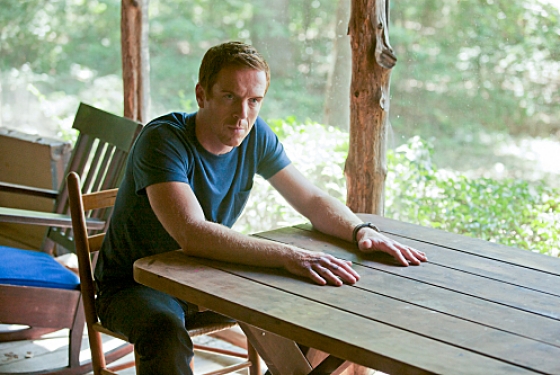

Homeland

The brazen minor miracles of “Homeland”

This great thriller has pulled the rug out from under viewers twice, yet somehow it always plays fair

  • more
    • All Share Services

The brazen minor miracles of Suspect #1: Nick Brody (Damian Lewis) answers the tough questions on "Homeland." (Credit: Showtime)
This article contains spoilers for "Homeland" season one, episode seven, "The Weekend." Read at your own risk.

I live for moments when an already strong drama strikes out in a new direction and becomes surprising and brilliant without violating the integrity of what came before. “Homeland” has managed this feat for two weeks running. Last night’s episode, “The Weekend,” was the peak of the series’ already-stellar freshman season. It moved three sets of characters — Carrie Mathison and her quarry, war hero and suspected terrorist Nick Brody; Carrie’s supervisor Saul and another suspected terrorist; and Brody’s wife Jess, daughter Dana and former lover Mike — off the show’s main field of play, then watched them reveal themselves to each other and to us. The episode was so deftly written, acted and directed — and so unconventionally yet elegantly structured — that it flirted with perfection. Unless “Homeland” pulls off another triumph in the new few weeks, consider “The Weekend” a lock for the top slot on my Best Episodes of 2011 list, trumping even the “Southland” finale, the “Pulp Fiction” episode of “Community” and the best of “Breaking Bad.”

What made it even more impressive was that it arrived one week after another great curveball episode, and built on its predecessor with such care that you could call the writing “logical” even though the characters’ behavior was flat-out bizarre.

Last Sunday’s episode ended with CIA analyst Carrie (Claire Danes) and Brody (Damian Lewis) — who’d been orbiting each other since the pilot — getting drunk at a pub and then having impulse sex in a parked car. Their boozy tryst might have been a credulity-derailing moment in any other ostensibly realistic show; but because “Homeland” had prepped the moment — carefully detailing Brody’s alienation, depression and troubled marriage and Carrie’s anti-psychotic drug regimen and lifelong history of flouting rules and courting danger — it felt psychologically credible and hilariously right. The moment played as if somebody had compiled a list of all the cat-and-mouse suspense pictures in which yin and yang leads stalked each other like possessive lovers and asked what would happen if subtext became text. (Pacino and De Niro leave the coffee shop in “Heat” and check into a motel; their crews stay up all night worrying about them.)

I can’t imagine “Homeland” trying to make like “The Killing” and pretend that Carrie and Brody could go on doing their respective things while keeping their backseat tryst and this week’s even more crazy and irresponsible log cabin vacation a secret from their loved ones and their government. “Homeland” respects its audience too much to pull dumb TV stunts like that. Rather than have its characters do whatever the writers want them to do that week, then avoid real-world implications the next week, it asked and answered a series of reasonable questions: “What flaws and pathologies would push two people into this kind of predicament? What would it do to them personally and professionally? And where would the show have to go after that if it wished to preserve the audience’s confidence?”

Obviously we won’t see the full picture until much later. But for now it appears that the show’s two lead characters — plus Carrie’s domestically hobbled mentor Saul (Mandy Patinkin), who personally went to Mexico to arrest the former terrorist moll Aileen and then did a Petrovich-Raskonikov routine during the long car ride back — have embraced their full potential as human beings. In the process, they’ve tarnished whatever professional standing they once had, and the show seems to have no illusions about this.

Even though I loved the mad fearlessness of Carrie and Brody’s first coupling, I worried that “Homeland” would never recover from it. This week’s exponential raising of the stakes increased my concern. The show is set in something like reality; in reality, if a suspected terrorist and the CIA agent who was tracking him did the horizontal bop in a woodland cabin — after leaving agency property in the same vehicle, a moment surely captured on one of the show’s omnipresent surveillance cameras — both their presumed raison d’etres would be instantly destroyed, and the show would be left with two choices: (1) deny reality or (2) embrace it.

Meredith Stiehm and Michael Cuesta, the writer and director of “The Weekend,” went with the second option, and in choosing it, they took the characters into new and rewarding territory. When Carrie made that slip about knowing what kind of tea Brody prefers — information she could not have gleaned just from being around him — his b.s. detector went off, and she had to lie to cover up her slip. In a lesser show, Brody would have bought Carrie’s fib, and we would have been subjected to another week of emotional bobbing-and-weaving. But “Homeland” decided instead to follow the moment where it might actually lead — to confrontation, then revelation. The conversation on the porch between Carrie and Nick was one of the sharpest, deepest impromptu interrogations I’ve seen on a TV show — a crackpot continuation of the lie detector scenes in the prior episode, but with Carrie (and by extension the audience) playing the role of lie detector.

One of the many wonderful ironies of the porch scene is that its raw disclosures could not have occurred if Carrie and Brody hadn’t behaved recklessly and self-destructively — and if the show hadn’t been willing to follow the moment to an honest place. Only two characters who got trapped in an emotional doom spiral and knew they would never pull out of it could have attained that degree of intimacy and trust.

My predictions — based on the writing, on Danes’ and Lewis’ performances, and on the show’s prior track record of dramatic fair play — are as follows:

(1.) Nick Brody is not a terrorist, and everything he told Carrie on the porch is true. That includes his explanations of what he was doing in his garage in the middle of the night (praying); why he turned to Islam (he needed to seek solace in religion and no Bibles were available); why he makes that fidgety hand gesture (he’s reflexively praying without prayer beads); why he killed his colleague Tom Walker (it was kill or be killed, and he’s not a hero-type); why he lied about Walker’s death (he was ashamed of having murdered him out of cowardice); and most important, why he was able to beat a CIA lie detector test (when you’ve been tortured in prison for eight years, you become a world-class liar).

(2.) Carrie has resolved several mysteries but ruined her career in the process; Brody has established his innocence and converted his worst CIA enemy into an ally, but is now useless as a PR symbol and has probably ruined his own military career, or what’s left of it; and Carrie has poisoned the real intimacy that she experienced with Brody in the cabin. What they had was powerful but could never last, and it’s likely damaged beyond any possibility of full repair. That’s what would happen to these two characters if they were real people stuck in the same situation, and I bet “Homeland” will honor that. The show respects reality too much to plug its ears, whistle a merry tune and continue on as if the Brody-Carrie thing didn’t happen or was no big deal.

The show doesn’t sentimentalize what happened. It gives the characters their moment of bliss, then takes it away realistically. (Kelsey Grammer is giving the year’s most exciting dramatic performance on “Boss”, but Lewis and Danes trump him in subtlety; they’re so good on “Homeland” that they make most other performances seem undernourished.)

(3.) The revelation that Tom Walker is still alive and being prepped to snipe at the presidential helicopter’s landing pad is a bombshell, but it’s no less absurd than Brody laying out the case for his own innocence on the porch. The twist was set up and justified by earlier intimations and details. (If the whole world — Brody included — hadn’t bought the story of Walker’s death in prison, Carrie wouldn’t have been so certain that Brody was the American sleeper agent.)

The twist also sets the stage for Brody and Carrie’s partial redemption. It would be foolish to predict future “Homeland” twists too confidently, but it looks as though the writers are setting the stage for Brody and Carrie to team up to capture or kill Walker, and perhaps flush out and capture his handlers in the process. “Homeland” being “Homeland,” I doubt we’ll be subjected to a ridiculous “The Killing”-style double-reverse fake-out revealing that Brody was the turned soldier all along, or some other such silliness. This is not the kind of drama that would do something like that.

I’m tempted to say that the show shouldn’t run for more than one season because if keeps going, there’s no way it can live up to its debut season. But with “Homeland,” you should never say never.

TV’s golden age of opening credits

Goodbye, theme songs. Now, title sequences for "American Horror Story," "Homeland" and others are required viewing

  • more
    • All Share Services

TV's golden age of opening credits Clips from the opening sequences of "Homeland" and "Mad Men"

One of the new television season’s most unsettling moments took place, as unsettling moments so often do, in a basement festooned with jars of pickled human fetuses.

Twenty seconds into a tour of this gruesomely decorated cellar, our skittery camera feed abruptly cuts out and, with an accompanying crunch of industrial music that could only have been composed by some dude wearing a black trench coat, we’re visually assaulted by an image that will haunt us forever: Connie Britton’s name, typeset in a bold, gothic font.

Now, the words “decidedly unscary lead actress provides unexpected fright” might very well appear somewhere in the series bible for “American Horror Story,” Ryan Murphy and Brad Falchuk’s gonzo FX drama set in a house in dire need of that diminutive psychic from “Poltergeist.” But deploying the tactic during the show’s main title sequence, using just Britton’s name? As her calming “Friday Night Lights” character, Tami Taylor, might have said, “That’s just clever, y’all.”

Not that anyone should be surprised when wildly imaginative content turns up during a program’s opening credits; these days, eye-popping intros can now be found on virtually any channel not named C-SPAN. And they aren’t picky. You see them setting up everything from big-budget premium-cable series such as HBO’s “True Blood” and Showtime’s “Dexter” to cultish hits such as IFC’s “Portlandia” and FX’s “Archer.” Reality and talk shows have them, and they even cling like remoras to the carcasses of the recently departed, as proven with NBC’s “Chuck” and Fox’s “Human Target.” While there are still many opening sequences that are as irritating as anything that has graced our sets since the dark, final days of “Small Wonder,” it’s also true that some of the best work being done on television today occupies the space once reserved for cheesy cast montages and explanatory ditties written by Alan Thicke.

“A lot of television main titles, from a design standpoint and a typography standpoint, are [still] profoundly mediocre, because they’re for goofy, silly shows,” says Kyle Cooper, the founder of Prologue, the influential design collective behind the instant-classic “American Horror Story” opener, as well as the one fronting its somber cousin “The Walking Dead.” “But mixed in, there’s some good things that get through.”

An increasing amount, actually. For those of us raised on a gluttonous diet of the programs now found on TV Land and conditioned to expect little more from opening credits than “… and Jerry Mathers as the Beaver,” flipping around the dial can make us feel as if a brave new world has sprung up overnight. And, even though the art of main title design on television has, in fact, been in the midst of a full-blown renaissance ever since Tony Soprano took his first drive through northern New Jersey in 1999, the number of quality openers seems to have skyrocketed on the sly. How else to explain that, in just 20 years, NBC has gone from the corny third-season main title sequence of “Blossom,” with its unfortunate misuse of flowery hats and Joey Lawrence, to the inspired paper cootie catcher gimmick of “Community,” which not only reveals the cast members’ names but also contains appropriately immature jokes, such as a drawing of a topless stick figure lady? And how is it that, in 1990, the painfully hideous bumper promo for the hideously painful “Club MTV With Downtown Julie Brown” was nominated for an Emmy — in the same category won in 2008 by the sublime animated opening sequence for “Mad Men”?

I may still be suffering from the concussive blow dealt by the intro to “Suddenly Susan” — a super-sized Brooke Shields stomping through San Francisco — so forgive me if I sound groggy when I ask: How exactly did opening credits become essential viewing?

“You could make a few different arguments,” says Chris Billig, executive producer at TCG Studio, the firm responsible for, among many other things, the purposefully discordant main title sequence of Showtime’s “Homeland.” “But I would make the argument that as television has become a more creative medium, it has drawn better talent. A lot of feature guys are willing to get involved in the creative process of television now. When you have that transition, you ultimately have a higher bar for your creative delivery.”

In recent years, of course, a number of directors and actors more often associated with cinema have dipped their toes in the foreboding waters of series television: notables like Martin Scorsese and Steve Buscemi (“Boardwalk Empire”); Dustin Hoffman and Nick Nolte (“Luck”); and Don Cheadle (“House of Lies”). But it has been a slow build to get to the point where a hugely successful movie guy like David Fincher would be willing to commit to the open-ended rigors of episodic storytelling, let alone with two-time Oscar-winner Kevin Spacey in tow. A film-to-TV transition by an A-lister would have been hard to fathom even just a dozen years ago, when networks were still the primary source of entertainment on the small screen. But then came “The Sopranos.” Fueled by its unprecedented success, HBO and other premium outlets, which aren’t as concerned about advertisers or the FCC, began rolling out the welcome mats — and wheelbarrows of cash  —for creative types. A trickle-down effect soon extended to basic cable, broadcast television and beyond, and here we are at a moment in history in which a bidding war for the exclusive rights to air 26 episodes of Fincher’s upcoming political drama “House of Cards” ends with upstart Netflix ponying up $100 million.

With that kind of cash at stake, the folks from film have been arriving in droves. And not surprisingly, they’re refashioning television in their own image. “In features, people realize that every minute of screen time is precious,” says Cooper, who became a hero of typography fetishists everywhere for his meticulously crafted title sequence for the 1995 Fincher mindbender “Se7en.” “The titles can do more than just setting up people’s names.”

Like many others in his field, Cooper subscribes to the philosophy popularized by Saul Bass, who almost single-handedly created the art of main title design in the 1950s and ’60s with his stylized sequences for Alfred Hitchcock (most notably “North by Northwest”), Stanley Kubrick (“Spartacus”), Otto Preminger (“The Man With the Golden Arm”) and other auteurs. His theory: “You try to reach for a simple, visual phrase that tells you what the picture is all about and evokes the essence of the story.”

Evocative brevity is very much on display in Cooper’s masterful opening credits for “The Walking Dead.” In just 35 seconds, viewers learn pretty much everything they need to know about the series — namely, that it’s a creepy, yet frustratingly slow-moving, zombie drama set in a post-apocalyptic world in which the zombies are rarely the focal point.

Bass’ philosophy is also in play during the opening sequence for “Boardwalk Empire.” Karin Fong, a director and designer at industry alpha dog Imaginary Forces, worked closely with series creator Terence Winter to find the best way to clue in savvy HBO audiences to the world they’re about to enter. Ultimately, they decided on an impressionistic approach that might have left Sherwood Schwartz scratching his head: shots of Steve Buscemi, dressed in period garb, standing alone on a beach surrounded by bottles of liquor. “I think many of the best titles don’t duplicate what is shown in the narrative that follows but instead serve to intrigue and pull in the viewer with emotional impact,” says Fong.

Essentially, she’s talking about content branding, or creating images that will emotionally adhere viewers to a particular show, a once-flourishing technique that had been in hibernation on television for many years. During Saul Bass’ heyday, visually compelling intros weren’t uncommon (e.g., the cartoonish opening for the 1965-69 CBS series “The Wild Wild West”). But with rare exceptions — “Miami Vice,” for one — networks went in a different, more utilitarian direction with opening credits in the 1970s and ’80s. “Maybe people chose not to put their money into that part of the show, or they forgot that you can do a lot of other business there,” says Cooper (who, perhaps not coincidentally, did the main titles for the 1999 film adaptation of “The Wild Wild West”).

Business, of course, explains the general trend over the last few decades, especially on networks, of marginalizing opening credits. You can’t blame the suits for wanting to truncate the stale convention in favor of a few more seconds of advertising space each week. By the mid-1980s, main title sequences on television had become entirely predictable: neatly explain the premise of the show or the characters in 30 seconds or less, hopefully via an insidiously hummable theme song, à la the ragtime “Mr. Belvedere” tune that still rattles around in my head daily and drove one should-be YouTube star crazy enough to lip-sync it while sitting on the toilet. Even programming honchos knew that, by and large, opening credits had become something to skip over — or, worse, given how rapidly the cable universe was expanding, something to flip away from. The fear of viewer flight got so bad that one fed-up ABC executive, perhaps after seeing the intro to “Full House,” suggested that the network eliminate them all together.

In the late-1980s, when “It’s Garry Shandling’s Show” savaged tired openings on his groundbreaking Showtime series with lyrics that literally went “This is the theme to Garry’s show/The opening theme to Garry’s show/This is the music that you hear as you watch the credits,” the death knell had tolled for earnest title sequences. Producers who wanted their shows to land with Gen X — the target demographic advertisers coveted most at that time — needed to inject them with winking humor (e.g., “The Fresh Prince of Bel-Air”), genuine genius (David Lynch’s iconic lead-in to “Twin Peaks”) or extreme brevity (“Murphy Brown,” “Seinfeld” and “Frasier”). For the networks, the last technique resulted in slight upticks in viewer retention and ad revenue, and helps explain why shorter titles and cold opens are so prevalent on broadcast television in 2012.

“At the end of the day, the networks are about selling soap and shampoo and stuff like that,” says Billig, whose company worked with J.J. Abrams to devise the famously brief “Lost” sequence. “There’s always the question of ‘How much time do we allow for the main title?’” In the case of “Lost,” the answer is 12 seconds.

Since it’s unlikely that the networks will ever be able to greenlight show openings as daring as the ones increasingly found setting up the likes of “American Horror Story” and other cable shows, and since the threat of viewer retention still gives them nightmares, maybe ABC and its broadcast rivals should strive to lead the charge in a promising sub-development: main title sequences that change from episode to episode. “Weeds,” for instance, produces a completely original vignette each week that not only cleverly incorporates the show’s title but also hints at the content of the episode. The ridiculously ornate maps concocted for the “Game of Thrones” opening sequence, which won the prime-time Emmy for outstanding main title design last September, change from episode to episode, depending on where the action takes place. Of course, those perpetually watchable credits sequences are just variations on a hugely successful long-running gag from a network show. What fan of “The Simpsons” hasn’t sat through the opening credits hundreds of times to see what Bart Simpson writes on the chalkboard or what happens with the couch?

For now, those of us whose brains are still playing “The Brady Bunch” earworm on repeat can rest easy knowing that the trend toward more visually sophisticated opening credits should prevent the unironic explanatory theme song from making a comeback — although Zooey Deschanel’s adorkable throwback “New Girl” intro is a near-miss. Of course, this may dismay fans of shows sporting inscrutable main title sequences, and fans of camp, for that matter. In other words, “Homeland” viewers shouldn’t expect to hear Claire Danes rhyme “She knows her Hezbollah” with “Despite being bipolar” when the show returns for Season 2.

“That would be awkward,” says Billig.

Continue Reading Close

Should “Homeland” have quit while it was ahead?

It's hard to imagine the Showtime series topping its debut season -- but a second is in the works anyway. VIDEO

  • more
    • All Share Services

Should Moment of truth: Nick Brody (Damian Lewis) wrestles with destiny on the season finale of "Homeland." (Credit: Showtime)
The following article contains spoilers for the season finale of "Homeland," season one. Read at your own risk.

Bugs Bunny and Daffy Duck might not seem to belong in a review of a searing cable drama about terrorism, but bear with me, OK? In the climax of “Show Biz Bugs” (1957), in which Bugs and Daffy compete for the right to claim top billing in a show, Daffy decides he’s had enough of being bested by the rabbit and hauls out his trump card, self-immolation. “I must warn those with weak constitutions to leave the theater for this performance,” the duck says, then swallows gasoline, nitroglycerine, gunpowder, uranium and a lit match, and explodes. “That’s terrific, Daffy!” Bugs exclaims from the wings, over thunderous applause. “They loved it! They want more!” “I know, I know,” says Daffy’s ghost, floating toward the rafters. “But I can only do it once!”

Season one of “Homeland” was great, but are executive producers Howard Gordon and Alex Gansa about to try to do it twice — even though it’s a trick that can only be done once? I worry that the only major tactical error that “Homeland” made in its 90-minute season-ender was letting Marine Sgt. Nick Brody come out of his weird odyssey free and unharmed. If the producers had let Brody swallow the match, so to speak — and complete his suicidal terrorist attack, or get shot or otherwise neutralized in the State Department bunker, or be talked down by Carrie or his teenage daughter, Dana, or his wife, Jessica, and then sent to prison — the series would have still dazzled as a stand-alone while leaving us lots of questions to chew over. Brody’s statement on the phone to Abu Nazir — about how it might be more advantageous to have a fifth column influencing U.S. foreign policy rather than a sleeper agent plotting a bloodbath — makes dramatic sense, and it works as a setup for a second season, one set in the heart of executive-branch power rather than on the military-intelligence fringes. But it’s damned hard to imagine how a scenario like the one that Brody laid out to Nazir could produce TV more exciting than the season that we just finished watching.

I could be wrong, of course — and I hope I am wrong, because this was a mostly terrific debut season, maybe the most unpredictable single year of a drama that I’ve seen since the first season of “Breaking Bad.” And there were enough plot threads left dangling to give “Homeland” somewhere to go next year: not just major developments such as Brody’s intimate access to power and the effect of electroshock treatment on Carrie’s sleuthing abilities, but questions such as, “Who took the chip containing Brody’s suicide statement?” and “Who is the mole in Saul and Carrie’s department?” I feel pretty sure that the answer to that second question isn’t “Saul” — but if it’s not Saul, then who could it be? Not David Estes, surely — that would just be dumb, in a “24″ way. Maybe they’ll add more characters next year to widen the list of suspects.

The stories of Carrie and Brody complemented each other in ways that only become clear in retrospect. Because Carrie has been “home” much longer than Brody, it’s easy to think of her as somehow being better adapted, more settled, than the suspect she’s been pursuing, but she really isn’t, or wasn’t. Her mental illness and Brody’s wartime trauma and brainwashing aren’t exactly alike, but for dramatic purposes they line up nicely. Both characters are loners who have seen and done and survived things that most of us can barely imagine, and both wrestled with alienation and fears of fraudulence and worthlessness, impotence and maladjustment. They are both passing for normal and living in fear of being found out. It was only a matter of time before they found each other.

One of the many compelling aspects of their relationship, such as it was, is the question of how intentional Brody’s actions were with regard to Carrie and her feelings. I’m pretty sure that Carrie was a wild card in Abu Nazir’s diabolically clever Marine One/Marine Two terrorist attack plan, and Brody dealt with her very effectively, both in the moment (following her out into the parking lot when she showed up at that group meeting, for example) and long-term (at the end of last week’s episode, I was shocked that he ratted her out rather than coming over as he told her he would, even though I should have seen the twist coming). Ultimately I think it’s right to say that the core of their relationship was authentic, even though both of them were ultimately using the other.

Also: I hereby belatedly and officially retract my worrying that by having Brody turn out to be a big faker who really was in with the terrorists, “Homeland” was going to turn into a higher-toned cousin of “The Killing.” Everything that happened after that big twist was justified — although of course that’s not the same thing as calling it plausible. But these terms are relative anyway. I find the details of the terrorist attack quite plausible — including the way Tom Walker carjacked a woman who lived a couple of blocks away from the attack site, in a sniper-friendly high-rise apartment, and who just happened to have bingo that night — but I still have trouble buying that a man as emotionally fragile as Brody could have sustained so great a deception and made so many spontaneous, just-right choices that helped preserve it. (Dana’s list of her dad’s outrages — shooting a deer, “stepping out on mom,” beating up his best friend — was hilarious, practically an auto-critique of the show you were watching.) And I don’t think the vice president’s cozying up to Brody quite passes the narrative smell test. The master plan doesn’t work unless Brody can get right inside the veep’s inner circle, close enough that Marine Two can drive his entourage inside a bunker where Marine One (Brody) can blow him up. But first, the veep has to instantly love Brody.

But no matter: from start to finish, the cast of “Homeland” made me believe what I was inclined to doubt, which is ultimately the highest complement that one can pay to actors. Damian Lewis, Claire Danes, Mandy Patinkin, Monica Baccarin, and stealth-best-in-show candidate Morgan Saylor deserve the armloads of awards they’re sure to get for their performances. And whether the series tops itself, becomes an embarrassment, or just sort of runs in place until everyone forgets it’s on, we’ll always have this magnificent first year to marvel over and revisit.

Continue Reading Close

When great TV shows disappoint

Why off-key episodes of "Homeland" and "Boss" made me revise my enthusiasm for two favorite new shows

  • more
    • All Share Services

When great TV shows disappointClaire Danes in "Homeland" and Kelsey Grammer in "Boss" (Credit: Showtime/Starz)

As regular readers know, I sometimes fall head-over-heels in love with promising new shows, and when they deliver a problematic or outright bad episode, it’s disillusioning. I tell myself it’s the nature of the beast — that it’s hard to make just one great half-hour or hour-long episode, let alone 10 or 12 or 26 in a row. The law of averages has to catch up eventually. But that doesn’t change the fact that a show that once seemed to have excellent judgment suddenly made what felt like out-of-character or flat-out stupid choices. A botch-job episode can make you wonder if you were right to like the show in the first place. At its most misjudged and tone-deaf, a bad episode of an otherwise terrific series can emphasize flaws you were previously inclined to overlook. It can even make you second-guess the things you praised in the past.

I’ll give you two recent examples, then pose a few questions and open the floor for readers to share their own experiences. I’ll place the examples within self-contained sections, so that you can easily skip them if you’re afraid of spoilers.

Example No. 1: “Boss”

The Starz drama “Boss” was one of the biggest surprises of the new season — a swaggering, slightly purplish Song of the City, featuring Kelsey Grammer in a career-reinventing performance as Chicago mayor Tom Kane. I praised it the way Chicagoans are supposed to vote: early and often. I still think Grammer is terrific, and I like most of the other recurring players, too — especially Connie Nielsen as Kane’s wife Meredith, and Martin Donovan as his ice-water-veined chief adviser, Ezra Stone. I was all set to write another piece praising it — specifically a celebration of the fifth episode, “Remembered’ (Nov. 18), which deepened and expanded the show’s scope. Directed by “Homicide: Life on the Street” cinematographer Jean de Segonzac and written by Angelina Burnett, it was a nearly perfect hour of TV, one that aced the macro as well was micro details of the show’s milieu. As I watched Kane and his people try to manage a PR nightmare — the contamination of a nearby town by toxic waste that Kane himself had buried when he was a sanitation commissioner back in the late 1980s — I felt certain I was in the hands of people who knew what they hell they were talking about. The dynamics of PR and public perception were brilliantly explored — especially the way that a master propagandist can redirect a scandal’s energy in ways that benefit the person who caused it. (I laughed out loud when the small-town mayor finally called a joint press conference with Kane, the man responsible for his town’s awful predicament, and profusely thanked him for his help during the crisis.)

The episode also connected “Boss” to a long tradition of civic tragedies about morality and ethics, invoking both “An Enemy of the People” and “Oedipus Rex.” Certain moments even seemed to suggest Kane’s degenerative neurological disorder and his mentor’s apparent dementia were somehow connected to that toxic waste site — that the sins of the past were perhaps coming back to haunt the present. (I always chuckle remembering a friend’s glib summary of the plot of “Oedipus Rex”: “Who is responsible for this accursed plague on Thebes? Oops, hold on a second– well, whaddaya know, it’s me!”

What stopped me from writing a column about this magnificent chapter? It was the next one, “Green,” actually, which just happened to be on the same screener disc as “Remembered.” Written by Lyn Green and Richard Levine and directed by Mario van Peebles, it was a hot mess of an episode, one that highlighted persistent flaws that have dragged on “Boss” even during its finest hours: specifically, a weirdly brutish and dehumanizing attitude toward women and sex, and a penchant for show-offy sadism and graphic violence that all but screams, “We’re on pay cable! We can do anything!” Certain scenes just felt like the R-rated cable version of running out the clock — particularly the sequence in which Kane’s daughter Emma (Hannah Ware) and her drug dealer boyfriend witnessed a savage beating in an alley, then went back to her apartment and had sex against a wall. Then in the final sequence, a troublesome alderman who was making life difficult for Kane got tortured, murdered and buried out at the O’Hare Aiport toxic waste site by the same underling he’d ludicrously mutilated in the premiere. (Right — as if this could happen and not instantly topple Kane and his administration.) The big twist with Meredith deciding to work against her husband was also stupid; I just didn’t believe that a municipal first lady who’d survived so much personal and political adversity – and seemingly made peace with all kinds of moral compromise — would suddenly decide to foul her own nest like that. A TV show can choose to be a vicious but realistic and fundamentally serious portrait of contemporary urban politics, a la “The Wire,” or a David E. Kelley-style naughty cartoon soap opera. It just can’t be both. In the immortal words of Henrik Ibsen, cognitive dissonance is a bitch.

Example No. 2: “Homeland”

Overseen by “24″ producers Howard Gordon and Alex Gansa, with heavy input from former “Homicide: Life on the Street” and “Rubicon” writer Henry Bromell, “Homeland” instantly struck me as one of the season’s best new dramas. The show’s first few episodes built beautifully from a somewhat plausible setup: longtime Iraq POW Nick Brody (Damian Lewis) tries to readjust to life back in the states while being secretly surveilled by CIA agent Carrie Mathison (Claire Danes), a pill-popping psych case who thinks Brody’s a domestic terrorist who got turned in captivity. Although the series played Carrie and Brody’s cat-and-mouse dynamics subtly and realistically during its early stretch, keeping them mostly apart, the show slowly began to hint that they were headed for a more, um, personal relationship. They made that official in the Nov. 6 and 13 episodes, which saw Carrie and Brody impulsively have sex in the back of a car, then trip off into the woods for a weekend that felt like “Last Tango With the Manchurian Candidate.” This all should have played as ridiculous TV contrivance, and in lesser hands it would have. But because the series had paved the way for it so meticulously — detailing the depth of Brody’s alienation from his wife, friends and country, as well as Carrie’s emotional instability and penchant for maverick movie hero-style “improvisations” — we bought it. Better yet, the cabin-in-the-woods subplot paved the way for what felt like a series-redefining revelation: in an informal interrogation on a sunlit porch, Brody told Carrie he was neither a terrorist nor a war hero, just a man who spent eight years in captivity and did whatever he had to do to survive, including converting to Islam and learning to love his jailer, the terrorist Abu Nazir. The episode was capped by another huge revelation: that Tom Walker (Chris Chalk), the Marine sniper whom Brody thought he’d been forced to murder in captivity, was alive, and being positioned to take a shot at the president’s helicopter.

This all seemed to set the stage for “Homeland” to become a different show than the one we’d originally been promised — a series in which a wrongly-accused former Marine joins forces with a CIA agent to capture a real menace. The next episode, however, pulled a sort of double-reverse fake-out, ending with a scene that implied that Brody really was a terrorist agent all along. It was a revelation too far, or so I thought. I wrote a piece about this episode wondering if it signaled a de-evolution into plot twists for their own sake, a tendency that made AMC’s once-promising “The Killing” grow more ludicrous and stupid by the week. I had other concerns as well — they’re detailed in this piece — but suffice to say they all came back to my suspicion that this series might prove more expedient than intelligent, more opportunistic than realistic, and that it was about to sacrifice all of its good qualities on the altar of “surprise.” Last Sunday’s episode seemed to set things back on track; I especially liked the explanation of why Tom Walker instinctively sought refuge in the mosque, Carrie’s expert detective work ending with that secret conversation in the clothing store, and the flashbacks to Brody’s captivity, during which he tutored Abu Nazir’s son, a darling boy who was ultimately killed along with dozens of other Iraqi children in a U.S. bombing run. The show’s exceptional performances — especially Lewis’, which grows deeper and more sympathetic by the week — have gone a long way toward quelling my concerns, or at least making me inclined to accept what common sense tells me is horse manure.

But several things still don’t sit right. One is the Brody-as-sleeper-agent thing. The more we learn about Brody personally, the less he seems like somebody who’s capable of sustaining a long-term deception, part of which must occur in the public eye. He radiates an everyday sort of pained decency, and when he told Carrie that he wasn’t a war hero-type — that in fact he was not all that brave of a person — I believed him. To pull off a long-term public-private performance like the one that Brody is supposedly engaged in, you have to be either very brazen or wired all wrong emotionally (maybe a bit of both). Brody just doesn’t read like that sort of person — not in his interactions with other characters, but more importantly in his quiet moments when he’s alone and nobody but the audience is watching him. And the politicization of Brody’s character — he’s been ordered to get close to the vice president, the man who ordered the airstrike that killed Nazir’s son — feels way too “Manchurian Candidate” for me, not compatible with his established personality, and probably unworkable in real-world terms. Also: political campaigns always miss things during vetting, but I am having a hard time believing that the vice president’s people would seriously consider letting their man get close to a former POW who once freaked out and shot a deer with a handgun during a house party, is under investigation as a possible terrorist by the CIA, and was once best buddies with a presumed-dead sniper who’s currently the subject of an FBI manhunt. (And come on, wasn’t Brody’s final conversation with his wife Jessica just dumb? What kind of wife would hear a story that her husband got mugged, didn’t go the extra mile to tell her about it, and disappeared for most of the day — and just accept it?)

And now back to our regularly scheduled column: The problem is, even when a show recovers from an off-key or outright bad episode, the memory of that episode stays with you, and you have to reconcile it (or excuse it, or forget it) as you continue to watch. Obviously I’ll wait until the end of the season to render a final verdict, but right now I’m thinking there was less to “Boss” and “Homeland” than I originally hoped — that what we’re seeing are, respectively, a more purplish and less disciplined Chicago cousin of “The Wire,” and a slowed-down, more depressed “24.” If I’m proved correct in my suspicions, it doesn’t mean that either show is not worth your time; there are still plenty of compensations, some of them extraordinary. I’ll continue to watch both of these series, just more skeptically, with a guilty-until-proven-innocent attitude. That’s how I watch most TV, because the nature of series TV almost guarantees drastic fluctuations in quality.

Are there any shows that won your heart early on, then made you re-evaluate your enthusiasm? What were the shows? What made you take a step back? And did you ever reconcile your objections and decide to keep watching? Has there ever been a TV series that in your opinion produced no bad episodes? Or does the nature of TV make such a scenario impossible?

Continue Reading Close

Will “Homeland” turn into another “The Killing”?

A climactic twist keeps the audience guessing at the expense of plausibility -- and audience goodwill

  • more
    • All Share Services

Will Morena Baccarin as Jessica Brody and Damian Lewis as Nicholas "Nick" Brody in "Homeland." (Credit: Kent Smith/Showtime)

It was probably only a matter of time before the executive producers of “Homeland,” Howard Gordon and Alex Gansa, reverted to their roots on Fox’s “24,” eroding a lot of the goodwill that this show has built up. I’ve described last week’s episode, “The Weekend,” as the most perfect hour of TV drama I’ve seen since the “Mad Men” episode “The Suitcase,” and I stand by that rave. Unfortunately, a viewer’s endorsement can be undone by problematic twists, and I have a sinking feeling that’s what just happened on “Homeland.”

The brilliance of “The Weekend” was predicated on the idea that everything we thought we knew about former POW Nick Brody (Damian Lewis) was wrong — that Brody was not really a pawn of the terrorist Abu Nazir, that he didn’t get turned in that Iraqi prison, that he’s still loyal to the United States, and that all the seemingly suspicious behavior witnessed by Carrie and her colleagues could be reasonably explained. A lot of people (myself included) assumed, or hoped, that the Carrie-Brody conversation on the porch last week meant that “Homeland” wasn’t going to turn into a typical twists-and-turns show, a thriller that sacrifices psychological plausibility on the altar of “surprise.” I still hope that turns out to be the case. But the last few minutes of last night’s episode, “Achilles Heel,” do not bode well.

I am not sure how to read the final scene that occurs after Carrie has told Brody that he didn’t beat Walker to death in prison and that he’s actually alive — the fake-out where we think we’re going to see Walker in that living room and it turns out to be Brody, and he furiously confronts that man (a handler?) and tells him that he’s had it, that the Walker ruse was just too much. “I’m through talking with Nazir, and you can tell him that,” Brody said, “Tell him it’s over.”

It reads like a scene in which a secret agent confronts a puppet master and turns on him; I use the phrase “it reads like” because I don’t believe we know exactly who that man is yet. (Do we?) In any event, the scene makes it seem as though Brody is a huge liar — that he was in fact part of a terrorist conspiracy all along, that the wounded innocence and even cowardice that he revealed to Carrie in the woods is part of what Carrie, in a lucid moment, described as a part of a “long con.”

That last scene in “Achilles Heel” raises questions that aren’t flattering to “Homeland,” whether you read them as indicative of innocence or guilt. If Brody is a brainwashed killer — part of a larger scheme that also involves Walker — is it believable that he’d maintain his conditioning after being horribly abused and mistreated for years, then finally lose it because of the Walker deception? Why would that be the last straw and not something else? Could anyone who’s been through what Brody has maintain what amounts to an elaborate public and private performance, 24 hours a day? I find the idea of a brainwashed Walker living on the fringe as a homeless person while Brody lives a functional middle-class life (with occasional freak-outs such as the deer shooting incident) much more believable. It doesn’t require Walker to maintain a performance, keep secrets from his wife and kids, fool the CIA and the media, etc. Walker just has to do what he’s told, keep to himself, bide his time and follow orders.

Of course, it’s possible that Walker and Brody are different cogs in the same conspiracy, and that one of these men is intended to distract from (or cover for) the other. But I prefer the idea of Brody as a pawn or patsy or victimized front man — that the bad guys created him in order to draw attention away from whatever they were actually up to with Walker, or whoever. Farfetched as that might be in real life, for a thriller series it’s more credible than any of the alternatives suggested by last night’s episode, which included the “Manchurian Candidate”-like twist of Brody being groomed to take the place of a congressman who’s resigning in the wake of a sex scandal. I don’t believe that any power brokers, no matter how opportunistic or evil, would think that an emotionally volatile former POW with no political experience would be a good candidate for national office. Brody shot a deer during a party. There were witnesses. (I also didn’t believe that long action sequence with FBI tactical units chasing Walker and accidentally killing a couple of Muslims in a mosque. Since killing Walker would be counterproductive, would the troopers really be using live ammo, as opposed to tranquilizer dart guns or nets or rubber bullets or some other non-lethal weapon? And wouldn’t at least one of the people guiding their actions back in the situation room have an eye on Google maps, and warn them via headset, “Be extra careful in there, guys”? But that’s more of a technical adviser issue than a failure or betrayal at the plot level.)

I suppose you could defend what happened in “Achilles Heel” on meta-fictional grounds — meaning that the narrative game “Homeland” is playing with the audience mirrors whatever game that Brody the deceiver is playing with Carrie and the whole national security state; that what we’ve been watching on “Homeland” is a kind of double-secret-reverse fake-out in which mysterious Brody convinces us he’s not the sort of character we naturally assume he is, the better to disguise the fact that he actually is what we feared he was, and protect whatever evil scheme that he’s a part of.

The game-lover in me likes the idea that my desire to have “Homeland” turn out to be something other than a typical twist-driven thriller is my own Achilles heel as a viewer, and the show exploited it. If that turns out to be the case, it’ll be a testament to Damian Lewis’ depth, skill and sympathetic face. Only a good actor could make me disregard my own conditioning as a thriller fan and think, “Hey, I guess Carrie had it wrong — Brody is not a terrorist, he’s just damaged and misunderstood.” And to be fair, it’s unlikely that a 13-episode series would have revealed most of its trump cards at the halfway point; since this is a thriller, there have to be more twists. But if a show goes too far in that direction — revealing that, say, Carrie or Saul are the real sleeper agents, twists that I really hope are not on deck — it’ll turn “Homeland” into a smaller, quieter “24,” a cartoon in which you can’t trust anybody or anything. Or worse, it’ll become “The Killing,” which started out as a realistic account of a single murder investigation and got stupider and more arbitrary by the week.

If this does turn out to be the central triumph of “Homeland” — using strong writing and acting to fool viewers into thinking it’s not just another shameless TV thriller — it’ll be a Pyrrhic victory at best.

Continue Reading Close