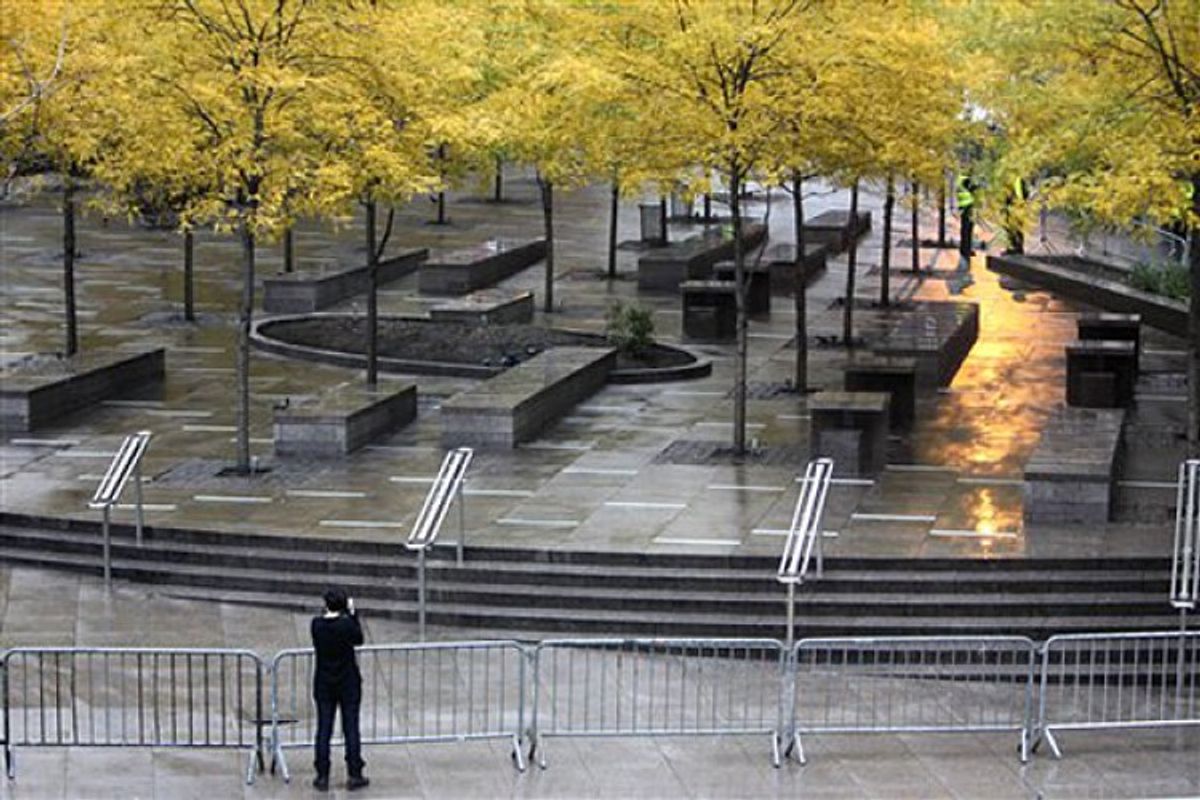
Forcibly dispersed in the wee, dark hours of Nov. 15, as pesky journalists were shoved away by the police, the occupants of Zuccotti Park -- aka Liberty Square -- were surely reminded that Michael Bloomberg was not only the mayor but, when all was said and done, possibly the best-known 1-percenter in Greater New York.
The mayor held a press conference later to say: “The First Amendment protects speech. It doesn’t protect the use of tents and sleeping bags to take over a public space.” Previously, the mayor had declared: “New York City is the city where you can come and express yourself. What was happening in Zuccotti Park was not that.” The protesters, he went on, had taken over the park, “making it unavailable to anyone else.” I suppose it could be said that any demonstration makes a given space “unavailable to anyone else.” And as for “expressing yourself,” well, that’s not what the First Amendment says, either.
In the originalist spirit of Associate Justice of the U.S .Supreme Court Antonin Scalia, let’s go to the text. Undeniably the mayor had one thing right. The First Amendment protects speech. It also prohibits “abridging ... the right of the people peaceably to assemble, and to petition the Government for a redress of grievances.” There can be no doubt but that the occupants of Zuccotti Park were peaceably assembling and that their purpose was, in the broad sense, petitioning, though some of them don’t like dotting the i’s and crossing the t’s on the de facto demands they are making on the authorities by the very act of congregating in their vicinity. As for incidents of violence and other illegal acts that took place in the square, the police were within their rights to interpose criminal justice, but not to sweep the square of tents, sleeping bags and other personal property. Even one New York Times columnist who thinks that eviction was “to a point ... defensible” calls the mayor and police chief Ray Kelly “imperial,” which is not a compliment, even in the Empire City.
But now that Mayor Bloomberg has joined the mayors of Oakland, Denver, Portland and Salt Lake City as agents of dispersal, the larger question preoccupying not only the occupiers but their larger concentric circles of supporters, as well as the chattering classes, is: Now what? What’s the relation between the turf and the movement? Both known and unknown unknowns abound, but it cannot be taken for granted that the expulsion is bad for the movement. To the contrary: Odds are that the expulsion -- from a place very far from Eden -- will function as a pick-me-up, driving greater numbers to the Nov. 17 actions planned by MoveOn and other groups for lower Manhattan and 300 other sites nationwide.
Movements wither when they don’t evolve, and they evolve when they learn intelligently how to avail themselves of opportunities and adapt to changes in the environment -- an ensemble of several moving parts (supporting groups, politicians, police). In fact, as many occupants and commentators have pointed out, Zuccotti was already having a hard time managing, and was looking more unruly with the passing days. Although the local community board overwhelmingly endorsed the occupation, not a few residents were annoyed by undisciplined drumming (reportedly by a few drummers who, even after the general assembly voted restrictions, insisted on their absolute right to drum whenever and wherever they liked -- an unwitting echo of Michael Bloomberg’s la ville, c’est moi).
Since Sept. 17, there have been so many moving parts in the evolving ensemble known as Occupy, each rubbing against the others in a whole ecology of protest, that predictions are foolhardy. But there’s a good chance that the great sprawling hard-to-pin-down Occupy movement is well along in the learning process and that it can gain more than it loses by leaving the Zuccotti/Liberty campground.
The urban planner Peter Marcuse, a strong supporter of the movement, has cautioned against “fetishizing” Zuccotti Park. He usefully distinguishes among seven functions of the movement:
- A confrontation function: “taking the struggle to the enemy’s territory, confronting, potentially disrupting, [its] operations.” That means the Wall Street area, for which Zuccotti Park was and remains, obviously, a convenient launch-pad.
- A symbolic function as a visible testimonial to a line of argument and a way of looking at the world.
- An educational function, promoting debate and clarification, toward the end of clarifying what the 1 percent and the 99 percent mean, and how that infernal cleavage developed.
- A glue function, “creating a community of trust and commitment to the pursuit of common goals.”
- An umbrella function, “creating a space ... in which quite disparate groups can work together in pursuit of ultimately consistent and mutually reinforcing goals -- ... a political umbrella, an organizing base for an on-going alliance, not just a temporary coalition, of the deprived and discontented.”
- An activation function, “inspiring others to greater militancy and sharper focus on common goals and specific demands ... providing space for ... cross discussions among supporting groups and interests, organizing ... events in support of ... reforms that point [toward] Occupy’s own ultimate goals of change.”
- A model function, “showing, by its internal organization and methods of proceeding, that an alternative form of democracy is possible.”
Hey, whoever said that organizing movements is simple or mindless?
Marcuse goes on to say that only the confrontation function required Zuccotti Park as such, and even that is far from clear. There do need to be meeting places, sites where people of different dispositions brush up against each other and stay in touch. Zuccotti offered advantages -- Wall Street proximity, for one -- but at a cost: very limited sunlight, leading one prominent supporter I know to publicly call it “hell’s half-acre.” There are other public places, even ones with symbolic resonance. (By some accounts, after all, on Sept. 17, when the occupation began, Zuccotti Park wasn’t the first choice -- it was Plan B.) As Peter Marcuse writes, “the defense of the permanent and round-the-clock occupancy of a specific space can lead to a fetishization of space that make the defense of that space the overwhelming goal of the movement, at the expense of actions furthering the broader goals that that space is occupied to advance.”
As for the model function, the utopian, communitarian spirit, it can thrive in many spaces. Now that the symbolism has been established in the public mind, some token encampment through the winter probably makes sense, but Liberty Square can be movable; Zuccotti has no patent on liberty. Anyway, it would be foolhardy to think that the tent-city way of life Zuccotti has promoted is a way of life that the 99 percent cottons to. It’s that 99 percent that needs, continually, to be assured that the movement speaks to and for them.
All the old questions remain. What of demands, programs, platforms? How will the movement relate to an election year? How can it contain violent outbursts? How can it maintain itself over time? How can the leaders who have emerged through the occupations cultivate their skills and withstand all the pressures that realities place on leaders? These are not problems that can be solved by turf. They are the givens, the questions that coil at the heart of any movement; and they are, and remain, ours.
Shares