Abortion
Why is Hollywood still terrified of abortion?
Forty years after Roe, abortion's so traumatic in films that it leads to suicide -- and teens deliver half-vampires
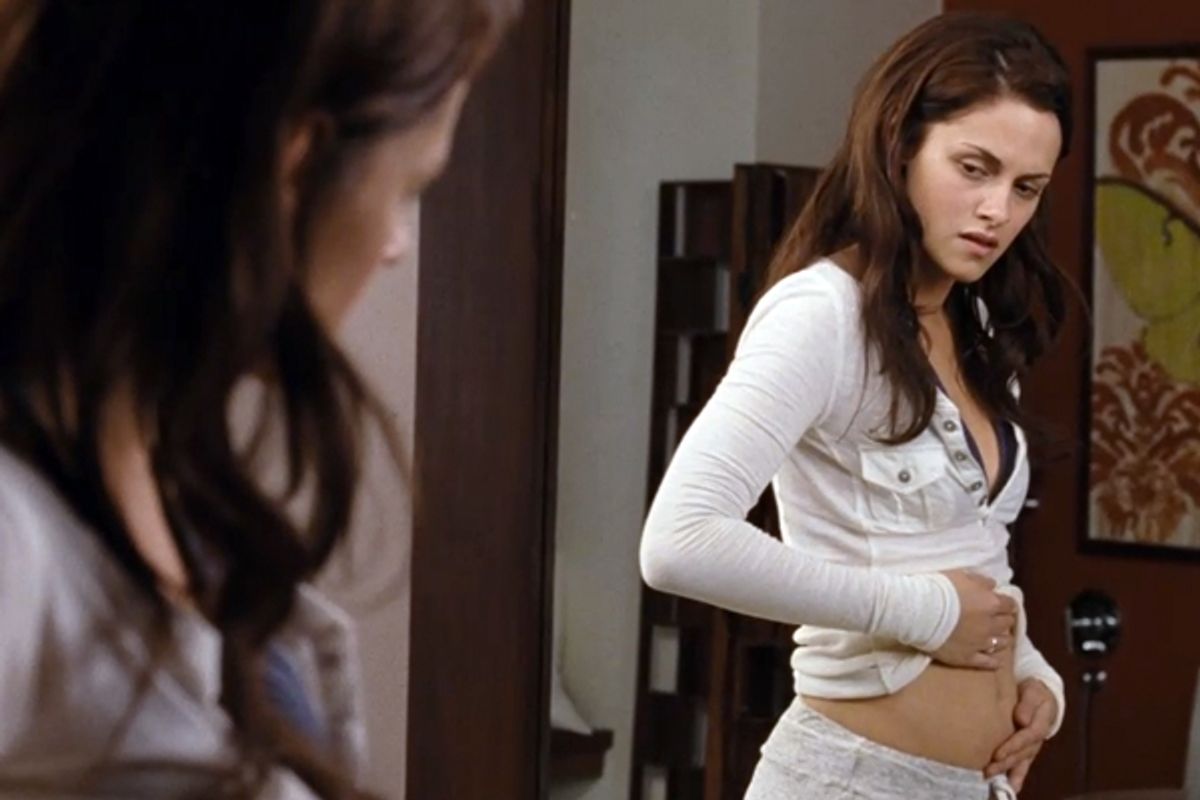
Kristen Stewart in "The Twilight Saga: Breaking Dawn - Part 1" Of course Bella would keep Edward’s baby. Dammit, she loves her sparkly vampire husband. She doesn’t care about the concerns of her family and friends, their pleas that she consider the risks of carrying a hellspawn to term. Like Julia Roberts’ saintly, ill-fated Shelby in “Steel Magnolias,” who pursues a pregnancy because she “would rather have 30 minutes of wonderful than a lifetime of nothing special” (and subsequently dies for it), Bella knows it’s her body, her choice. And a “Twilight” franchise dreamed up by a nice Mormon lady isn’t going to include a scene of newlywed, saved-herself-for-the-wedding night Bella trotting down to Planned Parenthood for a quickie D&C. No, her devotion to life is so great that it extends to life that isn’t even quite human.
Authentic to its characters as it may be, the gruesomely traditional blockbuster “Breaking Dawn” illustrates an unavoidable reality of contemporary cinema — that whether you’re in the mysterious realm of vampires or the corridors of power, normal, untraumatic abortion barely exists. Consider the movie offerings of just the past few years. In “The Last King of Scotland,” a clandestine attempt at abortion leads to a harrowing murder. In “Waitress,” Keri Russell hates her life and her abusive husband, but plunges on with an unwanted pregnancy. More recently, in George Clooney’s “The Ides of March,” a pregnancy and hush-hush abortion lead to a tragic suicide. And in “Crazy Stupid Love,” middle-aged Steve Carell’s Cal admits he and his estranged wife got married in the first place when she became pregnant – because apparently the option of not being pregnant never occurred to anybody. As Stephen Farber noted last year in the Daily Beast, movies like Ben Stiller’s “Greenberg,” which depict abortion as a matter-of-fact reality of many women’s lives, are few and far between.
When abortion does turn up in the movies, it’s likelier to be in the context of a riskier, more dramatic time and place, a gambit known to cinephiles as the “Dirty Dancing” plot device. Mike Leigh’s “Vera Drake” gave us a reassuring, pre-feminist abortionist in postwar Britain. Lasse Hallstrom’s “Cider House Rules” was a similarly nostalgic take on that whole bygone, “girl in trouble” era. And “4 Months, 3 Weeks, and 2 Days” offered abortion as, in the words of Salon’s Andrew O’Hehir, a “carefully plotted thriller” in ’80s-era Eastern Europe.
The surplus of movie and television pregnancies can’t all be attributed to some great Mormon conspiracy, though. An abortion is an action. A baby is a whole story line. “Juno” wouldn’t have had a whole lot going for it if the Ellen Page character had ignored her classmate’s warning that her fetus already had fingers. And had “Knocked Up” gone in the direction of what one character describes as “rhymes with smashmortion,” it would have been 15 minutes long.
Yet it’s hard not to note a not-so-faint whiff of judgment in all the tiptoeing around a procedure that 40 percent of American women undergo in their lifetimes. Sure, two-thirds of unwanted pregnancies in real life end up in abortion, but cinematic women who do it tend to wind up dying. Those who carry to term, meanwhile, are plucky heroines. And it’s not just the movies. Consider the entire premise of “American Horror Story” – a show that hinges on the rampant evil unleashed because an L.A. doctor did abortions in his basement back in the day. In present time, meanwhile, our brave heroine Vivian is continuing her pregnancy despite the fact that at least one of her babies apparently has hooves. Come on, even fans of “Personhood” amendments would give that one a pass.
Without her plot-enhancing, eminently true to the character pregnancy, Bella Swan would not be the Bella her fans have come to know and love. But until our entertainment broadens out and reflects our reality, abortion will be viewed as an aberration instead of the commonplace reality it is. Not every pregnancy winds up with a baby — even a half-vampire or Antichrist baby — in a woman’s arms, nor every abortion with a bloody corpse in a back alley. Safe, legal smashmortion happens. And nearly 40 years after Roe v. Wade, it’s absurd that supposedly progressive Hollywood remains so backward about acknowledging it.
Mary Elizabeth Williams is a staff writer for Salon and the author of "Gimme Shelter: My Three Years Searching for the American Dream." Follow her on Twitter: @embeedub. More Mary Elizabeth Williams.
Abortions made public
States want more data on abortion patients. Zealots want their hands on it. Shame is the new anti-choice strategy
(Credit: Cannaregio via Shutterstock/Salon/Benjamin Wheelock) It was an “anonymous informant,” Operation Rescue claimed last week, after someone slipped them the April records of 86 women who were treated at Central Family Medical. The clinic’s lawyer was blunter. “It certainly appears to me that a crime was committed,” Cheryl Pilate told the Kansas City Star. Though the clinic (which performs abortions) had already reported a break-in to a locked dumpster, Pilate said it wouldn’t have contained patient records, which are shredded. The “informant” must have gotten the documents – containing names, addresses and details of procedures – another way.
Continue Reading Close
Irin Carmon is a staff writer for Salon. Follow her on Twitter at @irincarmon or email her at icarmon@salon.com. More Irin Carmon.
Texas’ abortion enforcer
Fifth Circuit Court Judge Jerry Smith makes sure that the state's antiabortion legislation gets upheld
Jerry Smith Here is what the state of Texas considers “irreparable harm”: Continuing to provide Planned Parenthood with federal funds for the Texas Women’s Health program, which it has done for several years. Here is what it does not find harmful: immediately denying healthcare access to tens of thousands of women who have been going to Planned Parenthood affiliates for basic health services that aren’t abortions.
Continue Reading Close
Irin Carmon is a staff writer for Salon. Follow her on Twitter at @irincarmon or email her at icarmon@salon.com. More Irin Carmon.
The myth of the “morning-after abortion pill”
There's a reason why people mistake emergency contraception and abortion: The right intentionally confuses the two
(Credit: Shutterstock/Salon/Benjamin Wheelock) It started around February, when Republicans were still eager to talk about contraception. The Obama administration, or so Mitt Romney charged in Colorado, was forcing religious institutions to provide “morning-after pills –in other words abortive pills — and the like, at no cost.”
It was, of course, a lie. Romney was conflating two different pills: emergency contraception, known as the morning-after pill, which prevents a pregnancy; and chemical abortion, or mifepristone, which ends a pregnancy of up to seven weeks’ gestation and isn’t covered under the new guidelines. Since both pills were marketed in the U.S. around the same time, even some pro-choicers have gotten confused. But Colorado happens to be the epicenter of people confusing them on purpose. It’s the birthplace of the Personhood movement and home to Focus on the Family, both of which have strategically called emergency contraception “abortion” on the scientifically unproven basis that they could block a fertilized egg from implanting.
Continue Reading Close
Irin Carmon is a staff writer for Salon. Follow her on Twitter at @irincarmon or email her at icarmon@salon.com. More Irin Carmon.
Tuning out bad abortion laws
One woman's idea on how to counteract invasive ultrasound and sonogram rules: Hand out iPods at Planned Parenthood
(Credit: Kostia via Shutterstock) “I don’t know how you make anybody watch. You just have to close your eyes,” Pennsylvania Gov. Tom Corbett notoriously said of a now-shelved forced-ultrasound law in his state. Now one enterprising pro-choicer online has offered another option: Drowning it out with music.
Although it’s the transvaginal ultrasound laws that get all the attention, the true cutting edge of abortion restrictions is currently in place only in Texas, which not only mandates ultrasounds before abortion but also compels the woman to listen to a description of the sonogram and to a fetal heartbeat. (An attempt to get the law struck down on First Amendment grounds — both the woman’s and the doctor’s right not to be forced by the state to submit to ideological speech — has so far failed, and the law is currently being enforced.)
Continue Reading Close
Irin Carmon is a staff writer for Salon. Follow her on Twitter at @irincarmon or email her at icarmon@salon.com. More Irin Carmon.
Abortion options fade in South
Have antiabortion activists finally found a way to drive two women's clinics out of Mississippi and Alabama?
(Credit: iStockphoto/sjlocke) The New Woman All Women abortion clinic in Birmingham, Ala., survived a 1998 bombing, though Eric Rudolph’s terrorist attack took the life of a security guard and seriously injured a nurse. In Mississippi, Jackson Women’s Health is the last abortion clinic standing in the entire state. But both clinics, which share an owner, will likely soon close their doors – not by dint of violence, but by legislation, regulations and enforcement explicitly designed to shut them down.
Last week, Diane Derzis, who owns both clinics and several others, signed a consent order by the Alabama State Board of Health relinquishing New Woman All Women’s license to perform abortions by May 18. Any entity that might take on the license “must agree that it or he/she will not employ Diane Derzis” or another unnamed employee. Antiabortion activists celebrated, calling the clinic a “very dark and deadly place,” though the vast majority of the violations cited in the Board of Health’s report concerned record keeping and legibility of reports.
Continue Reading Close
Irin Carmon is a staff writer for Salon. Follow her on Twitter at @irincarmon or email her at icarmon@salon.com. More Irin Carmon.
Page 1 of 127 in Abortion